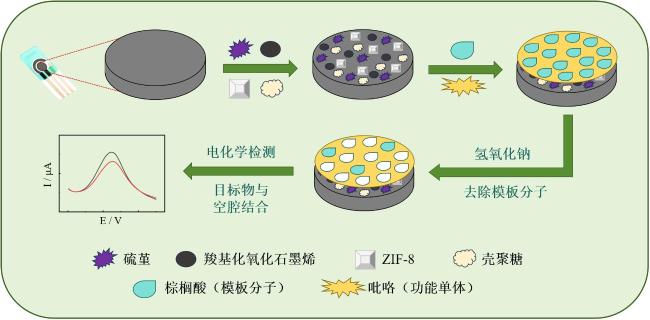
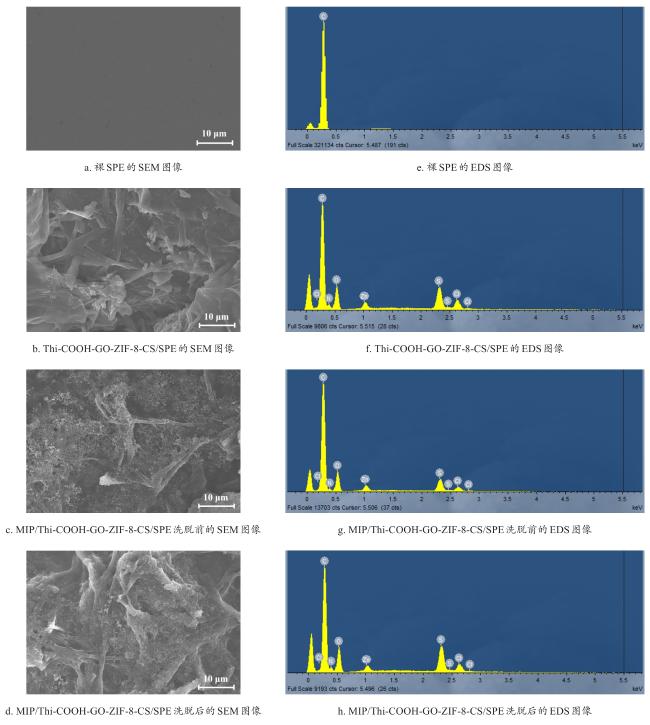
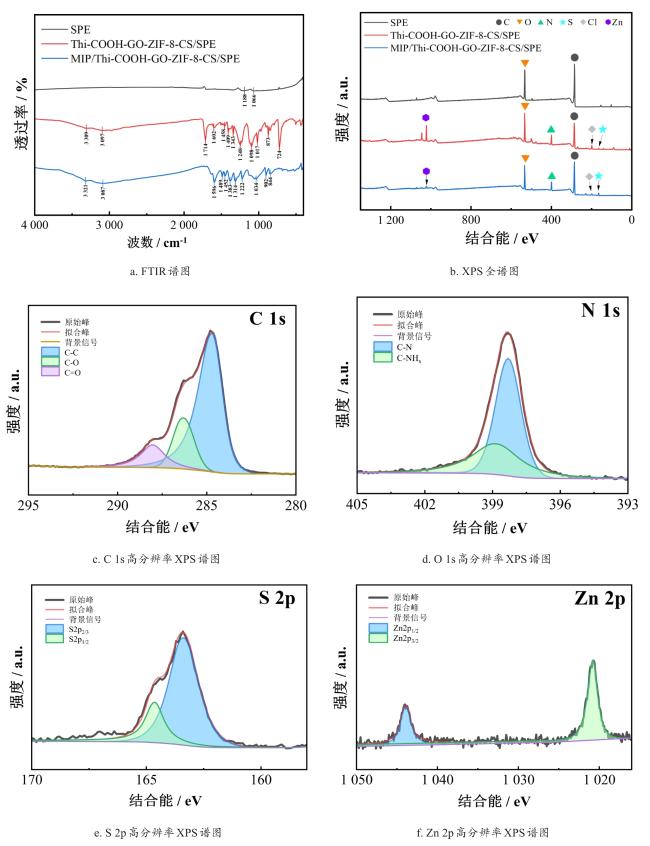
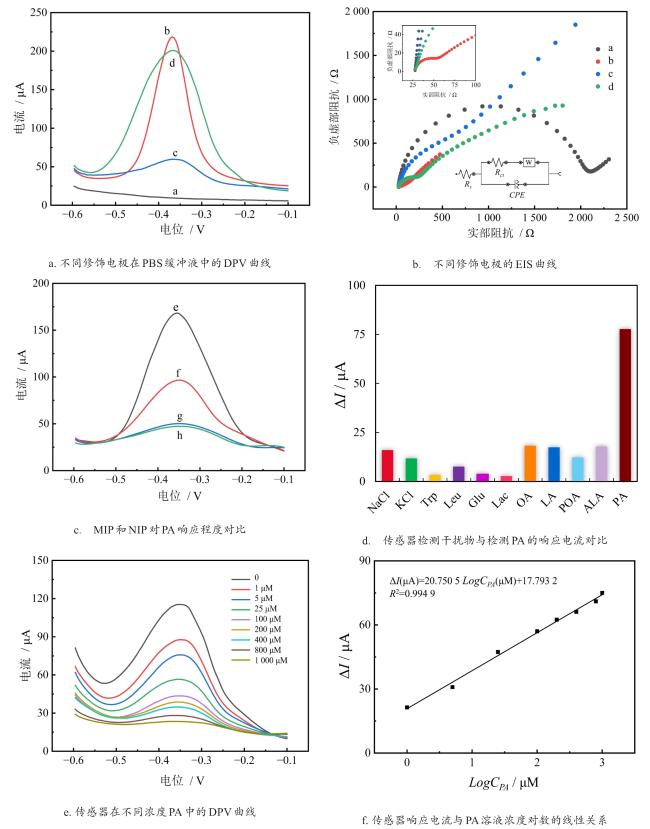
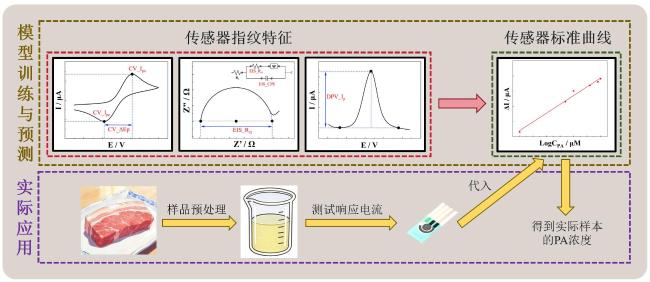
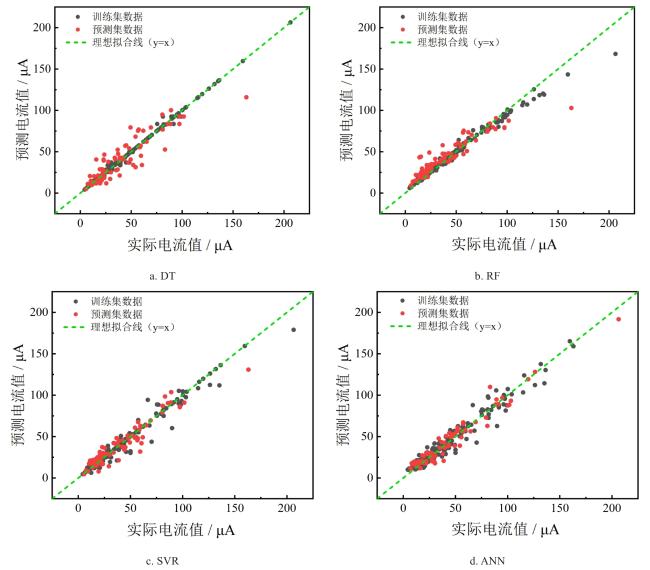
[Objective] Electrochemical sensors offer advantages such as high sensitivity, rapid response, and ease of miniaturization. However, performance variations across different sensor batches—caused by factors including substrate quality fluctuations, modification process errors, and environmental interference—necessitate independent and time-consuming manual calibration for each sensor prior to practical use. To address this issue, a data-driven calibration strategy integrating machine learning (ML) with electrochemical fingerprinting is proposed. This approach aims to uncover the intrinsic relationship between sensor characteristics and response behavior, enabling accurate prediction of calibration curves for newly fabricated electrodes, thereby enhancing testing efficiency while maintaining detection accuracy. [Methods] Using a molecularly imprinted polymer (MIP) electrochemical sensor for detecting palmitic acid (PA) in pork as a model system, the following investigations were systematically conducted. First, a MIP/Thi-COOH-GO-ZIF-8-CS/screen-printed electrode (SPE) sensor was fabricated and comprehensively characterized for its electrochemical behavior using electrochemical methods. Subsequently, a multimodal dataset for ML model training was constructed: electrochemical impedance spectroscopy (EIS) and cyclic voltammetry (CV) curves were collected from 45 bare SPEs in [Fe(CN)₆]³⁻ solution, from which five characteristic parameters—charge transfer resistance (Rct), constant phase element (CPE), anodic peak current (Ipa), cathodic peak current (Ipc), and peak potential separation (ΔEp)—were extracted. After fabricating these electrodes into MIP sensors, the thionine oxidation peak current I₀ was measured in blank solution using differential pulse voltammetry (DPV) as the sixth feature. Each electrode was then tested with six concentrations of PA standard solutions, recording the corresponding DPV response currents Iᵢ. The standard solution concentration served as the seventh feature, forming 270 sets of "feature-concentration-response" data pairs. Using electrode fingerprint features and PA standard solution concentrations as inputs, and the response current change ΔI (i.e., I₀-Iᵢ) as the output, four models—artificial neural network (ANN), decision tree (DT), random forest (RF), and support vector regression (SVR)—were constructed, with hyperparameters optimized via grid search. Finally, based on comprehensive evaluation of metrics including coefficient of determination (R²), root mean square error (RMSE), mean absolute error (MAE), and relative prediction deviation (RPD) on the prediction set, the optimal model was selected for subsequent validation with real samples. [Results and Discussions] Electrochemical characterization confirmed successful fabrication of the MIP/Thi-COOH-GO-ZIF-8-CS/SPE sensor: DPV showed significant recovery of the oxidation peak current after template molecule elution, while EIS revealed a decrease in charge transfer resistance Rct from 1.04 kΩ before elution to 240 Ω after elution, confirming effective formation of imprinted cavities. The sensor exhibited good selectivity for PA, with interference responses substantially lower than that for PA. Within the concentration range of 1–1 000 μM, ΔI showed excellent linear correlation with LogCPA. Among the ML models compared, ANN demonstrated optimal performance, outperforming DT, RF, and SVR across all metrics. The ANN also showed the closest performance between training and prediction sets with no obvious overfitting, indicating its effectiveness in learning deep mappings between multimodal features and sensor responses. Using the trained ANN model, 14 newly fabricated MIP/Thi-COOH-GO-ZIF-8-CS/SPE sensors were employed to validate the practical applicability of the predicted calibration curves. First, in tests with 80 μM PA standard solution, concentrations measured by five electrodes closely matched the actual value, with a relative standard deviation (RSD) of 4.34%. Second, in actual pork sample analysis, results from five electrodes showed excellent agreement with reference values obtained by traditional gas chromatography-mass spectrometry (GC-MS), yielding an RSD of 5.01%. Finally, in spiking recovery experiments, four electrodes at spiking levels of 300, 400, 500, and 600 μM achieved recovery rates ranging from 96.05% to 105.30%. These results conclusively demonstrate that the ANN model trained on electrode fingerprint features can accurately predict electrode-specific calibration curves, enabling direct application of sensors to real sample analysis without manual calibration curve determination. [Conclusions] This study successfully developed and validated an intelligent sensor calibration strategy integrating electrochemical fingerprinting with machine learning.The strategy achieves accurate prediction of individual sensor calibration curves. In practical application to PA detection in pork samples, the ML-calibrated sensors demonstrated excellent accuracy and stability. Without reliance on complex equipment or massive labeled datasets, this approach balances detection precision and efficiency, providing a viable technical pathway for standardized fabrication and scalable deployment of electrochemical sensors, with potential to advance their transition from laboratory research to practical commercial applications.