


0 引 言
稻瘟病是一种由稻瘟病菌引起的世界性普遍水稻病害,严重威胁水稻稳产与粮食安全。据数据统计,该病害每年可造成10%~30%的产量损失,在流行年份损失甚至更严重[1-3]。由于水稻是全球超过一半人口的主要粮食来源,稻瘟病的有效防控对保障粮食安全具有重要意义[4, 5]。稻瘟病的发生与发展受品种抗性、生育期、气象条件及田间管理措施等多种因素共同影响,其防治决策高度依赖领域知识与实践经验。传统防治方式主要依靠农户经验或专家咨询,但受限于知识获取渠道分散、信息表达不统一,以及专业知识差异,这类方式难以满足快速、精准和规模化防治需求。因此,构建系统化、结构化的知识表示与推理方法,辅助稻瘟病防治决策,具有重要的现实需求。
知识图谱作为一种以图结构组织实体及其语义关系的知识表示形式,能够有效整合多源异构数据,在农业知识管理与智能决策中展现出良好的应用潜力。近年来,随着农业信息化的发展,相关研究逐步将本体建模、自然语言处理和数据挖掘等技术引入知识图谱构建过程,实现对作物、病害、环境因素等多维信息的系统化表达与融合。在应用层面,已有研究基于知识图谱构建农业决策支持系统,通过整合多源数据并进行语义关联分析,为作物病害诊断、种植管理及防治策略制定提供辅助支持[6],QI等[7]构建了中国气象与中文稻瘟病农业知识图谱(Chinese Magnaporthe oryzae Agricultural Knowledge Graph,Cn-MAKG),实现了气象与农业信息的结构化存储与管理。BHUYAN等[8]和AMINU等[9]分别基于知识图谱与本体规则开展了农业推理与智能问答研究,为农业知识的组织与共享提供了重要基础。Xie等[10]将神经网络架构搜索、知识图谱与Transformer相结合,用于植物病害检测,通过构建辣椒疾病知识图谱增强模型的领域知识建模能力;CVEJOSKI等[11]将神经网络与农业知识结合,构建了玉米热旱胁迫模型,可准确预测产量损失,并有效划分抗性品种,为作物抗逆研究提供了可解释的建模方案;KHALID等[12]提出了面向农业的三层知识管理框架,实现知识存储、共享与决策支持;ZHANG等[13]系统总结了农业知识图谱构建方法,为智能搜索、推荐与问答提供技术基础;QIAO等[14]提出知识引导的时空注意力图网络,用于作物产量预测。此外,ANLEY和TESEMA [15]通过融合专家知识与机器学习方法,构建了农业生产决策支持模型。
在通用知识图谱领域,GNN已成为关系推理和链接预测任务的主流方法。例如,SCHLICHTKRULL等[17]提出的关系图卷积网络(Relational Graph Convolutional Network,R-GCN)通过引入关系特定的变换,实现了对多关系数据的建模;VELIČKOVIĆ 等[25]开发的图注意力网络(Graph Attention Network,GAT)利用自注意力机制用于自适应地为相邻节点分配注意力权重,提升了模型的表达能力;TERU 等[21]则通过子图推理的方式,实现了对未见实体的归纳式关系预测。这些工作充分证明了GNN在处理图结构复杂语义方面的巨大潜力。这些方法在建模复杂的图结构和语义依赖关系方面展现出了强大的能力,然而,现有的大多数研究都集中在通用知识图谱基准数据集(例如Freebase 15k和WordNet 18)上,而它们在特定领域,例如农业知识图谱的适用性仍有待深入探索。
针对稻瘟病防治场景的专用知识图谱推理研究仍较为有限,稻瘟病相关知识具有较强的领域专业性,实体关系存在稀疏与缺失问题,且知识图谱中包含多类型实体与多层级语义关系。传统GCN及其变体R-GCN和GAT虽在通用数据集上表现突出,但在农业领域知识图谱,尤其是稻瘟病防治这一细分场景中仍存在明显局限,深层特征传播过程中容易出现特征过平滑问题,导致关键语义关系的区分能力下降。为此,本研究构建了面向稻瘟病防控的专用知识图谱,并融合R-GCN关系建模思想与GAT注意力机制,设计了融合残差连接与注意力机制的残差注意力图卷积网络(Residual-Attention Graph Convolutional Network,Residual-AttentionGCN)模型,用于知识图谱关系推理任务。模型将节点相似性度量作为先验结构信息嵌入图卷积过程,并结合残差结构与注意力机制优化特征传播,提升复杂语义依赖关系的刻画与学习能力。在此基础上搭建稻瘟病防治专家系统原型,为稻瘟病智能防控与农业知识服务提供技术支撑。
1 材料与方法
1.1 知识图谱的构造
构建知识图谱的第一步是定义本体框架,本体框架以结构化和标准化的方式描述领域知识中的核心概念及其属性与语义关系,为实体与关系的构建提供统一的语义基础和建模规范。稻瘟病防治知识图谱的本体主要包含5类实体类型,即水稻品种、地区、气候条件、疾病等级,以及防治措施。表1给出了稻瘟病防治知识图谱中的主要实体类型及其属性定义,其中不同类型实体具有明显不同的属性结构。例如,水稻品种实体主要包含品种名称及抗病等级等分类属性,地区实体包含地理位置等空间属性,气候条件实体由平均温度、湿度等连续数值属性组成,疾病等级属于离散等级属性,而防治措施则属于策略性描述信息。由于不同实体类型在属性类型、特征维度及语义角色上存在显著差异,稻瘟病知识图谱形成了典型的异构知识图谱结构。
表1 稻瘟病知识图谱中的实体类型及属性定义Table 1 Entity types and their attributes in the rice blast knowledge graph |
| 实体类型 | 属性字段 | 示例实体 | 数据来源 |
|---|---|---|---|
| 水稻品种 | 品种名称、品种来源、特点和性状、产量表现、栽培技术要点 | 紫糯18、红糯1A | 来源于中国水稻数据中心 |
| 地区 | 地区名称、经度、纬度 | 永泰、古田、长乐、上杭 | 来源于4块固定试验田 |
| 疾病等级 | 疾病类型、严重程度等级(0~9级) | 3级、6级 | 来源于图像识别评估结果 |
| 气候条件 | 平均温度、温度方差、平均湿度、湿度方差 | 平均温度、湿度指数 | 来源于近5年 6–9 月气象统计 |
| 防治措施 | 防治策略描述 | 喷洒农药、选用抗病品种 | 来源于相关文献与专家知识 |
|
在关系层面,知识图谱定义了多种语义关系类型,用于描述不同实体之间的关联模式。表2展示了实体之间的主要语义关系类型,这些关系在图结构中形成多跳语义依赖。例如,一个典型的知识推理路径可以表示为品种、地区、气候、病害等级和防治措施。该路径反映了水稻品种在特定地区种植、受当地气候条件影响,从而产生不同稻瘟病等级,并进一步对应相应防治措施的农业知识逻辑。因此,该知识图谱不仅包含异构实体,还具有复杂的语义传播路径,为后续图神经网络模型的关系预测与知识推理提供了重要基础。
表2 稻瘟病知识图谱不同实体之间的关系类型定义Table 2 Definitions of relationship types between different entities in the rice blast knowledge graph |
| 关系类型 | 源实体 | 目标实体 | 描述 |
|---|---|---|---|
| 栽培关系 | 水稻品种 | 地区 | 表示某一水稻品种在特定地区种植 |
| 感染关系 | 水稻品种 | 病害等级 | 表示该品种的稻瘟病感染程度 |
| 环境关系 | 地区 | 气候条件 | 表示某地区对应的气候环境特征 |
| 风险因素关系 | 气候条件 | 病害等级 | 表示某些气候条件可能导致病害发生 |
| 防治关系 | 病害等级 | 防治措施 | 表示针对某一病害等级推荐的防控措施 |
1.1.1 实体构建
根据数据源中的对象类别及其语义边界,对水稻品种、地区、气候条件、疾病等级和防治措施五类核心要素进行实体抽取与规范化定义,其中,水稻品种实体的属性信息主要来源于中国水稻数据中心,共构建312个品种实体,每个实体包含品种名称、品种来源、特点与性状、产量表现及栽培技术要点等属性字段。
地区实体对应于中国南方某省布设的4个固定水稻试验田地块,其空间尺度限定为具体试验区域,而非行政区划层面的县或市级单元。上述试验田不仅用于定义地区实体,同时作为多源农业数据的统一承载单元,集成了多维度观测信息,包括实际种植的水稻品种数据、田间管理措施(如通风调控、土壤调节及农药施用等)、近5年水稻生育期(6—9月)的气象观测数据,以及历年稻瘟病发生记录。这些异构数据共同构成了知识图谱构建的核心数据基础。
气候条件实体基于试验田长期气象观测数据构建,其属性采用统计特征进行表征,包括平均温度、温度方差、平均湿度及湿度方差等指标。通过对原始时间序列数据进行统计建模,将动态气象信息转化为结构化静态特征,以满足图神经网络对输入数据形式的要求。
疾病等级实体用于刻画稻瘟病的严重程度,依据国际水稻研究所(International Rice Research Institute,IRRI)标准划分为0~9级量化等级,并进一步归纳为抗病(R)、中度抗病(M)和感病(S)三类。对于每一组“水稻品种、地区、年份”样本,其疾病等级由前期构建的图像识别模型对田间样本进行评估获得,从而建立品种与病害之间的定量关联关系。
防治措施实体通过对农业领域相关文献的系统整理,并结合领域专家经验进行归纳与规范化构建,共形成68类稻瘟病防控方法,用于描述不同病害情境下的干预策略。为提高实体表达的一致性,对防治措施进行了统一命名与分类处理,从而增强知识图谱的结构规范性与可用性。
在多源数据融合方面,以4块试验田为统一连接枢纽,将不同来源的数据通过共享实体及语义关系进行整合。其中,品种数据与试验田中的种植记录相结合,气象数据与地区实体进行关联,病害观测结果与品种及地区形成联合标注,而防治措施则通过专家知识与病害等级建立映射关系。通过上述方式,实现了不同数据源之间的统一语义建模。从整体结构来看,该知识图谱形成了以“水稻品种、地区、气候条件、疾病等级、防治措施”为主线的多层语义结构。统计结果表明,本研究构建的知识图谱包含398个概念层实体,包括水稻品种312个、地区4个、气候条件4个、疾病等级10个、防治措施68个,并在不同环境与病害组合条件下扩展形成11 521个实例化节点和45 291条关系,主要关系包括“栽培”(12 300条)、“感染”(11 800条)、“环境”(10 600条)及“防治”(10 591条)关系。根据平均度数公式| 计算[26],其值约为7.86,表明图谱整体呈现出稀疏特性,仍存在大量潜在关系有待进一步挖掘。
从整体上看,本研究构建的知识图谱在宏观层面呈现出“品种-地区-气候-疾病-防治”的链式关系。然而,在具体数据层面,各实体之间并非简单一一对应关系。例如,不同水稻品种可在多个试验区域种植,不同年份的气象条件存在差异,且疾病等级与防治措施之间具有多对多映射关系。因此,图谱中实际包含跨层连接及局部子图结构,而非严格的单链拓扑。
1.1.2 关系构建
关系构建依托农业生产中的实际因果关联完成语义建模,并结合 4 组固定试验田的多源监测信息,实现多类型数据的统一组织与关联表达。
在品种与地区之间,通过“栽培关系”建立连接。由于同一水稻品种可在不同地区的多个试验田中种植,因此一个品种实体通常可以对应多个地区实体,栽培关系反映了水稻品种的种植适应性与空间分布特征。此外,在环境建模方面,将地区实体与气候条件实体进行关联构成“环境关系”,用于描述不同试验田在水稻生育期内的气候特征,环境关系基于长期气象观测数据建立,是连接自然环境与农业生产的重要桥梁;在病害建模方面,将水稻品种与疾病等级进行关联构成“感染关系”,感染关系是结合“品种-地区-年份”三元组合下的田间观测数据及图像识别模型结果,对稻瘟病严重程度进行量化标注,从而构建品种与病害之间的定量关系,其中,基于前期构建的水稻病害图像识别模型[27]对田间样本进行自动评估,从而实现稻瘟病严重程度的量化标注;在防控策略建模方面,将疾病等级与防治措施进行关联构成“防治关系”,防治关系是基于农业专家经验及相关研究成果构建,用于描述不同病害等级下的推荐防控策略。图1展示了不同稻瘟病严重程度的典型样本图像,其中标注数字表示对应的病害等级。
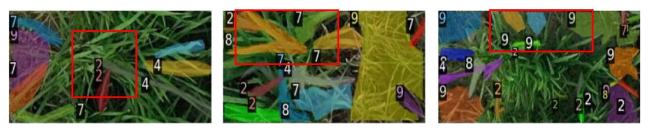
通过上述关系构建方式,使得不同数据源能够在知识图谱中实现统一融合。具体而言,知识图谱中将不同地区的试验田提供的种植记录数据将品种与地区连接,气象数据将地区与气候条件连接,病害观测数据将品种与疾病等级连接,专家知识数据将疾病等级与防治措施连接,从而形成完整的多跳语义推理路径,即“水稻品种→地区→气候条件→疾病等级→防治措施”。
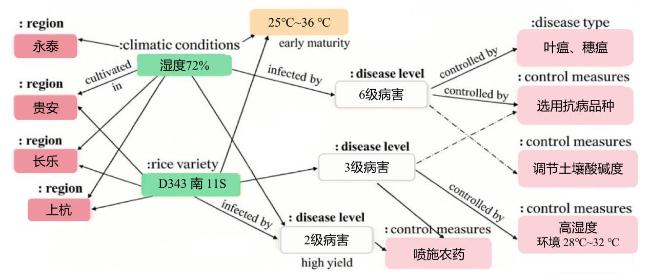
图2展示了稻瘟病知识图谱的局部结构示意,图2中以水稻品种、地理区域和气候因子为核心节点,进一步关联病害等级及防治措施等实体类型,不同颜色节点表示不同类型实体,粉色节点表示地理区域(如永泰、贵安、长乐、上杭),绿色节点表示关键环境与品种信息(如湿度条件及主栽品种),浅橙色节点表示关键气候阈值(如25 ℃~36 ℃),白色节点表示病害等级(如3级、6级),而防治措施及病害类型则作为决策与表征节点存在。实体之间通过多种语义关系连接,其中“cultivated in”表示品种与地区之间的栽培关系,“climatic conditions”表示地区与气候条件之间的环境关系,“infected by”表示品种与病害等级之间的感染关系,“controlled by”表示病害等级与防治措施之间的控制关系,实线表示已观测的显式关系,虚线表示潜在但尚未发现的隐含关系,需要通过图神经网络模型进行预测,图2所示的知识图谱结构能够体现稻瘟病发生与防控过程中的多层语义依赖关系,为后续Residual-AttentionGCN 模型的关系预测与知识推理提供了结构基础,并支持精准农业背景下的防控决策优化和病害风险评估。
1.2 模型构建
为优化稻瘟病知识图谱任务模型性能,本研究在图神经网络中融入多项优化策略。利用残差连接优化深层网络信息传递,缓解梯度消失问题,提升特征学习效果;依托注意力机制对邻域节点自适应赋权,凸显有效语义信息,减少无关节点干扰。关系预测训练中采用负采样构建负样本,提升模型关系判别能力。训练期间引入Dropout与早停(EarlyStopping)策略,降低模型过拟合程度,增强实际场景下的泛化能力。
1.2.1 节点特征编码
在构建图神经网络模型之前,需要首先对知识图谱中的实体属性进行统一编码,将其转换为可输入神经网络的数值向量表示。由于稻瘟病知识图谱中包含多类型实体,其属性结构存在明显差异,因此需要针对不同类型属性采用相应的编码方式。
对于分类属性(如水稻品种来源、防治措施类别,以及抗病等级等),采用独热编码(One-hot Encoding)方法将其转换为二进制向量,其维度等于该属性的类别数量。该方式能够保持不同类别之间的语义独立性,并避免人为引入顺序关系。对于连续型数值属性(如平均温度、温度方差、平均湿度、湿度方差以及经纬度等),采用 Z 分数标准化(Z-score normalization)进行归一化处理,使其转换为均值为0、标准差为1的标准分布。该处理能够消除不同属性量纲差异对模型训练过程的影响,并提高梯度下降的稳定性。经过上述编码处理后,不同实体类型的属性被转换为数值向量,从而形成节点的初始特征表示。
1.2.2 特征对齐与模型输入表示
由于不同类型实体的属性集合存在异构性,其编码后的特征向量长度并不一致。例如,水稻品种实体包含多个农艺属性,其特征向量维度相对较高;而防治措施实体仅包含少量策略属性,其特征向量维度较低。这种特征维度差异是农业知识图谱中实体异构性的直接体现。
为实现统一建模,采用零填充策略对不同长度的特征向量进行对齐。即在对所有实体完成属性编码后,先统计各实体特征向量的最大长度,并将该长度设为统一特征维度C。各类实体编码后的最大特征维度为10,故取C=10作为统一输入维度。对于长度小于C的特征向量,在其末尾补零,使所有实体特征向量扩展至统一维度。
比如,某水稻品种实体编码后形成8维特征向量,则通过在末尾补充2个零值扩展为10维向量;而某防治措施实体若仅包含3个属性特征,则通过补零扩展至10维。该方式能够在不增加额外模型参数的情况下实现特征空间对齐,并保持原始属性语义的独立性。
经过特征对齐后,知识图谱中N个实体节点的特征向量被组合为初始特征矩阵 H (0),如公式(1) 所示:
H (0)∈ R N × C
式中:N表示节点数量(本研究为11 521个);C表示统一特征维度(C= 10); R N × C 表示矩阵的维度空间。另外,图结构由邻接矩阵 A ∈ R N × N 表示,其中矩阵元素Aij 表示节点i与节点j之间是否存在关系连接。为刻画节点自身特征在信息传播中的作用,引入自环结构,构造增广邻接矩阵 ,如公式(2) 所示:
式中: I 为单位矩阵。特征矩阵 H (0)与邻接矩阵 共同构成图神经网络模型的输入。
1.2.3 Residual-AttentionGCN模型结构
稻瘟病知识图谱包含丰富且复杂的语义关联关系,准确建模实体之间的语义相关性是关系预测任务的关键。传统GCN在多层传播过程中容易产生特征过平滑问题,从而削弱对关键语义关系的区分能力。为解决该问题,本研究提出一种融合残差连接与注意力机制的图卷积网络模型Residual-AttentionGCN。
图3主要展示Residual-AttentionGCN 模型的核心计算机制与结构设计,包括注意力计算、特征聚合及残差连接等关键组成。该模型由多个残差注意力图卷积模块串联构成,每个模块包含图注意力卷积层、非线性激活函数以及残差连接结构。模型输入为节点特征矩阵 H (0) 与邻接矩阵 ,通过多层邻域特征聚合逐步学习节点嵌入表示,并最终通过全连接层输出关系预测结果。
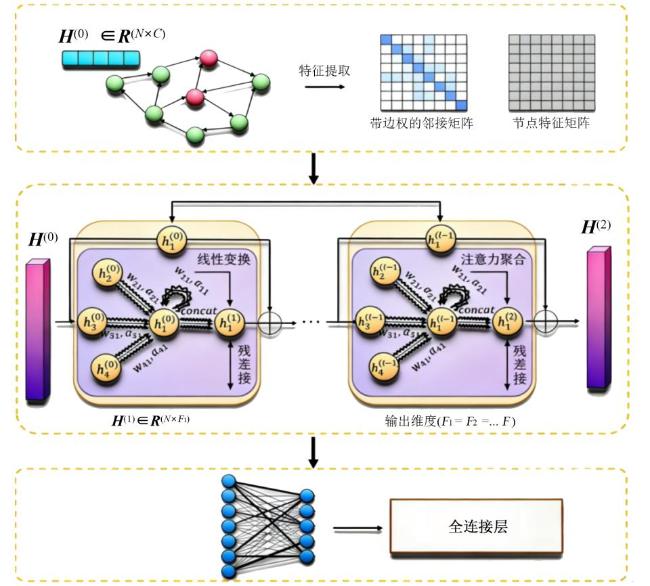
在标准图注意力网络(GAT)中,节点i与节点j之间的注意力系数 计算如公式(3) 所示:
式中: 表示带泄露修正线性单元激活函数; aT 为可学习权重向量 a 的装置; W 为线性变换矩阵; h i 和 h j 表示节点的原始特征向量;||表示向量拼接操作。
与仅依赖可学习注意力权重的标准GAT不同,本研究进一步引入节点特征相似度作为先验信息,对注意力权重进行辅助约束。节点之间的边权 由特征相似度函数计算得到公式(4) :
式中: 表示节点特征相似度函数; h i 和 h j 表示节点的特征向量。本研究采用4种相似度度量方法进行比较,包括:余弦相似度(Cosine similarity)、皮尔逊相关系数(Pearson correlation)、Jaccard 系数(Jaccard coefficient)和欧几里得距离(Euclidean distance)。需要说明的是,这4种相似度度量并非同时输入模型,而是作为不同的边权构造策略,与模型结构组合形成多组实验方案,用于比较不同相似度度量方法对关系预测性能的影响。在特征更新阶段,节点表示通过邻域聚合方式进行更新,如公式(5) 所示:
式中: 为节点 i 在第 l 层的特征向量; 为非线性激活函数(如 Sigmoid、ReLU 等);N(i)表示节点i的邻域节点集合; 表示节点之间的注意力权重; 为第 l 层的线性变换矩阵; 为节点 j 在第 层的特征向量。为了提高深层网络的训练稳定性,在每一层图卷积模块中引入残差连接,其输出形式为公式(6) :
式中: 为第 l 层的输出特征矩阵; 为第 层的输入特征矩阵; 为图卷积层的特征变换函数(本研究为注意力图卷积操作)。该结构允许节点特征在不同层之间直接传递,从而改善梯度传播路径,并缓解深层网络训练过程中的梯度衰减问题。
1.2.4 模型实现流程
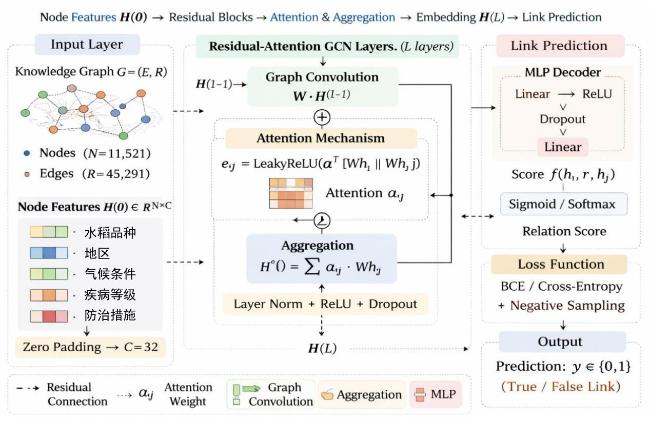
模型以知识图谱中经过特征预处理后的节点特征矩阵 H (0 )及其对应的图结构为输入,通过多层残差注意力图卷积模块对节点表示进行逐层更新。在每一层中,节点特征首先通过线性变换映射至新的特征空间,随后引入注意力机制对邻域节点的重要性进行自适应建模,实现对关键邻居信息的加权聚合。同时,通过残差连接将输入特征与聚合结果进行融合,以增强特征传播能力并改善深层网络中的梯度传播问题。
经过多层特征传播与语义信息融合,模型输出各实体节点的低维嵌入表示矩阵 ,其中 N 为节点总数,D 为模型最后一层的输出特征维度。随后通过全连接层将节点嵌入映射至关系预测空间,实现实体间潜在关系的建模与判别。模型训练采用交叉熵损失函数进行参数优化,并引入Dropout与早停(Early Stopping)正则化策略,以提升模型泛化能力与训练稳定性。
从结构上看,Residual-AttentionGCN 由多层残差注意力图卷积单元堆叠构成,每个单元包含“注意力计算-邻域聚合-残差融合”三个关键步骤。其中,注意力机制用于学习邻域节点的重要性权重,从而突出关键语义关系并抑制噪声信息;残差结构通过跨层信息传递增强特征表达能力,并有效缓解深层网络中的梯度消失与过平滑问题。该协同设计使模型能够更有效地刻画稻瘟病知识图谱中复杂的多跳语义依赖关系,从而提升关系预测的准确性。
1.2.5 模型设置与对比方法
将知识图谱中的关系样本随机划分为训练集(70%)、验证集(15%)和测试集(15%)。其中,验证集用于模型训练过程中的超参数选择和早停策略(early stopping)的判断依据,当验证集损失值在连续若干训练轮次(epoch)内不再下降时,则停止训练,以防止过拟合。测试集则用于最终评估模型的泛化性能,为保证实验结果的可复现性,本研究对模型结构参数、训练策略及实验环境进行统一说明,模型结构采用两层GCN结构,隐藏层维度设置为128,各层之间使用ReLU激活函数,训练过程中采用Adam优化器,初始学习率设为0.001,batch size设为32,此外,为缓解过拟合问题,在模型训练中引入Dropout机制,其比例设置为0.5,同时,在验证集上采用早停策略(early stopping)用于监控模型性能,当验证指标在连续10个epoch内未出现提升时终止训练。在样本构建方面,针对图结构学习任务引入负采样机制以平衡训练数据,正负样本比例设置为1:1,负样本通过随机采样非连接节点对生成,本研究所涉实验基于PyTorch框架实现,并在配备3张NVIDIA TESLA V100 GPU(每张显存32 G)的算力环境中完成,单次模型训练时间约为30 min,为降低随机性带来的影响,所有实验均重复运行多次,并取平均值作为最终结果。
基于上述配置,本研究所构建的残差注意力图卷积网络(Residual-AttentionGCN)模型,用于稻瘟病知识图谱中实体关系的预测。为系统评估该模型的有效性与优势,选取了三类典型图卷积神经网络模型作为对比方法,包括基础图卷积神经网络(BasicGCN)、残差图卷积神经网络(ResidualGCN)以及集成图卷积神经网络(EnsembleGCN)。
1.2.6 静态相似度与注意力机制的融合策略
在模型设计中,采用余弦相似度、Jaccard 相似度、欧几里得距离和皮尔逊相关系数用于刻画实体之间的先验关联强度,这4种静态相似度度量反映的是与模型参数无关的领域知识信息,而非数据驱动的动态学习结果,需要指出的是,静态相似度并未被直接用作最终的注意力权重,而是在注意力计算阶段与可学习的注意力打分协同作用,最终的注意力权重 计算为公式(7) :
式中: 表示节点之间的原始注意力得分; 表示权重系数; 表示节点之间的边权。具体而言,静态相似度在softmax归一化之前被引入,用于调制可学习注意力打分,从而影响不同邻居节点在注意力分配中的相对重要性。通过这种方式,模型在注意力系数计算过程中同时受到两类信息的约束:(1)可学习注意力用于捕捉上下文相关的动态特征关系;(2)静态相似度为注意力分配提供稳定的先验引导。该融合策略并非简单叠加权重,而是在注意力打分阶段实现协同建模,从而增强模型对稻瘟病知识图谱中关键语义依赖关系的刻画能力。
2 结果与讨论
2.1 模型训练评估
2.1.1 模型训练损失与统计分析
为比较不同模型在训练过程中的收敛特性,将BasicGCN、EnsembleGCN、ResidualGCN 和 Residual-AttentionGCN等4种模型在不同边权构造策略下的训练损失变化情况进行分析,此外,4种模型分别结合余弦相似度、Jaccard 相似度、欧几里得距离和皮尔逊相关系数生成边权,又形成了16 种模型组合。
图5 展示了在10 000次训练迭代过程中,不同模型组合的损失函数变化曲线。可以观察到,不同相似度度量下的最小损失值整体差异较小,最大差异不超过0.04,但不同模型结构之间的性能差异较为明显。实验结果表明,引入残差连接的模型(ResidualGCN和Residual-AttentionGCN)相比于未引入残差连接的BasicGCN,不仅收敛到的损失值更低(BasicGCN ≈ 1.30,ResidualGCN ≈ 1.18,Residual-AttentionGCN ≈ 1.04),其损失曲线的下降更快、收敛更稳定。这表明残差连接改善了梯度在网络深层的反向传播路径,使得模型能够更有效地进行参数更新,从而在宏观上改善训练稳定性。这正是残差结构缓解梯度消失问题在训练动态上的直观体现。
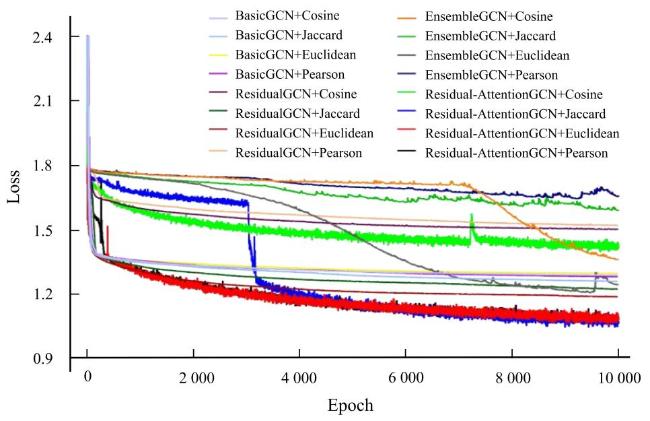
具体而言,如图5所示,EnsembleGCN 的最小损失值约分布在1.38~1.64区间;ResidualGCN 的损失值整体降低至1.10~1.50范围内;在ResidualGCN基础上引入注意力机制后,模型性能得到进一步提升,其最小损失值下降至约1.04~1.05。综合16种模型的比较结果可以发现,引入注意力机制的 ResidualGCN 模型在训练收敛性方面表现最佳。表3给出了4种模型分别结合4类相似度度量所形成的16个组合模型的最小损失值和平均损失值。从表中可以看出,Residual-AttentionGCN 在多种相似度设置下均取得了较低的损失水平。其中,结合Jaccard相似度时模型的最小损失值最低(1.044),而结合欧几里得距离时模型的平均损失值最低(1.176)。
表3 稻瘟病防治知识图谱研究的16种模型的性能比较Table 3 Comparison of the performance among 16 models for Rice Blast Prevention Knowledge Graph Research |
| 模型名称 | 最小损失 | 平均损失 |
|---|---|---|
| BasicGCN+Cosine | 1.287 | 1.325 |
| BasicGCN+Jaccard | 1.259 | 1.300 |
| BasicGCN+Euclidean | 1.296 | 1.330 |
| BasicGCN+Pearson | 1.281 | 1.325 |
| EnsembleGCN+Cosine | 1.359 | 1.667 |
| EnsembleGCN+Jaccard | 1.588 | 1.671 |
| EnsembleGCN+Euclidean | 1.206 | 1.478 |
| EnsembleGCN+Pearson | 1.643 | 1.707 |
| ResidualGCN+Cosine | 1.501 | 1.543 |
| ResidualGCN+Jaccard | 1.222 | 1.279 |
| ResidualGCN+Euclidean | 1.187 | 1.235 |
| ResidualGCN+Pearson | 1.519 | 1.568 |
| Residual-AttentionGCN+Cosine | 1.388 | 1.491 |
| Residual-AttentionGCN+Jaccard | 1.044* | 1.296 |
| Residual-AttentionGCN+Euclidean | 1.054 | 1.176* |
| Residual-AttentionGCN+Pearson | 1.054 | 1.185 |
|
在训练过程中,较小的最小损失值反映了模型在最优状态下的拟合能力,而较低的平均损失值则表明模型整体训练过程更加稳定。因此,上述结果表明 Residual-AttentionGCN 在收敛性方面优于对比模型。
2.1.2 与经典图神经网络模型的对比实验
为进一步验证所提出Residual-AttentionGCN模型的先进性与通用有效性,本研究在GCN系列模型对比的基础上,引入经典GAT作为代表性当前最优方法(State-of-the-Art,SOTA)方法,在相同数据集、特征设置和评价指标条件下进行了补充对比实验。
GAT通过自注意力机制对邻居节点进行加权聚合,是图表示学习领域中应用广泛的经典模型。为保证对比的公平性,实验中采用与Residual-AttentionGCN相同的节点特征表示、训练样本划分方式、损失函数和评价指标,仅在网络结构上替换为标准GAT架构。表4给出了Residual-AttentionGCN与GAT在稻瘟病防治知识图谱关系预测任务中的定量对比结果,为后续模型性能分析提供了依据。
表 4 Residual-AttentionGCN与经典GNN模型的性能对比Table 4 Quantitative comparison between Residual-AttentionGCN and classical GNN models |
| 模型 | 边权策略 | 最大准确率 | 平均准确率 | 最大召回率 | 平均召回率 | 最大F 1 | 平均F 1 |
|---|---|---|---|---|---|---|---|
| GAT | 内部注意力 | 0.902 | 0.761 | 0.895 | 0.742 | 0.888 | 0.735 |
| Residual-AttentionGCN | 欧氏距离 | 0.933 | 0.796 | 0.936 | 0.808 | 0.921 | 0.789 |
|
2.2 欧几里得距离边权策略的优势分析
在多种边权计算策略中,结合欧几里得距离的Residual-AttentionGCN在损失收敛速度及分类性能指标上均取得最优表现,其原因主要源于稻瘟病特征空间的数据分布特性与特征表达方式。稻瘟病知识图谱节点特征由多源异构属性构成,包括气候条件、疾病等级、地区信息和防治措施等。尽管对特征进行了标准化处理,其绝对数值差异仍具有明确的农业语义含义。欧几里得距离能够直接刻画节点特征在高维空间中的几何差异,对特征幅值变化较为敏感,因此更有利于区分不同病害状态与环境条件。
相比之下,余弦相似度侧重于特征方向一致性,对模长变化不敏感;皮尔逊相关系数强调特征间的线性相关关系,更适用于时间序列或统计分析场景。在以实体关系推理为核心的农业知识图谱任务中,上述度量方式对节点间静态语义差异的刻画能力相对有限。综合来看,欧几里得距离与残差注意力图卷积结构具有更好的匹配性,因此在本研究中表现出更优性能,能够更直接反映节点特征在高维空间中的几何差异。
2.3 模型性能验证
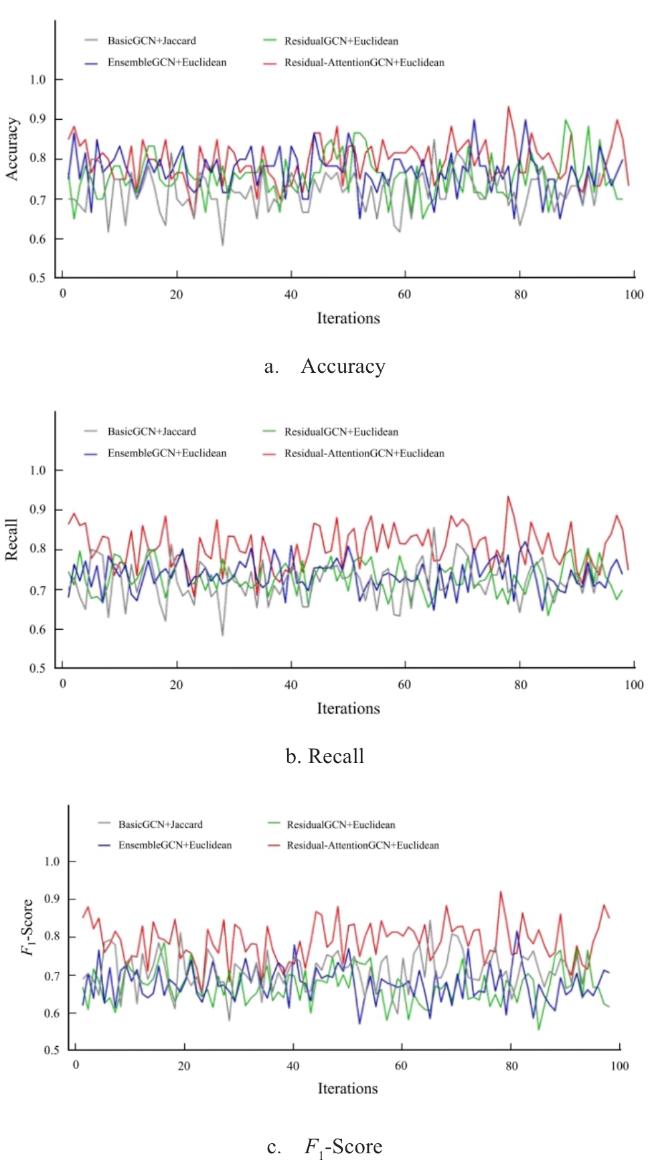
为进一步验证模型性能,本研究采用重复随机验证方法,从测试集中随机抽取100个子集作为不同验证场景,并在各场景下评估模型性能。如图6所示,各模型在100次随机验证中的性能表现存在明显差异。BasicGCN+Jaccard模型虽然在个别场景下可达到较高准确率(最高0.850),但平均性能较低(0.720),且波动较大。EnsembleGCN+Euclidean和ResidualGCN+Euclidean在平均性能上有所提升,但仍存在一定程度的波动。相比之下,Residual-AttentionGCN+Euclidean在各项指标上均表现出更优性能,其最大准确率、召回率和F 1分别达到0.933、0.936和0.921,同时平均指标亦明显高于其他模型。
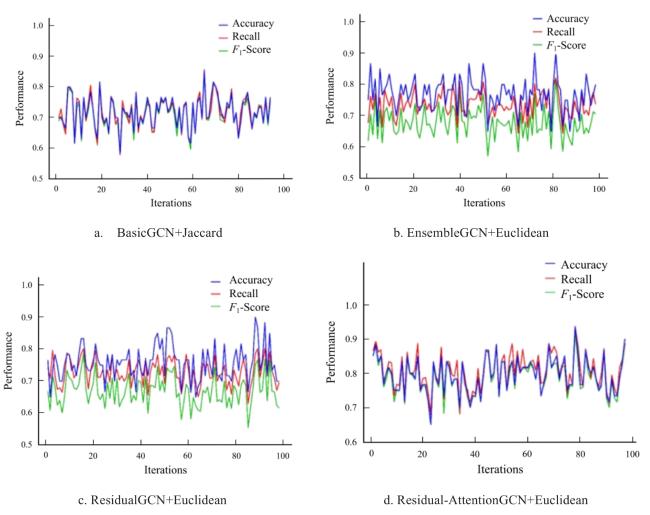
综上,Residual-AttentionGCN+Euclidean模型在准确率、召回率及F 1分数等指标上均表现出显著优势,同时在多次随机验证中具有更高的平均性能和更低的波动范围,由此可见,引入注意力机制与残差结构的协同设计能够有效提升模型对复杂农业知识图谱语义关系的建模能力。
2.4 模型稳定性验证
本模型性能的一致性通过多次随机实验中的平均指标及其波动情况进行评估,较高的平均性能结合较小的波动范围,能够反映模型在不同数据划分条件下的整体表现。如图7,不同模型在多次实验中的平均性能存在差异。对于Residual-AttentionGCN+Euclidean模型,其平均准确率为0.796,在整体水平上高于对比模型;在召回率和F 1分数方面亦表现出相对较高的平均值(平均F 1为0.789)。由结果显示,该模型在不同数据划分下仍存在一定程度的性能波动,说明其对数据分布变化具有一定敏感性。可见,本研究更侧重于采用平均性能指标对模型进行评价,以更客观地反映其整体表现。
2.5 模型分类测试
为分析模型在不同防治措施类别上的分类性能,结合混淆矩阵与马修斯相关系数(Matthews Correlation Coefficient,MCC)进行综合评估。如图8所示,分别展示了模型在各类别上的预测结果及其分类一致性。
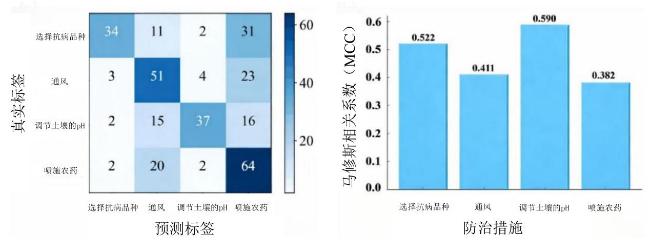
式中:k表示混淆矩阵的类别数;Ckk 表示第k类的正确预测数量;Ckl 表示预测为k类但真实为l类的样本数量(l≠k); 表示真实类别为 、预测类别为 的样本数量( )。MCC取值范围为[-1, 1],其中,1表示完全正确分类,0表示随机预测,-1表示完全错误分类。与单一精度指标相比,MCC能够更加全面地反映模型在类别不平衡情况下的分类性能。
从图8b所示的MCC结果来看,不同类别之间存在明显性能差异,其中,“选择抗病品种”和“调整土壤pH”等类别的MCC值较高,说明模型在这些类别上的预测一致性较强;而“喷洒农药”类别的MCC值较低,表明模型在该类别上的判别能力相对较弱。这些现象主要源于两方面原因,一方面是“喷洒农药”在知识图谱中的样本数量相对较少,存在一定程度的数据分布不平衡;另一方面是“喷洒农药”措施通常作为补救性策略,其应用场景与多种气候条件及病害等级存在交叉关系,导致其语义边界相对模糊,从而增加了模型判别难度。
综上所述,图8所示结果表明,Residual-AttentionGCN模型在整体分类任务中具有良好的性能表现,但在部分语义边界模糊或样本不足的类别上仍存在提升空间。未来可通过引入类别重加权策略、样本增强方法或优化知识图谱结构,以进一步提升模型在复杂农业决策场景中的鲁棒性与泛化能力。
2.6 讨论
从分类层面进一步分析模型性能,表5给出了不同模型在稻瘟病知识图谱上的定量对比结果。可以看出,Residual-AttentionGCN 在平均准确率(0.796)、平均召回率(0.808)和平均F 1分数(0.789)等指标上均高于 GCN、R-GCN、GAT 及 AirGNN 等模型,其中R-GCN与Residual-AttentionGCN同为多关系图神经网络,但R-GCN无法捕捉异构实体间潜在关联及语义重要性、缺乏注意力机制导致特征提取针对性弱、无残差连接易出现梯度消失且训练稳定性差,AirGNN则侧重适配分布式通信场景、提升信道损伤下的鲁棒性,而本研究模型侧重通过残差连接与注意力机制刻画异构农业知识的复杂语义依赖关系,因此,表现出的性能与Residual-AttentionGCN差距较大。
表5 Residual-AttentionGCN与经典图神经网络模型的定量性能对比Table 5 Quantitative performance comparison with classical GNN models |
| 模型 | 数据集 | 最大准确率 | 平均准确率 | 最大召回率 | 平均召回率 | 最大F 1 | 平均F 1 |
|---|---|---|---|---|---|---|---|
| GCN | 稻瘟病知识图谱 | 0.850 | 0.720 | 0.856 | 0.719 | 0.845 | 0.712 |
| R-GCN | 稻瘟病知识图谱 | 0.873 | 0.742 | 0.868 | 0.735 | 0.861 | 0.728 |
| GAT | 稻瘟病知识图谱 | 0.902 | 0.761 | 0.895 | 0.742 | 0.888 | 0.735 |
| AirGNN | 稻瘟病知识图谱 | 0.910 | 0.774 | 0.907 | 0.781 | 0.902 | 0.768 |
| Residual-AttentionGCN(本文) | 稻瘟病知识图谱 | 0.933 | 0.796 | 0.936 | 0.808 | 0.921 | 0.789 |
|
进一步分析不同防治措施类别的分类结果可以发现,模型在“选用抗病品种”和“改善通风条件”等类别上的表现相对较好,这主要由于相关语义路径较为明确,模型更易学习其关联模式。相比之下,“喷洒农药”类别的性能相对较低,可能与该类别样本数量有限以及其应用场景涉及多种因素交叉、语义边界较为复杂有关,从而增加了模型判别难度。
3 稻瘟病防治专家系统原型与应用场景分析
为验证所提出Residual-AttentionGCN模型在实际农业场景中的应用可行性,基于该模型构建了一个稻瘟病防治专家系统原型,其系统结构与界面如图9所示。系统采用模块化设计思想,主要包括病害诊断、关系推理和防治建议推荐三个核心功能模块,实现了知识图谱管理与智能决策支持的一体化应用。
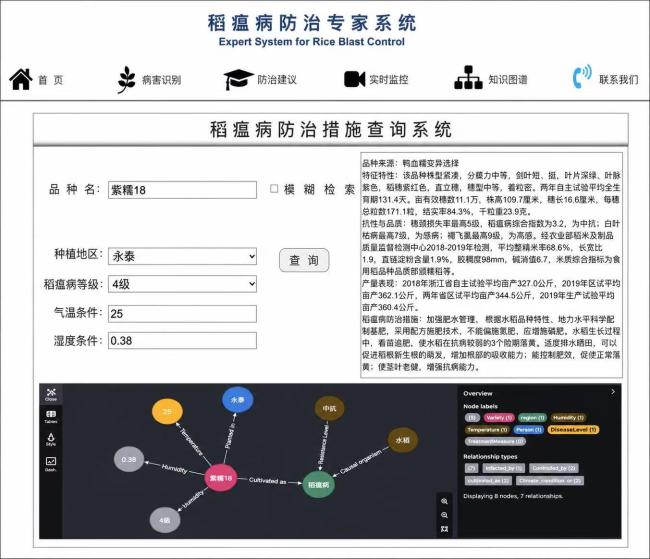
在病害诊断模块中,系统首先接收用户输入的水稻品种、种植地区、气候条件,以及田间症状等信息,并将其映射到知识图谱中的对应实体。对于可量化症状信息,系统结合前期构建的图像识别与病害等级评估模型,对当前样本的稻瘟病严重程度进行初步判定,从而得到相应的疾病等级实体。该过程实现了从用户输入到病害等级表征的标准化转换,为后续知识推理提供统一的语义起点。
在关系推理模块中,系统以已识别的品种、地区、气候条件和病害等级等实体为基础,调用知识图谱中的已有显式关系,并进一步利用 Residual-AttentionGCN 模型对潜在关系进行预测。具体而言,模型通过对节点特征与图结构信息进行联合学习,推断“品种-地区-气候条件-疾病等级-防治措施”路径中尚未显式观测到的隐含关联。例如,在给定某一品种和种植地区后,系统能够结合气候条件特征推理该场景下更可能出现的病害风险等级;在给定病害等级后,系统还能够进一步推断与该等级具有较强语义关联的防治措施。通过这种方式,系统不仅能够利用知识图谱中的已有知识,还能够挖掘潜在的农业语义关系,从而增强决策支持能力。
在防治建议推荐模块中,系统根据关系推理结果生成候选防治措施集合,并结合病害等级、环境条件及措施关联强度对候选策略进行筛选和排序。对于高风险病害状态,系统优先推荐与当前病害等级关联度较高且在知识图谱中出现频次较高的防治措施,例如选用抗病品种、调整土壤 pH值、改善通风条件或喷施农药等。最终,系统以列表形式向用户输出推荐结果,并给出对应的病害风险等级和防治依据,从而实现从“农业场景输入-病害风险诊断-潜在关系推理-防治措施推荐”的完整闭环。
在系统实现方面,后端采用 Python 作为主要开发语言,并结合图神经网络推理框架完成模型部署;前端采用基于Web的交互式界面,用于展示病害诊断结果与防治建议。系统运行环境为通用计算平台(Intel i7 级 CPU,32 GB 内存),未依赖高性能GPU加速,以验证系统在一般农业信息化条件下的部署可行性。
在响应性能方面,对系统进行了多次交互测试。在典型应用场景下,单次病害查询与防治建议推理的平均响应时间约为0.5~0.8 s,能够满足农业生产中对实时性和交互性的基本需求。实验结果说明,该专家系统在保证较高预测精度的同时,具有良好的响应效率与工程可行性,为后续在农业生产管理中的推广应用提供了基础。
此外,为进一步验证系统推理结果的可靠性,设计了若干模拟用户查询案例进行测试。例如,当用户输入某一水稻品种及其种植地区与气候条件时,系统能够结合知识图谱中的已有关系以及 Residual-AttentionGCN 模型预测的潜在关系,对稻瘟病发生风险进行推断,并给出相应的防治建议。测试结果表明,系统返回的病害风险等级及推荐防治措施与已有农业知识库和专家经验基本一致,能够较为准确地反映水稻品种、生长环境与稻瘟病发生之间的关联关系。
因此,基于Residual-AttentionGCN构建的稻瘟病防治专家系统不仅具备良好的响应性能,而且在病害诊断、关系推理和防治建议推荐等方面表现出较高的可信度,为农业知识推理与病害防控决策支持提供了一种可行的实现路径。同时,该平台还可作为农业知识共享与技术交流的应用载体,为稻瘟病防治经验和研究成果的传播提供支持。
4 结 论
本研究围绕稻瘟病防治知识图谱构建与智能推理问题,提出了一种采用图神经网络融合残差连接与注意力机制的模型Residual-AttentionGCN,并系统评估了其在关系预测任务中的性能,评估结果表明,Residual-AttentionGCN与BasicGCN、ResidualGCN和EnsembleGCN等传统图卷积网络模型相比,Residual-AttentionGCN 在训练损失收敛性、准确率、召回率和F 1分数等关键指标上均表现出较明显的优势,特别是在采用欧几里得距离作为边权构建策略时,模型取得了0.933的最高准确率、0.936的最高召回率以及0.921的最高 F 1分数,在平均性能方面也优于参与比较的其他模型。
尽管本研究构建的稻瘟病知识图谱规模有限,但通过引入残差连接、注意力机制,以及显式节点相似度建模,Residual-AttentionGCN模型仍能够有效学习实体之间的结构与语义表示,在准确率、召回率及F 1分数等指标上均表现出良好的准确性与预测能力,依托模型生成的稻瘟病防治专家系统原型,实现了从知识图谱管理、关系推理到防治决策推荐的完整应用流程,该系统在普通计算环境下即可实现亚秒级响应,具有良好的工程可行性和应用潜力,为智慧农业和精准植保提供了一种新的技术路径。此外,本研究尽管以稻瘟病防治为研究对象,所提出的模型在结构设计与建模思想上具有良好的通用性,具有增强复杂语义依赖关系的表达能力,但方法在部分样本数量较少的防治措施类别上仍存在一定的性能提升空间。例如,知识图谱结构相对简化,上游图像识别模型的预测误差可能对下游任务产生影响,同时模型在不同数据划分下存在一定性能波动以及构建的专家系统评估主要基于案例分析与功能验证,尚未引入系统性的用户研究或专家盲评。鉴于上述不足,后续研究将从数据规模扩展、图结构优化及误差传播分析、引入样本重加权策略、图结构优化,以及跨领域知识迁移等方法,提升模型在复杂农业决策场景中的鲁棒性和泛化能力。同时引入领域专家参与的盲评机制,并设计定量评价指标与对照实验,以更加客观地评估系统的实际应用效果与决策支持能力。