


0 引 言
在油菜角果识别与计数研究中,已有学者主要从基于点云的三维重建与分析入手开展探索。徐胜勇等[4]提出一种基于RGB-D相机的油菜分枝三维重建和角果识别定位方法,角果识别准确率达96.76%,点云配准单项处理耗时为124.2 s。谢忠红等[5]采用双目相机采集油菜分枝的多视角点云数据,提出基于内部形状描述子-线性同余法(Intrinsic shape signature-Linear congruential generator, ISS-LCG)组合特征点的配准方法,将配准误差降至0.066 mm,点云特征点平均配准时间为8.706 s。LIU等[6]提出一种基于改进PointNet++的油菜角果分割与计数模型KAN-GLNet(Kolmogorov-Arnold Network with Global-Local Feature Modulation),该算法实现了油菜角果高精度计数,语义分割平均交叉比(mean Intersection over Union, mIoU)达94.50%,计数准确率达97.45%。通过点云的三维重建与分析可准确识别分枝及单株的油菜角果数量,然而,点云技术受限于高昂的设备算力成本、冗长的处理时间与复杂的操作门槛,难以满足大田考种低成本、普适化的落地需求。
近年来,深度学习驱动的目标检测与计数算法在智慧农业领域实现了广泛落地与应用。在改进卷积神经网络方面,陈韬等[7]在点对点网络(Point-to-Point Network, P2PNet)基础上引入高效通道注意力与坐标通道混洗模块,构建了猪只计数模型,较好地解决了复杂场景下猪只的漏检和误检问题。孙守鑫等[8]提出一种基于无人机图像和多尺度注意力时间卷积网络(Multi-scale Attention Temporal Convolutional Network, MSA-TCN)模型的烟株计数方法,实现山地环境下烟株的高精度密度图计数。目前多数高性能卷积模型通常通过增加网络深度或引入多尺度特征融合、注意力机制等结构来提升准确率,但这类方法往往导致模型参数量与计算量显著增加,限制了其在边缘设备上的实时部署能力,同时在真实复杂农业场景中的鲁棒性仍有待提升[9, 10]。
1 数据采集和预处理
1.1 数据采集
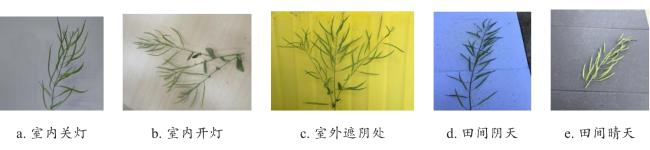
在2024年5月5日至7日、2025年8月11日至16日,分别于重庆市农业科学院农业工程研究所试验田、青海省湟中区海子沟乡与鲁沙尔镇农户种植田,采集处于成熟期的庆油3号与青杂9号油菜植株。为贴近实际考种需求并增强数据集的多样性,人工剪取植株分枝后,分别在室内、室外遮阴及田间自然光照三种环境下进行拍摄(如图1)。采集设备为iPhone 15智能手机,拍摄距离控制在30~50 cm,获取分辨率4 032×3 024像素的RGB图像共3 842幅,其中田间图像2 453幅、室外图像825幅、室内图像564幅。
1.2 数据集构建
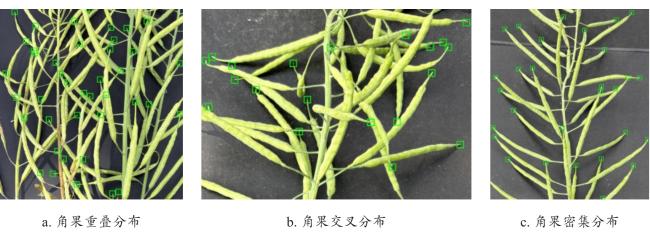
鉴于角果高密度生长与多角度重叠,直接检测整体易导致边界模糊和重复计数。相比之下,果喙作为角果唯一的细长终端,不仅特征显著且无籽粒填充,与充实区差异明显。因此,选取果喙作为检测目标,以降低密集场景下的漏检与误检率。使用LabelImg工具对原始图像中的成熟油菜角果喙区域顶端进行方形框标注(图2),共标注图像3 842张、标注框97 348个,储存为YOLO格式文件。训练设置中,数据集按8:1:1的比例划分为3 074张训练集、384张验证集与384张测试集。
为提升目标模型的鲁棒性与泛化能力,本研究在训练阶段采用开源计算机视觉库Ultralytics提供的数据增强功能(v8_transforms),对输入图像进行随机在线扰动。首先通过Mosaic将多张图像拼接以提升目标密度,并叠加随机透视/仿射变换;随后以一定概率引入Copy-Paste、MixUp与CutMix等混合增强策略;在此基础上,再进行色调、饱和度、明度(Hue, Saturation, Value, HSV)颜色空间扰动与随机翻转以增强对成像条件变化的适应性。不同于传统的训练前数据增强策略,本研究采用训练中增强策略,随机组合上述图像变化方法,数据随机梯度优化,即每个轮次都能使用重新增强的数据,极大提升了有限数据量下的模型泛化能力。此策略使训练集大致扩展至2 710×n_epoch×p,其中n_epoch为轮次,取值最大为100,考虑到实际训练采用了早停策略,模型会在验证集性能不再提升时终止训练,因此实际有效训练轮次具有不确定性,p=0.5为随机增强概率。
2 研究方法
2.1 YOLOv11n网络模型优化及改进
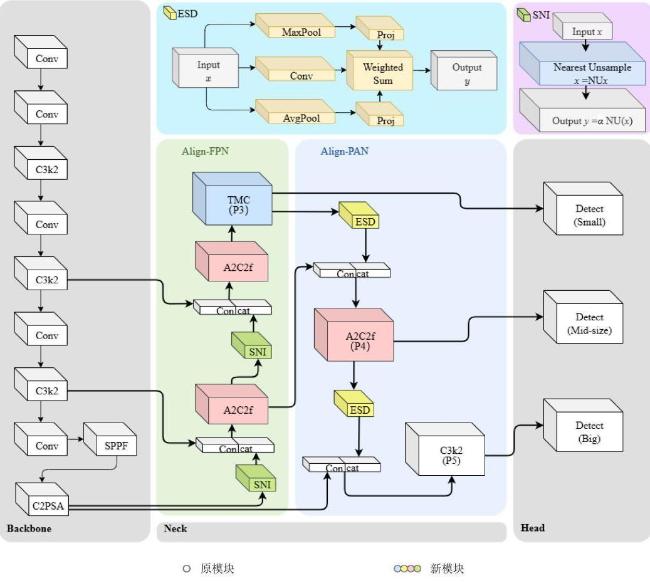
针对油菜角果密集重叠与果喙微小导致的精准检测难题,本研究对YOLOv11n基线模型进行改进,提出改进模型YOLOv11n-A3(YOLOv11n with Area Attention and Aligned Fusion),其网络结构如图3所示。主体沿用YOLOv11n的轻量化卷积结构,为进一步增强模型对角果特征的全局表达能力,在主干网络高层嵌入跨阶段局部空间注意力(Cross Stage Partial with Spatial Attention, C2PSA)模块以进行通道与空间的联合建模;在保留快速空间金字塔池化(Spatial Pyramid Pooling Fast, SPPF)模块扩大感受野优势的同时,显著提升多尺度特征的表征能力,且未大幅增加计算成本。其次,引入区域注意力(Area Attention,A2)模块[19],对颈部特征融合网络进行局部增强。将原有的部分卷积替换为A2模块,旨在保持训练与部署风险可控的同时,利用其局部区域感知能力,提升网络对密集重叠小目标的特征提取与抗干扰能力。最后,构建了由对齐特征金字塔网络(Aligned Feature Pyramid Network, Align-FPN)与对齐路径聚合网络(Aligned Path Aggregation Network, Align-PAN)组成的双向特征对齐与融合结构,以替代原有的标准特征融合路径。在Align-FPN阶段,通过区域注意力增强型交叉特征模块(Area-Attention Enhanced Cross-Feature module, A2C2f)与上下文增强(Tiny Multi-Scale Context, TMC)模块(P3)实现高层语义特征向低层特征的有效传递,并引入可扩展邻域交互(Soft Nearest Neighbor Interpolation, SNI)模块以缓解不同尺度特征在空间分布上的不一致问题;在Align-PAN阶段,进一步结合高效空间下采样(Extended Spatial-window Down-sampling, ESD)模块对特征进行分离与增强,通过自适应加权融合机制突出关键尺度特征,从而显著增强多尺度特征之间的交互能力与一致性。
2.1.1 区域注意机制
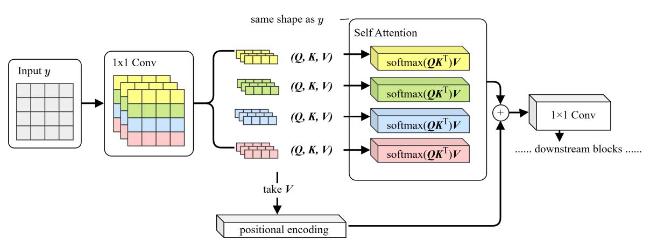
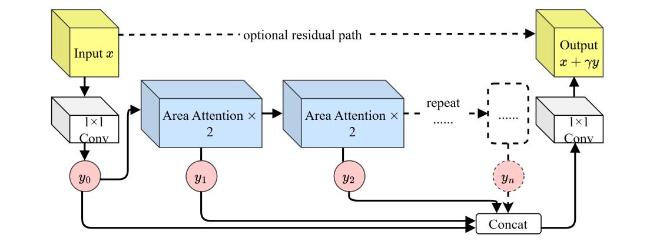
为提升密集小目标表征能力,本研究在YOLOv11n基线模型的颈部网络中引入A2模块,该模块通过区域级上下文建模增强空间信息交互,在计算开销较小的情况下缓解小目标特征稀疏问题,并强化油菜分枝结构与果尖空间关联建模,从而提升遮挡和密集分布场景下的果尖识别效果。A2模块结构如图4所示。
2.1.2 TMC模块
为降低密集小目标的漏检风险并提升边界定位稳定性,本研究在特征融合阶段提出了轻量化的上下文增强模块TMC(结构如图6所示)。该模块在保持特征图尺寸与通道数不变的前提下,首先将输入特征送入两条并行的深度卷积(Depthwise Convolution, DConv)分支,其中一支空洞率(dilation)为1,另一支空洞率为2,以此在不采样的情况下获取多尺度空间特征。两分支输出经逐元素相加后,再通过1×1逐点卷积(Pointwise Convolution, PWConv)完成通道间的信息交互与混合,并接入二维批量归一化(Batch Normalization 2d, BN2d)层。最后,模块通过残差连接将原始输入与主分支特征相加,并由Sigmoid线性单元(Sigmoid Linear Unit, SiLU)激活输出。
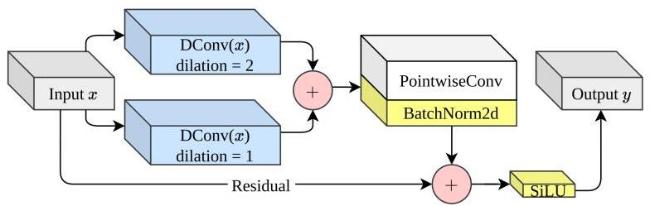
在本研究的角果检测场景中,TMC的价值重点体现在与小目标细节密切相关的P3尺度(stride=8)上。它以极低的参数和计算代价,有效补充了5×5等效感受野的上下文信息,从而显著增强了细长目标的连贯性表达与局部噪声抑制能力。
2.1.3 Align-PAFPN特征融合
YOLOv11n的颈部网络采用PAFPN结构进行多尺度特征融合。然而,上/下采样与逐点融合操作隐含着特征对齐误差:尺度变换引起的插值与采样偏移会导致同一空间位置在不同层级中出现语义“错位”与细节稀释,严重损害油菜角果这类密集小目标的可分辨性。为缓解此问题,本研究在经典PAFPN基础上引入特征对齐机制,构建Align-PAFPN(Aligned Path Aggregation Feature Pyramid Network)颈部网络(如图3所示)。受文献[21]启发,该结构在不改变原有拓扑关系的前提下,在跨尺度分支上显式引入了轻量对齐单元:采用ESD及SNI模块,分别替换原有融合过程中的上采样和下采样。这一改进使得不同尺度特征在融合前具有更一致的空间对应关系,从而提升跨尺度融合的稳定性与小目标的表征质量。
2.1.4 YOLOv11n-A3架构小结
表1给出基线YOLOv11n与YOLOv11n-A3的结构差异,主要集中在颈部网络引入了A2,以及重构了特征融合路径。
表1 基线YOLOv11n与YOLOv11n-A3的结构对比Tab. 1 Architecture comparison between baseline YOLOv11n and YOLOv11n-A3 |
| | | | |
|---|---|---|---|
| | | | |
| | | | |
| | | | |
| | | | |
| | | | |
| | | | |
| | | | |
| | | | |
| | | | |
如表1所示,从研究方法的角度看,这种设计具有两点优势:
1)可复现性与可回滚性。
模型主体拓扑与检测头接口保持不变,但在末端集成了C2PSA,无需修改数据预处理与标签分配等外围流程,避免了潜在干扰变量。同时,新增模块可随时平滑回退至基线结构,从而保障实验对比的公平性与结构变量的可控性。
2)权重迁移的工程可行性。
局部替换未改变网络特征图的尺度传递逻辑,使改进模型能直接加载YOLOv11n的预训练权重进行初始化。这一高度兼容性有效降低了从零训练的收敛难度与计算成本,大幅缩短算法在农业端侧设备上的部署与验证周期。
2.2 实验设置
2.2.1 实验环境与参数设置
模型的训练与测试过程均在Ubuntu 22.04LTS工作站环境下完成。硬件方面,Intel Xeon Platinum 8259 L系列处理器(主频约2.5 GHz),配置4vCPU与16 GB运行内存,并配备1块NVIDIA T4 Tensor Core GPU(16 GB显存)。软件方面,基于PyTorch 2.5.0深度学习框架搭建完整开发平台。编程语言采用Python 3.11。训练策略方面,学习率设置为0.002,采用Adam优化器,固定随机种子为1 337,输入图像尺寸统一调整为960×960像素,整个训练过程共设定100轮,并采用早停策略:当验证集指标在连续30轮内未获得提升时停止训练,批次大小为8,其他超参数沿用默认设置,并最终基于测试集数据统计模型性能指标。
2.2.2 评价指标
在角果检测中,采用精确率(precision, P)、召回率(recall, R)、F 1分数(F 1-Score, F 1)、平均精度均值(mAP0.5、mAP0.5-0.95)评估模型的检测精度;同时选取参数量(Params)、计算量(Giga Floating-point Operations Per Second, GFLOPs)、检测速度(Giga Floating-point Operations, FPS)作为轻量化与端侧部署潜力的评价指标。在角果计数中,选用平均绝对误差(Mean Absolute Error, MAE)、均方根误差(Root Mean Squared Error, RMSE)、平均绝对百分比误差(Mean Absolute Percentage Error, MAPE)、决定系数(Coefficient of Determination, R 2)作为计数结果的量化指标。
本研究评价指标均基于目标检测框级匹配进行统计,而非像素级度量。在验证阶段,模型首先以较低置信度阈值(conf=0.001)保留候选检测框,以构建完整的Precision-Recall曲线;随后执行非极大值抑制(Non-Maximum Suppression, NMS),其中IoU阈值设为0.7,并限制每张图像的最大检测数量为300。在完成候选框筛选后,预测框与同类别标注框依据IoU阈值进行一一匹配,在不同置信度截断下统计真阳性(TP)、假阳性(FP)与假阴性(FN),从而计算对应的P与R。FPS基于验证集图像逐张推理的平均耗时换算,用于比较不同模型的推理速度。
2.2.3 损失函数
采用复合型目标检测损失函数,对边界框回归、类别预测、分布式回归进行联合优化。整体损失函数的计算如公式(1) 所示。
式中: 、 、 分别表示边界框回归损失、分类损失、分布式焦点损失; 、 和 分别表示上述三项损失对应的权重系数,分别设定为12.0、0.5、1.5。
设一张图像中共有N个正样本,对于第 个正样本,其预测边界框表示为 ,对应的真实边界框表示为 。记该正样本的类别预测概率为 ,真实类别标签为 。在单类别检测任务中, 。对于全部候选位置,记第 个位置的目标置信度预测为 ,其对应监督标签为 ,其 表示前景, 表示背景。设全部候选位置数为 。
边界框回归损失用于约束预测框与真实框之间的几何一致性。采用CIoU损失表示,计算如公式(2) 和公式(3) 所示。
式中: 表示两个边界框中心点之间的欧氏距离; 表示同时包围预测框与真实框的最小外接框对角线长度; 表示宽高比一致性项; 为对应的权重系数。
分类损失用于衡量类别预测结果与真实标签之间的差异。本研究采用二元交叉熵损失计算,如公式(4) 所示。
为了进一步提升边界框回归的精细度,本研究引入分布式焦点损失。其基本思想是将连续坐标回归转化为离散分布学习。设第 个正样本在边 上的连续监督目标记为 ,其中 分别表示左、上、右、下四个方向;设该边对应的离散预测分布为 。分布式焦点损失计算如公式(6)所示。
式中: 表示交叉熵损失; 和 分别表示 的下取整和上取整。该损失通过对相邻离散位置进行加权监督,使模型能够以分布预测的方式逼近连续回归目标,从而提高边界框回归的细粒度表达能力和训练稳定性。当模型未启用该分支时,可令 。
综上,本研究通过边界框回归损失、分类损失和分布式焦点损失的加权组合,对目标检测任务进行联合优化。其中, 用于提升定位精度, 用于增强类别判别能力, 则进一步增强边界框回归的细粒度建模能力。
3 结果与分析
3.1 不同检测模型综合对比试验
为进一步验证改进后模型YOLOv11n-A3的优越性,使用测试集数据,将其与EfficientDet、实时检测Transformer(Real-Time DEtection TRansformer, RT-DETR)、YOLOv8n和基线模型YOLOv11n进行对比分析,各模型实验结果如图7所示。
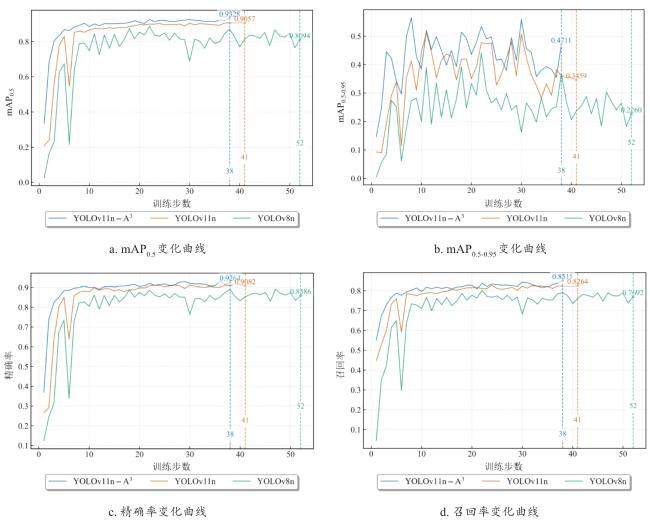
由表2可知,YOLOv11n-A3在精确率、召回率、mAP0.5-0.95分别达到了92.6%、85.1%、47.1%,较基线模型分别提高了1.8、2.5、12.5个百分点。与EfficientDet、RT-DETR、YOLOv8n相比,YOLOv11n-A3的mAP0.5分别高出9.9、2.1、12.4个百分点,精确率分别高出9.5、2.0、6.7个百分点,F1分数分别高出8.1、0.4、7.6个百分点;在更为严格的mAP0.5-0.95和召回率上,YOLOv11n-A³仅次于RT-DETR。究其结构差异,RT-DETR依托Transformer的全局自注意力机制,在全局上下文捕获与高阈值定位上优势显著;而YOLOv11n-A3虽有A2加持,但受CNN局部感知局限,全局建模能力略逊一筹。
表2 油菜角果实验结果对比Tab. 2 Comparison of experimental results for rapeseed siliques |
| | | | | | | | | | | | | |
|---|---|---|---|---|---|---|---|---|---|---|---|---|
| | | | | | | | | | | | | |
| | | | | | | | | | | | | |
| | | | | | | | | | | | | |
| | | | | | | | | | | | | |
| | | | | | | | | | | | | |
然而,得益于CNN架构高效的归纳偏置,YOLOv11n-A3在模型轻量化方面优势明显,其参数量仅为2.58 M,计算量也保持在6.39 GFLOPs的较低水平。与EfficientDet、RT-DETR和YOLOv8n相比,其参数量分别大幅减少了60.9%、92.1%和14.3%,计算量较RT-DETR的107.99 GFLOPs骤降了94.1%。在检测速度方面,YOLOv11n-A3的检测速度达到了625.3帧/s,单图处理帧率虽略低于基线YOLOv11n与YOLOv8n,但其检测速度是RT-DETR的2.3倍。在角果计数方面,YOLOv11n-A3的MAE、RMSE、MAPE及R 2分别为2.61个、3.7个、11.37%和0.937,计数精度显著优于EfficientDet与RT-DETR;尽管受轻量化结构限制,其回归误差较YOLOv8n略有微幅增加,但整体依然保持了较高的计数精准度与稳定性。综上分析,YOLOv11n-A3在检测精度、计数准确性与计算开销之间取得了较好的平衡,充分展现了其轻量高效的优越性,更适用于边缘移动设备上的油菜微小果喙实时检测计数任务。
3.2 消融实验
为验证各改进模块对模型性能的贡献,在保持训练参数一致的条件下,依次引入TMC、Align-PAFPN和A2模块进行消融实验,共设置8组对比试验,结果如表3所示。
表3 YOLOv11n-A3消融实验结果Tab. 3 Ablation study results of YOLOv11n-A3 |
| | | | | | | | | | | | | |
|---|---|---|---|---|---|---|---|---|---|---|---|---|
| | | | | | | | | | | | | |
| | | | | | | | | | | | | |
| | | | | | | | | | | | | |
| | | | | | | | | | | | | |
| | | | | | | | | | | | | |
| | | | | | | | | | | | | |
| | | | | | | | | | | | | |
| | | | | | | | | | | | | |
|
从表3可知,以Baseline为基准,仅引入上下文增强的TMC后,mAP0.5与精确率出现小幅提升,但mAP0.5-0.95略有回落,表明该模块对分类判别稳定性具有一定增强作用,但也对微小果喙的精细边界回归产生了干扰,削弱了高IoU阈值下的定位精度。当仅引入对齐融合的Align-PAFPN时,mAP0.5与mAP0.5-0.95均获得明显提升,说明对齐后的多尺度特征融合机制有助于提升预测框的几何一致性,从而在更严格的匹配阈值下仍能保持较高性能。当仅引入A2模块后,mAP0.5-0.95提升更为显著,表明A2在增强高分辨率特征表达能力的同时,有助于提升小目标的精细定位能力。
在组合结构中,TMC-A相较于单模块配置在召回率与F1分数上表现更为稳健,说明上下文增强与对齐融合之间存在一定互补关系。值得注意的是,缺乏Align-PAFPN对齐的TMC-A2模型mAP0.5-0.95骤降至28.2%,表明TMC的多尺度特征与A2的局部特征极易产生空间错位与拮抗。由此反证,Align-PAFPN是消除特征冲突、协同释放模块增益的关键条件。
最终,虽然完整组合模型A3的mAP0.5-0.95较Dual-A略有回落,但其在mAP0.5、精确率、召回率及F 1分数等指标上均达到了最优状态,较基线模型分别提高2.7、1.8、2.5、2.2个百分点。表明当TMC、Align-PAFPN与A2同时启用时,模型能够在判别可靠性与定位精度之间达到平衡,从而验证了整体结构设计的合理性与有效性。
此外,在角果计数性能方面,各模块组合的R 2均稳定在0.91~0.94之间,展现出可靠的拟合能力。其中,TMC-A取得了最低的绝对误差。最终的A3模型虽然在计数误差上存在极微小的波动,但其在维持高精度计数的前提下,换取了目标定位精度的显著突破,在检测鲁棒性与计数稳定性之间实现了平衡。
3.3 测试结果可视化
将数据集的真实标注和YOLOv11n模型检测结果,以及YOLOv11n-A3模型检测结果进行可视化,如图8所示。
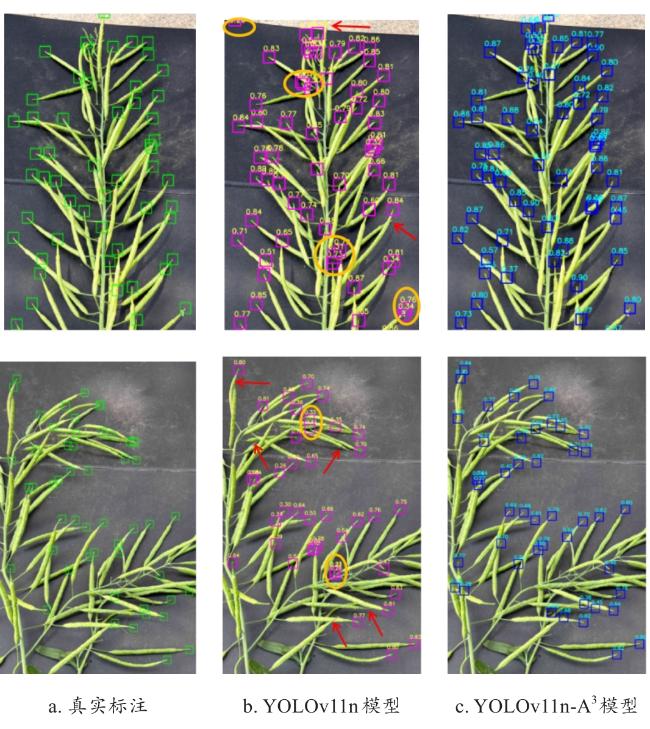
图8可见,YOLOv11n在检测分枝油菜角果时存在较明显的漏检与误检现象,主要表现为对杂质、角果柄的误检,重复识别,以及对交叉、重叠、遮挡角果的漏检。相比之下,改进后的YOLOv11n-A3模型在各类角果分布的检测精度与稳定性方面均有显著提升,表现出更优的目标定位能力和更高的置信度分布。
3.4 改进YOLOv11n模型在油菜角果计数中的应用
3.4.1 模型部署与应用
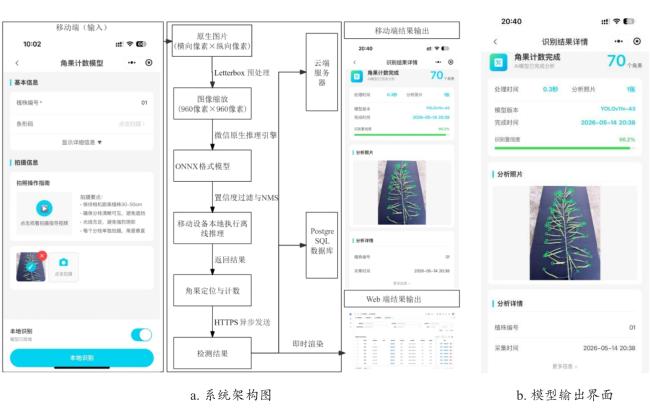
基于Django框架开发了油菜育种人工智能(Artificial Intelligence, AI)工具(图9),该系统由小程序与后台管理平台构成。移动端获取油菜分枝原生图像后,系统通过Letterbox预处理策略将图像像素缩放至960×960,加载ONNX格式模型直接在移动端执行离线推理。经置信度过滤与NMS后,移动端即时渲染识别结果,并将其通过超文本传输安全协议(Hypertext Transfer Protocol Secure, HTTPS)异步提交至云端服务器,统一存储于开源关系型数据库(Postgre Structured Query Language, PostgreSQL)。田间移动端实测数据表明,该系统单图端侧推理耗时为0.2~0.4 s,有效满足了实际考种的低延迟应用需求。
3.4.2 模型应用测试
表4 不同场景下油菜分枝样本角果计数结果汇总Tab. 4 Summary of silique counting results for rapeseed branch samples under different scenarios |
| | | | | | | |
|---|---|---|---|---|---|---|
| | | | | | | |
| | | | | | ||
| | | | | | ||
| | | | | |
|
4 结 论
为解决油菜离体考种中因角果密集重叠及果喙微小引发的精准计数难题,本研究提出一种基于YOLOv11n-A3的检测与计数方法。针对油菜角果目标特点,在主干网络集成SPPF与C2PSA以强化特征的多维联合表达,并在颈部构建融合A2的Align-PAFPN架构,从而协同缓解空间信息错位并提升区域上下文交互能力。实验结果表明,模型精确率、召回率、mAP0.5-0.95分别达92.6%、85.1%、47.1%,较基线模型分别提高了1.8、2.5、12.5个百分点;且计算量为6.39 GFLOPs,参数量为2.58 M,检测速度达625.3 帧/s;同时,模型在角果计数任务中展现出优异的拟合精度,R 2达0.937,MAE仅为2.61个。本研究在维持低计数误差的前提下,大幅提升了复杂遮挡场景下的目标定位精度,为油菜角果检测与计数提供了高效、轻量化的技术支撑。此外,为满足田间实时考种的应用需求,本研究将轻量化模型封装并部署于自主开发的油菜育种AI工具中,可实现对油菜角果的快速精准计数,有效验证了所提轻量化算法在端侧设备上的工程应用潜力。
YOLOv11n-A3虽然在检测和计数任务中取得了较好的效果,但在极端遮挡与高密度簇生场景中仍有提升空间,未来研究拟引入多模态数据融合或多视角特征匹配机制,实现油菜整株角果的检测与计数。