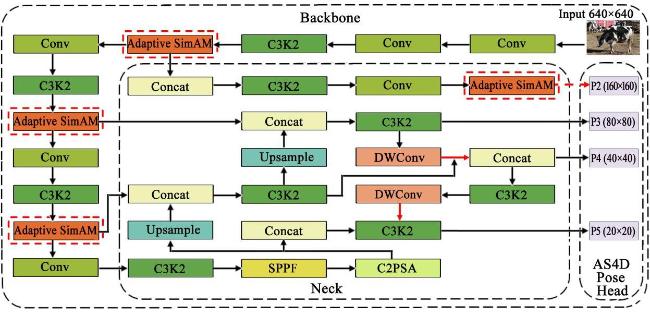
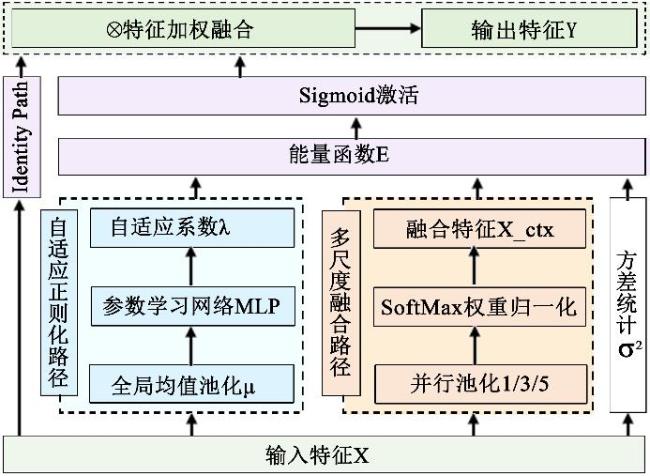
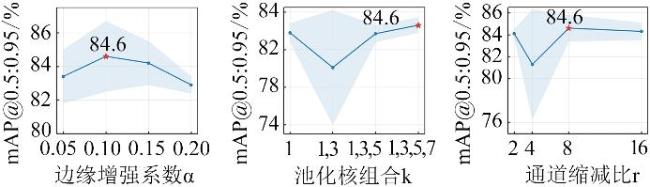
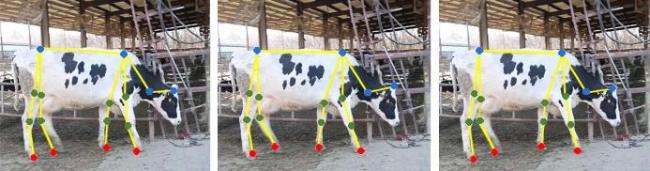
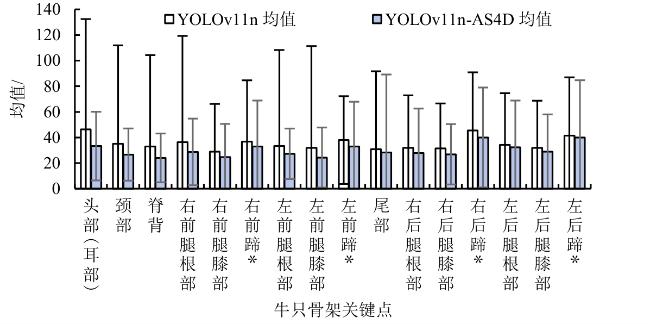
[Objective] In large-scale Holstein farms, accurate pose estimation remains difficult because images are affected by complex illumination, occlusions caused by facilities and neighboring individuals, and local similarity between black-and-white coat patterns and barn textures, which weaken feature discrimination and reduce keypoint localization reliability. Distal keypoints, especially hoof keypoints, are particularly affected. Existing lightweight models meet real-time requirements but have insufficient representational ability for these small distal keypoints under occlusion and background interference. To improve distal keypoint localization while keeping the model compact and real-time, a lightweight Holstein cattle pose estimation algorithm, YOLOv11n-AS4D, was proposed based on YOLOv11n-Pose by integrating adaptive attention with multi-scale perception. [Methods] Two complementary improvements were introduced. First, an asymmetric four-scale detection head based on P2 high-resolution features was constructed to compensate for the spatial information loss of small distal keypoints during repeated downsampling. Compared with conventional three-scale structures, the added P2 branch (stride 4) provides a higher-resolution feature layer that retains shallow spatial details for final keypoint prediction. To control the extra cost of this high-resolution branch, three coordinated strategies were adopted: a unidirectional feature flow, in which the P2 branch only received deep semantic features for prediction and was not propagated back into the bottom-up aggregation path, thereby suppressing shallow noise transmission; a progressive channel configuration, with 64, 128, 256, and 512 channels for P2 to P5, which kept the main convolutional cost of each scale at a comparable level; and depthwise separable convolution in the aggregation path to further reduce computation. Second, an Adaptive SimAM module was proposed to improve feature discrimination under occlusion and texture interference. Unlike the original SimAM with a fixed regularization coefficient and a single-scale response, it introduced three extensions: adaptive regularization, which generated a sample-level coefficient from a global feature descriptor to adjust the attention response to the current feature distribution; multi-scale energy modeling, which combined multi-receptive-field pooling with a Sobel-based edge prior to jointly capture local residual texture and larger-scale context; and hierarchical deployment, which inserted the module after the P2, P3, and P4 stages of the backbone and at the P3 scale of the neck according to their functional roles. The model was trained and evaluated separately on a self-constructed Holstein cattle pose dataset and the public CMBN dataset to examine scene adaptability and generalization. [Results and Discussions] On the self-constructed and CMBN datasets, YOLOv11n-AS4D achieved 97.6% and 98.0% precision, 97.6% and 98.7% recall, and 84.6% and 83.8% mAP@0.5:0.95, respectively. Compared with YOLOv11n-Pose, mAP@0.5:0.95 increased by 1.2 and 1.4 percentage points, precision increased by 0.4 and 0.3 percentage points, and recall increased by 0.4 and 0.5 percentage points, respectively,,indicating improved localization under stricter thresholds. The number of parameters decreased from 2.90/2.91 M to 2.27/2.28 M, while computational cost increased from about 7.3/7.2 GFLOPs to 9.8 GFLOPsand the end-to-end inference speed reached 83.1 f/s, showing that accuracy was improved at a moderate computational cost while real-time inference was maintained. Ablation experiments showed that the two modules were complementary rather than redundant. Their joint gains in mAP@0.5:0.95 were 1.2 and 1.4 percentage points on the self-constructed and CMBN datasets, respectively, exceeding the summed individual gains on the self-constructed dataset and remaining close to their sum on the CMBN dataset. This indicated that the four-scale detection head and Adaptive SimAM enhanced different aspects of feature representation: fine-scale spatial localization of distal keypoints and feature discrimination under occlusion, respectively. In occlusion robustness tests, , average precision (AP) under severe occlusion increased from 73.5% for YOLOv11n-Pose to 75.9% for YOLOv11n-AS4D, and on continuous video sequences, the keypoint missing rate decreased from 8.73% for the baseline to 1.94% for the proposed model. Per-keypoint analysis showed reduced hoof localization errors, confirming the benefit of high-resolution feature compensation for small distal keypoints. [Conclusions] The proposed YOLOv11n-AS4D improved Holstein cattle pose estimation accuracy under complex farming conditions while reducing the number of parameters, with only a moderate increase in computation. By combining an asymmetric four-scale detection head with Adaptive SimAM, it mitigated spatial information loss of distal keypoints and improved feature discrimination under occlusion, while maintaining real-time inference, thereby providing more reliable skeleton perception for downstream behavior recognition, lameness assessment, and intelligent herd management.