

0 引 言
随着全球农业现代化进程加速,中国《加快建设农业强国规划(2024—2035年)》为畜牧业高质量发展绘制了蓝图。该规划聚焦生猪、奶业、肉牛、肉羊等产业,并强调“科技装备支撑能力持续强化”,这为家畜种业振兴与精准养殖的技术创新与应用提供了明确的政策导向。智慧养殖作为农业现代化的关键环节,其核心在于对家畜生长状况的精确把控[1]。体尺是监测和评价家畜生长状况和产肉量的关键指标。全面、准确地测定家畜的体尺表型数据,对于养殖链条中育种、家畜饲养管理等环节至关重要。
传统的家畜体尺测量主要使用卷尺、直尺等工具测量家畜体尺[2],这种测量方法不仅效率低、劳动强度大,而且测量精度易受主观因素影响,无法实现对家畜生长的实时、动态监测[3],难以满足规模化畜牧养殖的需求。随着计算机视觉和传感器技术发展,基于二维图像的家畜体尺测量技术率先得到探索和应用,研究人员使用相机对家畜进行单侧拍摄,去除图像背景并提取轮廓图像,根据轮廓曲线定位体尺测量关键点并计算体尺[4-6],这种体尺测量方法为后续基于三维点云测量体尺技术的发展奠定了重要基础。但二维图像数据缺少深度信息,易受到光照、姿态、背景等因素影响[7],在围度体尺测量及非标准姿态适应方面存在局限。而三维点云作为一种高效的三维结构表示方式[8],包含更多空间信息,几何精度更高,能够更加清晰地还原家畜三维体型特征。
与人工测量和二维图像方法相比,基于三维点云的家畜体尺测量具有非接触、尺度还原准确、空间信息丰富和三维结构表达完整等优势。三维点云能够直接提供家畜体表真实尺度下的空间坐标和局部曲面结构,不仅可用于体长、体高、体宽等线性体尺测量,也更适合胸围、腹围、臀围和管围等围度体尺的切片提取、曲线拟合和周长计算,并可进一步支持臀部丰满度、后躯形态[9, 10]和肢蹄结构[11]等局部三维形态特征的提取。家畜体尺参数是体况状态评估、生长发育监测、体重预测、生产性能分析和遗传评估的重要表型数据,其中线性体尺及其组合指数可反映骨骼发育和体型结构[12],围度体尺与躯干发育、体重变化和营养沉积关系密切[13],局部形态信息可为体型评价、选种育种、新经济性状挖掘[14]和精准饲养管理提供数据支撑。因此,三维点云技术能够在保持非接触、无应激测量优势的基础上,拓展家畜体尺表型评价维度,为智慧养殖决策提供更加全面的数据依据。当前基于三维点云的家畜体尺测量方法主要包括三步:第一步采集家畜点云;第二步对点云进行预处理;第三步对处理后的家畜点云进行体尺测量。该方法有助于提高体尺测量效率和准确性,减少家畜应激反应,为畜牧养殖精细化管理提供支持[15]。
目前该领域内的研究主要围绕单一家畜在特定采集场景中的体尺测量,已逐渐形成一套从数据采集到体尺输出的技术体系,然而在实际的复杂养殖场景中存在背景干扰、点云缺失、非标准姿态和跨物种适应性等问题,现有测量设备和方案仍面临测量精度、鲁棒性和规模化部署能力不足等问题。基于此,本文以猪、牛、羊三类主要家畜为研究对象,按照点云采集、点云预处理、点云补全与分割、关键点提取、体尺参数计算的技术流程,系统梳理基于三维点云的家畜体尺测量研究进展,归纳、分析、总结不同方法的技术特点、适用场景及存在问题,并对未来发展方向进行展望。
1 家畜点云数据采集
1.1 点云数据采集传感器
主流的传感器可分为4类:双目相机、深度相机、激光雷达(Light Detection and Ranging, LiDAR)和RGB相机,针对不同的数据采集场景,以及对采集数据的需求,传感器的选用情况也不同。
1.1.1 双目相机
1.1.2 深度相机
深度相机也称3D相机,根据工作原理分为结构光深度相机和飞行时间(Time of Flight,ToF)深度相机。
结构光深度相机主动投射编码光斑,通过形变计算深度,精度高且可用于夜间,近距离下可达到0.1mm精度,但结构光深度相机由于其主动投射光照特性,因此易受高强度光照影响。该类传感器代表型号包括Kinect V1、Xtion Pro相机。郭浩等[18]选用Xtion相机对奶牛模型及真实奶牛拍摄验证Xtion在奶牛体尺测量上的可行性,测量胸宽、尻宽等6项体尺参数平均误差小于5 mm。
1.1.3 激光雷达
1.1.4 RGB相机
RGB相机本身属于二维成像设备,但可通过多视角三维重建或单目深度估计等方法恢复目标表面的三维空间信息,并进一步生成家畜点云数据。其中,基于运动恢复结构(Structure-from-Motion,SfM)的多视角三维重建是RGB图像生成点云的典型方案。该方法通常通过手持相机或固定多相机从不同角度采集高重叠率图像,利用尺度不变特征变换(Scale-Invariant Feature Transform,SIFT)等算法提取并匹配不同图像中的同名特征点,结合相机内外参数和不同视角下的相机位姿,基于三角测量原理恢复目标三维结构,进而生成稀疏点云,并通过密集重建获得较完整的三维点云。井雪瑶[23]通过RGB相机对奶牛进行多视角环绕视频采集,利用SIFT算法检测并匹配不同视频帧中的关键点,结合相机内外参数和三角测量生成初始点云,并进一步引入神经辐射场(Neural Radiance Fields, NeRF)和三维高斯溅射(3D Gaussian Splatting, 3DGS)算法进行高保真三维重建,实现了奶牛6项体尺测量,平均相对误差均低于3%。该方案硬件成本低、采集方式灵活,但对图像重叠率、光照条件、目标静止状态和后处理流程要求较高。
除了基于SfM的多视角点云重建外,单目深度估计也为RGB图像生成家畜点云提供了另一种低成本路径。该方法通过深度学习模型从单幅RGB图像中预测像素级深度信息,并结合相机内参将二维像素点反投影到三维空间,从而形成带有空间坐标的三维点云,用于后续体尺计算。LI等[24]结合关键点检测与单目深度估计,获取肉牛图像中的关键点和相对深度信息,并通过距离标定将相对深度转换为真实尺度,实现了肉牛体斜长、体高、胸深等体尺测量。与多视角SfM方法相比,单目深度估计采集过程更简单,对设备和拍摄流程要求较低,但其深度恢复精度容易受光照、遮挡、背景、拍摄视角和模型泛化能力影响,同时精度不稳定,通常需要借助距离标定或已知参考尺寸实现真实尺度转换。
1.2 数据采集方案
表1 家畜点云数据采集方案Table 1 Livestock point cloud data collection schemes |
| 数据采集方案 | 代表方案 | 方案特点 | 适用采集场景及对象 | 传感器类型 | 文献 |
|---|---|---|---|---|---|
| 定点通道式 | 采集稳定、姿态较易约束;但通道栏杆易造成遮挡 | 圈舍、通道等稳定测量场景;适用于猪、牛、羊 | 深度相机、双目相机、LiDAR | [17, 18, 20, 25, 26] | |
| 固定式 | 定点拱门式 | 适合多视角同步采集,采集效率高;但对同步、配准和实时性要求较高 | 高通量、多视角同步采集场景;适用于猪、牛 | 深度相机 | [27, 28, 29] |
| 便携手持式 | 设备灵活、搭建简单;但采集效率较低,点云重建流程较复杂 | 临时性、小规模或试验性采集场景;适用于牛 | RGB相机、深度相机 | [2, 23, 24, 30] | |
| 移动式 | 设备移动式 | 采集范围大、对养殖环境干扰小;但易受光照、天气和设备移动稳定性影响 | 开放式、放牧式大范围采集场景;适用于牛 | 无人机搭载RGB相机或LiDAR | [31, 32] |
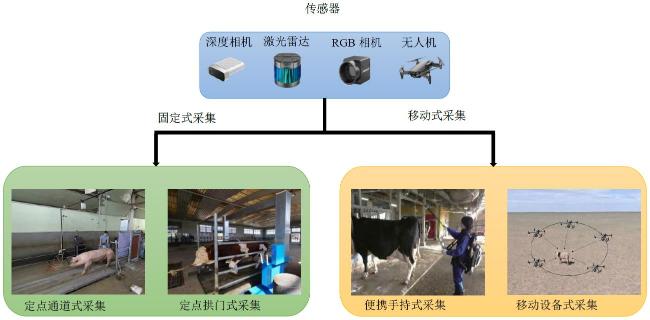
通道式通常由数据采集人员在通道两端设置障碍,使家畜单向通过,利用多台传感器从通道两侧和上方同步采集数据,这种方案能有效利用传感器视场角并保护人员安全,但会因栏杆遮挡导致数据发生缺失。ZHU等[25]通过在商业化猪场内搭建数据采集通道,在通道左右两侧及上方架设Kinect V2深度相机同步采集长白猪的三维点云数据。
拱门式是在特定区域建立门形数据采集平台,当家畜经过拱门时开始数据采集,通过在门形装置中放置多台数据采集传感器,从不同角度对家畜进行同步拍摄,相较于通道式,该方案避免了护栏遮挡导致的点云缺失,但家畜通过时速度较快,对传感器实时性有一定要求,且无护栏限位,家畜的行动路线难以控制,易导致其冲撞设备影响采集稳定性。李嘉位等[28]通过在肉牛养殖场搭建拱门式数据采集平台进行荷斯坦肉牛点云数据收集,放置五台Kinect V2深度相机,4台分布于拱门两侧,1台位于拱门顶部。
设备移动式则通过空中环绕拍摄获取数据,尤其适用于放牧场景,能无接触地捕获大范围信息,LOS等[31]使用多种无人机搭载不同的传感器系统采集荷斯坦奶牛的点云数据,包括RGB相机采用SfM方法生成点云,以及搭载激光雷达直接扫描得到点云。
移动式采集方案对养殖环境几乎无影响,但相对于固定式采集方案,更易受光线、天气等外界因素干扰,数据处理过程复杂且精度较低。
1.3 小结
综合已有研究可知,不同点云采集传感器在采集成本、点云精度、视场范围、同步性能和环境适应性方面各有优势与局限。双目相机和RGB相机成本较低、部署灵活,但对标定精度、图像纹理、光照条件要求较高,且RGB相机需要在目标静止状态下进行数据采集;深度相机适合近距离体表点云采集,但易受强光、遮挡、视场范围和多设备同步误差影响;LiDAR抗干扰能力和同步性能较强,但设备成本和数据处理复杂度较高。因此,现有的点云采集传感器难以同时满足家畜点云采集对体表细节、点云完整性、抗干扰能力、同步性能和部署成本的多重需求。
在采集方案选择上,应结合家畜体型、饲养环境和测量任务进行匹配。猪和羊体型较小、姿态变化较快,更适合固定式、多视角、近距离采集方案,确保采集姿态稳定和体表点云完整;牛体型较大、运动相对缓慢,除圈舍、挤奶通道或限位栏中的固定式多视角采集外,也可在放牧场、草地等散养环境中采用手持式设备或搭载传感器的无人机进行移动多视角采集。总体而言,未来实际应用中应围绕“家畜对象-养殖场景-测量指标”选择合适的采集设备和点云重建方式,而不是追求统一的最优采集方案。
2 家畜三维点云数据预处理
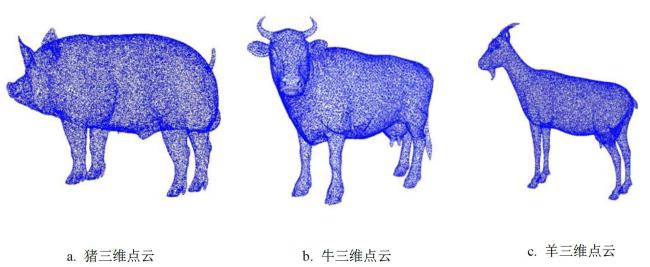
2.1 三维点云的概念
2.2 家畜点云预处理方法
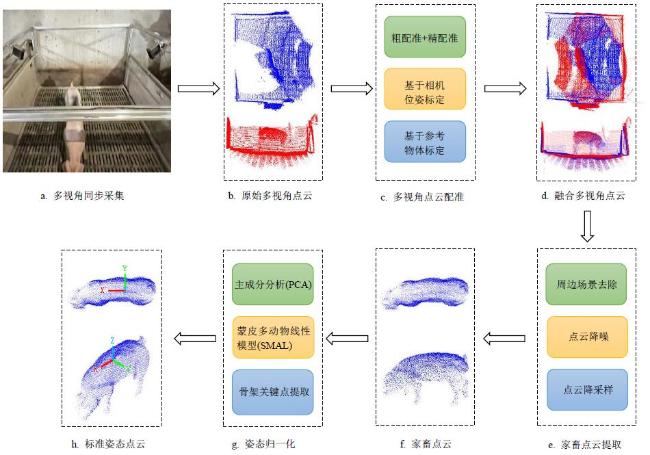
受采集环境与传感器精度限制,原始点云存在噪声与背景冗余。预处理是保障后续体尺计算精度的前提。点云预处理流程通常包括配准、滤波降噪、姿态归一化、补全4类操作。总体的家畜点云数据预处理流程示例如图3所示。
2.2.1 多视角点云配准
在采集家畜三维点云时,单台传感器往往难以覆盖完整表面,因此需采用多视角采集方案更完整地重建家畜三维点云模型,而不同传感器采集的点云位于各自独立坐标系中,须通过配准技术统一至同一坐标系以实现多视角融合(图3b~图3d)[38];家畜点云配准通常遵循粗配准到精配准的流程[39],其中粗配准旨在为精配准提供初始变换,可通过传感器外参或场景参照物获取初始旋转矩阵与平移向量,例如LIANG等[40]使用随机抽样一致性(Random Sample Consensus,RANSAC)算法定位对应点对估计初始变换,李嘉位等[41]利用相机内外参数实现坐标系转换与点云合成。精配准多采用迭代最近点(Iterative closest point, ICP)算法通过迭代优化实现局部最优对齐[42],但ICP在处理非刚性形变及计算效率方面存在局限,李哲等[43]基于超级四点一致集(Super 4-Points Congruent Sets,Super4PCS)改进ICP,与传统ICP相比,运行时间由0.528 s缩短至0.183 s,配准误差由1.56×10⁻⁵ m降低至0.72×10⁻⁵ m。WENG等[44]针对多视角肉牛点云处理中地面干扰、采样特征丢失和配准稳定性不足等问题,提出一种面向肉牛体尺测量的点云处理框架,结合自适应阈值随机抽样一致性(Adaptive Threshold Random Sample Consensus,AT-RANSAC)地面分割、多尺度曲率特征保留采样和正态分布变换—迭代最近点(Normal Distributions Transform–Iterative Closest Point,NDT–ICP)配准完成牛体点云重建。多视角点云配准为后续体长、体高、胸围和腹围等体尺计算提供统一的空间坐标基础。若配准误差较大,容易引起关键点错位、切片位置偏移和围度拟合不稳定,因此配准精度是影响三维体尺测量可靠性的前提。
2.2.2 点云滤波降噪
实际养殖场景中拍摄得到的家畜点云往往带有栏杆、地面等背景点云,以及噪点,这些冗余点云会影响后续的测量精度。滤波处理是去除噪点、提取目标点云并减少后续计算量的关键步骤[45]。针对不同采集条件下获得的点云数据,研究人员提出了多种处理方法,总体流程如图3d~图3f所示,通过不同的方法,实现对环境点云的去除、降噪。现有方法可分为两类。一是基于几何、统计与聚类特性的传统数学方法,如范才虎等[46]联合直通滤波与统计滤波保留93.86%的有效点云后,再利用随机抽样一致性(RANSAC)算法分割地面以提取完整羊体;HUANG等[47]提出条件滤波(Conditional Removal Filter,CRF)-统计离群滤波(Statistical Outlier Removal Filter,SORF)-体素网格滤波(Voxel Grid Filter,VGF)融合策略,增强复杂场景数据质量;李嘉位等[41]则通过RANSAC去地后结合降维密度聚类与感知盒滤波,有效滤除贴体栏杆噪声,错误率仅5.41%;李哲等[43]利用加权局部最优投影(Weighted Locally Optimal Projection,WLOP)方法,在滤波的同时保持关键点云结构。二是基于深度学习的分割方法,如YANG等[48]通过改进仅关注系 数实例分割网络(You Only Look At CoefficienTs,YOLACT++)从二维图像分割奶牛区域并映射至点云,体表提取误差为2.18%;CHANG等[49]将点集层次化特征学习网络(PointNet++)与软池化(SoftPool)结合增强局部特征,猪体点云分割精度达98.33%;翁智等[50]改进Mask2former网络,引入卷积块注意力模块(Convolutional Block Attention Module, CBAM)与坐标注意力(Coordinate Attention, CA)提升对背景干扰的鲁棒性,分割精度达88.1%,并实现二维分割结果至三维点云的映射。对家畜体尺测量任务而言,滤波降噪的目的不单是为了减少栏杆、地面、饲槽等冗余点云,还能提高点云视觉质量,降低噪点对关键点定位、切片截取和围度拟合的干扰。尤其在实际养殖环境中,目标提取精度往往决定了后续体尺计算误差的下限。
2.2.3 姿态归一化
姿态归一化在家畜点云处理中具有关键作用,旨在通过旋转、平移等操作统一规范家畜点云朝向与坐标位置[51, 52],从而减少后续体尺计算的复杂度,其处理流程如图3f~图3h所示。当前方法主要分为两类:(1)基于几何主成分分析(Principal Component Analysis,PCA)的刚性归一化方法,如王可等[53]结合地面法向量校正PCA坐标轴,以地面法向量确定规范坐标系中的竖直Y轴,并在地面平面内将猪体头尾方向和左右体宽方向分别对齐X轴和Z轴,其中X轴正方向指向猪头,负方向指向猪尾。该类方法无需依赖外部参数,计算高效、可解释性强,但对噪声敏感且难以处理非刚性形变。(2)基于模型的非刚性姿态矫正方法,如ZHU等[25]采用改进L1中值骨架模型(Improved L1-Median Skeleton Model)提取猪体三维骨架及关节点,通过骨架关节点与局部点云绑定,并利用旋转矩阵将非标准姿态转换为标准姿态,转换后8项体尺的平均相对误差为1.57%;LI等[29]构建基于微姿态特征的弹性网校正模型(Posture-based Measurement Adjustment,PMA),通过12类解剖参数量化姿态变异,使体斜长与腹围误差分别降至3.47%与2.36%;LUO等[54]则采用蒙皮多动物线性模型(Skinned Multi-Animal Linear Model,SMAL)实现多姿态统一。该类方法虽对非刚性形变适应性强、精度高,但模型构建复杂且对训练数据质量要求较高。对于体高、体长等线性体尺,姿态偏转会直接影响测量方向定义;对于胸围、腹围等围度体尺,躯干弯曲与头部抬低会引起切面位置漂移。因此,姿态归一化实质上是在降低非标准姿态对体尺计算稳定性的影响。
2.2.4 家畜点云补全
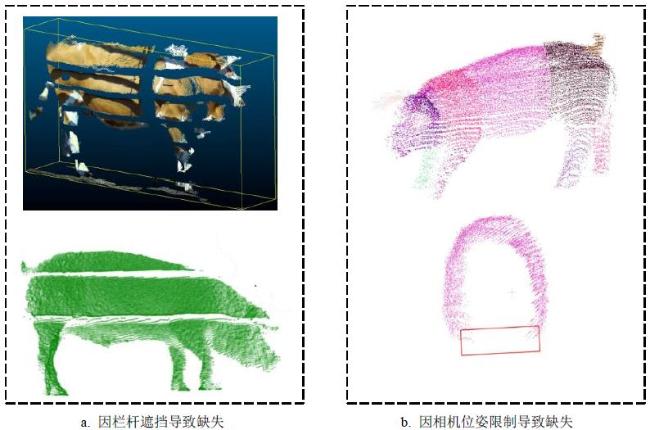
完整的三维点云是实现高精度体尺测量的基础。然而,在实际采集过程中,如图4所示,受传感器视角限制及栏杆遮挡等因素影响,点云往往存在缺失,影响围度体尺的测量精度。针对该问题研究人员提出不同的点云补全方法,通常对需要测量围度体尺的点云切片进行非均匀有理B样条曲线(Non-Uniform Rational B-Spline, NURBS)[55]或其他数学方法拟合并计算曲线周长得到结果,何东建等[56]采用动态补点策略的3次B样条曲线拟合修复奶牛点云,平均误差为1.623 mm;如图5a所示,李孟飞等[57]结合阈值分析、3次B样条曲线与边缘检测补全猪体点云,使胸围、腹围测量误差分别降至0.89和0.64 cm;尹令等[58]通过极坐标转换与曲线拟合恢复猪只腹部轮廓,体尺测量平均误差为3.32%;WU等[59]利用支持向量回归(Support Vector Regression,SVR)与贝塞尔曲线修复肉牛点云,四项体尺整体平均相对误差为3.5%。如图5b所示,初梦苑等[60]提出基于视频错帧的补全方法,通过多帧信息融合实现缺失区域修复。如图5c所示,SUN等[61, 62]提出先分割后补全的分布式策略,针对山羊不同部位采用相应补全方法,各项体尺平均相对误差不超过3.1%,类似地,ZHANG等[63]提出一种面向奶牛动态采集场景的语义引导三维重建方法,先利用CSS-PointNet++对侧视点云中的躯干与四肢进行语义分割,再结合双视角点云配准与基于语义信息的镜像补全完成奶牛行走状态下的三维重建,为后续基于体积和表面积的体重估计提供了较完整的点云基础。XU等[64]采用分步填充策略,依次对腿部与躯干进行NURBS曲线拟合、网格重建与泊松圆盘采样,实现完整猪体重建,使管围、胸围和腹围测量误差分别降低1.24%、11.47%和9.48%。
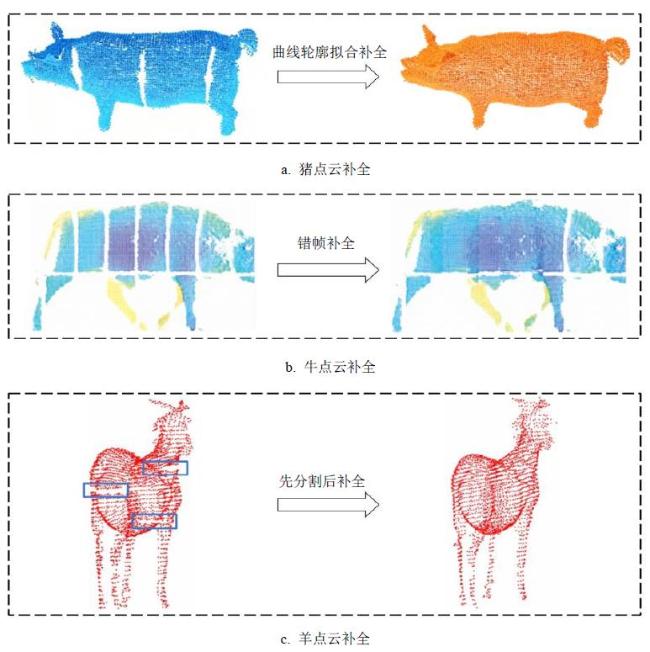
当前家畜点云补全主要采用曲线拟合、轮廓补点、镜像恢复和多帧融合等传统方法。这些方法便于根据体尺测量位置进行针对性处理,但通常依赖点云缺失范围、轮廓形状和人工参数。当缺失区域较大,或家畜躯干、四肢等部位的表面结构较为复杂时,单纯依靠拟合较难同时恢复整体形态和局部细节。除上述方法外,通用深度学习点云补全模型也为家畜点云缺失修复提供了可借鉴的技术路线。基于深度网格变形的点云自编码网络(Point Cloud Auto-Encoder via Deep Grid Deformation,FoldingNet)[65]通过折叠式解码器将规则二维网格映射至三维点云。该方法主要面向点云自编码与无监督特征学习。点云补全网络(Point Completion Network,PCN)[66]首次实现了端到端的点云补全,直接以残缺点云为输入,采用粗到细的两阶段解码结构,先预测稀疏的整体轮廓,再生成较为稠密的完整点云。为进一步增强生成点云的结构表达能力,结构化点云解码网络(Structural Point Cloud Decoder,TopNet)[67]采用树状结构逐步生成完整点云,使模型能够更好地恢复目标的整体形状和局部结构。而网格化残差网络(Gridding Residual Network,GRNet)[68]在无序点云与规则三维网格之间建立可微转换,并利用网格邻域信息增强点云结构和空间上下文表达。在基本点云生成框架逐渐成熟后,研究重点开始转向辅助先验信息的利用。视图引导点云补全网络(View-Guided Point Cloud Completion,ViPC)[69]开创性地引入单视图图像作为全局结构先验,显著提升了复杂缺失情况下的补全质量;基于自视图增强和自结构双生成器的点云补全网络(Complementing Point Cloud via Self-View Augmentation and Self-Structure Dual-Generator,SVDFormer)[70]进一步利用多视角深度图实现自视图增强,无需外部图像输入即可实现高精度局部结构生成。在精细化处理方面,基于多步点移动路径学习的点云补全网络(Point Cloud Completion by Learning Multi-Step Point Moving Paths,PMP-Net)系列[71, 72]将补全建模为多点移动路径优化问题,通过最小化移动距离约束实现点级对应关系学习。近年来,生成模型与零样本学习成为新方向,例如基于三维生成先验的零样本点云补全框架(Zero-Shot Point Cloud Completion via 3D Generative Priors,GenPC)[73]利用大规模预训练图像到三维生成模型所包含的三维形状先验,结合深度提示与几何保持融合实现零样本点云补全,降低了模型对成对训练数据和已知类别的依赖。需要指出的是,大多数深度学习补全模型主要面向ShapeNet、PCN等通用的刚性物体点云数据集构建,其训练目的是整体形状重建,而非围度体尺敏感区域的局部几何恢复。因此,这些模型在迁移至家畜体尺测量任务时,仍面临训练样本不足、家畜非刚性形变强、毛发与遮挡噪声显著、围度轮廓恢复困难等问题。家畜点云补全应关注体尺测量关键点区域的局部几何恢复。补全结果是否能够保持切片轮廓的连续性和曲率的合理性,将直接影响胸围、腹围、臀围等围度体尺计算的稳定性。未来可将围度区域几何结构、姿态先验和多帧点云融合与深度学习模型相结合,发展面向家畜体尺测量任务的专用补全方法。
2.3 小结
家畜点云由原始采集数据转化为可用于体尺计算的数据,通常需要经过多视角配准、滤波降噪、姿态归一化和缺失区域补全。多视角点云首先要统一至同一坐标系,栏杆、地面及噪点等干扰信息需要从目标点云中剔除;当家畜出现偏转、弯曲等非标准姿态时,还需对点云方向和局部形态进行校正;胸腹部轮廓因遮挡或视角限制发生缺失时,则需要恢复相应的测量区域。不同测量任务对点云质量的要求并不相同,体长和体高主要受点云方向及关键点位置影响,而胸围、腹围和臀围等指标更依赖测量截面的完整性。因此,预处理的步骤应结合采集设备、点云缺陷类型和待测体尺进行选择。
传统的几何处理、统计滤波、聚类和曲线拟合方法实现较为方便,计算过程和参数作用也比较直观,但其结果也受到阈值、邻域范围、聚类参数的影响。当圈舍结构、点云密度或家畜姿态发生变化时,原有参数往往需要重新调整。深度学习方法能够从数据中提取目标点云和局部结构特征,对复杂背景、姿态变化和局部缺失具有较好的适应能力,但其应用仍受到标注数据、模型规模和计算资源的限制。后续研究需要将配准、降噪、姿态归一化和点云补全与关键点定位及体尺计算算法联系起来,并根据最终体尺误差评价各环节的实际效果,从而提高复杂养殖环境下点云处理和体尺测量的稳定性。
3 家畜体尺测量方法
常规的家畜体尺指标包括体长、体高、胸围、管围等,测量标准如表2所示。根据关键点定位方式不同,基于三维点云的家畜体尺测量方法可分为两类:一类是直接定位关键点的体尺测量方法,在家畜点云或RGB图片中定位体尺测量关键点并计算体尺;另一类是基于点云分割定位关键点的体尺测量方法,即先对家畜点云进行身体部位或关键区域分割,再在对应区域内定位关键点并计算体尺。前者流程较为简洁,后者能够缩小关键点搜索范围,提高体尺测量的稳定性。
| 体尺指标 | 猪 | 牛 | 羊 |
|---|---|---|---|
| 体长 | 耳根中点至尾根点的直线距离 | 肩端至坐骨端的直线距离 | 肩端至坐骨端的直线距离 |
| 体高 | 肩胛骨最高点至地面的垂直距离 | 鬐甲最高点至地面的垂直距离 | 鬐甲最高点至地面的垂直距离 |
| 臀宽 | 髋骨间最大宽度 | 腰角外缘间宽度 | 腰角外缘间宽度 |
| 臀高 | 髋骨最高点至地面的垂直距离 | 两腰角连线中点至地面的垂直距离 | 臀部最高点至地面的垂直距离 |
| 臀围 | 两后膝前缘经臀部的周径 | 两腰角与臀端连线中点的水平周径 | 两后膝前缘经臀部的周径 |
| 胸深 | 背部至胸部下缘的垂直距离 | 鬐甲后缘至胸骨底部的垂直距离 | 肩胛骨背线至胸骨的垂直距离 |
| 胸宽 | 肩胛后缘间的最大宽度 | 肩胛后缘间的最大宽度 | 肩胛后缘间的最大宽度 |
| 胸围 | 肩胛后缘处体躯水平周径 | 肩胛后缘处体躯水平周径 | 肩胛后缘处体躯水平周径 |
| 腹围 | 腹部最大水平周径 | 腹部最大水平周径 | 腹部最大水平周径 |
| 管围 | 前肢管骨最小水平周长 | 前肢管骨最小水平周长 | 前肢管骨最小水平周长 |
3.1 直接定位关键点的体尺测量方法
3.1.1 直接定位体尺测量关键点方法
3.1.2 基于直接定位关键点的体尺计算方法
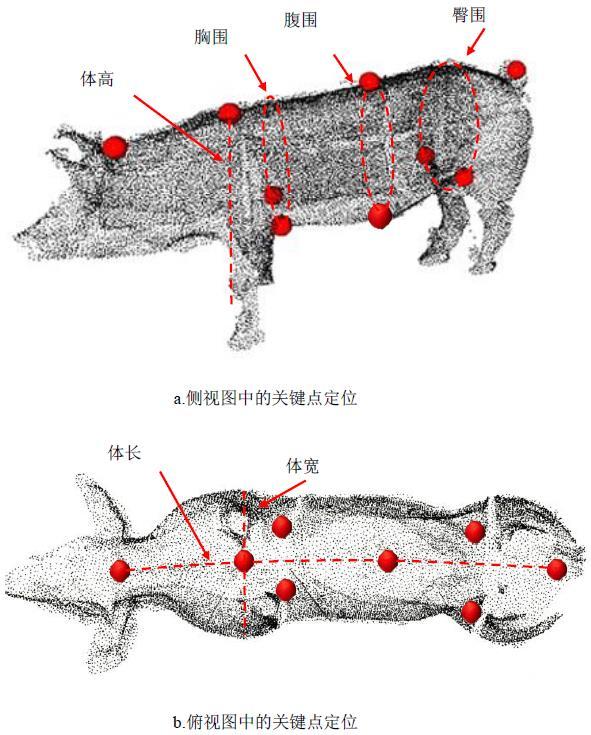
表3统计了不同研究的直接定位关键点的家畜体尺测量方法,现有方法主要包括人工标记、基于几何特征定位、二维图像关键点检测后映射至三维坐标,以及基于点云数据直接定位关键点等类型。人工标记方法操作直观,但自动化程度较低[79];基于几何特征的方法通常依赖轮廓曲率、极值点或几何约束确定测量点,具有较好的可解释性;基于二维图像关键点检测的方法可利用成熟的姿态估计或目标检测模型定位测点,再结合深度图像或相机参数恢复三维坐标[78];基于点云数据直接定位关键点的方法则能够直接利用三维空间结构信息,减少二维映射误差[77]。总体来看,直接定位关键点方法流程相对简洁,适用于体型轮廓清晰、姿态较标准且测量关键点易于确定的家畜。牛体型较大,鬐甲、臀部、背线、胸深等解剖位置相对明显,在侧视图像、深度图或局部点云质量较好的条件下,可通过关键点检测、轮廓曲率分析或几何特征直接定位体高、体长、臀高、胸深等测点。因此,在牛体尺测量中直接定位关键点方法具有较好的适用性。对于猪和羊,当采集环境受控、姿态较标准且主要测量体长、体高、体宽等线性体尺时,也可以采用直接定位关键点方法;但在自由行走、躯体弯曲、低头、遮挡或被体毛影响明显的情况下,直接测点定位容易出现偏移,测量稳定性相对不足。
表3 基于直接关键点定位的家畜体尺测量方法Table 3 Livestock body measurement methods based on direct key point localization |
| 采集对象 | 采集方案 | 传感器 | 关键点定位方法 | 体尺计算结果 | 文献 |
|---|---|---|---|---|---|
| 牛 | 便携手持式 | 深度相机 | 基于三维表面轮廓、梯度和曲率特征定位关键点 | 多数体尺偏差低于6% | [80] |
| 牛 | 定点拱门式 | 3D扫描仪 | 在三维扫描模型中人工标记关键点 | 6项体尺与人工测量相关系数为0.62~0.89 | [27] |
| 牛 | 便携手持式 | RGB相机 | YOLOv5s检测牛体目标,Lite-HRNet定位体尺关键点,并结合Global-Local Path Networks单目深度估计恢复深度信息 | 4项体尺平均相对误差约7.82% | [24] |
| 牛 | 定点通道式 | 深度相机 | 通过OpenCV图形界面在深度图像中人工选取测点,并映射至深度图像 | 5项体尺平均绝对百分比误差约11.58% | [79] |
| 牛 | 定点通道式 | 深度相机 | 基于点云轮廓曲线、极值点和几何约束定位体尺测量关键点 | 3项体尺平均绝对误差约2.09 cm | [75] |
| 牛、羊 | 便携手持式 | 深度相机 | 改进U-Net分割躯干区域,多阶段密集堆叠沙漏网络定位体尺关键点 | 牛4项体尺平均相对误差为1.09%;羊4项体尺平均相对误差为1.37% | [81] |
| 牛 | 定点通道式 | 深度相机 | 在RGB图像上进行关键点检测定位并投影至点云 | 牛5项体尺平均绝对百分比误差约4.96% | [76] |
| 牛 | 便携手持式 | 深度相机 | 采用改进YOLOv8-Pose模型在RGB图像中定位关键点,并映射至点云坐标系 | 4项体尺平均相对误差约3.80% | [78] |
| 猪 | 定点拱门式 | 深度相机 | 提出测地线距离回归关键点检测法并配合改进PointNet++模型定位 | 6项体尺平均绝对百分比误差为3.90% | [77] |
| 牛 | 定点通道式 | 深度相机 | 采用轻量化YOLOv8-Pose模型在RGB图像中检测关键点,并映射至由深度图生成的三维坐标系 | 6项体尺平均绝对百分比误差约1.28% | [82] |
3.2 基于点云分割定位关键点的体尺测量方法
3.2.1 点云分割模型
点云分割模型能够对点云中的不同语义区域进行分类,是实现家畜身体部位划分的重要工具。与通用三维场景分割任务相比,家畜体尺测量更关注肩部、胸部、腹部、臀部和四肢等与体尺定义直接相关的解剖区域。因此,通用点云分割模型在迁移至家畜体尺测量任务时,需要重点考虑局部几何特征提取、全局姿态建模和复杂场景部署能力。
从模型类型看,PointNet++[83]、动态图卷积神经网络(Dynamic Graph Convolutional Neural Network,DGCNN)[84]等方法擅长提取局部结构特征,适合支撑基于部位轮廓与几何极值的体尺关键点搜索;点云Transformer网络(Point Transformer)[85]、第三代点云Transformer网络(Point Transformer V3)[86]和基于状态空间模型的点云分析网络(PointMamba)[87]等方法则兼顾全局建模能力与效率,更适合作为家畜体尺测量任务中分割模型迁移与轻量化部署的候选框架。需要指出的是,这些模型大多源于通用物体或室内外场景的点云分割任务,其训练目标与家畜体尺测量并不完全一致。家畜点云具有非刚性形变明显、不同物种体表结构差异大、毛发与遮挡噪声显著等特点,使得通用分割模型直接迁移时容易出现部位边界模糊、四肢与躯干混淆、极端姿态下分割不稳定等问题。因此,在家畜体尺测量任务中,更值得关注的不是哪种分割模型性能最强,而是哪种分割模型最能服务于关键点定位与体尺计算以及边缘部署。
3.2.2 基于点云分割的定位体尺测量关键点方法
点云分割将家畜体尺测量由在整头点云中直接搜索关键点转化为“分割-定位”的两步流程[37]。其核心思想是先将家畜点云划分为头部、躯干、四肢等与体尺定义直接相关的解剖区域,再在对应区域内部依据几何特征、边界信息或局部极值稳定地定位关键点或确定测量切面,从而减少在完整点云中直接搜索关键点所带来的不稳定性,并为实现高通量体尺测量提供支撑。相较于直接定位方法,基于点云分割的方法能够有效缩小关键点搜索范围,降低噪声、遮挡以及非标准姿态对关键点定位结果的干扰,尤其适用于围度、宽度体尺等对测量区域稳定性要求较高的体尺测量任务。
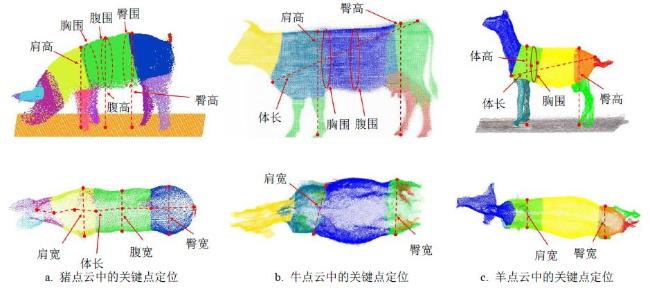
3.2.3 基于点云分割定位关键点体尺计算方法
完成关键点定位或测量切面确定后,对于体长、体高、体宽等直线体尺,通常直接计算两个关键点之间的欧氏距离;对于胸围、腹围等围度体尺,其计算依赖于关键点确定的切面,通常对该切面的轮廓点云采用B样条曲线拟合,并通过累计拟合长度计算周长[37]。因此,基于点云分割的体尺测量流程不仅包括身体部位划分和关键点定位,还需要结合不同体尺指标的测量标准选择相应的几何计算方法。
表4从采集对象、采集方案、传感器、分割方法及体尺计算误差等方面进行了归纳。总体上,传统区域切片方法在标准姿态下的有限体尺测量任务中具有较好可解释性,而深度学习分割方法在复杂背景、多姿态和多项体尺同步测量任务中表现出更强优势。
表4 基于点云分割的家畜体尺测量方法Table 4 Livestock body measurement methods based on point cloud segmentation |
| 采集对象 | 采集方案 | 传感器 | 分割方法 | 体尺计算结果 | 文献 |
|---|---|---|---|---|---|
| 猪 | 定点通道式 | 深度相机 | 采用改进PointNet++分割猪体头部、耳部、躯干、四肢和尾部等区域。 | 计算9项体尺平均相对误差为3.39% | [90] |
| 猪 | 定点通道式 | LiDAR | 采用PointVector++分割猪体各部位,并提取体尺表型测量区域。 | 计算10项体尺平均绝对百分比误差为5.46% | [37] |
| 牛 | 定点拱门式 | 深度相机 | 连续水平切片结合五点聚类梯度边界识别算法提取肉牛关键区域。 | 计算5项体尺平均相对误差为2.42% | [91] |
| 牛 | 定点通道式 | 深度相机 | 采用动态不平衡八叉树分组(Dynamic Unbalanced Octree Grouping,DUOS)改进PointNet++分割牛体和四肢等7个区域。 | 计算6项体尺平均相对误差为2.03% | [92] |
| 牛 | 定点通道式 | 深度相机 | 采用掩码多层几何点模型(Masked Multilevel Geometric Point,MMLG-Point)进行牛体点云分割 | 计算5项体尺平均绝对百分比误差低于6% | [93] |
| 牛 | 定点拱门式 | 深度相机 | 采用FGPointKAN++进行奶牛点云部位分割,并结合自适应关键切片平面识别计算体尺。 | 计算4项体尺平均绝对百分比误差为2.32% | [88] |
| 牛 | 定点通道式 | 深度相机 | 采用CattlePartNet分割肉牛体尺关键区域,用于体高、体长、胸围、腹围和臀高测量。 | 计算5项体尺平均绝对百分比误差为5.53% | [94] |
| 羊 | 定点通道式 | 深度相机 | 采用改进PointStack分割山羊头部、前后肢、胸部、腹部、臀部和尾部。 | 计算6项体尺平均绝对百分比误差为3.51% | [89] |
| 羊 | 定点通道式 | 深度相机 | 提出DyFusion-PCT分割羊体背线、头颈前部、胸廓截面和远端肢体等关键测量区域。 | 计算6项体尺平均相对误差为3.20% | [95] |
早期相关研究通常借助点云几何结构和局部轮廓特征对测量区域进行约束。李嘉位等[91]通过双向断层切片将肉牛点云分割为头颈、前中后躯干、下肢及臀尾等部位,并进一步基于腿部边界派生出肩、胸、腹、臀等关键区域替代传统关键点,实现了肉牛5项体尺测量。这类方法的共同特点在于:先通过区域划分缩小关键点搜索范围,再在相应区域内完成体尺计算,从而降低整体点云中无关部位和局部噪声对体尺测量结果的干扰。
为进一步提高关键点定位与测量切面确定的稳定性,研究人员开始将点云分割模型引入家畜体尺测量任务,并在分割结果基础上结合聚类、曲率分析、边缘检测、轮廓提取和切片拟合等几何后处理方法完成体尺计算。HOU等[94]通过改进PointNet++,并进一步构造CattlePartNet模型实现肉牛肩部、胸部、腹部和臀部等关键区域分割,并依据分割区域内的曲率特征定位测量关键点;LIANG等[95]提出动态融合点云Transformer网络(Dynamic Fusion Point Cloud Transformer,DyFusion-PCT),实现羊体背线、头颈前部、胸廓截面及远端肢体等关键测量区域的分割,并依据分割结果提取关键点和截面轮廓。WENG等[92]将PointNet++与动态不平衡八叉树分组相结合,实现牛体部位分割,并结合聚类、Alpha Shapes轮廓提取与对称修复等策略完成多项体尺测量。针对家畜点云标注样本不足和模型泛化能力有限的问题,WENG等[93]进一步提出MMLG-Point无监督预训练方法,在少量标注样本条件下实现牛体点云分割与体尺测量,并在猪点云数据上表现出一定跨物种泛化能力。由此可见,通用点云分割模型在迁移到家畜体尺测量任务时,通常并不是直接输出体尺结果,而是与聚类、曲率分析、边缘检测和切片拟合等步骤相结合,形成“分割-定位-测量”的任务链,使分割结果服务于体尺测量。
在此基础上,为适应真实养殖场景中的姿态变化和标注数据不足问题,近期研究进一步将点云分割与姿态自适应和模型迁移结合。ZHOU等[88]提出融合特征组增强模块(Feature Group Enhance,FGE)和Kolmogorov–Arnold网络(Kolmogorov–Arnold Network,KAN)的FGPointKAN++分割网络与自适应关键切割平面识别(Adaptive Key Cutting Plane Recognition,AKCPR)算法对牛体点云进行分割,结合支持向量机识别切面位置与角度定位关键点,实现了奶牛行走姿态下肩高、体宽、胸围和腹围四项体尺计算,同时减弱了姿态变异对测量结果的影响。SHI等[96]提出核卷积与图注意力机制融合网络(Kernel Convolution Integrated with Graph Attention Mechanism,KCGATNet)模型,在猪体点云上完成预训练后,仅利用少量牛体标注样本即可实现多种牛品种点云的稳定分割,并指出不同身体部位的精确分割能够促进体尺测量,显示出家畜点云分割由单物种专用模型向跨物种迁移和小样本泛化发展的趋势。
总体来看,基于点云分割的家畜体尺测量研究已由依赖局部几何特征的关键区域约束,逐渐发展到借助深度学习模型实现身体部位分割,并进一步向多姿态适应、跨物种迁移和小样本泛化方向拓展。该类方法能够为围度体尺和局部形态参数测量提供较稳定的区域基础,但仍受限于高质量部位标注数据不足、不同物种体表结构差异较大及模型复杂度偏高等问题。未来需要进一步探索面向家畜体尺测量任务的轻量化分割模型、多姿态数据集构建,以及分割结果与关键点定位、切面识别的一体化设计。
3.3 小结
综上,基于三维点云的家畜体尺测量方法由早期依赖人工标注、轮廓曲率和几何分析,逐渐发展为融合关键点检测、点云分割和区域约束的自动化测量方法。现有研究主要形成了直接定位关键点和基于点云分割定位关键点两类技术路线。前者流程简洁,适用于姿态较标准、点云质量较高且以线性体尺为主的测量任务;后者能够缩小关键点搜索范围,降低身体部位相互干扰,更适合姿态变化明显、局部遮挡较多以及胸围、腹围、臀围等围度体尺测量场景。
目前,相关方法已在猪、牛、羊等家畜对象上得到应用,测量指标也由体长、体高、体宽等线性体尺扩展到围度体尺和臀部丰满度等体态指标。随着深度学习方法的发展,关键点检测和点云分割模型在自动化测量、多项体尺同步提取和复杂背景适应方面表现出巨大潜力。但现有研究仍存在体尺定义、数据采集条件和评价标准不统一,高质量家畜点云数据集不足,以及复杂模型边缘部署能力有限等问题。未来应进一步统一体尺关键点定义与评价标准,发展轻量化、可迁移的关键点定位和点云分割模型,并推动体尺测量向体况评分、局部形态评价等三维表型智能分析拓展。
4 讨 论
4.1 当前主要挑战
随着三维传感器、点云处理算法和深度学习模型的发展,基于三维点云的家畜体尺测量已逐渐形成由点云采集、点云预处理、关键点定位、体尺参数计算构成的技术流程。现有的研究表明,在受控场景下,基于三维点云的方法已能够实现猪、牛、羊等家畜体尺的非接触测量。但在真实养殖环境下仍存在以下挑战。
(1)复杂养殖场景下采集到的点云质量低。现有研究多在单头家畜、固定通道或相对受控的采集条件下开展,而养殖现场的栏杆、粪污和饲槽会形成大量背景点,家畜运动又会引起运动畸变[97]和多视角数据不同步。不同传感器受到的影响也不相同:双目相机和RGB相机依赖纹理与光照,深度相机在强光和近距离遮挡下容易产生深度空洞,LiDAR虽然受环境光影响较小,但设备成本和点云处理量较高。群养条件下还存在个体接触和相互遮挡,容易造成点云粘连,使个体边界、测量关键点和围度切面难以准确确定。顶部俯拍虽然便于获取背部信息,但侧腹部点云不足,难以直接用于胸围和腹围计算[33, 98]。因此,采集系统能否适应家畜运动、群体遮挡和不同圈舍结构,仍是影响现场测量稳定性的主要因素。
(2)模型算法对复杂场景的适应性与部署能力仍需提升。真实养殖场景与实验室受控条件存在明显差异,圈舍、通道和栏位中常伴随栏杆、地面、饲槽等背景干扰,家畜姿态也难以保持统一,使点云预处理和体尺测量关键点定位容易受到噪声、遮挡及非标准姿态的影响。传统点云处理方法通常依赖人工设定的阈值、参数和几何约束,当圈舍结构、传感器布设方式或家畜姿态发生变化时,往往需要重新调整参数,跨场景适用性有限。深度学习方法虽然能够从数据中学习点云特征,并已应用于点云分割、姿态校正、关键点定位和点云补全等任务,但其训练效果较大程度上依赖高质量标注数据,且模型参数量和计算开销通常较大,限制了其在边缘设备上的部署。
(3)家畜多姿态点云数据集匮乏。家畜在点云采集过程中姿态多变且不可控,但现有研究多以标准站立姿态或相对受控场景下的点云为主要对象,对低头、转身、躯体弯曲、自由行走和局部遮挡等非标准姿态覆盖不足。近年来,虽已有研究构建了特定家畜的三维点云数据集[99],但总体数量仍较少,物种和品种、采集场景有限,姿态类型、样本规模偏少。同时,不同研究在体尺关键点定义、身体部位标注方式、测量切面选取和误差评价指标等方面尚不统一,导致模型训练结果和测量精度难以公平比较。数据集与评价标准的不足限制了点云处理模型的泛化能力以及相关算法在不同家畜对象和真实养殖场景中的推广应用。
4.2 未来发展趋势
(1)提升点云采集系统性能。未来应进一步提升点云采集传感器在精度、视场范围、同步性能和环境适应性方面的综合能力。单一传感器难以同时满足高精度、抗干扰和强同步的采集需求,因此可发展跨模态传感器融合机制,结合深度相机近距离体表细节捕捉能力、LiDAR抗干扰和强同步特性,以及RGB图像在目标识别和语义信息提取方面的优势,构建多源融合和2D-3D融合采集模式[100],以缓解复杂光照、局部遮挡、近距离采集缺失和家畜运动畸变等问题。此外,便携、移动的数据采集设备也将成为未来重要方向,如搭载深度传感器或LiDAR的巡检机器人、移动采集平台和无人机系统,可进一步提高家畜点云采集的自动化程度和场景适应能力;同时,面向群养动物体尺测量,未来还可结合2D-3D以及多视角互补采集,通过多视角采集结合实例分割方法,降低群养遮挡和点云粘连对个体点云提取的影响,提升多头家畜体尺测点提取、遮挡恢复和连续化测量能力,为高质量、规模化的家畜体尺测量提供数据基础。
(2)优化点云处理算法与轻量化体尺测量模型,提升复杂场景适应性和部署能力。针对真实养殖场景中背景复杂、噪点干扰多和家畜姿态不受控等问题,后续研究应围绕点云处理与体尺测量算法在复杂场景适应性、跨场景泛化能力和轻量化部署能力方面的优化。一方面,提升点云预处理算法和体尺测量关键点定位模型对复杂背景、局部缺失和非标准姿态的适应能力,使其能够在不同的数据采集环境下稳定完成目标点云提取、关键点定位。另一方面,应减少传统方法对人工阈值、参数和几何约束的依赖,增强其对不同圈舍结构、传感器布设方式和家畜姿态变化的泛化能力。同时,针对深度学习模型对标注数据需求高、模型复杂度大导致边缘部署困难等问题,应降低标注依赖以及模型轻量化。在降低标注依赖方面,可结合无监督预训练、自监督特征学习、半监督学习和迁移学习等方法提升小样本条件下的点云分割与关键点定位能力。在模型轻量化方面,可采用模型剪枝、知识蒸馏、轻量级特征提取模块和冗余参数压缩等方式,降低模型参数量、计算复杂度和推理时间,在保证体尺测量精度的基础上提高其在边缘设备上的实时部署能力。
(3)构建并开源多物种、多姿态家畜点云数据集。未来研究应加强不同机构和团队之间的协作,面向猪、牛、羊等主要家畜,构建并公开覆盖不同品种、不同生长阶段、不同养殖环境和多种姿态类型的高质量点云数据集。数据采集应尽量涵盖标准站立、自由行走、采食、低头、转身、躯体弯曲和局部遮挡等真实场景下的姿态,以提高模型的适应能力。同时,应统一体尺真值采集方式、关键点定义、身体部位标注、姿态类别划分、训练测试数据划分和误差评价指标,为点云预处理、点云补全、点云分割、关键点定位等任务的算法复现、模型训练、公平比较及跨场景推广提供数据支撑。
5 总 结
本文围绕基于三维点云的家畜体尺测量技术,系统梳理了家畜的点云数据采集、点云预处理、关键点定位与体尺参数计算等环节的研究进展。现有研究表明,三维点云能够提供深度信息和空间几何信息,相较于二维图像方法,可更完整地表征家畜体表轮廓、空间尺度和局部形态特征,为体长、体高、体宽等线性体尺,以及胸围、腹围、臀围和管围等围度体尺测量提供可靠的数据基础。同时,三维点云技术也为体况评分、局部形态评价等三维表型信息挖掘提供了新的技术路径,有助于推动家畜体型评价由单一体尺测量向综合表型分析拓展。
尽管基于三维点云的家畜体尺测量已在猪、牛、羊等对象中取得一定进展,但在复杂场景下的稳定采集、模型鲁棒性与轻量化部署、数据集及评价标准建设等方面仍需持续突破,并进一步将体尺测量结果与体况评分、局部形态评价、生长发育监测和生产性能分析相结合,推动三维点云体尺测量由几何参数提取向三维表型智能分析拓展,为精准饲养、遗传评估、选种育种和智慧养殖决策提供技术支撑。