Smart Agriculture ›› 2026, Vol. 8 ›› Issue (3): 99-118.doi: 10.12133/j.smartag.SA202604003
• Special Issue--Digital Technologies Reshaping Agriculture and Agricultural Economics • Previous Articles Next Articles
XIE Junhua, WANG Sen, YANG Qichang( )
)
Received:2026-04-01
Online:2026-05-30
Foundation items:Key Research and Development Program of Xinjiang Uygur Autonomous Region(2023B02014-1); National Key Research and Development Program of China(2023YFF1001500); Key Research and Development Program of Sichuan Provincial Science and Technology Plan(2023YFN0003); The Agricultural Science and Technology Innovation Program(CAAS-ZDRW202415)
About author:XIE Junhua, E-mail: xiejunhua@caas.cn
corresponding author:
CLC Number:
XIE Junhua, WANG Sen, YANG Qichang. Economic Vulnerability Assessment Method and Transition Pathways for Plant Factories[J]. Smart Agriculture, 2026, 8(3): 99-118.
Add to citation manager EndNote|Ris|BibTeX
URL: https://www.smartag.net.cn/EN/10.12133/j.smartag.SA202604003
Fig. 1
Integrated framework for diagnosing economic vulnerability and identifying transition pathways in PFAL systems
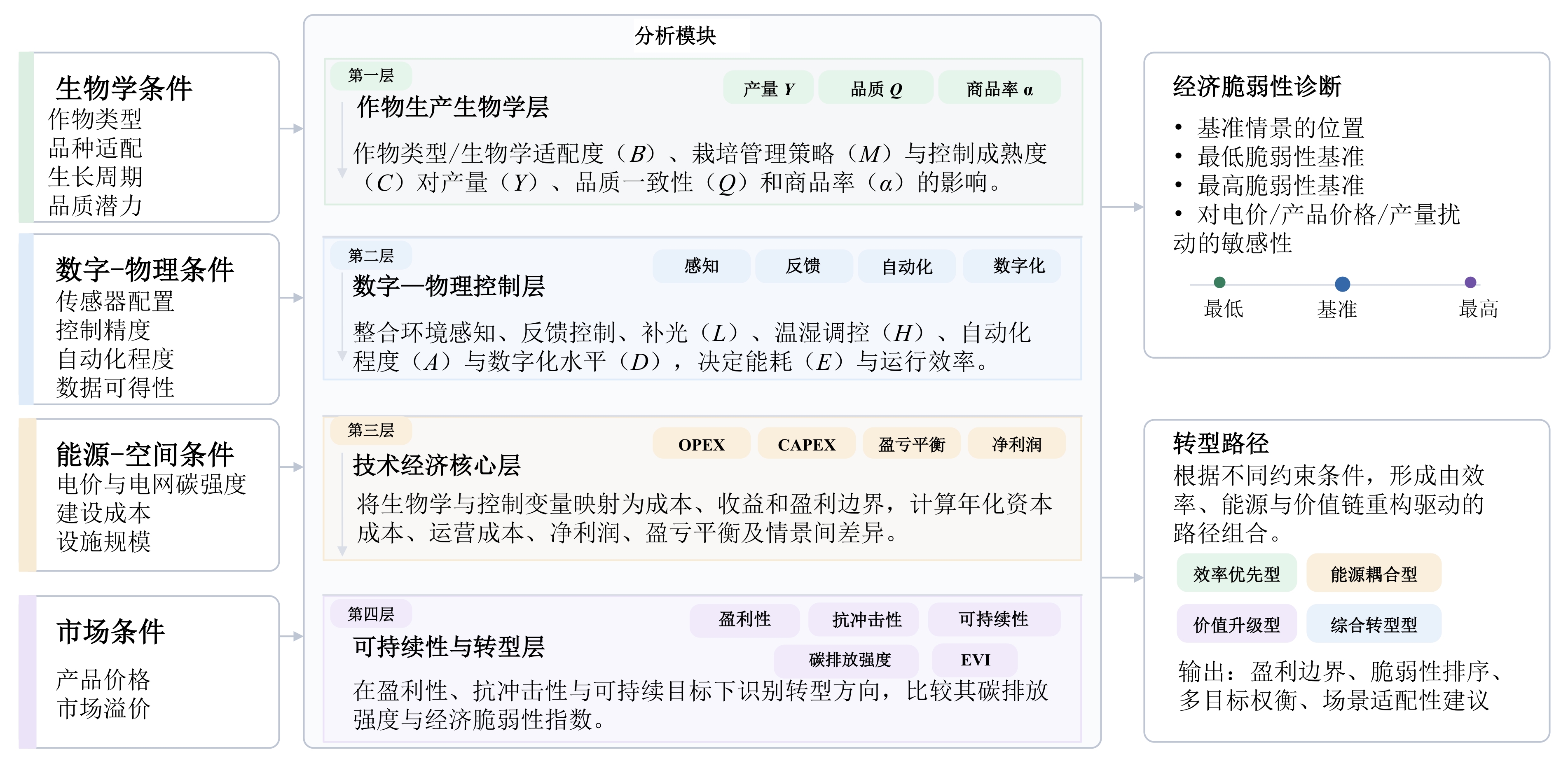
Table 1
Variable definitions and mapping relationships for economic vulnerability assessment of plant factories with artificial lighting
| 模块 | 核心变量 | 操作性定义 | 主要映射关系 | 植物工厂经济脆弱性诊断中的角色 |
|---|---|---|---|---|
| 生物学层 | , | 作物原型与栽培管理 | (1) | 决定毛产量上限 |
| 生物学层 | , | 商品率与品质一致性 | (2) | 将产品转化为商品 |
| 数字-物理控制层 | 控制成熟度 | 、 、 、 均为 的函数 | 连接控制升级与经济结果 | |
| 数字-物理控制层 | , , , | 补光、温湿调控、自动化和数字化 | (3) (4) | 决定能耗与劳动替代 |
| 技术经济层 | (元/m2), (%), (年), (%) | 单位资本性支出(capital expenditure, CAPEX)、贴现率、寿命期、维护率 | (5) (6) | 构成资本年化压力 |
| 技术经济层 | 元/kWh, (元/(人·年)), (元/kg), (元/kg) | 电价、工资、耗材与其他运营成本 | , , | 构成OPEX主体 |
| 技术经济层 | (元/kg), (元/kg), (元/(m2·年)) | 售价、单位成本、单位面积利润 | (7) (8) | 识别盈亏边界 |
| 脆弱性层 | , , | 盈利缺口、能源暴露度、碳约束暴露度 | (9) | 对情景稳健性排序 |
| 输出层 | TP | 转型路径类型 | 结果反馈 | 形成效率优先、能源耦合、价值升级和综合转型四类路径 |
Table 2
Parameter settings and description for the economic vulnerability model of plant factories with artificial lighting lettuce
| 参数 | 符号 | 取值 | 来源/说明 |
|---|---|---|---|
| 基础控制下毛产量/(kg/(m2·年)) | 80 | 介于元分析年化代理值(62.8)与先进商业值(115)之间 | |
| 控制成熟度对毛产量提升系数 | 0.437 5 | 使C=1时达到115 kg/(m2·年) | |
| 基础控制下商品率/% | 0.88 | 闭环智能情景提升至 0.95 | |
| 控制成熟度对商品率提升系数 | 0.07 | 模型设定,使C=1时达到0.95 | |
| 基础控制下单位商品电耗/(kWh/kg) | 12.0 | 位于公开文献当前区间内 | |
| 控制成熟度对单位商品电耗降低系数 | 0.30 | 使C=1时 kWh/kg | |
| 基准单位CAPEX/(元/m2) | 8 000 | 位于公开PFAL投资区间内部 | |
| 控制升级导致CAPEX增加系数 | 0.15 | 模型设定,反映自动化与控制升级成本 | |
| 贴现率/% | 5 | 沿用PFAL规模经济研究设定[ | |
| 寿命期/年 | 15 | 沿用PFAL规模经济研究设定[ | |
| 维护费率/% | 1.5 | 沿用PFAL规模经济研究设定[ | |
| 生产制造及有关人员平均工资/(元/(人·年)) | 78 561 | 国家统计局2024年数据 | |
| 基础人工需求系数/(人·年/m2) | 1/250 | 模型设定,人工成本核算 | |
| 基础自动化替代率 | 0.10 | 模型设定,人工替代基准 | |
| 控制成熟度对自动化提升系数 | 0.35 | 使C=1时β=0.45 | |
| 营养液、种子和卫生材料成本/(元/kg) | 1.6 | 模型设定 | |
| 其他可变运营成本 | 0.4元/kg | 模型设定 |
Table 3
Control-Energy-Market scenario combinations and value basis for PFAL lettuce
| 维度 | 符号 | 取值 | 含义 | 设定依据 |
|---|---|---|---|---|
| 控制成熟度 | C0 | 0.0 | 基础控制 | 规则控制 有限自动化 |
| 控制成熟度 | C1 | 0.5 | 增强控制 | 传感、执行与调度增强 |
| 控制成熟度 | C2 | 1.0 | 闭环智能 | 闭环调控 较高自动化 |
| 能源情景 | E1 | 元/kWh kg CO2/kWh | 能源富裕型 | 低碳低价电力锚点 |
| 能源情景 | E2 | 元/kWh; kg CO2/kWh | 常规电网型 | 全国平均电网碳因子锚点 |
| 能源情景 | E3 | 元/kWh; kg CO2/kWh | 高价高碳型 | 不利能源条件 |
| 市场情景 | M1 | 元/kg | 常规鲜食市场 | 官方周均蔬菜批发价上沿 |
| 市场情景 | M2 | 元/kg | 品牌溢价市场 | 中等价格阈值情景 |
| 市场情景 | M3 | 元/kg | 高值直供市场 | 高价格阈值情景 |
Table 4
Yield, cost, profit and carbon intensity under different control maturity levels in the E2+M3 Scenario
| 控制情景 | 毛产量 /(kg/(m2·年)) | 商品率 | 商品产量 /(kg/(m2·年)) | 单位商品电耗 /(kWh/kg) | (元/kg) 单位成本 / | 利润 /(元/(m2·年)) | 碳强度 /(kg CO2/kg) |
|---|---|---|---|---|---|---|---|
| 基础控制 | 80.0 | 0.880 | 70.40 | 12.0 | 27.67 | -258.36 | 6.37 |
| 增强控制 | 97.5 | 0.915 | 89.21 | 10.2 | 22.94 | 94.83 | 5.41 |
| 闭环智能 | 115.0 | 0.950 | 109.25 | 8.4 | 19.26 | 518.04 | 4.46 |
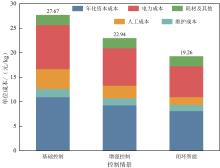
Fig. 2
Unit cost composition under different control scenarios for conventional grid-connected mode + high-value direct supply market
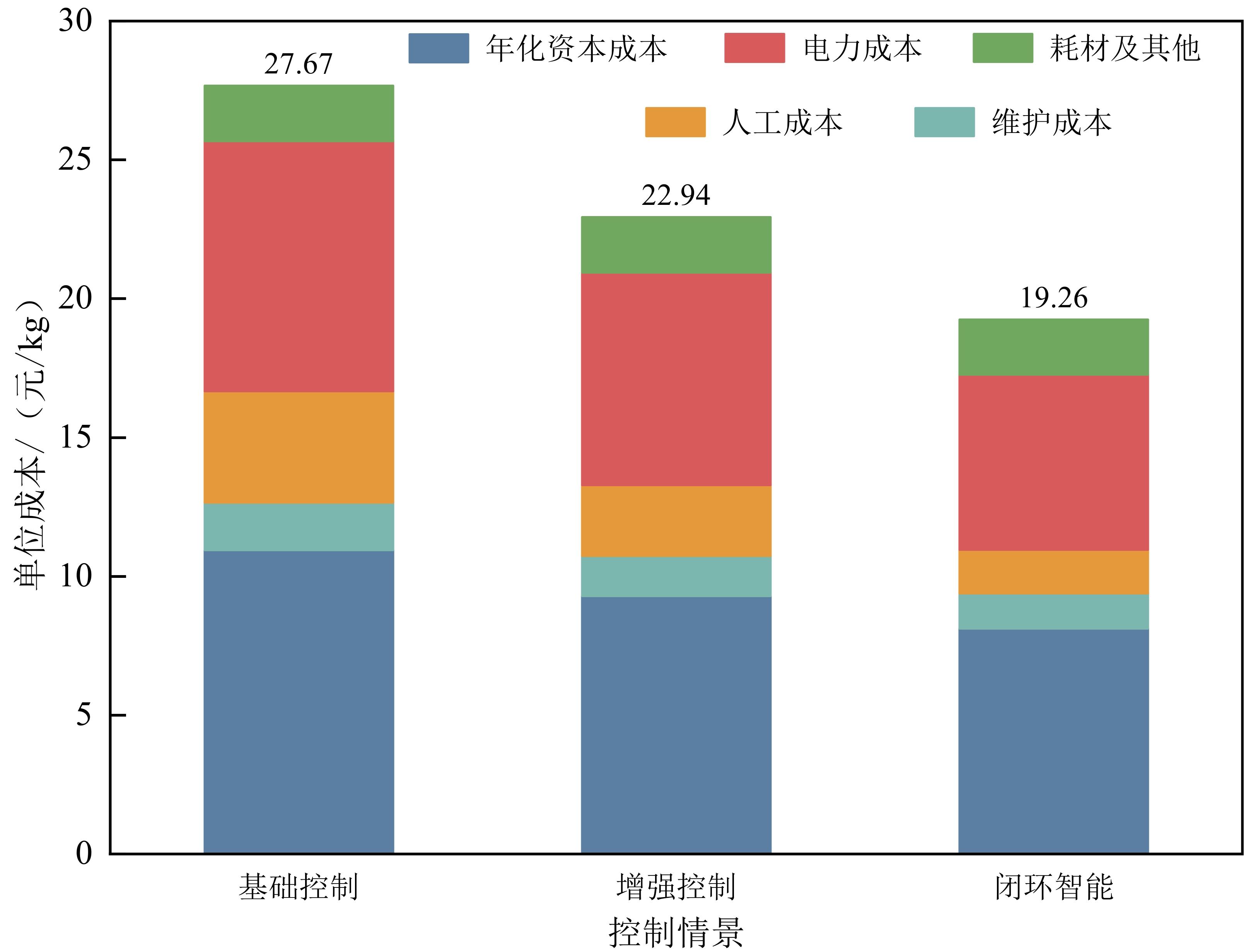
Fig. 3
Break-even price and electricity price boundary under different control maturity
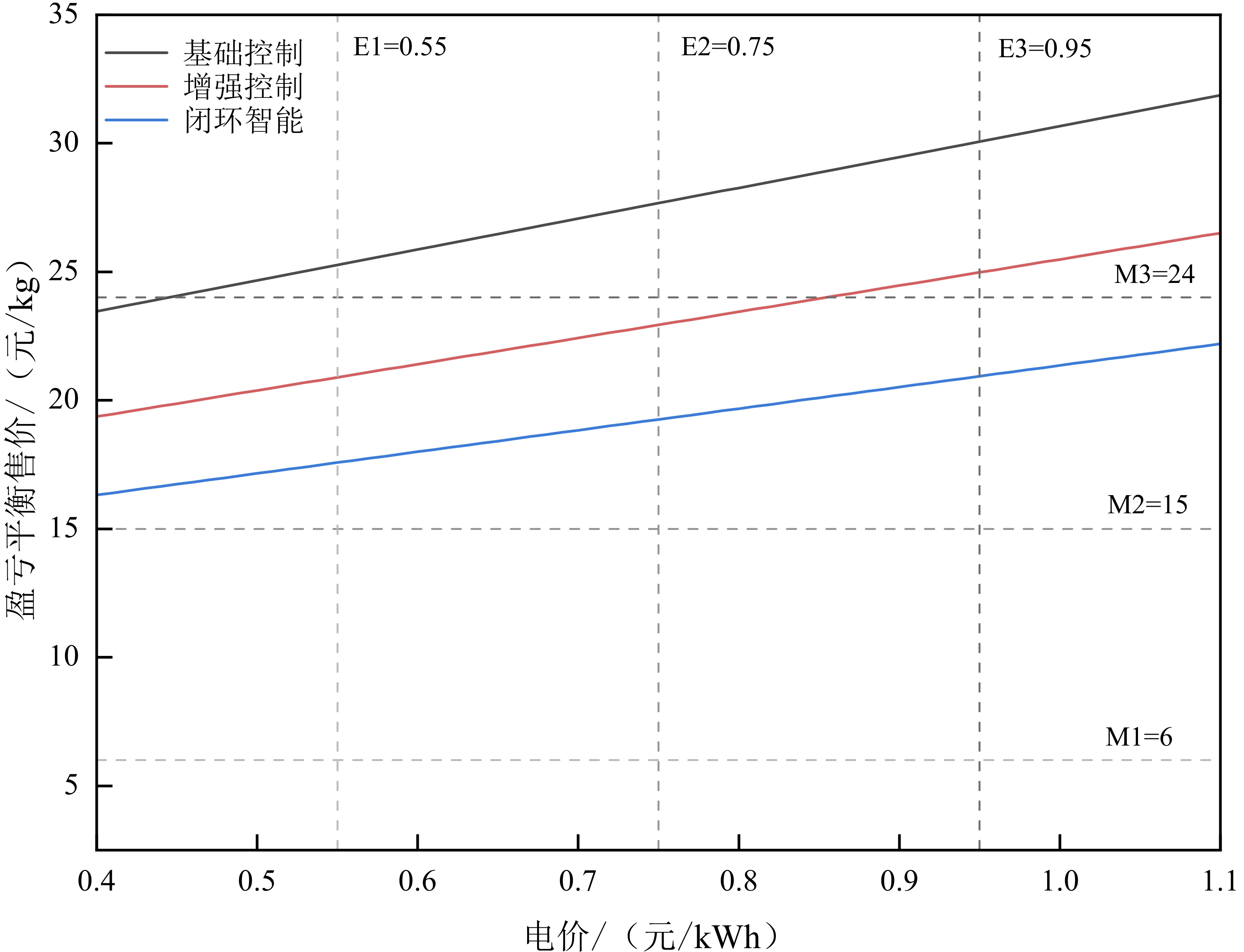
Fig. 4
Unit-area profit heat map for the 27 scenario combinations
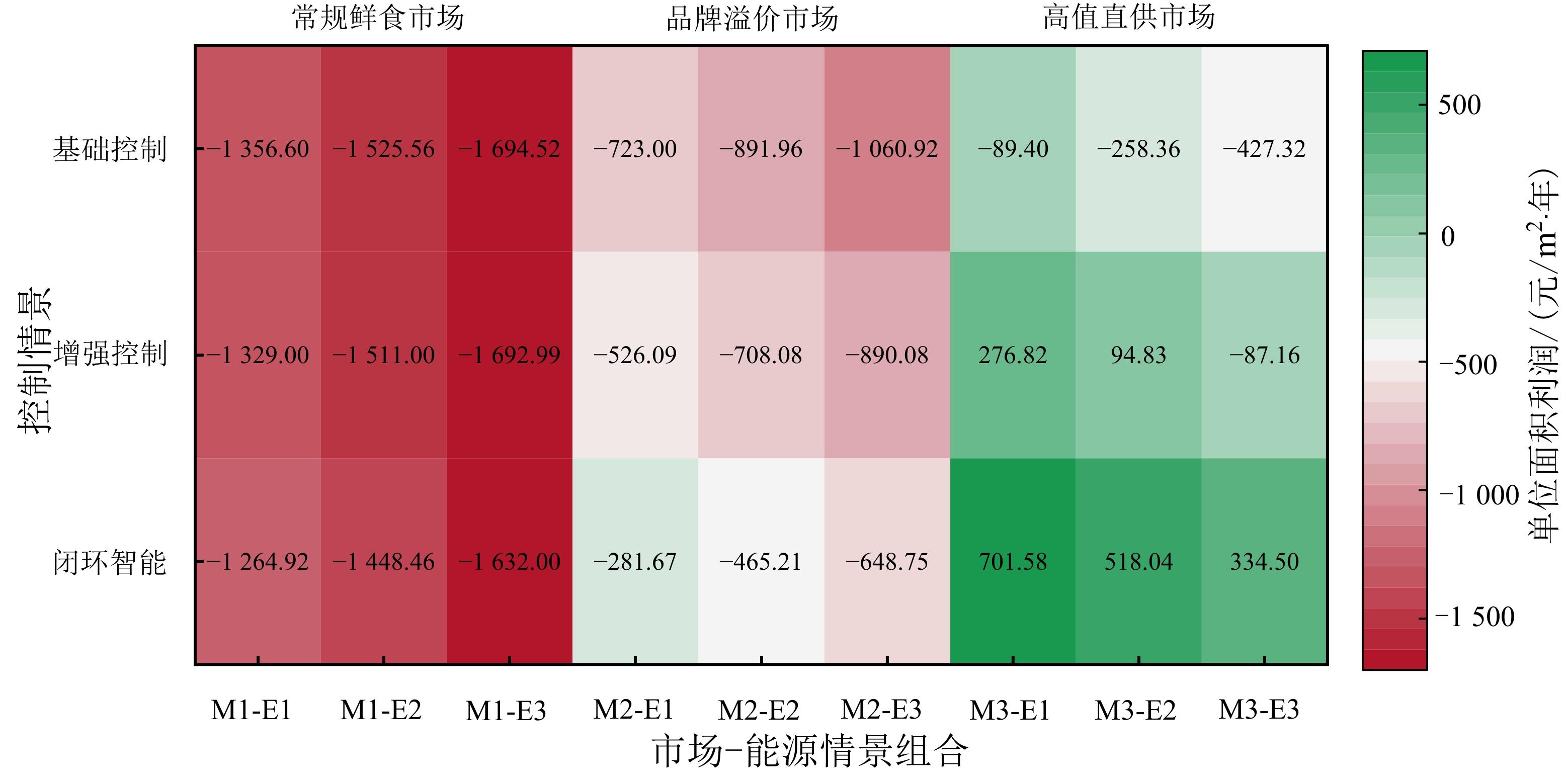
Fig. 5
Heat map of the EVI across combinations of control maturity, energy conditions, and market scenarios
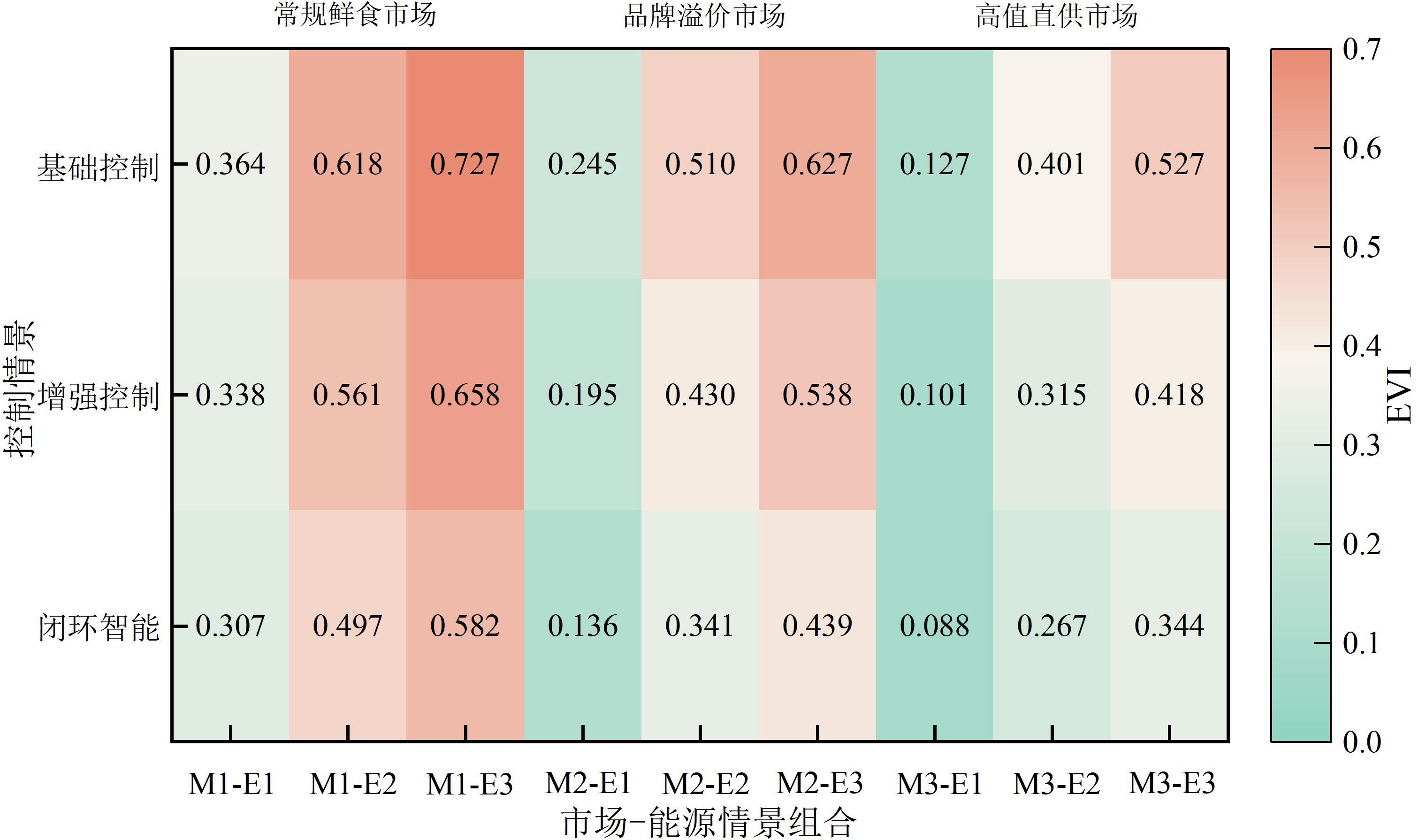
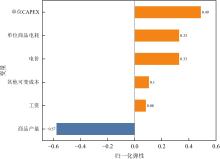
Fig. 6
Normalized local elasticities of unit cost for PFAL lettuce under the C2-E2-M3 scenario
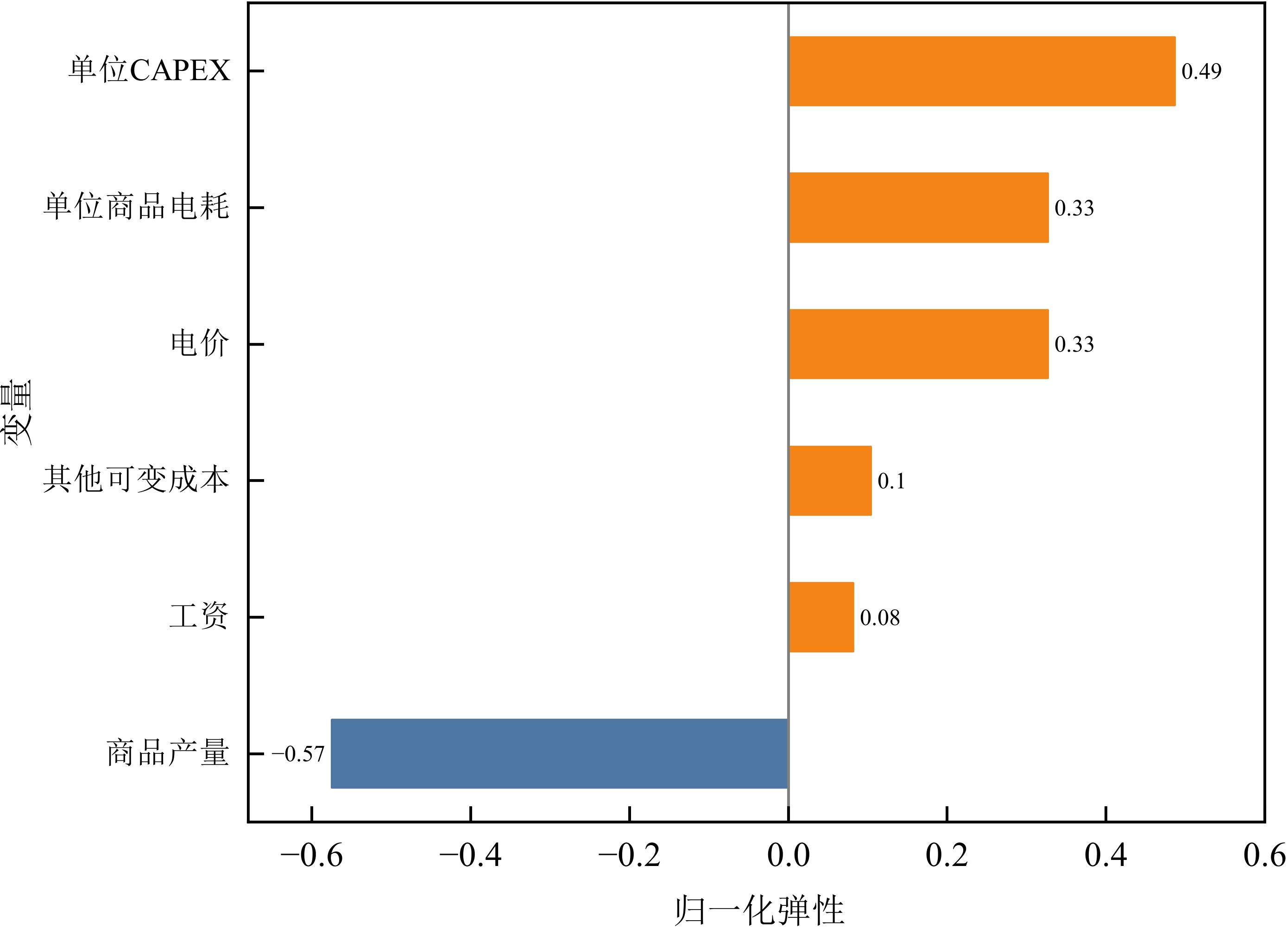
Table 5
Transformation path identification for plant factories with artificial lighting lettuce based on profit, EVI and local elasticity
| 典型情景 | 结果特征 | 主导约束 | 对应路径 | 优先措施 |
|---|---|---|---|---|
| 增强控制+常规电网型+高值直供市场 | 利润已转正但边际有限,EVI中等 | 商品产量、资本强度 | 效率优先型 | 提高商品率、降低单位CAPEX、优化作业节拍 |
| 闭环智能+高价高碳型+高值直供市场 | 利润为正但能源暴露度和碳约束暴露度偏高 | 电价、电网碳因子 | 能源耦合型 | 分时电价响应、绿电采购、储能或源网荷储协同 |
| 闭环智能+任意能源+品牌/常规市场 | 技术成熟但售价不足以覆盖总成本 | 市场实现 | 价值升级型 | 品牌化、净菜化、活体供应、合同直供 |
| 基础控制+常规鲜食市场+常规/高价高碳电网 | 利润和EVI均处于不利区间 | 控制、能源、市场三重约束 | 综合转型型 | 同步升级控制、能源获取与销售模式 |
Table 6
Effects of policy support and channel cost on profits under the E2+M3 representative scenario
| 扩展情景 | 基础控制C0/(元/(m2·年)) | 增强控制C1/(元/(m2·年)) | 闭环智能C2/(元/(m2·年)) |
|---|---|---|---|
| 基准情景 | -258.36 | 94.83 | 518.04 |
| 投资补贴20% | -104.21 | 260.54 | 695.31 |
| 电价优惠20% | -131.64 | 231.32 | 655.70 |
| 投资补贴20%+电价优惠20% | 22.51 | 397.03 | 832.97 |
| 渠道成本增加1元/kg | -328.76 | 5.62 | 408.79 |
| 渠道成本增加2元/kg | -399.16 | -83.60 | 299.54 |
| 渠道成本增加3元/kg | -469.56 | -172.81 | 190.29 |
| 投资补贴20%+电价优惠20%+渠道成本增加1元/kg | -47.89 | 307.82 | 723.72 |
Table 7
Typical PFAL cases in China and their correspondence with model pathways
| 案例 | 公开资料显示的主要特征 | 对应模型路径 | 对本研究结论的启示 |
|---|---|---|---|
| 京东植物工厂 | 自有品牌“京觅”;线上京东生鲜与线下七鲜销售;冷链覆盖区域市场;年产量约300 t;强调安全、标准化和渠道能力 | 价值升级型;综合转型型 | 高值直供市场需要品牌、冷链、销售渠道和终端信任支撑;高价格情景不能只看售价,也要计入渠道成本 |
| 中科三安植物工厂 | LED光谱、环境控制和智能装备;叶菜、药用植物、茄果类等多品类布局;规模化产业基地;生产周期缩短 | 效率优先型;能源耦合型 | 控制升级和规模化可提高单位面积产出,但同时带来资本强度和能源依赖,需与能源条件和高附加值作物组合协同 |
Appendix
Table 1 Robustness under ±10% perturbations of key mapping coefficients
| 扰动对象 | 扰动幅度 | 正利润情景数 | 最佳EVI情景 | 最差EVI情景 | 最高利润情景 |
|---|---|---|---|---|---|
| -10% | 5 | C2-E1-M3 | C0-E3-M1 | C2-E1-M3 | |
| 10% | 5 | C2-E1-M3 | C0-E3-M1 | C2-E1-M3 | |
| -10% | 5 | C2-E1-M3 | C0-E3-M1 | C2-E1-M3 | |
| 10% | 5 | C2-E1-M3 | C0-E3-M1 | C2-E1-M3 | |
| -10% | 5 | C2-E1-M3 | C0-E3-M1 | C2-E1-M3 | |
| 10% | 5 | C2-E1-M3 | C0-E3-M1 | C2-E1-M3 | |
| -10% | 5 | C2-E1-M3 | C0-E3-M1 | C2-E1-M3 | |
| 10% | 5 | C2-E1-M3 | C0-E3-M1 | C2-E1-M3 | |
| -10% | 5 | C2-E1-M3 | C0-E3-M1 | C2-E1-M3 | |
| 10% | 5 | C2-E1-M3 | C0-E3-M1 | C2-E1-M3 |
Appendix
Table 2 Main computational results under 27 scenario combinations
| 情景 | ||||||||||
|---|---|---|---|---|---|---|---|---|---|---|
| C0-E1-M1 | 70.4 | 12.0 | 25.27 | -1 356.60 | -1.06 | 1.60 | 0.763 | 0.261 | 0.068 | 0.364 |
| C0-E1-M2 | 70.4 | 12.0 | 25.27 | -723.00 | -0.31 | 1.60 | 0.406 | 0.261 | 0.068 | 0.245 |
| C0-E1-M3 | 70.4 | 12.0 | 25.27 | -89.40 | 0.44 | 1.60 | 0.050 | 0.261 | 0.068 | 0.127 |
| C0-E2-M1 | 70.4 | 12.0 | 27.67 | -1 525.56 | -1.06 | 6.37 | 0.783 | 0.325 | 0.746 | 0.618 |
| C0-E2-M2 | 70.4 | 12.0 | 27.67 | -891.96 | -0.31 | 6.37 | 0.458 | 0.325 | 0.746 | 0.510 |
| C0-E2-M3 | 70.4 | 12.0 | 27.67 | -258.36 | 0.44 | 6.37 | 0.133 | 0.325 | 0.746 | 0.401 |
| C0-E3-M1 | 70.4 | 12.0 | 30.07 | -1 694.52 | -1.06 | 8.16 | 0.800 | 0.379 | 1.000 | 0.727 |
| C0-E3-M2 | 70.4 | 12.0 | 30.07 | -1 060.92 | -0.31 | 8.16 | 0.501 | 0.379 | 1.000 | 0.627 |
| C0-E3-M3 | 70.4 | 12.0 | 30.07 | -427.32 | 0.44 | 8.16 | 0.202 | 0.379 | 1.000 | 0.527 |
| C1-E1-M1 | 89.21 | 10.2 | 20.9 | -1 329.00 | -0.91 | 1.36 | 0.713 | 0.268 | 0.034 | 0.338 |
| C1-E1-M2 | 89.21 | 10.2 | 20.9 | -526.09 | -0.03 | 1.36 | 0.282 | 0.268 | 0.034 | 0.195 |
| C1-E1-M3 | 89.21 | 10.2 | 20.9 | 276.82 | 0.85 | 1.36 | 0.00 | 0.268 | 0.034 | 0.101 |
| C1-E2-M1 | 89.21 | 10.2 | 22.94 | -1 511.00 | -0.91 | 5.41 | 0.738 | 0.334 | 0.610 | 0.561 |
| C1-E2-M2 | 89.21 | 10.2 | 22.94 | -708.08 | -0.03 | 5.41 | 0.346 | 0.334 | 0.610 | 0.43 |
| C1-E2-M3 | 89.21 | 10.2 | 22.94 | 94.83 | 0.85 | 5.41 | 0.000 | 0.334 | 0.610 | 0.315 |
| C1-E3-M1 | 89.21 | 10.2 | 24.98 | -1 692.99 | -0.91 | 6.93 | 0.760 | 0.388 | 0.826 | 0.658 |
| C1-E3-M2 | 89.21 | 10.2 | 24.98 | -890.08 | -0.03 | 6.93 | 0.399 | 0.388 | 0.826 | 0.538 |
| C1-E3-M3 | 89.21 | 10.2 | 24.98 | -87.16 | 0.85 | 6.93 | 0.039 | 0.388 | 0.826 | 0.418 |
| C2-E1-M1 | 109.25 | 8.4 | 17.58 | -1 264.92 | -0.83 | 1.12 | 0.659 | 0.263 | 0.000 | 0.307 |
| C2-E1-M2 | 109.25 | 8.4 | 17.58 | -281.67 | 0.24 | 1.12 | 0.147 | 0.263 | 0.000 | 0.136 |
| C2-E1-M3 | 109.25 | 8.4 | 17.58 | 701.58 | 1.31 | 1.12 | 0.000 | 0.263 | 0.000 | 0.088 |
| C2-E2-M1 | 109.25 | 8.4 | 19.26 | -1 448.46 | -0.83 | 4.46 | 0.688 | 0.327 | 0.474 | 0.497 |
| C2-E2-M2 | 109.25 | 8.4 | 19.26 | -465.21 | 0.24 | 4.46 | 0.221 | 0.327 | 0.474 | 0.341 |
| C2-E2-M3 | 109.25 | 8.4 | 19.26 | 518.04 | 1.31 | 4.46 | 0.000 | 0.327 | 0.474 | 0.267 |
| C2-E3-M1 | 109.25 | 8.4 | 20.94 | -1 632.00 | -0.83 | 5.71 | 0.713 | 0.381 | 0.652 | 0.582 |
| C2-E3-M2 | 109.25 | 8.4 | 20.94 | -648.75 | 0.24 | 5.71 | 0.284 | 0.381 | 0.652 | 0.439 |
| C2-E3-M3 | 109.25 | 8.4 | 20.94 | 334.50 | 1.31 | 5.71 | 0.000 | 0.381 | 0.652 | 0.344 |
Appendix Table 3
Robustness test of EVI weighting schemes
| 权重方案 | 权重设置( , , ) | 最佳情景 | 最差情景 | 前5重合数 | 后5重合数 | Spearman | Kendall |
|---|---|---|---|---|---|---|---|
| 等权重 | 0.333, 0.333, 0.333 | C2-E1-M3 | C0-E3-M1 | 5 | 5 | 1.000 | 1.000 |
| 盈利缺口加权 | 0.500, 0.250, 0.250 | C2-E1-M3 | C0-E3-M1 | 4 | 4 | 0.944 | 0.829 |
| 能源暴露加权 | 0.250, 0.500, 0.250 | C2-E1-M3 | C0-E3-M1 | 5 | 5 | 0.999 | 0.989 |
| 碳约束加权 | 0.250, 0.250, 0.500 | C2-E1-M3 | C0-E3-M1 | 5 | 4 | 0.976 | 0.886 |
| 剔除 | 0.000, 0.500, 0.500 | C2-E1-M1/M2/M3并列 | C0-E3-M1 | 3 | 3 | 0.842 | 0.682 |
| 剔除 | 0.500, 0.000, 0.500 | C2-E1-M3 | C0-E3-M1 | 5 | 5 | 0.991 | 0.943 |
| 剔除 | 0.500, 0.500, 0.000 | C2-E1-M3 | C0-E3-M1 | 3 | 4 | 0.782 | 0.647 |
| [1] |
|
| [2] |
|
| [3] |
|
| [4] |
|
| [5] |
|
| [6] |
|
| [7] |
|
| [8] |
|
| [9] |
|
| [10] |
|
| [11] |
|
| [12] |
王剑, 赵浩森, 马越, 等. 设施蔬菜智能管控技术研究进展与展望[J]. 智慧农业(中英文), 2026, 8(1): 104-119.
|
|
|
|
| [13] |
王鹏, 曾固, 熊姜玲, 等. 植物工厂中光质对高品质蔬菜生产的影响研究进展[J]. 安徽农学通报, 2021, 27(23): 24-29, 35.
|
|
|
|
| [14] |
|
| [15] |
|
| [16] |
|
| [17] |
|
| [18] |
|
| [19] |
|
| [20] |
|
| [21] |
|
| [22] |
|
| [23] |
|
| [24] |
|
| [25] |
|
| [26] |
|
| [27] |
|
| [28] |
|
| [29] |
|
| [30] |
|
| [31] |
|
| [32] |
|
| [33] |
|
| [34] |
|
| [35] |
|
| [36] |
|
| [37] |
|
| [38] |
|
| [39] |
杨其长, 白音巴特尔, 程瑞锋. 智慧植物工厂发展历程及展望[J]. 农业工程学报, 2026, 42(3): 97-106.
|
|
|
|
| [40] |
程方平, 杨昌敏, 梅林森, 等. 我国植物工厂技术装备研究进展[J]. 农业工程, 2025, 15(2): 67-73.
|
|
|
|
| [41] |
余洋. 智能植物工厂控制系统研究与优化[D]. 杭州: 浙江大学, 2021.
|
| [42] |
2024年城镇单位就业人员年平均工资情况[EB/OL]. 国家统计局, (2025-05-14 )[2026-05-22].
|
| [43] |
2025 年第 19 周国内外农产品市场动态[EB/OL]. 农业农村部市场与信息化司, (2025-05-12) [2026-05-21].
|
| [44] |
2025 年第 51 周国内外农产品市场动态[EB/OL]. 农业农村部市场与信息化司, (2025-12-24) [2026-05-21].
|
| [45] |
关于发布2023年电力二氧化碳排放因子的公告[EB/OL]. 生态环境部, 国家统计局, (2025-12-31) [2026-05-21].
|
| [46] |
国际种业 10周年】探秘通州神奇植物工场:京东全资打造,长在床上的蔬菜长啥样?[EB/OL]. 北京市通州区人民政府, (2021-11-12) [2026-05-22].
|
| [47] |
北京通州: 神奇的植物工厂[EB/OL]. 北京市农业农村局, (2022-06-17) [2026-05-22].
|
| [48] |
全球首座无人植物工厂探秘[EB/OL]. 福建省人民政府, (2023-06-18) [2026-05-22].
|
| [49] |
【中国科学报】沙漠里的蔬菜“绿洲”[EB/OL]. 中国科学院, (2021-11-03) [2026-05-22].
|
| [50] |
李宗耕, 周成波, 胡江涛, 等. 人工光植物工厂节能技术研究进展[J]. 照明工程学报, 2024, 35(5): 41-46.
|
|
|
|
| [51] |
OECD,
|
| [52] |
|
| [53] |
|
| [54] |
|
| [55] |
|
| [56] |
|
| [57] |
|
| [58] |
|
| [59] |
|
| [60] |
|
| [61] |
|
| [62] |
|
| [63] |
|
| [64] |
|
| [65] |
|
| [1] | FANG Hongwei, HU Ranran, REZIYAN· Wakasi. Construction of A Comprehensive Evaluation System, Practice Pattern, and Driving Mechanism for Smart Agriculture Development [J]. Smart Agriculture, 2026, 8(3): 26-39. |
| Viewed | ||||||
|
Full text |
|
|||||
|
Abstract |
|
|||||