Smart Agriculture ›› 2026, Vol. 8 ›› Issue (1): 120-147.doi: 10.12133/j.smartag.SA202507028
• Overview Article • Previous Articles Next Articles
DAI Weijiao1( ), LIANG Yudongchen1(), ZHOU Yong2, YAO Chao1, ZHANG Cheng1,3, SONG Yongjian4, LI Guoliang1, TIAN Fang1,3()
Received:2025-07-28
Online:2026-01-30
Foundation items:甘肃省现代农业产业技术体系建设专项(GSARS02)
About author:梁禹东辰,硕士研究生,研究方向为计算机视觉。E-mail:YudongchenLiang@webmail.hzau.edu.cn LIANG Yudongchen, E-mail: YudongchenLiang@webmail.hzau.edu.cn.
corresponding author:
CLC Number:
DAI Weijiao, LIANG Yudongchen, ZHOU Yong, YAO Chao, ZHANG Cheng, SONG Yongjian, LI Guoliang, TIAN Fang. Advances and Prospects in Body-Size Measurement of Sheep: From 2D Vision to 3D Reconstruction and 2D-3D Fusion[J]. Smart Agriculture, 2026, 8(1): 120-147.
Add to citation manager EndNote|Ris|BibTeX
URL: https://www.smartag.net.cn/EN/10.12133/j.smartag.SA202507028
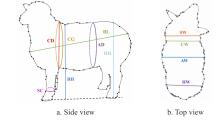
Fig. 1
Sheep body measurement diagram Note: BL denotes body length; BH denotes body height; CD denotes chest depth; CG denotes chest girth; AD denotes abdominal dimension; HH denotes hip height; SC denotes shank circumference; SW denotes shoulder width; CW denotes chest width; AW denotes abdominal width; HW denotes hip width.
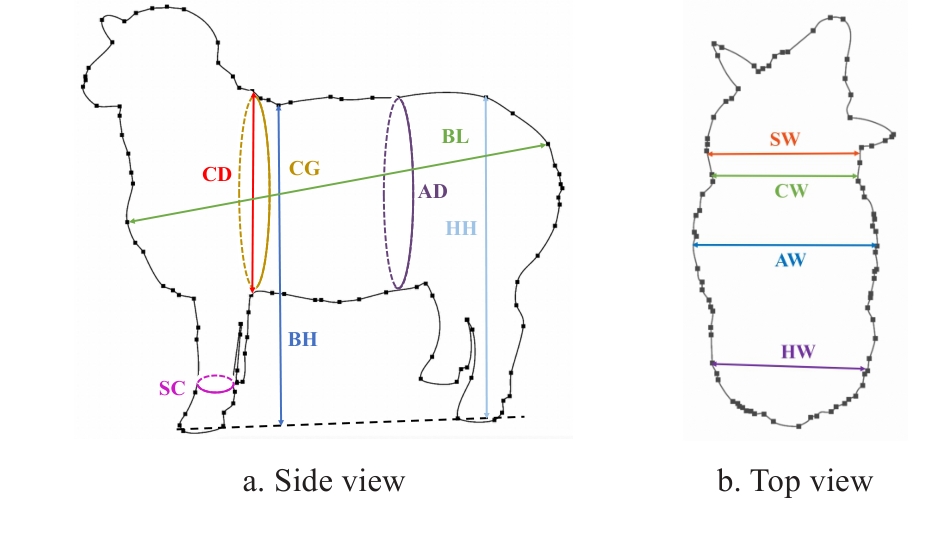
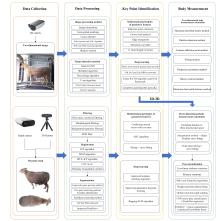
Fig. 2
Overview diagram of sheep body measurement techniques Note: SLIC denotes simple linear iterative clustering; R-CNN denotes region-based convolutional neural network; ICP denotes iterative closest point; SLAC denotes simultaneous localization and calibration; Lite-HRNet denotes lite high-resolution network; SIFT denotes scale-invariant feature transform; SVM denotes support vector machine. ROR denotes radius outlier removal; ISS3D denotes intrinsic shape signatures 3D; 4PCS denotes 4-points congruent sets; KCGATNet denotes kernel-based channel graph attention transformer network.

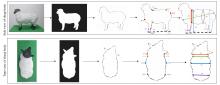
Fig. 3
2D image sheep body measurement process a. Raw image b. Background denoising c. Contour extraction d. Key point identification e. Body measurement


Table 1
image-based body size measurement methods: applications in sheep and reference cases in livestock
| Subjects | Camera setup | Image algorithms | Individual number | Traits & accuracy | Main limitations | Year | Work |
|---|---|---|---|---|---|---|---|
| Sheep | Logitech C920 hdpro webcam | Partial least squares algorithm | 27 | BL: 3.5%; BH: 3.5%; CD: 3.5% | Colour-contrast sensitive | 2014 | [ |
| Sheep | CCD wide-angle camera | Background difference method | NA | BL: 2%; BH: 2% | Cluttered background leaks | 2014 | [ |
| Sheep | MV-EM120C | SLIC + FCM clustering | 27 | BL: 2.03%; BH: 1.13%; CD: 4.45%; CW: 2.25%; HH: 1.54%; HW: 2.41% | Cluster number must be tuned | 2018 | [ |
| Pig | Kinect v1 (RGB) | Semi-global matching + image subtraction | 200 | BL, BH, HH, HW, SW: < 2.83 % | Depth not used; Lighting sensitive | 2019 | [ |
| Cow | Single RGB | Canny algorithm | NA | BL: 0.06%; BH: 2.28% | Edge gaps need manual repair | 2020 | [ |
| Yak | Single RGB | Sobel operator + SLIC | 33 | BH: 1.95%; BL: 3.11%; CD: 4.91% | K-value manually tuned | 2021 | [ |
| Cattle | Azure Kinect DK | Shadow aberration method + Watershed segmentation | 34 | BL: 2.7 cm; BH: 2.07 cm; AW: 1.47 cm | High-contrast uniform background required | 2022 | [ |
| Sheep | Single RGB | PreciseEdge | 75 | BL: r=0.943; BH: r=0.931; CG: r=0.893 | High-contrast uniform background required | 2022 | [ |
| Sheep, Cattle | Intel RealSense D415 | U-Net | 55 | BL: 2.42 %; BH: 1.86 %; HH: 2.07 %; CD: 2.72 % | Heavy model, embedded-unfriendly | 2022 | [ |
| Cattle | Hikvision RGB | SOLOv2 | 200 | BL: 1.36 %; BH: 0.44 %; CD: 2.05 %; CW: 2.80 % | Extreme-pose drift | 2022 | [ |
| Cattle | Smartphone RGB | YOLOv5s+Lite-HRNet | 30 | BL: 7.55%; BH: 6.75%; CD: 8.00%; SC: 8.97% | Key-point occlusion drift | 2024 | [ |
| Cattle | RealSense D455 | Improved Mask2former | 137 | BH: 4.32%; HH: 3.71%; BL: 5.58%; SC: 6.25% | High posture sensitivity, large errors in girth measurements | 2024 | [ |
Table 2
Comparison of geometric feature extraction methods for sheep body size measurement
| Subjects | Method | Principle | Time complexity | Advantage | Disadvantage | Work |
|---|---|---|---|---|---|---|
| Sheep | Corner (inflection-point) detection | Compute curvature or angle discontinuities along the contour | O(n) | Very fast; accurate localization | Noise-sensitive | [ |
| Sheep | Convex-hull analysis | Compute the convex hull of a point set and retain its vertices | O(n log n) | Parameter-free; fast execution | Keeps only "most convex" points; loses concavities | [ |
| Sheep | Edge detection | Detect gray-level discontinuities via gradient/entropy/filtering | O(n) | Highly general-purpose | Fragile edges; post-processing required | [ |
| Sheep | Maximum-curvature extraction | Locate curvature extrema along the edge | O(n) | Mathematically well-defined | Requires smoothing; prone to burrs | [ |
| Sheep | Region-based U-chord curvature | Compute curvature with a fixed-chord sliding window | O(n) | Balances local & global shape | Extra chord-length parameter to tune | [ |
Table 3
Comparison of deep learning-based keypoint detection methods for sheep and related livestock body size measurement
| Subjects | Method | Principle | Advantage | Disadvantage | Work |
|---|---|---|---|---|---|
| Sheep, Cattle | Multi-stage dense hourglass | Multi-scale fusion with iterative up/down-sampling for end-to-end key-point detection | Highest localization accuracy and strong robustness to pose and coat variations | Large parameter count, high GPU memory usage, slow inference speed | [ |
| Cattle | YOLOv5s +Lite high-resolution network(Lite-HRNet) | YOLOv5s proposes regions; Lite-HRNet refines keypoints | Excellent speed-accuracy trade-off, lightweight design, and suitable for edge deployment | Relies on detection box quality; key points tend to drift under dense occlusion | [ |
| Pig | Faster R-CNN +Neural Architecture Search (NAS) | Faster R-CNN defines the search region; NAS refines the keypoints | High detection accuracy and strong generalizability | Slowest inference speed, difficult to meet real-time requirements, and long training and hyper-parameter tuning cycles | [ |
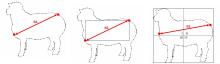
Fig. 4
Body length measurement methods of sheep a. Overall contour point selection method b. Maximum inscribed matrix method c. Zone detection method
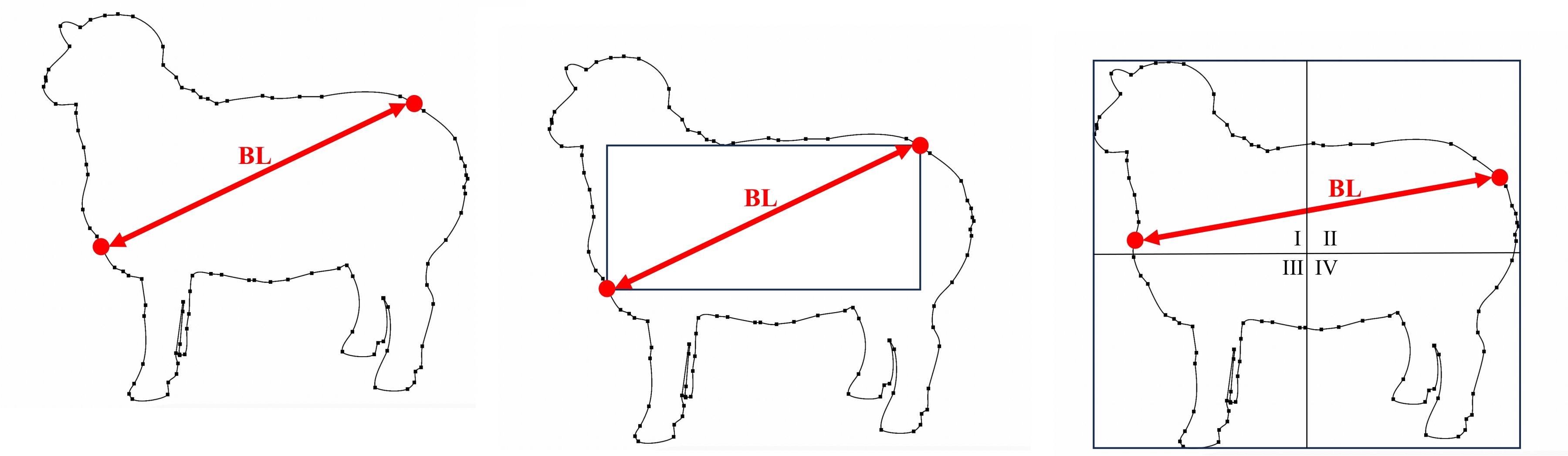
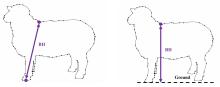
Fig. 5
Body height measurement method of sheep a. Withers-to-left-fore-hoof connecting method b. Perpendicular distance from the withers point to the line connecting the fore and hind hooves
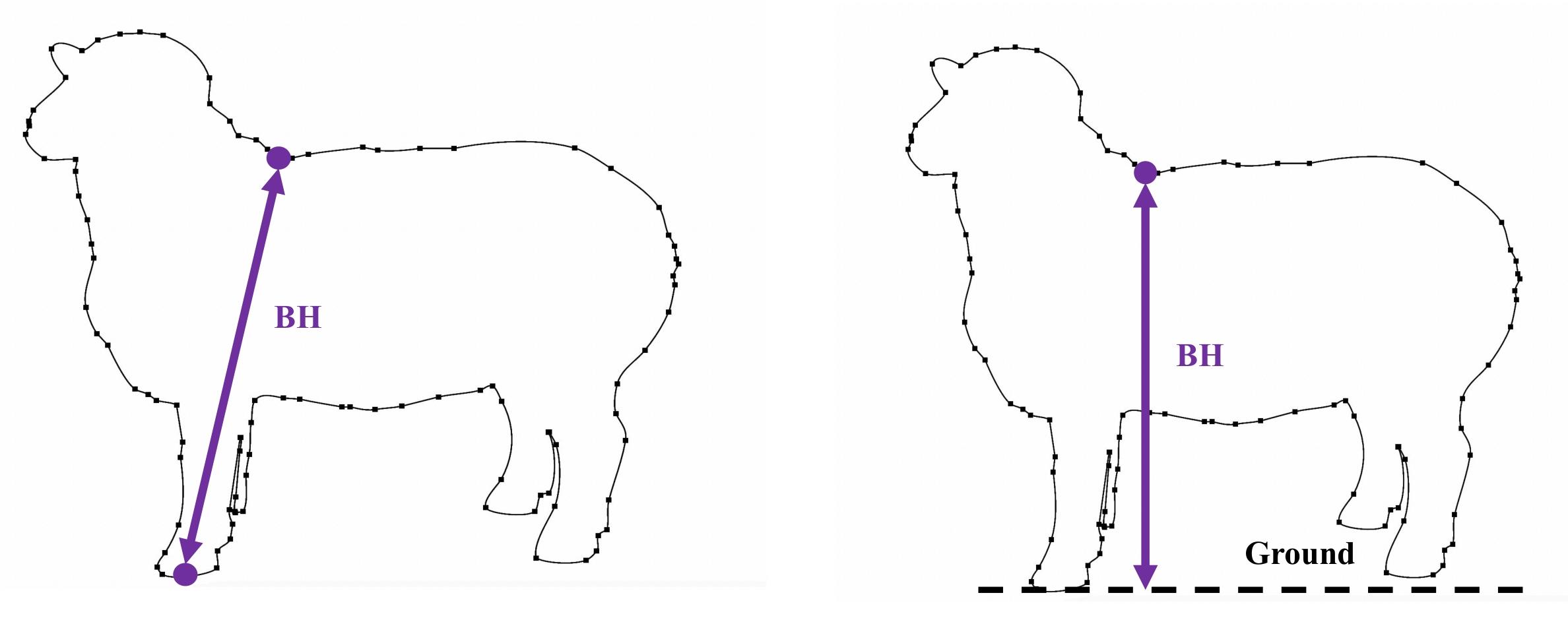
Fig. 6
Hip height measurement method of sheep a. Projection calculation method b. Vertical distance from hip-height point to the hoof line
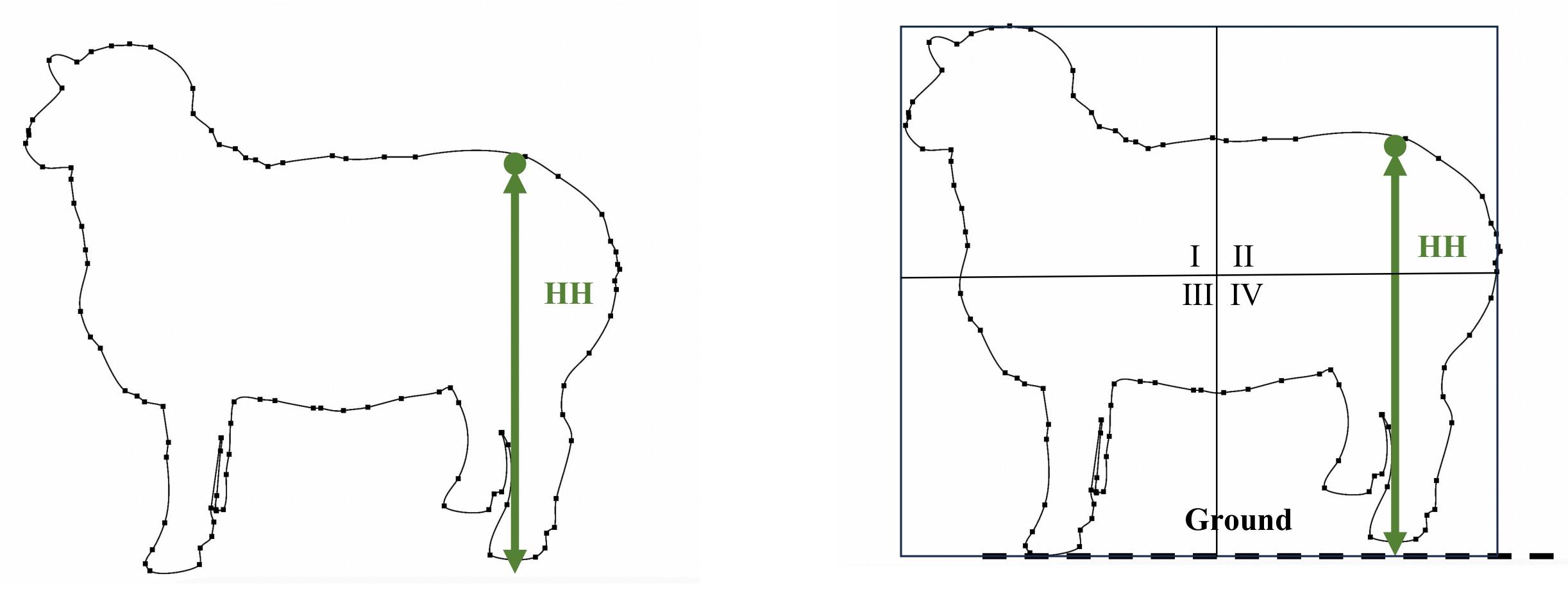
Fig. 7
Chest width measurement methods of sheep a. Contour inflection point calculation method b. Binary centroid method c. Horizontal distance maximum method
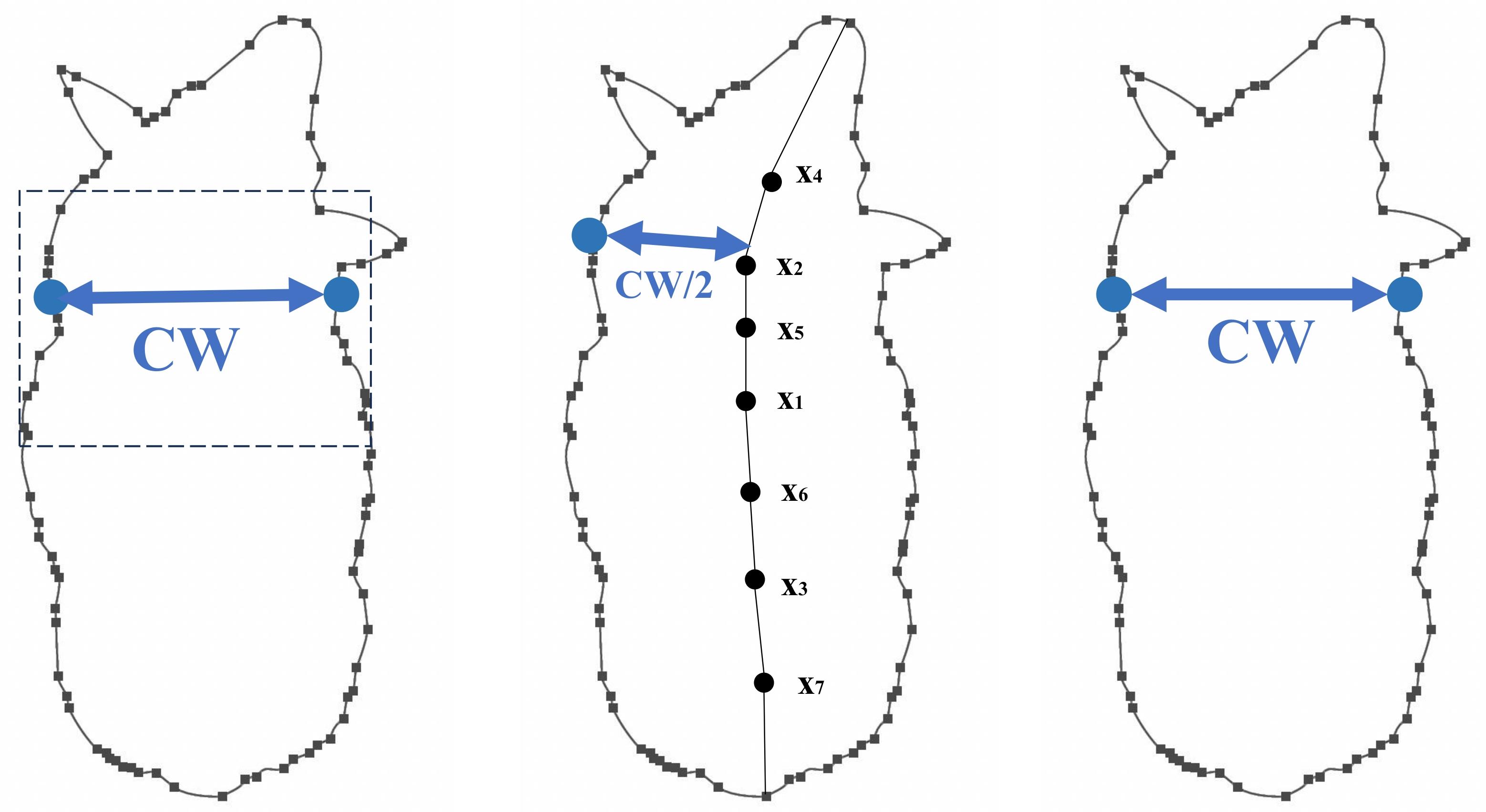
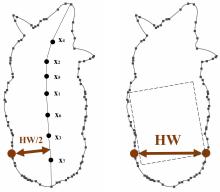
Fig. 8
Hip width measurement methods of sheep a. Binary centroid method b. Maximum inscribed rectangle method
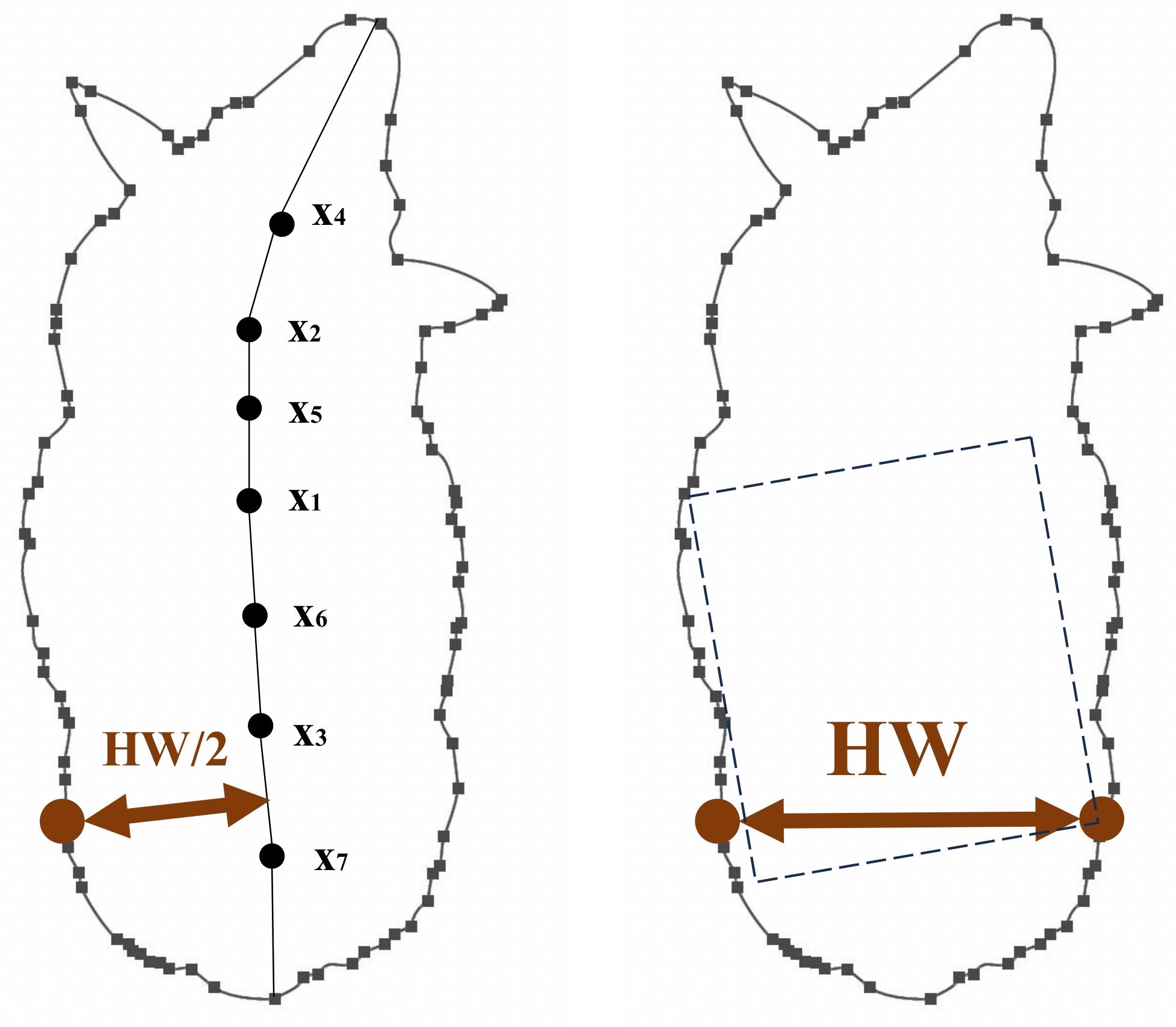
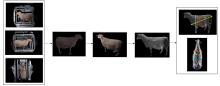
Fig. 9
Three-dimensional point cloud body size measurement process of sheep a. Original point cloud b. Filtering c. Registration d. Point cloud simplification e. Body size measurement

Table 4
Comparison of 3D point cloud methods for sheep and related livestock body size measurement
| Subjects | Camera type | Algorithms | Animal Numbers | Body traits & accuracy | Year | Work |
|---|---|---|---|---|---|---|
| Sheep | REVscan_3D | Octary tree+ Delaunay triangulation | 1 | BL / BH / CW / HH / HW: 1.01 % | 2019 | [ |
| Cow | Binocular Vision | Scale-invariant feature transform(SIFT) Algorithms | 20 | BL:1.14%; BH:1.57%; SW:2.24% | 2020 | [ |
| Sheep | TOF 3D camera | Principal component analysis Random sampling consistency algorithm Improved regional growth method | 1 | BL / BH / CD / HH: 2.36 % | 2020 | [ |
| Cattle | Kinect v2 | Background subtraction, ROR Algorithms, Iterative Closest Point (ICP), ISS3D | 103 | BL / BH / CD / HH: <3 % | 2020 | [ |
| Pig | Intel RealSense D720 | Depthwise Separable Convolution | 239 | BL: 0.75 cm; HW: 0.38 cm; BH: 1.23 cm; SW: 0.33 cm; HH: 0.66 cm | 2021 | [ |
| Cattle | Kinect DK | Five-point clustering gradient boundary recognition algorithm | 10 | BL: 2.3%; BH: 2.8%; CG: 2.6%; AD: 2.8%; SW: 1.6% | 2022 | [ |
| Pig | Kinect v2 | Variance classification algorithms | 50 | BL: 0.7%; BH: 1.8%; SW: 3.3% | 2022 | [ |
| Pig | RealSense L515 | DeepLabCut+EfficientNet-b6 | 12 | BL / BH / HH / HW / SW: 1.79 cm | 2023 | [ |
| Pig | NA | Improved PointNet++ | 25 | BL: 2.57%; BH: 2.18%; HH: 2.28%; SW: 4.56%; CG: 2.50%; AD: 3.14% | 2023 | [ |
| Sheep | Kinect v2 | ICP,pass-through filtering, statistical filtering, RANSAC | 2 | BL / BH / HH / HW: <5 % | 2024 | [ |
| Sheep | MV-EM120C GigE | YOLOv11n-Pose, CNN, ElasticNet | 51 | BL: 3.11%; BH: 1.93%; CW: 3.38%; CD: 2.52% | 2025 | [ |
| Sheep | KinectV2 | PointNet++ | 24 | BH: 1.67%; CW: 3.63%;HH: 1.14%; BL: 2.71%; CG: 3.57%; HW: 3.71% | 2025 | [ |
| Sheep | Kinect DK | Improved PointNet++, CPD | 120 | BL: 3.34%; BH: 3.07%; HH: 3.32%; CD: 3.63%; CG: 2.81% | 2025 | [ |
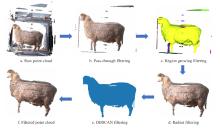
Fig. 10
Multi-algorithm fusion filtering process diagram of sheep Note: DBSCAN denotes density-based spatial clustering of applications with noise.
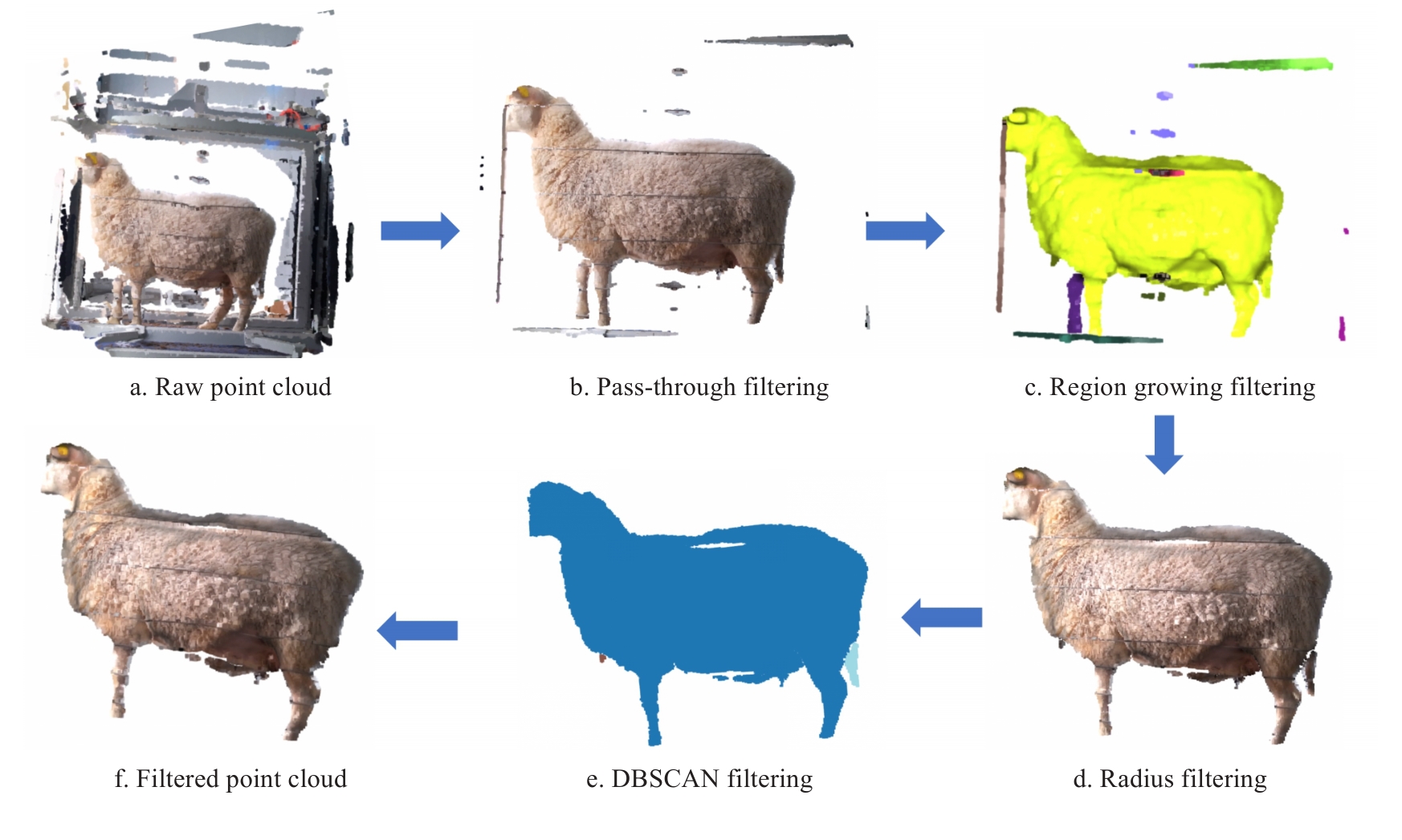
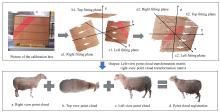
Fig. 11
Coarse registration of sheep point cloud using a calibration box

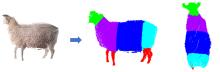
Fig. 12
Schematic of sheep body point cloud segmentation for circumference measurement a. Point cloud registration b. Front view after segmentation c. Top view after segmentation

Table 5
Comparison of key-point methods based on artificially constructed geometric features of sheep study
| Subjects | Method | Principle | Advantages | Limitations | Work |
|---|---|---|---|---|---|
| Sheep | Normal-vector and curvature fusion simplification algorithm | Simplify point cloud by combining normal vectors and curvature, automatically extract body measurement points on cow back | Preserves key feature points, offers high extraction accuracy, and adapts to various postures | Relies heavily on point cloud quality and pre-processing, high computational complexity | [ |
| Sheep | Spatial distribution statistical method | Based on spatial distribution features of point cloud, set thresholds through pass through filtering, combined with extremum method and dimensionality reduction projection to locate measurement points | High computational-efficiency, real-time-capability, robust-to wool-thickness-interference | Dependent-on fixed-postures and prior spatial-proportion-knowledge, limited breed/growth-stage adaptability, sensitive-to outlier point clouds | [ |
Table 6
Comparison of sheep pose normalization methods
| Subjects | Method | Pose-handling strategy | Advantages | Limitations | Work |
|---|---|---|---|---|---|
| Sheep | Global-local non-rigid warping | Use dynamic position encoding with a similarity transformation group to obtain the pose, followed by template alignment | No reliance on strict symmetry or complete point clouds, enabling non-rigid pose recovery | Heavy computation; template library required | [ |
| Sheep | CNN micro-pose classification + ElasticNet regression | An error-correction model based on CNN micro-pose classification and ElasticNet regression | Lightweight deployment | Still sensitive to resolution/angle; extreme poses fail | [ |
| Sheep | PointNet++ region segmentation and re-projected coordinate frame | Multi-view local pose normalization, PointNet++ segmentation, re-projected coordinate frame | Suppresses drifting landmarks under sudden poses | Relies solely on geometric coordinates without fusing RGB or other modalities, resulting in limited discriminative power under occlusion or specular reflection | [ |
Table 7
The relationship between body weight and body size of sheep
| Animal numbers | Body size indicators | Number of indicators | Year | Work |
|---|---|---|---|---|
| 882 | BL, BH, CG, SC, HH, HW, etc. | 7 | 2018 | [ |
| 94 | BL, BH, CG, SC | 4 | 2018 | [ |
| 50 | BL, BH, CD, CG, CW, SC, HW, etc. | 9 | 2019 | [ |
| 706 | BL, BH, CG, SC | 4 | 2020 | [ |
| 145 | BL, BH, CD, CG, CW, HW | 6 | 2020 | [ |
| 32 | BL, BH, CD, CG, CW, SC | 6 | 2021 | [ |
| 136 | BL, BH, CD, CG, CW, SC, SH, HW | 8 | 2021 | [ |
| 745 | BL, BH, CD, CG, CW, SC, HH | 7 | 2021 | [ |
| 653 | BL, BH, CD, CG, CW, HW | 6 | 2021 | [ |
| 408 | BL, BL, BH, CD, CG, CW, SC, etc. | 10 | 2022 | [ |
| 558 | BL, BH, CG | 3 | 2022 | [ |
| 12 500 | BL, BH, CD, CG, CW, SC, HH, BW, etc. | 13 | 2022 | [ |
| 507 | BL, BH, CG, etc. | 5 | 2022 | [ |
| 56 | BL, BH, CG, SC, HH, HW | 6 | 2022 | [ |
| 100 | BL, CG, HH, SH | 4 | 2022 | [ |
| 334 | BL, BH, CG, SC | 4 | 2023 | [ |
| 1 289 | BL, BH, CD, CG, CW, SC | 6 | 2023 | [ |
| 150 | BL, CG, SH | 3 | 2023 | [ |
| 210 | BL, CD, CG, CW, HH, BH、etc. | 7 | 2023 | [ |
| 239 | BL, BH, CD, CG, CW, etc. | 6 | 2024 | [ |
| 916 | BL, BH, CG, SC | 4 | 2024 | [ |
| 239 | BL, BH, CG, CW, SC, etc. | 6 | 2024 | [ |
| 100 | BL, CG, HH, HW, AD, SW, etc. | 14 | 2024 | [ |
Table 8
Accuracy data comparison of 2D, 3D, and 2D-3D body measurement methods in sheep and other livestock
| Subjects | Methods | Animal numbers | Body traits & accuracy | Year | Work |
|---|---|---|---|---|---|
| Sheep | 2D | 27 | BL: 2.03%; BH: 1.13%; CD: 4.45%; CW: 2.25%; HH:1.54%; HW: 2.41% | 2018 | [ |
| Cattle | 2D | NA | BL: 0.06%; BH: 2.28% | 2020 | [ |
| Sheep | 2D | 55 | BL: 2.42 %; BH: 1.86 %; HH: 2.07 %; CD: 2.72 % | 2022 | [ |
| Cattle | 2D | 30 | BL: 7.55%; BH: 6.75%; CD: 8.00%; SC: 8.97% | 2024 | [ |
| Sheep | 3D | 1 | BL / BH / CD / HH: 2.36% | 2020 | [ |
| Cattle | 3D | 103 | BL/BH/CDP/HH: <3% | 2020 | [ |
| Sheep | 3D | 239 | BL: 0.75 cm; HW: 0.38 cm; BH: 1.23 cm; SW: 0.33 cm; HH: 0.66 cm | 2021 | [ |
| Cattle | 3D | 10 | BL: 2.3%; BH: 2.8%; CDM: 2.6%; AD: 2.8%; SW: 1.6% | 2022 | [ |
| Sheep | 3D | 2 | BOL/BH/HH/HW: <5% | 2024 | [ |
| Sheep | 3D | 24 | BH: 1.67%; CW: 3.63%; HH: 1.14%; BL: 2.71%; CDM: 3.57%; HW: 3.71% | 2025 | [ |
| Cattle | 2D-3D | NA | BL: 2.14%; BH: 0.76%; HH: 0.76% | 2022 | [ |
| Pig | 2D-3D | NA | BL: 2.33%; BH: 1.92%; SW: 1.29%; HW: 1.26% | 2021 | [ |
| Horse | 2D-3D | 80 | BH/BL/HH/CG/AD: <2.29% | 2024 | [ |
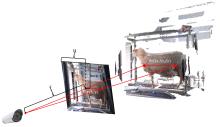
Fig.13
Schematic diagram of 2D-to-3D keypoint projection for sheep body measurement camera view point 2D pixel point 3D point

| [1] |
|
| [2] |
|
| [3] |
|
| [4] |
|
| [5] |
|
| [6] |
|
| [7] |
|
| [8] |
|
| [9] |
|
| [10] |
|
| [11] |
|
| [12] |
|
| [13] |
|
| [14] |
|
| [15] |
|
| [16] |
|
| [17] |
|
| [18] |
|
| [19] |
|
| [20] |
|
| [21] |
|
| [22] |
|
| [23] |
|
| [24] |
|
| [25] |
|
| [26] |
|
| [27] |
|
| [28] |
|
| [29] |
|
| [30] |
|
| [31] |
|
| [32] |
|
| [33] |
|
| [34] |
|
| [35] |
|
| [36] |
|
| [37] |
|
| [38] |
|
| [39] |
|
| [40] |
|
| [41] |
|
| [42] |
|
| [43] |
|
| [44] |
|
| [45] |
|
| [46] |
|
| [47] |
|
| [48] |
|
| [49] |
|
| [50] |
|
| [51] |
|
| [52] |
|
| [53] |
|
| [54] |
|
| [55] |
|
| [56] |
|
| [57] |
|
| [58] |
|
| [59] |
|
| [60] |
|
| [61] |
|
| [62] |
|
| [63] |
|
| [64] |
|
| [65] |
|
| [66] |
|
| [67] |
|
| [68] |
|
| [69] |
|
| [70] |
|
| [71] |
|
| [72] |
|
| [73] |
|
| [74] |
|
| [75] |
|
| [76] |
|
| [77] |
|
| [78] |
|
| [79] |
|
| [80] |
|
| [81] |
|
| [82] |
|
| [83] |
|
| [84] |
|
| [85] |
|
| [86] |
|
| [87] |
|
| [88] |
|
| [89] |
|
| [90] |
|
| [91] |
|
| [92] |
|
| [93] |
|
| [94] |
|
| [1] | YANG Qilang, YU Lu, LIANG Jiaping. Grading Asparagus officinalis L. Using Improved YOLOv11 [J]. Smart Agriculture, 2025, 7(4): 84-94. |
| [2] | PENG Qiujun, LI Weiran, LIU Yeqiang, LI Zhenbo. High-Precision Fish Pose Estimation Method Based on Improved HRNet [J]. Smart Agriculture, 2025, 7(3): 160-172. |
| [3] | ZHANG Zhiyong, CAO Shanshan, KONG Fantao, LIU Jifang, SUN Wei. Advances, Problems and Challenges of Precise Estrus Perception and Intelligent Identification Technology for Cows [J]. Smart Agriculture, 2025, 7(3): 48-68. |
| [4] | QIAO Lei, CHEN Lei, YUAN Yuan. Bi-Intentional Modeling and Knowledge Graph Diffusion for Rice Variety Selection and Breeding Recommendation [J]. Smart Agriculture, 2025, 7(2): 73-80. |
| [5] | MA Weiwei, CHEN Yue, WANG Yongmei. Recognition of Sugarcane Leaf Diseases in Complex Backgrounds Based on Deep Network Ensembles [J]. Smart Agriculture, 2025, 7(1): 136-145. |
| [6] | CAO Bingxue, LI Hongfei, ZHAO Chunjiang, LI Jin. The Path of Smart Agricultural Technology Innovation Leading Development of Agricultural New Quality Productivity [J]. Smart Agriculture, 2024, 6(4): 116-127. |
| [7] | FAN Mingshuo, ZHOU Ping, LI Miao, LI Hualong, LIU Xianwang, MA Zhirun. Automatic Navigation and Spraying Robot in Sheep Farm [J]. Smart Agriculture, 2024, 6(4): 103-115. |
| [8] | LI Minghuang, SU Lide, ZHANG Yong, ZONG Zheying, ZHANG Shun. Automatic Measurement of Mongolian Horse Body Based on Improved YOLOv8n-pose and 3D Point Cloud Analysis [J]. Smart Agriculture, 2024, 6(4): 91-102. |
| [9] | XU Ruifeng, WANG Yaohua, DING Wenyong, YU Junqi, YAN Maocang, CHEN Chen. Shrimp Diseases Detection Method Based on Improved YOLOv8 and Multiple Features [J]. Smart Agriculture, 2024, 6(2): 62-71. |
| [10] | SHU Hongwei, WANG Yuwei, RAO Yuan, ZHU Haojie, HOU Wenhui, WANG Tan. Imaging System for Plant Photosynthetic Phenotypes Incorporating Three-dimensional Structured Light and Chlorophyll Fluorescence [J]. Smart Agriculture, 2024, 6(1): 63-75. |
| [11] | ZUO Haoxuan, HUANG Qicheng, YANG Jiahao, MENG Fanjia, LI Sien, LI Li. In Situ Identification Method of Maize Stalk Width Based on Binocular Vision and Improved YOLOv8 [J]. Smart Agriculture, 2023, 5(3): 86-95. |
| [12] | LIU Youfu, XIAO Deqin, ZHOU Jiaxin, BIAN Zhiyi, ZHAO Shengqiu, HUANG Yigui, WANG Wence. Status Quo of Waterfowl Intelligent Farming Research Review and Development Trend Analysis [J]. Smart Agriculture, 2023, 5(1): 99-110. |
| [13] | KANG Xi, LIU Gang, CHU Mengyuan, LI Qian, WANG Yanchao. Advances and Challenges in Physiological Parameters Monitoring and Diseases Diagnosing of Dairy Cows Based on Computer Vision [J]. Smart Agriculture, 2022, 4(2): 1-18. |
| [14] | Zhou Chengquan, Ye Hongbao, Yu Guohong, Hu Jun, Xu Zhifu. A fast extraction method of broccoli phenotype based on machine vision and deep learning [J]. Smart Agriculture, 2020, 2(1): 121-132. |
| Viewed | ||||||
|
Full text |
|
|||||
|
Abstract |
|
|||||