Smart Agriculture ›› 2026, Vol. 8 ›› Issue (5): 1-22.doi: 10.12133/j.smartag.SA202609040
• Topic--Frontier Technology Innovation and Industrial Applications of Agricultural Robots •
YANG Shuofei1,2, WANG Zhe1, YANG Shenghui1,2, MIAO Zhonghua3, CHEN Du1,2, ZHENG Yongjun1,2( ), SONG Zhenghe1,2, LI Hongwen1,2
Received:2026-09-17
Online:2026-09-30
Foundation items:National Natural Science Foundation of China(52305042)
About author:YANG Shuofei, E-mail: shuofei.yang@cau.edu.cn
corresponding author:
CLC Number:
YANG Shuofei, WANG Zhe, YANG Shenghui, MIAO Zhonghua, CHEN Du, ZHENG Yongjun, SONG Zhenghe, LI Hongwen. Autonomous Operation Technologies and Development Trends for Agricultural Robots in Complex Scenarios[J]. Smart Agriculture, 2026, 8(5): 1-22.
Add to citation manager EndNote|Ris|BibTeX
URL: https://www.smartag.net.cn/EN/10.12133/j.smartag.SA202609040
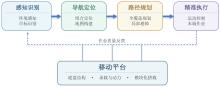
Fig. 1
System of agricultural robots
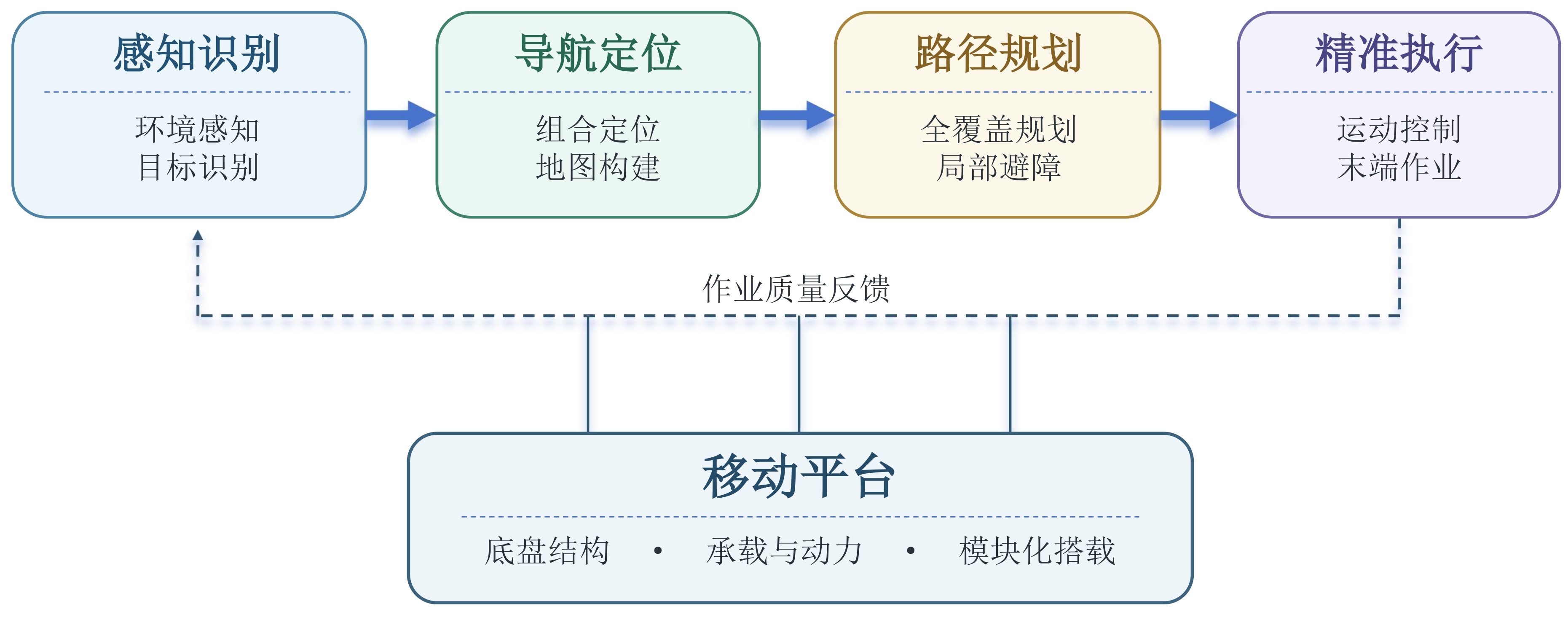
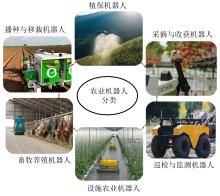
Fig. 2
Typical operation tasks and application scenarios of agricultural robots
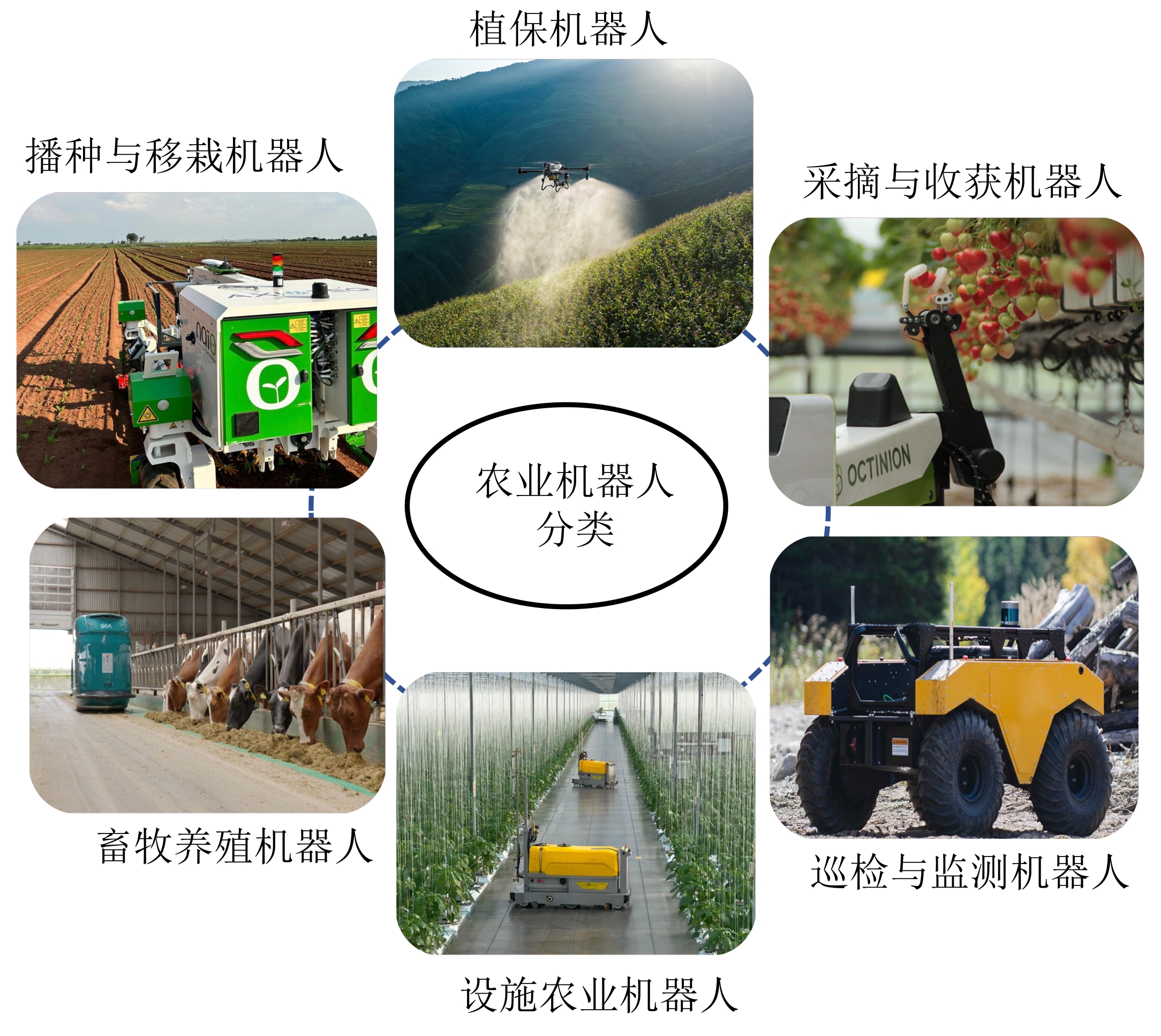
Fig. 3
Equipment for seeding and precision crop protection
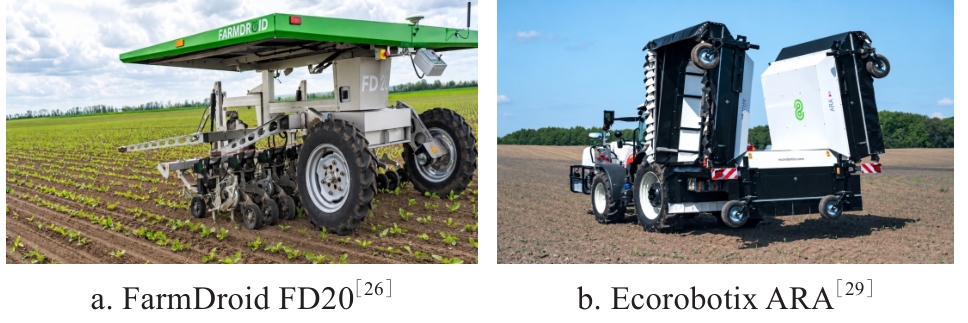
Fig. 4
Greenhouse tomato harvesting robots
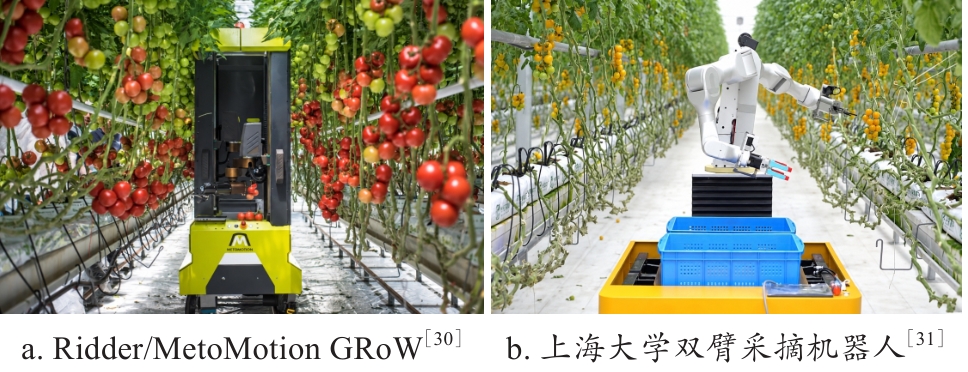
Fig. 5
EarthSense TerraSentia scouting and phenotyping robot
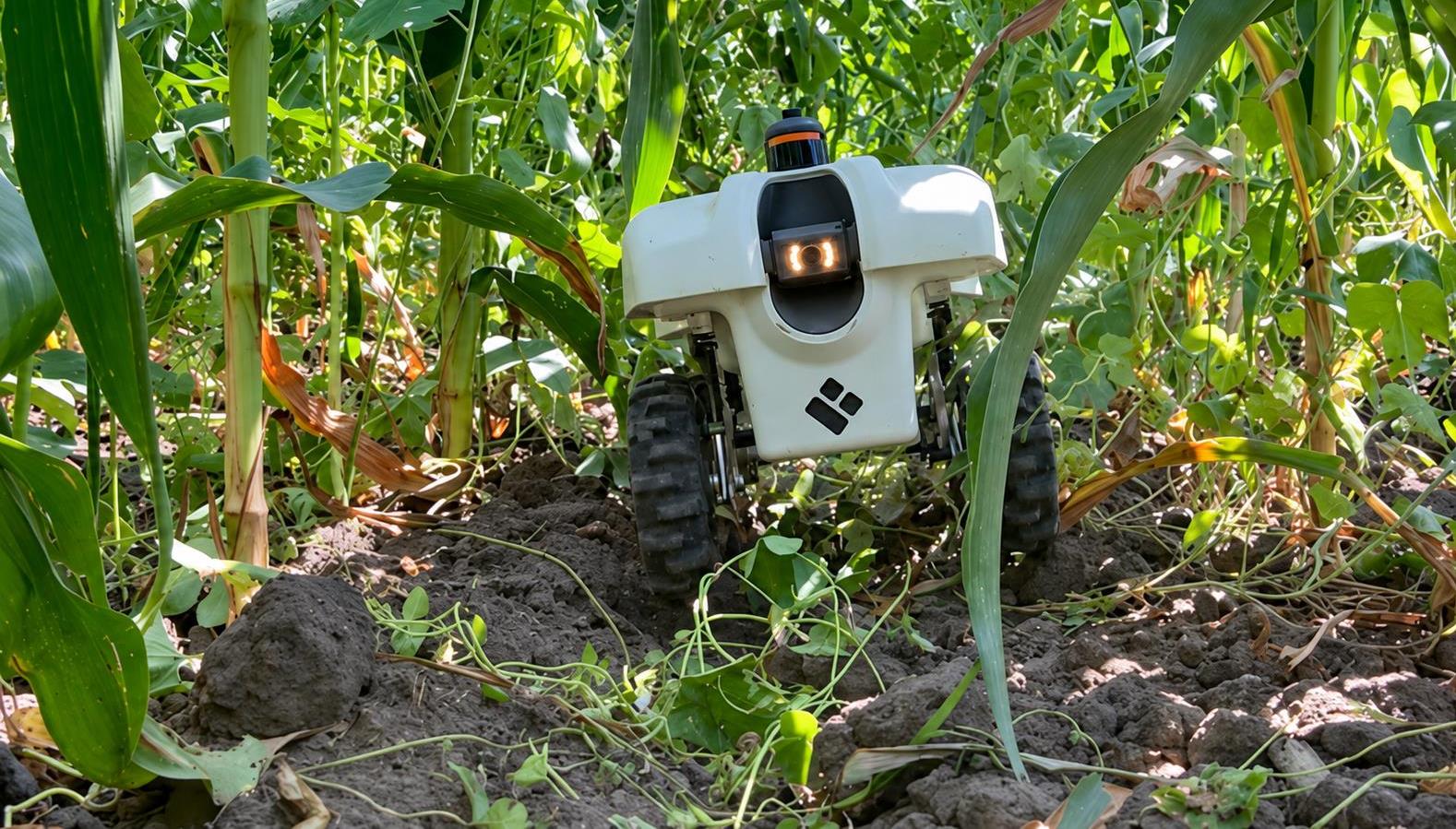
Fig. 6
Priva Kompano autonomous tomato de-leafing robot in greenhouse
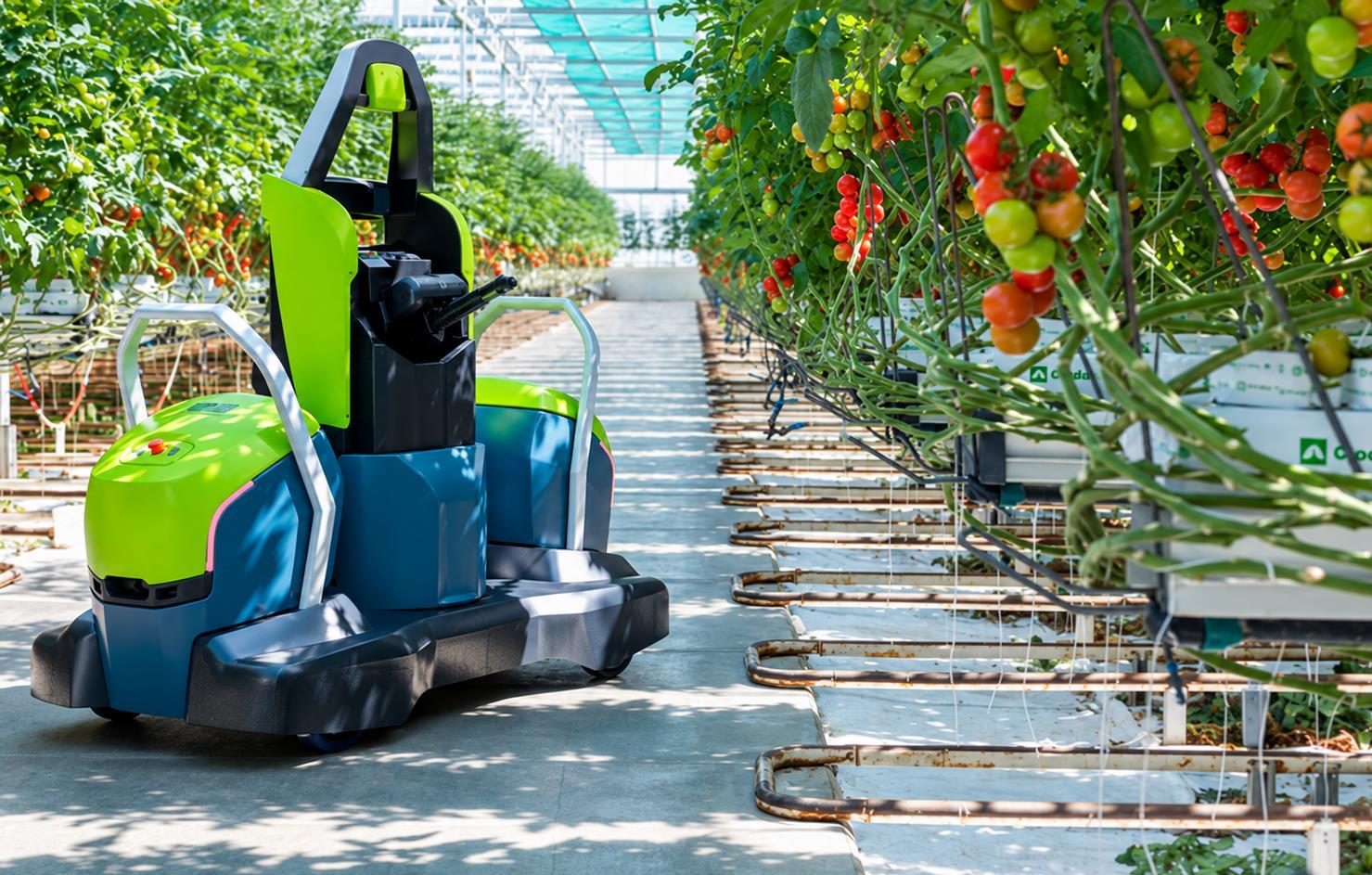
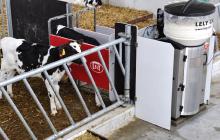
Fig. 7
Lely Astronaut A5 Next automatic milking robot
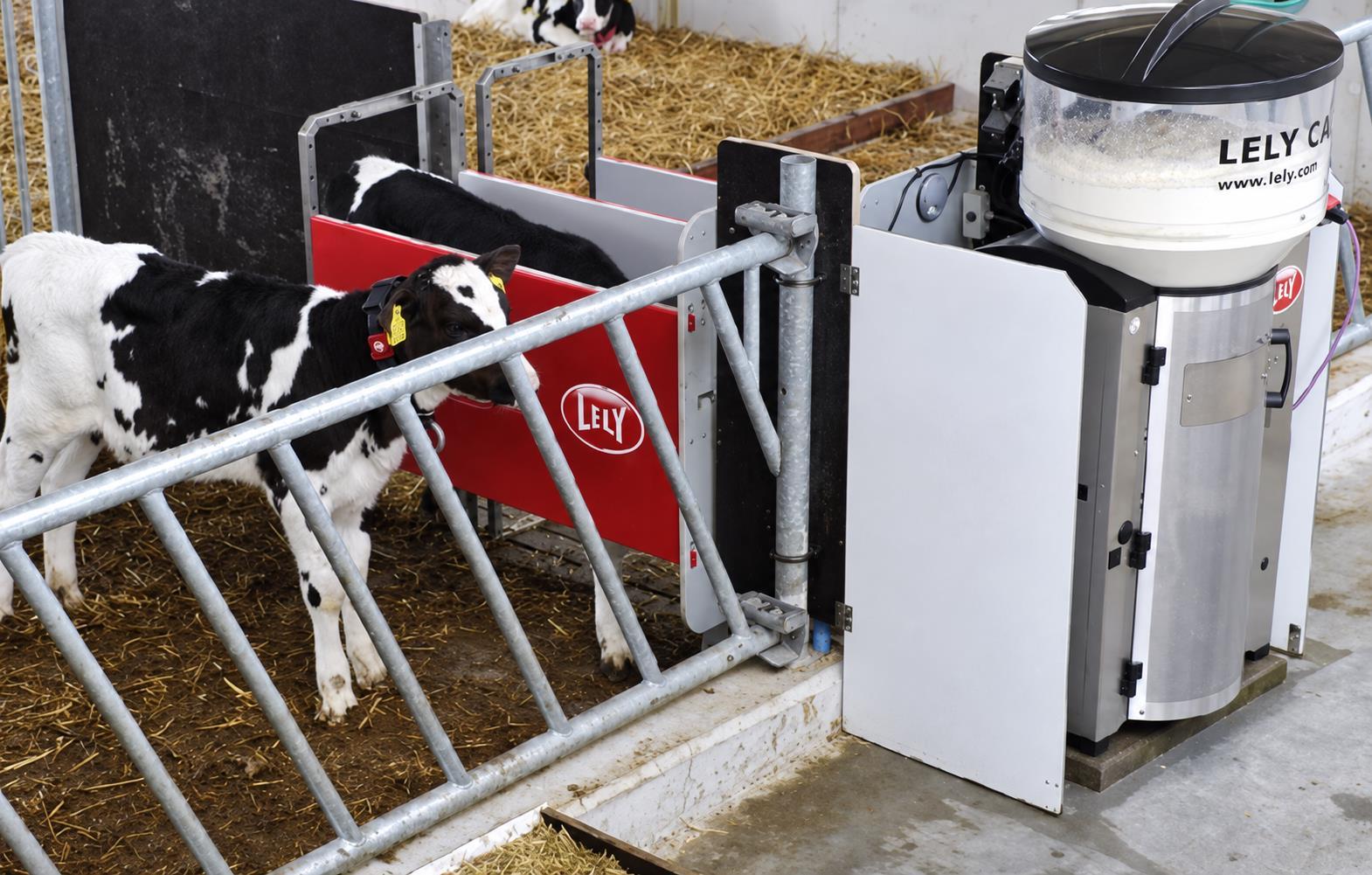
Fig. 8
Representative mobile platforms for agricultural robots
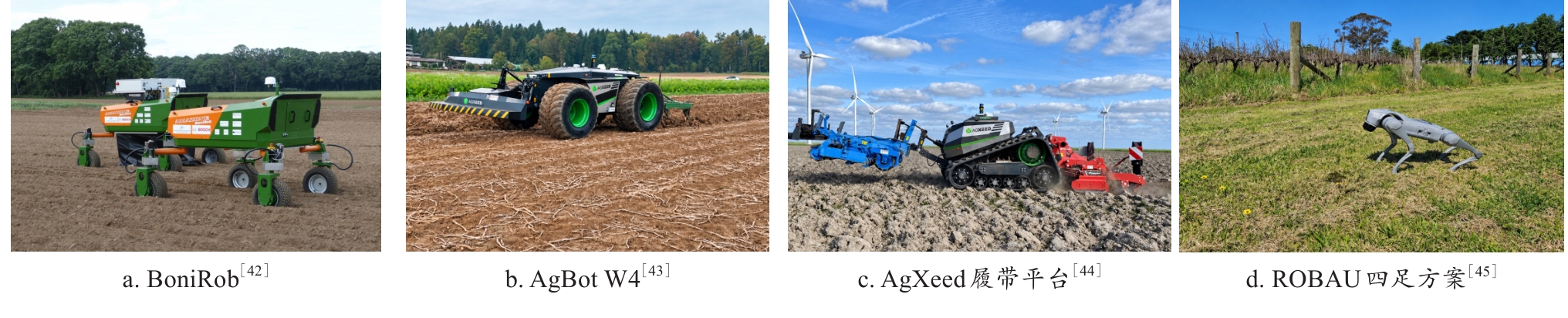
Table 1
Characteristics and selection considerations of major agricultural robot chassis
| 底盘形式 | 结构与运动特点 | 适用条件 | 选型与评价要点 |
|---|---|---|---|
| 阿克曼轮式 | 轮式滚动;转向几何关系明确 | 空间较为宽敞、地头能够容纳其转弯半径的作业环境 | 根据轴距、行驶速度以及所使用的农具进行跟踪和转弯评估[ |
| 独立驱动/转向轮式 | 可组合多种转向模式;部分平台可调轮距 | 行距变化、精细作业与狭窄空间机动 | 协调轮组控制,在给定载荷下记录转向性能、能耗及与作物接触的情况[ |
| 履带式 | 与农田接触面大;转向涉及滑移 | 坡地、湿地或重载情况下使用 | 计算滑移量、牵引力、扰土量以及单位作业功耗等[ |
| 腿式/轮腿复合 | 多足连杆机构;可改变着地点或转换行走模式 | 局部障碍物、斜坡地及巡检任务等 | 从负载能力、越障能力、稳定性、续航时间以及维修等方面进行比较 |
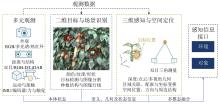
Fig. 9
Perception and recognition technology framework for agricultural robots
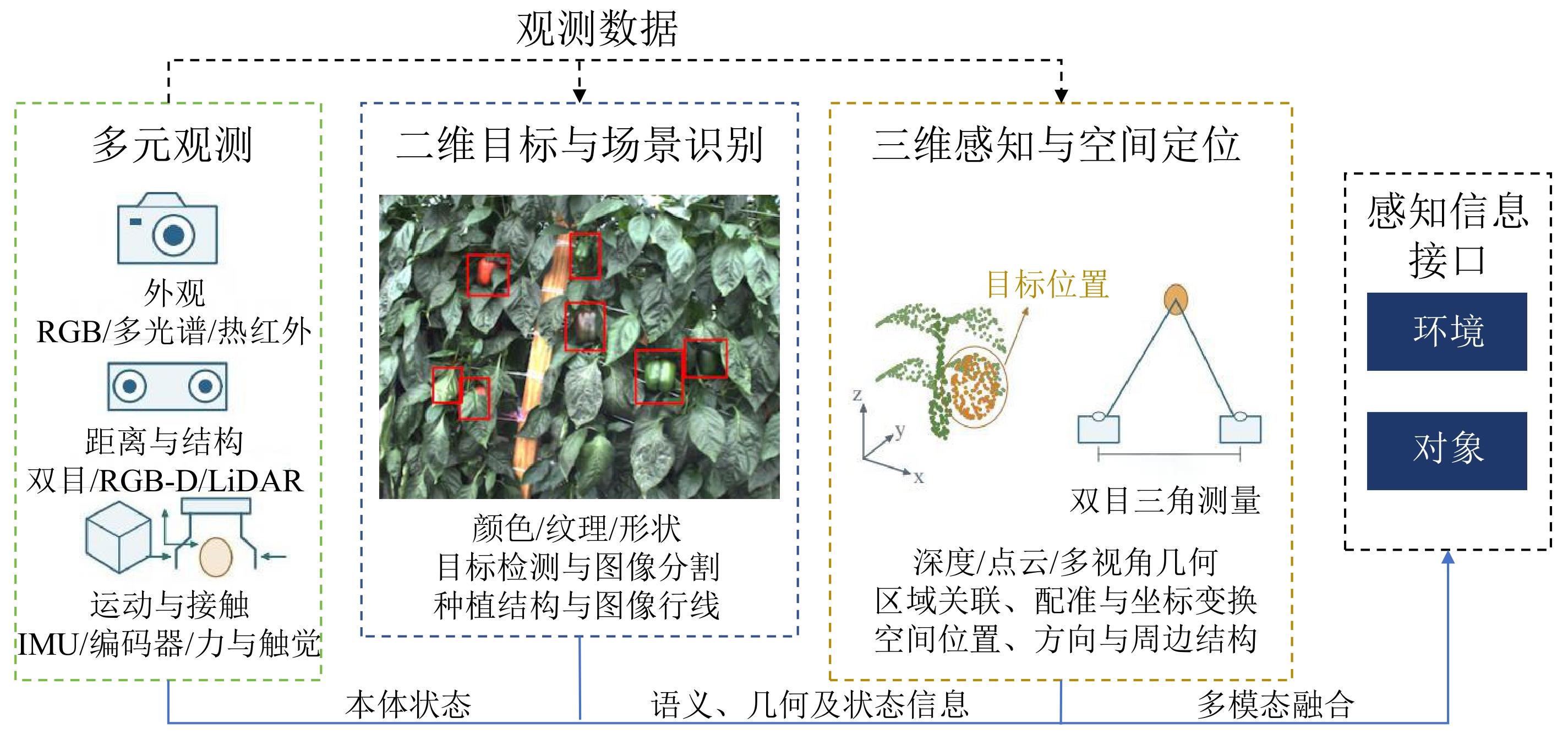
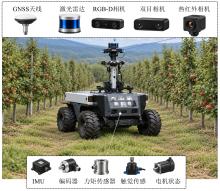
Fig. 10
Environmental perception and target recognition system of agricultural robots
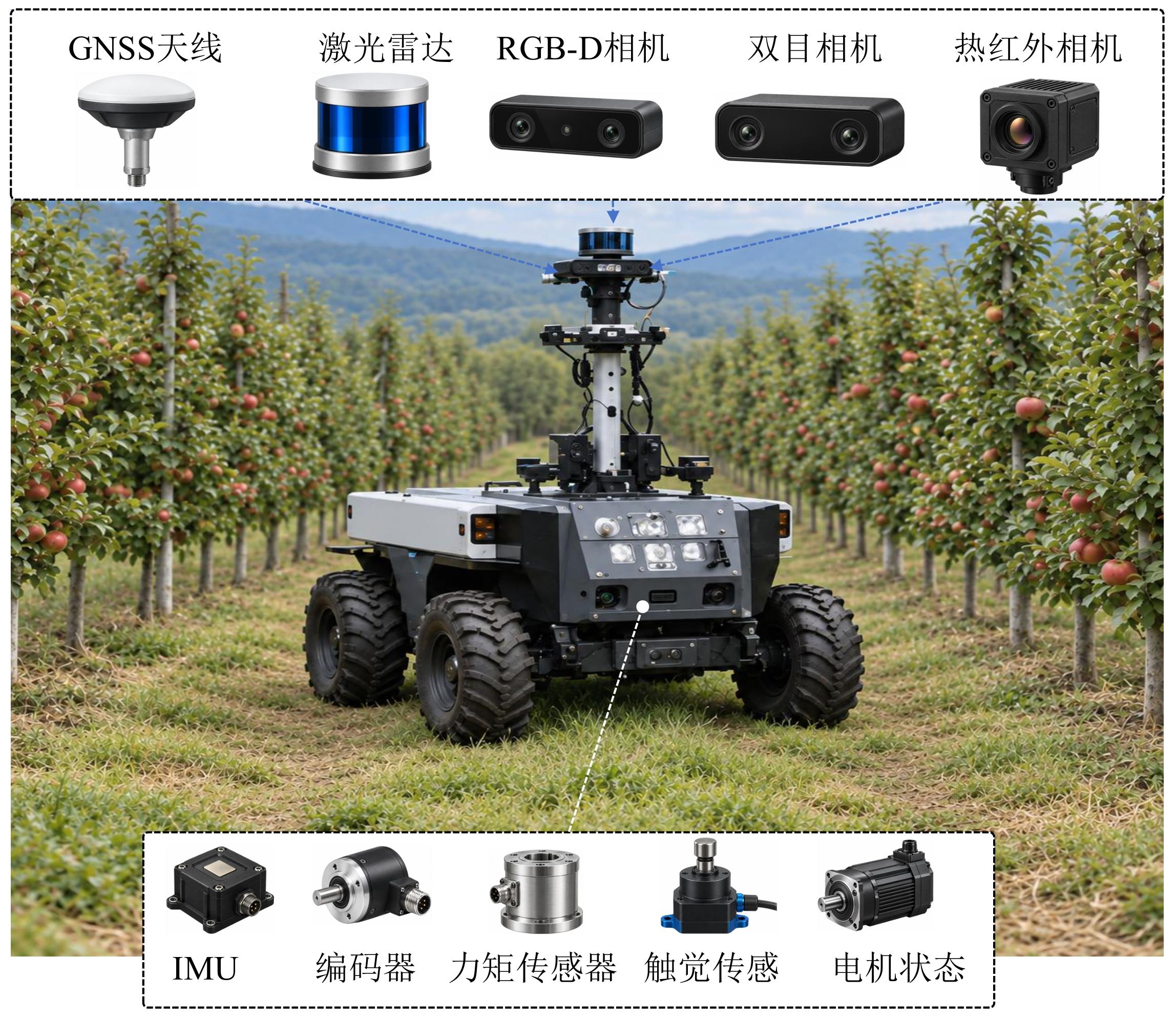
Fig. 11
Autonomous navigation planning and decision-making framework for agricultural robots

Fig. 12
Manipulator and task execution technology framework for agricultural robots
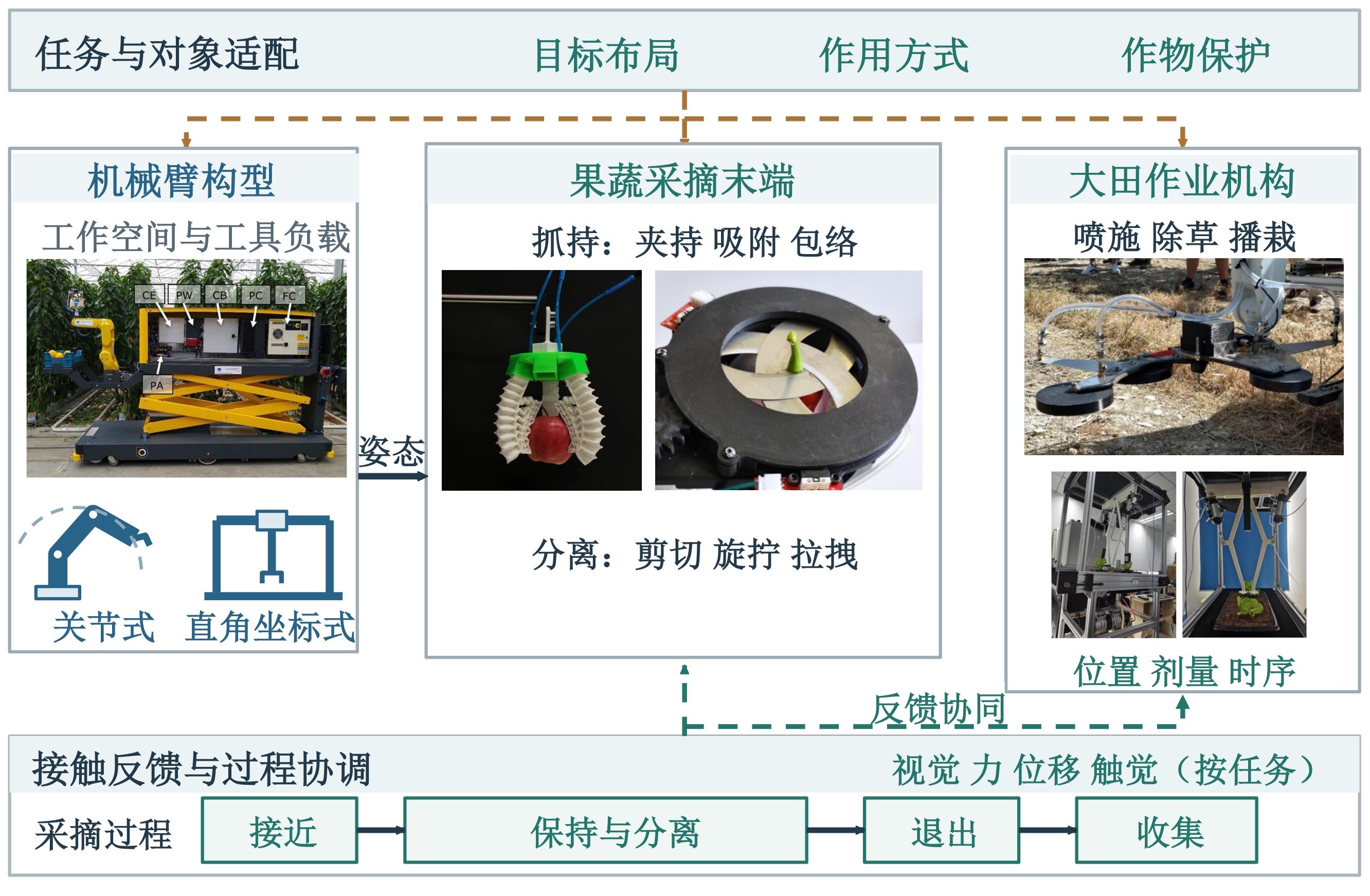
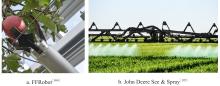
Fig. 13
Execution systems for selective harvesting and precision spraying
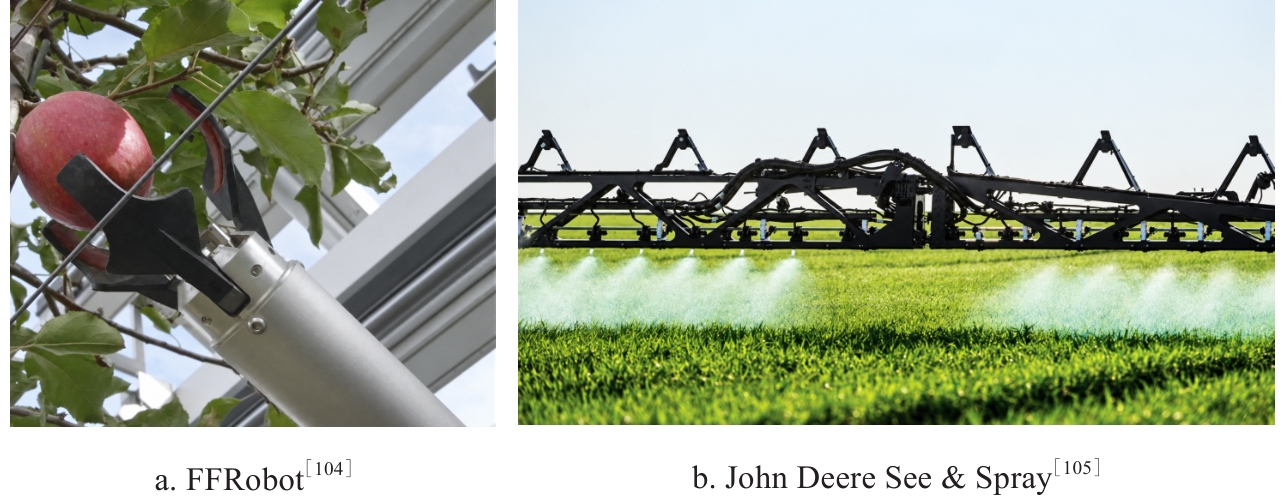
Table 2
Experimental conditions and results of representative agricultural robot studies
| 研究与任务 | 试验条件及配置 | 原研究报告结果 |
|---|---|---|
| PALVA等[ | 芬兰甜菜种植地;将FarmDroid FD20机器人除草、化学处理与未处理进行对照 | 7月5日的数据表明,用机械除草的试验区杂草数量为4.3±2.5株/m2,用化学除草剂除草的试验区为1.4±2.7株/m2,在没有任何管理的情况下杂草密度最高达到12.0±3.7株/m2 |
| VELASQUEZ等[ | 玉米大田;利用激光雷达、IMU以及车轮编码器所获取的信息进行多源信息融合分析;分别测试连续行、生产田与缺株间隙 | 试验采用单行作业情况、整个田块的情况以及有部分缺苗处进行试验,未施加人为干预措施。试验得出,车辆沿着预定路线行驶的距离分别是386.9 m、56.1 m、47.5 m |
| 胡炼等[ | 设施农业生产;外置固定二维激光雷达搭配拖拉机上的可移动激光接收器进行定位检测;大棚内拖拉机试验;全站仪参照;0.8 m/s | 直线、曲线行驶各5次试验所报告的均方根误差最大值分别为1.5和2.6 cm |
| ARAD等[ | 甜椒生产温室;使用SWEEPER甜椒采摘机器人开展了历时4周、涉及262个果实的采摘试验 | 经过优化后,采摘成功率提高到61%。每轮平均需要花费约24 s完成整个过程,包括机械手定位、检测以及采摘等 |
Table 3
Evaluation and reporting considerations for major agricultural robot tasks
| 作业任务 | 作业质量与生产率 | 定义与报告要点 |
|---|---|---|
| 播种/移栽 | 播深、株距、漏播/漏栽、伤苗;单位时间内完成有效作业面积或者作物苗数 | 作业效率的计算说明农艺阈值,以预定的目标落种点或者定植株数作为自变量的同时还要考虑到土质,以及人为的影响等多种因素。 |
| 除草/喷施 | 杂草处理、作物损伤、药剂在田间分布情况及其生物控制作用;单位合格作业面积的药液用量或能源消耗 | 确定基线数据采集时间段及范围并且正确计算理论用药量与实际有效成分之间的比值。所有的实验参数都必须用专门设备进行测定以保证结果科学性和准确性[ |
| 采摘 | 成熟目标采摘成功、果实损伤;单位总作业时间内获得的合格果实数量 | 明确目标总数、可达目标及成功定义;记录抓取、分离、输送、重试和卸果时间[ |
| 巡检/导航 | 信息采集完整性、定位/跟踪误差,以及遗漏情况;自动驾驶过程中无须人操作而真正行驶的距离或者运行时长相关参数 | 区分建图、定位和路径跟踪;注明参考测量方法与设备、误差计算方式、场景、接管事件与统计量[ |
| 连续运行与经济性 | 有效运行时间、发生故障次数及其维修间隔期、能耗;单位合格面积或产品成本 | 覆盖转场、补给、监护及停机;说明试验地块、对象数量及持续时间、年度利用时间和成本边界[ |
| [1] |
罗锡文, 吴海华, 陈学庚, 等. 我国农业装备创新发展成就与未来展望[J]. 中国工程科学, 2026, 28(1): 218-230.
|
|
|
|
| [2] |
尹彦鑫, 孟志军, 赵春江, 等. 大田无人农场关键技术研究现状与展望[J]. 智慧农业(中英文), 2022, 4(4): 1-25.
|
|
|
|
| [3] |
|
| [4] |
|
| [5] |
|
| [6] |
|
| [7] |
赵春江, 范贝贝, 李瑾, 等. 农业机器人技术进展、挑战与趋势[J]. 智慧农业(中英文), 2023, 5(4): 1-15.
|
|
|
|
| [8] |
|
| [9] |
|
| [10] |
|
| [11] |
刘成良, 贡亮, 苑进, 等. 农业机器人关键技术研究现状与发展趋势[J]. 农业机械学报, 2022, 53(7): 1-22, 55.
|
|
|
|
| [12] |
|
| [13] |
何勇, 黄震宇, 杨宁远, 等. 设施农业机器人导航关键技术研究进展与展望[J]. 智慧农业(中英文), 2024, 6(5): 1-19.
|
|
|
|
| [14] |
|
| [15] |
马贵福, 郑浡文, 班婷, 等. 农机群协同作业路径规划与动态避障方法研究[J]. 智能化农业装备学报(中英文), 2026, 7(3): 1-18.
|
|
|
|
| [16] |
陆在旺, 张玉成, 马宜科, 等. 农业多机器人全覆盖作业关键技术研究进展与展望[J]. 智慧农业(中英文), 2025, 7(5): 17-36.
|
|
|
|
| [17] |
|
| [18] |
|
| [19] |
|
| [20] |
|
| [21] |
DJI. DJI Agriculture[EB/OL]. [2026-10-20].
|
| [22] |
OCTINION. Strawberry picking robot Rubion[EB/OL]. [2026-10-20].
|
| [23] |
GEA. 饲喂机器人: GEA DairyFeed F4500[EB/OL]. [2026-10-20].
|
| [24] |
|
| [25] |
|
| [26] |
FARMDROID. FarmDroid FD20: Autonomous Farming Robot for Precision Agriculture[EB/OL]. [2026-10-19].
|
| [27] |
|
| [28] |
|
| [29] |
ECOROBOTIX. ARA UHP Sprayer[EB/OL]. [2026-10-19].
|
| [30] |
RIDDER. Tomato Harvesting Robot GRoW Will Officially Be Introduced at GreenTech[EB/OL]. [2026-10-19].
|
| [31] |
上海大学. 硬核突破!上海大学自研具身智能双臂拟人番茄采摘机器人[EB/OL]. (2026-05-25)[2026-10-19].
|
| [32] |
TERRA-MEPP. Robot[EB/OL]. [2026-10-14].
|
| [33] |
|
| [34] |
|
| [35] |
PRIVA. 普瑞瓦(Priva)推出了世界上第一台全自动的番茄摘叶机器人[EB/OL]. (2022-06-08)[2026-10-19].
|
| [36] |
肖坚星, 王天海, 王宁, 等. 农业机器人障碍物检测与避障技术研究进展[J]. 农业工程学报, 2025, 41(13): 35-49.
|
|
|
|
| [37] |
|
| [38] |
|
| [39] |
LELY. Automatic Milking Robot: Lely Astronaut A5 Next[EB/OL]. [2026-10-19].
|
| [40] |
王韦韦, 陈黎卿, 杨洋, 等. 农业机械底盘技术研究现状与展望[J]. 农业机械学报, 2021, 52(8): 1-15.
|
|
|
|
| [41] |
|
| [42] |
|
| [43] |
AGXEED. AgBot W4 Series[EB/OL]. [2026-10-19].
|
| [44] |
AGXEED. AgBot T 2 5 SERIES[EB/OL]. [2026-10-19].
|
| [45] |
ROBAU. AgTech: AI Robotic Inspection & Surveillance[EB/OL]. [2026-10-19].
|
| [46] |
潘宇真, 魏佳炜,
|
|
|
|
| [47] |
SA I,
|
| [48] |
|
| [49] |
|
| [50] |
|
| [51] |
|
| [52] |
|
| [53] |
|
| [54] |
|
| [55] |
|
| [56] |
|
| [57] |
|
| [58] |
李道亮, 赵晔, 杜壮壮. 农业领域多模态融合技术方法与应用研究进展[J]. 农业机械学报, 2025, 56(1): 1-15.
|
|
|
|
| [59] |
|
| [60] |
|
| [61] |
|
| [62] |
|
| [63] |
|
| [64] |
|
| [65] |
|
| [66] |
|
| [67] |
|
| [68] |
|
| [69] |
|
| [70] |
张智刚, 殷珍, 吴潇, 等. 农业机械自动导航技术研究进展[J]. 农业工程学报, 2025, 41(23): 1-13.
|
|
|
|
| [71] |
|
| [72] |
|
| [73] |
|
| [74] |
|
| [75] |
|
| [76] |
樊湘鹏, 许燕, 周建平. 棉田施药机器人视觉导航方法与田间试验[J]. 农业工程学报, 2025, 41(6): 52-61.
|
|
|
|
| [77] |
|
| [78] |
|
| [79] |
胡炼, 王志敏, 汪沛, 等. 基于激光感知的农业机器人定位系统[J]. 农业工程学报, 2023, 39(5): 1-7.
|
|
|
|
| [80] |
|
| [81] |
|
| [82] |
沈跃, 肖鑫桦, 刘慧, 等. 果园机器人LiDAR/IMU紧耦合实时定位与建图方法[J]. 农业机械学报, 2023, 54(11): 20-28, 48.
|
|
|
|
| [83] |
|
| [84] |
汪小旵, 谢慎亮, 黄薛凯, 等. 基于3D激光雷达SLAM的温室芦笋采收机器人自主导航方法[J]. 农业机械学报, 2026, 57(4): 138-150.
|
|
|
|
| [85] |
|
| [86] |
孙国祥, 黄银锋, 汪小旵, 等. 基于LIO-SAM建图和激光视觉融合定位的温室自主行走系统[J]. 农业工程学报, 2024, 40(3): 227-239.
|
|
|
|
| [87] |
|
| [88] |
|
| [89] |
夏先飞, 贾磊, 张硕, 等. 果蔬采摘机器人研究现状及发展趋势[J]. 农业工程学报, 2026, 42(2): 14-28.
|
|
|
|
| [90] |
陈凯, 解印山, 李彦明, 等. 多约束情形下的农机全覆盖路径规划方法[J]. 农业机械学报, 2022, 53(5): 17-26, 43.
|
|
|
|
| [91] |
|
| [92] |
姜龙腾, 迟瑞娟, 马悦琦, 等. 基于栅格法的农业机器人路径规划方法研究[J]. 农机化研究, 2024, 46(6): 19-24.
|
|
|
|
| [93] |
|
| [94] |
|
| [95] |
|
| [96] |
|
| [97] |
|
| [98] |
|
| [99] |
|
| [100] |
谭励, 余煌, 杜小强, 等. 基于稳定夹持的类球形果实采摘末端执行器优化设计与试验[J]. 机械工程学报, 2026, 62(3): 353-365.
|
|
|
|
| [101] |
|
| [102] |
陈建能, 陈倩雯, 刘林敏, 等. 旋转式两工位名优茶采摘收集一体末端执行器设计与试验[J]. 农业机械学报, 2024, 55(10): 136-144.
|
|
|
|
| [103] |
虞浪, 俞高红, 吴浩宇, 等. 欠驱动关节型柑橘采摘末端执行器设计与试验[J]. 农业工程学报, 2023, 39(17): 29-38.
|
|
|
|
| [104] |
FFROBOTICS. The Future of Fresh Fruit Harvest[EB/OL]. [2026-10-19].
|
| [105] |
|
| [106] |
|
| [107] |
|
| [108] |
|
| [109] |
罗锡文, 廖娟, 臧英, 等. 我国农业生产的发展方向: 从机械化到智慧化[J]. 中国工程科学, 2022, 24(1): 46-54.
|
|
|
|
| [110] |
吴华瑞, 赵春江, 李静晨. 基于多模态融合大模型架构Agri-QA Net的作物知识问答系统[J]. 智慧农业(中英文), 2025, 7(1): 1-10.
|
|
|
|
| [111] |
|
| [112] |
|
| [113] |
|
| [114] |
|
| [115] |
|
| [1] | WANG Ting, WANG Na, CUI Yunpeng, LIU Juan. Research Progress and Prospects of Cloud-Edge-Device Integrated Middleware for Agricultural Product Quality Control [J]. Smart Agriculture, 2026, 8(4): 1-16. |
| [2] | MA Mengxian, XU Zhen, YUAN Quan, ZHOU Wenzong, ZHANG Chunyan. Path Planning Algorithm for an Eel Feeding Robotic Arm Based on Improved BI-RRT [J]. Smart Agriculture, 2026, 8(2): 251-264. |
| [3] | CHEN Ruotong, LIU Jifang, ZHANG Zhiyong, MA Nan, WEI Peigang, WANG Yi, YANG Yantao. Intelligent Inspection Path Planning Algorithm for Large-Scale Cattle Farms [J]. Smart Agriculture, 2026, 8(1): 178-191. |
| [4] | WANG Jian, ZHAO Haosen, MA Yue, XING Bin, ZHU Wenying. Research Progress and Prospects of Intelligent Control Technology for Facility Vegetable [J]. Smart Agriculture, 2026, 8(1): 104-119. |
| [5] | LU Zaiwang, ZHANG Yucheng, MA Yike, DAI Feng, DONG Jie, WANG Peng, LU Huixian, LI Tongbin, ZHAO Kaibin. Progress and Prospects of Research on Key Technologies for Agricultural Multi-Robot Full Coverage Operations [J]. Smart Agriculture, 2025, 7(5): 17-36. |
| [6] | LIU lining, ZHANG Hongqi, ZHANG Ziwen, ZHANG Zhenghui, WANG Jiayu, LI Xuanxuan, ZHU Ke, LIU Pingzeng. Key Technologies and Construction model for Unmanned Smart Farms: Taking the "1.5-Ton Grain per Mu" Unmanned Farm as An Example [J]. Smart Agriculture, 2025, 7(1): 70-84. |
| [7] | HE Yong, HUANG Zhenyu, YANG Ningyuan, LI Xiyao, WANG Yuwei, FENG Xuping. Research Progress and Prospects of Key Navigation Technologies for Facility Agricultural Robots [J]. Smart Agriculture, 2024, 6(5): 1-19. |
| [8] | LIU Yang, JI Jie, PAN Deng, ZHAO Lijun, LI Mingsheng. Localization Method for Agricultural Robots Based on Fusion of LiDAR and IMU [J]. Smart Agriculture, 2024, 6(3): 94-106. |
| [9] | ZHAO Chunjiang, FAN Beibei, LI Jin, FENG Qingchun. Agricultural Robots: Technology Progress, Challenges and Trends [J]. Smart Agriculture, 2023, 5(4): 1-15. |
| [10] | CHEN Ruiyun, TIAN Wenbin, BAO Haibo, LI Duan, XIE Xinhao, ZHENG Yongjun, TAN Yu. Three-Dimensional Environment Perception Technology for Agricultural Wheeled Robots: A Review [J]. Smart Agriculture, 2023, 5(4): 16-32. |
| [11] | XU Jishuang, JIAO Jun, LI Miao, LI Hualong, YANG Xuanjiang, LIU Xianwang, GUO Panpan, MA Zhirun. Path Planning and Motion Control Method for Sick and Dead Animal Transport Robots Integrating Improved A * Algorithm and Fuzzy PID [J]. Smart Agriculture, 2023, 5(4): 127-136. |
| [12] | ZHOU Longgang, LIU Ting, LU Jinzhu. Traversal Path Planning for Farmland in Hilly Areas Based on Floyd and Improved Genetic Algorithm [J]. Smart Agriculture, 2023, 5(4): 45-57. |
| [13] | GUO Wei, WU Huarui, ZHU Huaji. Design and Application of Facility Greenhouse Image Collecting and Environmental Data Monitoring Robot System [J]. Smart Agriculture, 2020, 2(3): 48-60. |
| [14] | Zhu Jiangpeng, Cen Haiyan, He Liwen, He Yong. Development and performance evaluation of a multi-rotor unmanned aircraft system for agricultural monitoring [J]. Smart Agriculture, 2019, 1(1): 43-52. |
| Viewed | ||||||
|
Full text |
|
|||||
|
Abstract |
|
|||||