Smart Agriculture ›› 2026, Vol. 8 ›› Issue (2): 118-132.doi: 10.12133/j.smartag.SA202510010
• 专题--多源遥感驱动数字农业创新与实践 • 上一篇 下一篇
巫晨旭, 左浩龙, 李刚( )
)
收稿日期:2025-10-11
出版日期:2026-03-30
作者简介:通信作者:
WU Chenxu, ZUO Haolong, LI Gang()
Received:2025-10-11
Online:2026-03-30
Foundation items:Heilongjiang Province Double First-Class Discipline Coordinated Innovation Achievement Project(LJGXCG 2025-P18)
About author:Corresponding author:摘要:
【目的/意义】 本研究旨在突破传统光学遥感在云遮天气与耕地破碎地形下的局限性,通过构建一种具备优秀跨模态融合能力与泛化性能的深度网络模型来提升农业遥感分类精度。 【方法】 提出一种基于注意力机制的3D卷积神经网络(3D Convolutional Neural Network Based on Attention Mechanism, Attention-3DCNN)模型:其通过3D卷积+2D卷积结构处理时序哨兵二号多光谱影像,在空间与时间维度上提取丰富特征;同时以深度可分离卷积形式处理来自哨兵一号的合成孔径雷达(Synthetic Aperture Radar, SAR)数据,实现对全天候可获取信息的高效抽取;进一步,模型引入“通道-时间-空间”三重注意力机制与残差连接策略,对两个模态的特征进行动态加权与深度融合,使得在光学数据缺失或遮挡严重的情形下,SAR数据能够有效补偿并维持分类性能。 【结果和讨论】 为全面评价模型性能,选取法国全景农业卫星时序数据集,以及山东省沂水县实测数据集进行对比实验:在法国数据上模型达到97.5%的整体准确率,在沂水县数据上获得93%的准确率,均显著优于对照基线模型;同时,通过对注意力分布的可视化分析可见,模型聚焦的关键物候期与当地农业实地记录高度一致,其高权重光谱波段亦符合农学机理,这体现出模型在判别机制层面的可解释性。 【结论】 综上,Attention-3DCNN模型在耕地破碎、云遮影响严重的山区条件下显著提升了作物分类精度,具有良好的推广前景与应用价值。
中图分类号:
巫晨旭, 左浩龙, 李刚. 面向云遮挡与复杂地块场景下的跨模态注意力多源遥感农作物分类[J]. 智慧农业(中英文), 2026, 8(2): 118-132.
WU Chenxu, ZUO Haolong, LI Gang. Cross-Modal Attention for Multi-Source Remote Sensing Crop Classification under Cloud Occlusion and Complex Field Scenarios[J]. Smart Agriculture, 2026, 8(2): 118-132.

图1
山东省沂水县研究区域示意图 注:该图基于自然资源部标准地图服务网站下载的审图号为GS(2019)3333号标准地图制作,底图无修改。

表1
PASTIS数据集与Sentinel-2波段对应关系及分辨率对比表
| PASTIS 波段 | Sentinel-2 波段 | 原始分辨率/m | 重采样后分辨率/m |
|---|---|---|---|
| 1—4 | B2—B4, B8 | 10 | 10 |
| 5—7 | B5—B7 | 20 | 10 |
| 8 | B8A | 20 | 10 |
| 9—10 | B11—B12 | 20 | 10 |

图2
PASTIS数据集 a. 光学影像 b. SAR数据 c. 分类标签

表2
PASTIS与沂水县数据集核心参数的对比
| 参数 | PASTIS(法国) | 沂水县(中国) | 对迁移的潜在影响 |
|---|---|---|---|
| 云覆盖率/% | 28 | 33 | 沂水县需更强的抗云干扰能力 |
| 时相数量(4—9月) | 32个时相 | 23个时相 | 沂水县时序信息更稀疏,考验时间注意力 |
| 平均地块面积/hm2 | 1.2 | <0.5 | 沂水县需更高的空间细节捕捉能力 |

图3
沂水县主要农作物分类数据集


图4
Attention-3DCNN模型总架构图 注:DSConv为深度可分离卷积层;3D-CNN、2D-CNN分别是3D卷积层和2D卷积层;Ad-Pooling为自适应池化。


图5
多光谱分支模型图 注:Conv3D(3×3×3,s=1,p=1,C_out=64),Conv2D(3×3,s=1,p=1,C_out=128),Ad-Pooling(1×1,s=1,p=0,C_out= 128);s为步长,p为填充,C_out为输出大小;spectral、time、spatial分别代表通道、时间、空间注意力机制。


图6
SAR分支模型架构图 注:BN为批量归一化;LeakyReLu为LeakyReLU激活函数DSConv(3×3,s=1,p=1,C_out=C_in);Ad-Pooling(1×1,s=1,p=0,C_out=128);s为步长;p为填充;C_out为输出大小;C_in为输入大小。


图7
注意力机制流程图


图8
通道注意力机制模型图

表3
Attention-3DCNN模型与其他模型在不同数据集上的表现
| 模型名称 | OA(PASTIS)/% | 宏平均F 1分数(PASTIS) | Kappa(PASTIS) | OA(沂水县)/% | 宏平均F 1分数(沂水县) | Kappa(沂水县) |
|---|---|---|---|---|---|---|
| 标准3D-CNN | 94.2 | 0.932 | 0.915 | 87.2 | 0.845 | 0.822 |
| 光学-SAR简单融合模型 | 95.3 | 0.945 | 0.928 | 89.5 | 0.876 | 0.858 |
| 仅SAR 3D-CNN模型 | 91.6 | 0.902 | 0.889 | 88.3 | 0.861 | 0.842 |
| 注意力双分支融合模型 | 95.1 | 0.938 | 0.935 | 89.9 | 0.882 | 0.870 |
| 通道注意力双分支融合模型 | 96.5 | 0.953 | 0.942 | 90.0 | 0.898 | 0.890 |
| 时间注意力双分支融合模型 | 95.8 | 0.945 | 0.942 | 89.5 | 0.894 | 0.887 |
| 空间注意力双分支融合模型 | 96.9 | 0.959 | 0.956 | 91.0 | 0.906 | 0.900 |
| Attention-3DCNN | 97.5 | 0.970 | 0.965 | 93.0 | 0.920 | 0.910 |

图9
在消融实验中Attention-3DCNN与其他模型在沂水县数据集上的结果
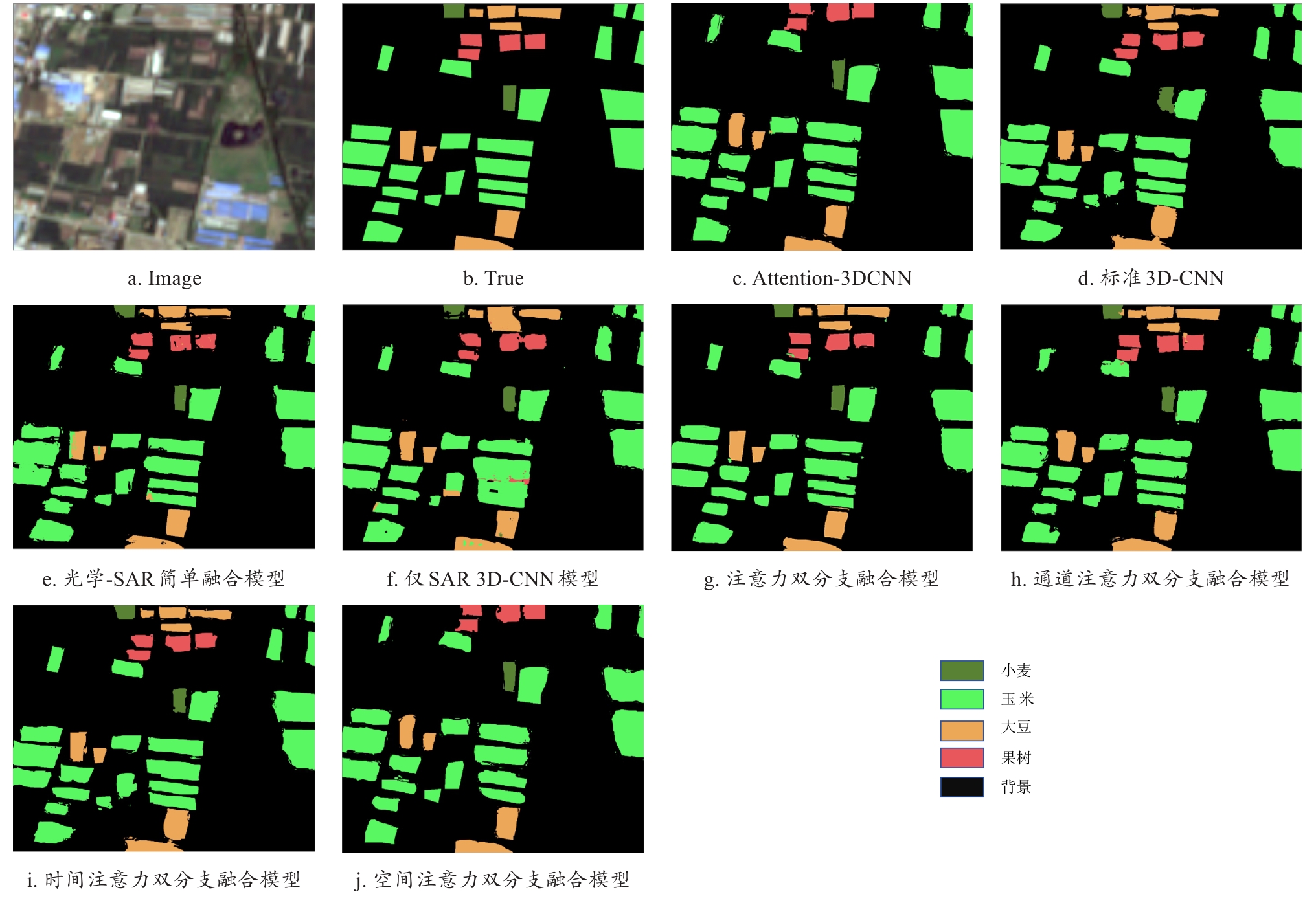

图10
在消融实验中Attention-3DCNN模型与其他模型在PASTIS数据集上的结果

表4
Attention-3DCNN模型与其他模型的对比
| 模型名称 | 核心方法简述 | OA(沂水县)/% | Kappa(沂水县) | 参数量/M | 计算量/GFLOPs | 推理时间/(ms/景) |
|---|---|---|---|---|---|---|
| 3D-ConvSTAR | 3DCNN多源融合(固定权重) | 89.5 | 0.858 | 45.2 | 128.3 | 156 |
| Self-Attention 3D | 自注意力机制+3DCNN | 90.5 | 0.872 | 52.7 | 145.6 | 183 |
| UNet++ | 编码器-解码器结构,多尺度特征融合 | 88.0 | 0.835 | 68.9 | 212.4 | 245 |
| CNN-LSTM-DS | 光学影像时序+纹理特征融合 | 86.5 | 0.815 | 43.0 | 98.7 | 132 |
| TGF-Net | 基于Transformer与卷积(CNN)架构 | 90.5 | 0.900 | 105.3 | 285.1 | 312 |
| Attention-3DCNN | 跨模态三重注意力(通道-时间-空间) | 93.5 | 0.910 | 41.3 | 97.2 | 133 |

图11
在对比实验中Attention-3DCNN模型与其他模型在沂水县数据集上的对比结果

表5
在高云量的条件下Attention-3DCNN模型与其他模型在沂水县数据集的对比
| 模型名称 | 主要依赖信息 | OA/% | 宏平均F 1 | Kappa |
|---|---|---|---|---|
| 3D-ConvSTAR | 光学时序为主 | 83.6 | 0.802 | 0.775 |
| Self-Attention 3D | 光学 + 时序注意力 | 85.1 | 0.821 | 0.796 |
| UNet++ | 光学空间特征 | 82.4 | 0.789 | 0.761 |
| CNN-LSTM-DS | 光学时序 + 手工特征 | 81.9 | 0.781 | 0.754 |
| TGF-Net | Transformer + CNN融合 | 86.3 | 0.836 | 0.812 |
| Attention-3DCNN | 跨模态三重注意力(S2+S1) | 89.4 | 0.872 | 0.846 |
表6
多源遥感农作物分类研究中不同模型在高云量条件下的下降幅度
| 模型 | 常规OA/% | 高云量OA/% | 下降幅度/百分点 |
|---|---|---|---|
| 3D-ConvSTAR | 89.5 | 83.6 | 5.9 |
| Self-Attention 3D | 90.5 | 85.1 | 5.4 |
| UNet++ | 88.0 | 82.4 | 5.6 |
| CNN-LSTM-DS | 86.5 | 81.9 | 4.6 |
| TGF-Net | 90.0 | 86.3 | 3.7 |
| Attention-3DCNN | 93.0 | 89.4 | 3.6 |
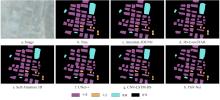
图12
在高云量的条件下Attention-3DCNN与其他模型在沂水县数据集的结果图

表7
地块破碎程度较高条件下Attention-3DCNN与其他模型在沂水县数据集的对比
| 模型名称 | 主要结构特点 | OA/% | 宏平均F 1 | Kappa |
|---|---|---|---|---|
| 3D-ConvSTAR | 3D 卷积,局部时空建模 | 84.9 | 0.816 | 0.792 |
| Self-Attention 3D | 3DCNN + 自注意力 | 86.2 | 0.829 | 0.806 |
| UNet++ | 编码器-解码器,多尺度跳连 | 83.5 | 0.801 | 0.776 |
| CNN-LSTM-DS | 空间 CNN+时序LSTM | 82.7 | 0.793 | 0.768 |
| TGF-Net | Transformer + CNN 融合 | 87.1 | 0.842 | 0.818 |
| Attention-3DCNN | 跨模态三重注意力 (含空间注意力) | 90.2 | 0.881 | 0.856 |
表8
多源遥感农作物分类研究中地块破碎程度较高条件下不同模型在沂水县数据集上的性能下降幅度
| 模型名称 | 常规测试OA/% | 破碎地块OA/% | 下降幅度/百分点 |
|---|---|---|---|
| 3D-ConvSTAR | 89.5 | 84.9 | 4.6 |
| Self-Attention 3D | 90.5 | 86.2 | 4.3 |
| UNet++ | 88.0 | 83.5 | 4.5 |
| CNN-LSTM-DS | 86.5 | 82.7 | 3.8 |
| TGF-Net | 90.0 | 87.1 | 2.9 |
| Attention-3DCNN | 93.0 | 90.2 | 2.8 |
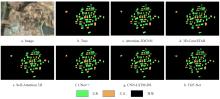
图13
在地块破碎的条件下Attention-3DCNN模型与其他模型在沂水县数据集的结果图

表9
法国 PASTIS 与中国沂水县各类别关键特征及模型注意力调整对比
| 分类类别 | 关键特征 | 法国PASTIS注意力权重(均值) | 沂水县注意力权重(均值) | 调整分析 |
|---|---|---|---|---|
| 小麦 | 抽穗期 | 时间: 0.76; 通道(B5): 0.21 | 时间: 0.79; 通道(B5): 0.23 | 物候提前,时间权重前移;红边波段重要性增强 |
| 大豆 | 开花结荚期 | 通道(VH): 0.35 | 通道(VH): 0.62 | 光学数据受限,SAR通道权重显著提升以补偿 |
| 背景 | 非农用地 | 空间: 0.58 | 空间: 0.71 | 地块破碎,模型更关注局部空间结构 |
表10
模型识别的关键物候期与沂水县农业局观测数据对比
| 作物类型 | 模型识别关键物候期(第X—X天) | 对应公历时间 | 沂水县农业农村局观测记录 | 匹配度/% |
|---|---|---|---|---|
| 小麦 | 120—150天 | 4月中下旬—5月上旬 | 4月20日—5月10日抽穗 | 100 |
| 玉米 | 180—210天 | 7月上旬—8月上旬 | 7月5日—8月5日灌浆 | 100 |
| 大豆 | 160—190天 | 6月下旬—7月下旬 | 6月25日—7月25日结荚 | 100 |
| 果树 | 70—90天 | 2月下旬—3月中旬 | 2月28日—3月15日萌芽 | 100 |
| [1] |
刘伊,张彦军. ReluformerN:轻量化高低频增强高光谱农业地物分类方法 [J]. 智慧农业(中英文), 2024, 6 (5): 74-87.
|
|
|
|
| [2] |
|
| [3] |
|
| [4] |
|
| [5] |
|
| [6] |
|
| [7] |
|
| [8] |
郭交, 王鹤颖, 项诗雨, 等. 基于多特征优化的PolSAR数据农作物精细分类方法[J]. 农业机械学报, 2024, 55(9): 275-285.
|
|
|
|
| [9] |
王佳玥, 蔡志文, 王文静, 等. 协同多源国产高分影像和面向对象方法的南方农作物遥感识别[J]. 中国农业科学, 2023, 56(13): 2474-2490.
|
|
|
|
| [10] |
林云浩, 王艳军, 李少春, 等. 一种耦合DeepLab与Transformer的农作物种植类型遥感精细分类方法[J]. 测绘学报, 2024, 53(2): 353-366.
|
|
|
|
| [11] |
张伟雄, 唐娉, 孟瑜, 等. 基于多尺度时空全局注意力的遥感影像时间序列农作物分类[J]. 遥感学报, 2024, 28(11): 2865-2877.
|
|
|
|
| [12] |
|
| [13] |
|
| [14] |
|
| [15] |
|
| [16] |
|
| [17] |
|
| [18] |
|
| [19] |
|
| [20] |
蔡玉林, 王兴路, 高洪振, 等. 融合3DCNN和Vision Transformer的多模态遥感数据树种分类方法[J]. 激光与光电子学进展, 2025, 62(20): 2028001.
|
|
|
|
| [21] |
李泽慧, 张琳, 山显英. 三维卷积神经网络方法改进及其应用综述[J]. 计算机工程与应用, 2025, 61(3): 48-61.
|
|
|
|
| [22] |
杨朋辉, 杨长青, 刘静, 等. 基于2D-3D卷积神经网络的情绪识别模型[J]. 燕山大学学报, 2025, 49(1): 66-73.
|
|
|
|
| [23] |
|
| [24] |
|
| [25] |
|
| [26] |
|
| [27] |
|
| [28] |
|
| [29] |
|
| [30] |
|
| [31] |
|
| [32] |
史洁宁, 吴田军, 黄启厅, 等. 耦合NDVI与纹理时序特征的地块作物遥感分类[J]. 南方农业学报, 2025, 56(1): 29-40.
|
|
|
|
| [33] |
|
| [34] |
|
| [1] | 苏玉杰, 李玥, 魏霖静, 吴兵, 郭林海, 剡斌, 周慧, 高玉红, 康亮河, 刘欢, 苏舜昌. 基于轻量化改进YOLOv11n-Seg的胡麻倒伏区域识别方法[J]. 智慧农业(中英文), 2026, 8(2): 35-47. |
| [2] | 赵丽成, 卢鑫羽, 吴茜, 任妮, 周玲莉, 程雅雯, 胡安琦, 戚超. 基于改进YOLOv10和LAMP通道剪枝的串番茄成熟度检测算法研发[J]. 智慧农业(中英文), 2026, 8(2): 133-146. |
| [3] | 连振翔, 费徐峰, 任周桥. 基于河马优化算法与机器学习的土壤有机质制图采样策略[J]. 智慧农业(中英文), 2026, 8(2): 48-58. |
| [4] | 刘恩奇, 刘淼, 王拓, 朱耀辉, 陈日强, 徐波, 高美玲, 张静, 杨耘, 杨贵军. 基于时序气温特征增强的苹果始花期Bi-LSTM预测方法[J]. 智慧农业(中英文), 2026, 8(2): 86-97. |
| [5] | 许晓斌, 朱红春, 李峰, 贺威, 杨家铭, 李振海. 高时空分辨率遥感支撑的农业精准灾害预警:进展、瓶颈与融合路径[J]. 智慧农业(中英文), 2026, 8(2): 18-34. |
| [6] | 蔡玉琴, 刘大铭, 徐琴, 李波洋, 刘博杰. 基于自适应Kalman滤波与GWO-LSTM-Attention的温室温湿度预测方法[J]. 智慧农业(中英文), 2026, 8(1): 148-155. |
| [7] | 胡雨萌, 关非凡, 谢东辰, 马萍, 余有本, 周杰, 聂炎明, 黄铝文. 基于增强型轻量U-Net3+的茶叶病害诊断方法[J]. 智慧农业(中英文), 2026, 8(1): 15-27. |
| [8] | 黄先果, 朱启兵, 黄敏. 基于时序多源信息融合的果蔬新鲜度在线检测系统[J]. 智慧农业(中英文), 2026, 8(1): 203-212. |
| [9] | 武张斌, 何宁, 吴延东, 郭新宇, 温维亮. 点云数据驱动的玉米叶片生物量估算方法[J]. 智慧农业(中英文), 2026, 8(1): 156-166. |
| [10] | 姚晓通, 曲绍业. 基于改进YOLOv12s的辣椒叶片病虫害轻量化检测方法[J]. 智慧农业(中英文), 2026, 8(1): 1-14. |
| [11] | 张运, 张露敏, 许广涛, 郝佳慧. 基于双分支与多尺度注意力机制的稻虾田遥感提取方法[J]. 智慧农业(中英文), 2025, 7(6): 185-195. |
| [12] | 谢文豪, 张新, 董文, 郑逸榛, 程博, 涂文丽, 孙凤青. 基于Stacking集成学习的地块尺度农作物分布制图[J]. 智慧农业(中英文), 2025, 7(6): 196-209. |
| [13] | 卢怡行, 董文, 张新, 闫若一, 张玉加, 唐涛. 基于物理约束PROSAIL-cGAN的冬小麦LAI光谱样本增强与反演方法[J]. 智慧农业(中英文), 2025, 7(6): 149-160. |
| [14] | 王银辉, 赵安周, 李丹, 朱秀芳, 赵军, 王紫晴. 轻量可解释的大豆遥感识别模型构建与评估[J]. 智慧农业(中英文), 2025, 7(6): 136-148. |
| [15] | 龙禹桥, 孙晶, 温艳茹, 汪楚涯, 董秀春, 黄平, 吴文斌, 陈晋, 丁明忠. 南方丘陵山区耕地撂荒遥感监测综述[J]. 智慧农业(中英文), 2025, 7(6): 58-74. |
| 阅读次数 | ||||||
|
全文 |
|
|||||
|
摘要 |
|
|||||