• •
修贤超1, 费士祺1,2,3, 张伟1( ), 黄文倩2,3, 苗中华1
收稿日期:2026-03-13
出版日期:2026-05-22
基金项目:作者简介:修贤超,副教授,硕士生导师,研究方向为大模型与具身智能。E-mail:xcxiu@shu.edu.cn
通信作者:
XIU Xianchao1, FEI Shiqi1,2,3, ZHANG Wei1(), HUANG Wenqian2,3, MIAO Zhonghua1
Received:2026-03-13
Online:2026-05-22
Foundation items:National Natural Science Foundation of China(32401712); Natural Science Foundation of Shanghai(24ZR1424800); China Postdoctoral Science Foundation(2024M751937)
About author:XIU Xianchao, E-mail: xcxiu@shu.edu.cn
Corresponding author:摘要:
【目的/意义】 作为水果产后的关键环节,高效精准的质量检测对保障食品安全与提升产业效率至关重要。本文综述了YOLO模型在水果缺陷检测领域的研究进展,旨在为农业水果缺陷检测技术的进一步发展提供理论支撑与技术参考。[进展] 近年来,基于深度学习的目标检测算法,特别是YOLO(You Only Look Once)系列模型在实时性、高精度和低计算量的优势,在水果缺陷检测研究获得了出色的效果。本文聚焦水果缺陷检测,首先回顾了YOLOv1至YOLO26的发展历程,并分析每代YOLO的创新改进。在此基础上,综述了YOLO系列模型在多种水果缺陷检测任务中的应用现状,列举了这些算法在应对水果缺陷检测挑战方面的贡献,具体包括内部与隐性缺陷的识别、复杂表面形态下的缺陷检测,以及模型的轻量化与边缘部署。同时,本文也探讨了这些技术如何满足高速生产线的实时处理,以及在资源受限的硬件设备上实现高效部署的工业需求。 【结论/展望】 最后,总结了算法局限性,数据集特异性,硬件部署约束和复杂检测环境影响四方面的挑战,并从公共数据集的构建,模型可解释性,人机协作策略机制和大模型与YOLO的结合的四个方面展望了未来研究方向。
中图分类号:
修贤超, 费士祺, 张伟, 黄文倩, 苗中华. YOLO系列模型在水果缺陷检测的研究进展及发展趋势[J]. 智慧农业(中英文), doi: 10.12133/j.smartag.SA202603017.
XIU Xianchao, FEI Shiqi, ZHANG Wei, HUANG Wenqian, MIAO Zhonghua. Research Progress and Development Trends of YOLO Family of Algorithms in Fruit Defect Detection[J]. Smart Agriculture, doi: 10.12133/j.smartag.SA202603017.
表1
基于深度学习的水果缺陷检测主要步骤
| 主要步骤 | 详细操作 |
|---|---|
| 数据集准备 | 构建水果缺陷数据集,数据清洗,数据标注,数据集划分 |
| 模型设计 | 设计合适的深度学习模型,以适应水果缺陷检测任务的要求 |
| 模型训练 | 利用整理后的水果缺陷数据集训练模型,同时调整网络的训练参数 |
| 模型评估 | 选用合适的评估指标验证模型性能,如准确率、精确率、召回率、F 1值、平均精度均值等 |
| 缺陷检测 | 将新的缺陷水果图像输入到训练好的模型中进行检测,并输出缺陷检测结果 |
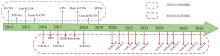
图1
基于深度学习的目标检测方法(2014-2026) 注:SPP-Net的全称是Spatial Pyramid Pooling Network;M2Det 的全称是Multi-Level Feature Pyramid Network based Single-Shot Object Detector
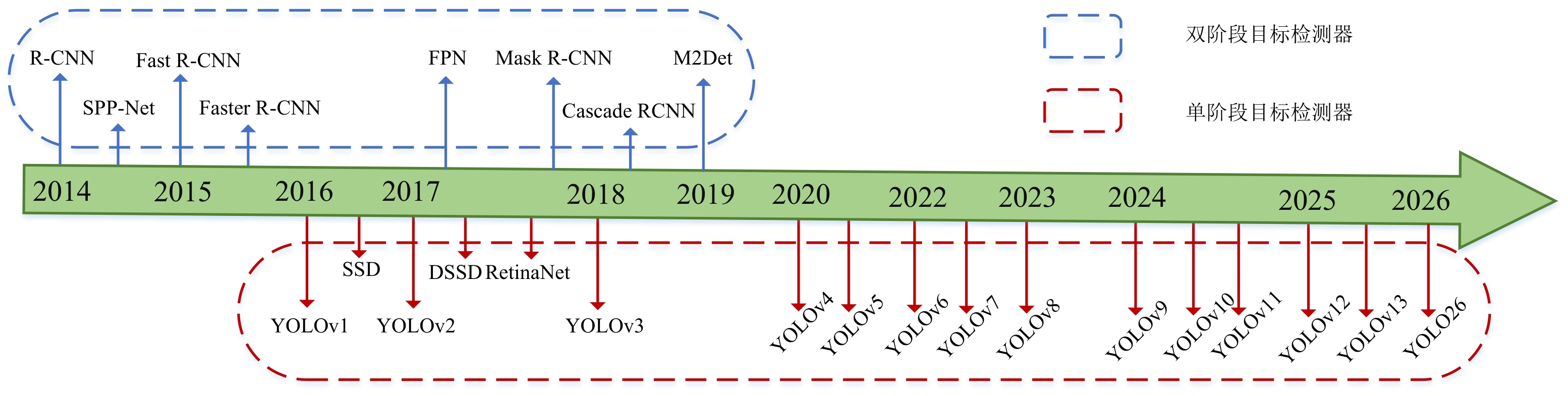
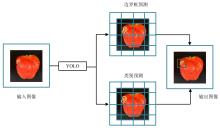
图2
基于YOLO的目标检测技术原理图
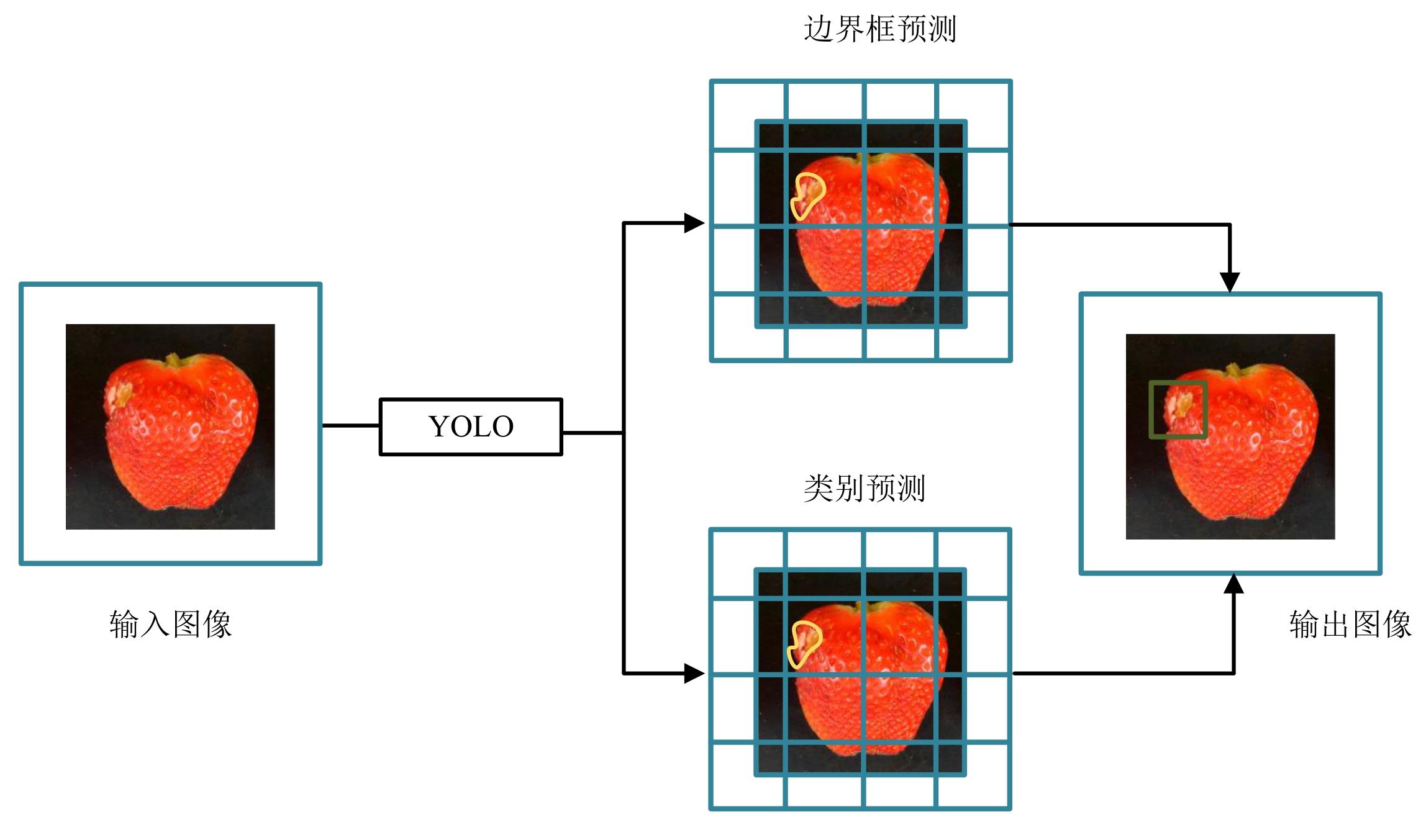
表2
YOLO各版本贡献
| 版本 | 贡献 | 框架 | |
|---|---|---|---|
| 第一阶段 | YOLOv1 | 单阶段检测器 | Darknet |
| YOLOv2 | 多尺度训练,维度聚类 | Darknet | |
| YOLOv3 | Darknet-53网络 | Darknet | |
| 第二阶段 | YOLOv4 | 空间金字塔池化模块,基于Mish的激活函数,CSPDarknet-53网络 | Darknet |
| YOLOv5 | 基于SWISH的激活函数,路径聚合网络 | Pytorch | |
| YOLOv6 | SimOTA标签分配策略,无锚框检测头 | Pytorch | |
| YOLOv7 | E-ELAN网络,Transformers预测头,扩展高效层聚合网络重参数化 | Pytorch | |
| YOLOv8 | 分布焦点损失函数,空间金字塔快速池化层,任务对齐分配策略 | Pytorch | |
| 第三阶段 | YOLOv9 | 可编程梯度信息,广义高效层聚合网络 | Pytorch |
| YOLOv10 | 无非极大值抑制训练方法,双重标签分配,面向提升精度与效率的整体模型设计 | Pytorch | |
| YOLOv11 | 带空间注意力的跨阶段局部网络,C3k2(Cross-Stage Partial Kernel-2)模块 | Pytorch | |
| YOLOv12 | 残差高效层聚合网络,区域注意力机制 | Pytorch | |
| YOLOv13 | 基于超图的自适应相关性增强,全流程聚合与分布 | Pytorch | |
| YOLO26 | MuSGD优化器,语义分割损失模块,多尺度原型模块 | Pytorch |
图3
部分水果常见表面缺陷图 a. 苹果 b. 梨 c. 番茄 d. 草莓 e. 冬枣 f. 柑橘 g. 柠檬
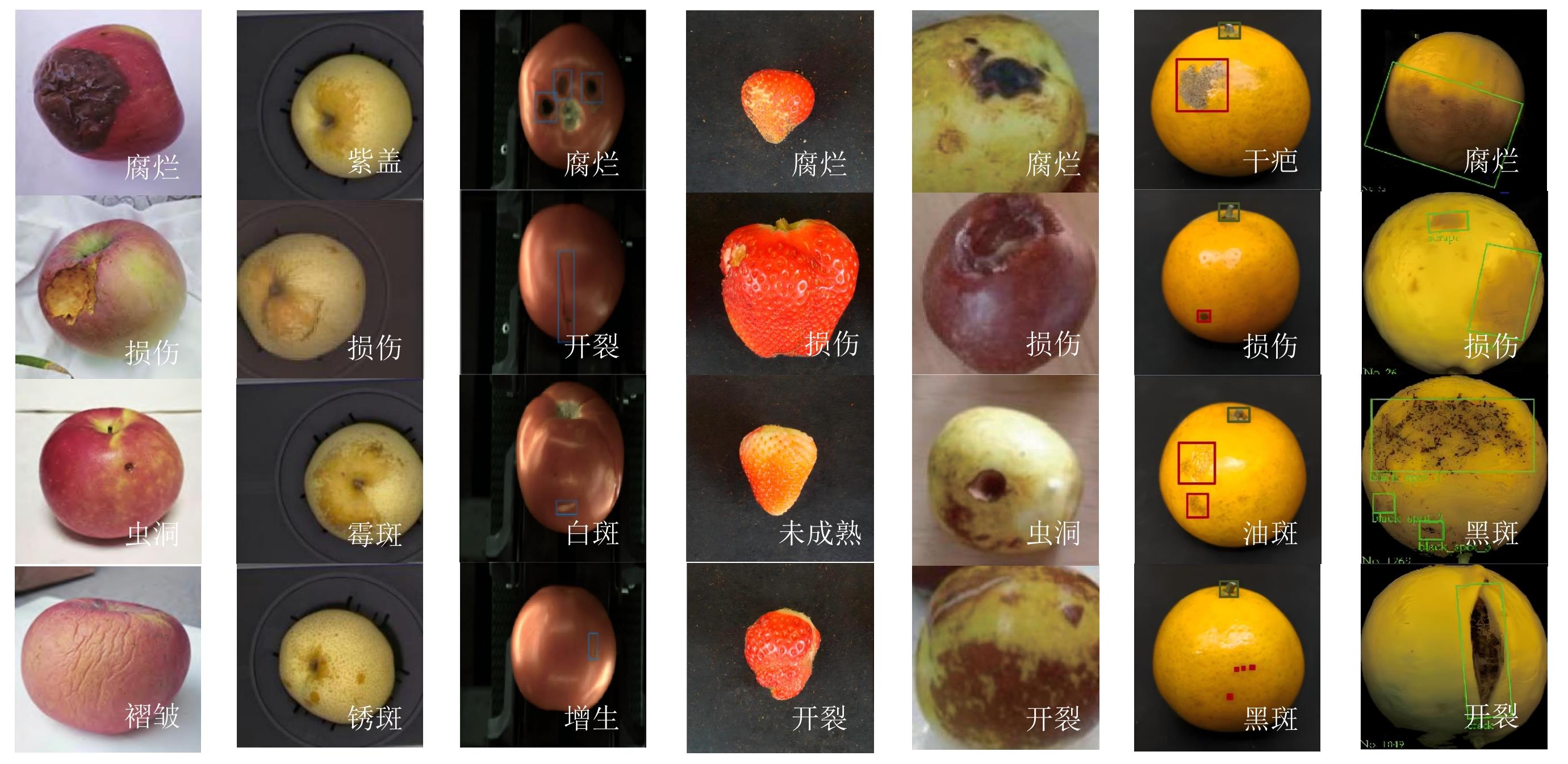
表3
基于YOLO系列模型的水果内部与隐性缺陷检测相关研究成果
| 年份 | 模型 | 水果 | 改进方法 | 研究难点 | mAP0.5/% |
|---|---|---|---|---|---|
| 2024 | YOLOv7[ | 柑橘 | 1)SIRI技术 2)坐标注意力机制 3)Mish激活函数 4)引入SPPFS(Spatial Pyramid Pooling - Fast, SPP Fand feature selection)模块 | RGB图像无法检测内部缺陷 | 95.9 |
| 2022 | YOLOv4[ | 苹果 | 1)近红外相机图像采集系统 2)模型的通道剪枝与层剪枝 | RGB图像无法检测内部缺陷 | 92.42 |
| 2023 | YOLOv3[ | 草莓 | 1)近红外相机图像采集系统 2)近红外与RGB图像像素融合 | RGB图像无法检测内部缺陷 | 87.18 |
| 2023 | YOLOv5[ | 柑橘 | 1)双光源采集系统 2)广义交并比(Generalized Intersection over Union,GIoU)损失函数 3)卷积块注意力模块(Convolutional Block Attention Module,CBAM) | 自然光下缺陷不易检测 | 98.7 |
| 2026 | YOLOv11[ | 柑橘 | 1)紫外荧光成像 | 自然光下缺陷不易检测 | 96.9 |
| 2025 | YOLOv12[ | 苹果 | 1)滤波成像与色彩空间重建结合 | 自然光下缺陷不易检测 | 98.9 |
| 2023 | YOLOv5[ | 草莓 | 1)引入分类模型 2)优化损失函数 | 复杂环境缺陷不易检测 | 85.4 |
| 2023 | YOLOv5[ | 草莓 | 1)引入Deeplabv3语义分割网络 2)添加分支结构 3)引入可变形卷积 | 复杂环境缺陷不易检测 | 62.8 |
表4
基于YOLO系列模型的复杂表面环境下水果缺陷检测相关研究成果
| 年份 | 模型 | 水果 | 改进方法 | 研究难点 | mAP0.5/% |
|---|---|---|---|---|---|
| 2022 | YOLOv8[ | 苹果 | 1)引入空间深度卷积(Space-to-Depth Convolution, SPD-Conv) 2)引入多尺度空洞注意力机制(Multi-scale Empty Attention, MSDA) 3)引入上下文引导特征金字塔网络(Context Guided Feature Pyramid Network, CGFPN) | 表面坑凹区域与缺陷相似易误检 | 91.4 |
| 2025 | YOLOv8[ | 苹果 | 1)引入部分卷积(Partial Convolution,PConv)模块 2)高效多尺度注意力(Efficient Multi-scale Attention,EMA)机制 3)最小点距离交并比(Minimum Point Distance Intersection over Union) 4)引入Slim-neck架构 | 表面坑凹区域与缺陷相似易误检 | 90.1 |
| 2023 | YOLOv5[ | 苹果 | 1)引入TRANS(Transformer)模块 2)引入BiFPN 3)基于归一化的注意力模块(Normalization-based Attention Module,NAM) | 表面坑凹区域与缺陷相似易误检 | 98.9 |
| 2024 | YOLOv5[ | 梨 | 1)BAM(Bottleneck Attention Module)注意力机制 2)设计C3-GDC(C3-GhostDynamicConv)卷积模块 3)明智交并比(Wise Intersection over Union,WIoU)损失函数 | 花萼/果梗与缺陷相似易误检 | 93.9 |
| 2025 | YOLOv5[ | 梨 | 1)基于双层路由注意力机制的视觉 Transformer( 2)引入双向特征金字塔网络(Bidirectional Feature Pyramid Network,BiFPN) | 花萼/果梗与缺陷相似易误检 | 68.2 |
| 2023 | YOLOv10[ | 柑橘 | 1)引入线性可变形卷积(Linear Deformable Convolution,LDConv) 2)引入广义特征金字塔网络(Generalized Feature Pyramid Network,GFPN) | 缺陷微小且复杂多变易漏检 | 98.7 |
| 2024 | YOLOv5[ | 柑橘 | 1)三维坐标注意力(Three-dimensional Coordinate Attention,TDCA)机制 2)引入CT(Contextual Transformer)模块 3)引入BiFPN | 缺陷微小且复杂多变易漏检 | 98.7 |
| 2024 | YOLOv8[ | 柠檬 | 1)CBAM注意力机制 2)设计C2f-SAS(Switchable Atrous Convolution)模块 | 缺陷形态复杂多变易漏检 | 90.62 |
| 2024 | YOLOv5[ | 苹果 | 1)设计DSCS卷积模块 2)指数线性单元(Exponential Linear Unit,ELU)激活函数 3)WIoU损失函数 | 缺陷微小且复杂多变易漏检 | 90.9 |
| 2024 | YOLOv7[ | 苹果 | 1)CBAM和ECA注意力机制 2)引入深度可分离卷积策略 3)参数化修正线性单元(Parametric Rectified Linear Unit,PReLU)损失函数 | 缺陷微小且复杂多变易漏检 | 90.7 |
| 2026 | YOLOv11[ | 苹果 | 1)设计三视角成像系统 2)引入非局部自注意力残差多层感知机模块(Non-Local Attention Residual Multi-layer perceptron,NARM) | 缺陷微小且复杂多变易漏检 | 89.8 |
| 2024 | YOLOv8[ | 李子 | 1)引入SPD-Conv模块 2)引入扩张式残差分割网络(Dilation-wise Residual Segmentation,DWRSeg)模块 3)高效交并比(Efficient Intersection over Union,EIoU)损失函数 | 缺陷微小且复杂多变易漏检 | 87.8 |
| 2025 | YOLOv11[ | 番茄 | 1)引入小波深度可分离卷积 ( Wavelet Depth Separable Convolution,WDWConv) 2)设计WC3k2模块 | 不规则缺陷易漏检 | 88 |
| 2024 | YOLOv7[ | 猕猴桃 | 1)CBAM注意力机制 2)设计C3-Ghost模块 3)优化损失函数 | 不规则缺陷易漏检 | 93 |
| 2024 | YOLOv7[ | 红枣 | 1)简单注意力机制(Simple Attention Module,SimAM) 2)引入深度可分离卷积 (Depthwise Separable Convolution,DSConv) 3)引入ByteTrack跟踪算法 | 密集排列遮挡且不规则缺陷易漏检 | 85.3 |
| 2025 | YOLOv5[ | 红枣 | 1)坐标注意力(Coordinate Attention,CA)机制 2)增加小目标检测头 | 密集排列遮挡且不规则缺陷易漏检 | 91.6 |
| 2025 | YOLOv7[ | 葡萄 | 1)WIoU损失函数 2)Bi-Former注意力机制 | 果实小且密集排列遮挡易漏检 | 80.1 |
| 2023 | YOLOX[ | 樱桃 | 1)CBAM注意力机制 2)改进损失函数 | 果实小且密集排列遮挡易漏检 | 91.84 |
| 2025 | YOLOv8[ | 樱桃 | 1)引入DySlimNeck动态颈部层 2)引入Detect-FRM(Detect-Fourier Representation Module)检测头 3)引入FasterNet-RepMixer网络 | 果实小且密集排列遮挡易漏检 | 91.5 |
表5
基于YOLO系列算法的水果缺陷检测模型轻量化相关研究成果
| 年份 | 模型 | 水果 | 改进方法 | 研究难点 | mAP0.5/% |
|---|---|---|---|---|---|
| 2025 | YOLOv11[ | 梨 | 1)引入BiFPN 2)CBAM注意力机制 3)引入TR2(Two Transformer)模块 4)双层迁移学习 | 实际场景计算资源受限模型难以部署 | 92.7 |
| 2023 | YOLOv4[ | 梨 | 1)PConv模块 2)EMA机制 3)MPDIoU损失函数 4)引入Slim-neck架构轻量化颈部网络 | 实际场景计算资源受限模型难以部署 | 85.52 |
| 2025 | YOLOv5[ | 苹果 | 1)多尺度检测头简化为双尺度或单尺度 2)移除冗余卷积层 | 实际场景计算资源受限模型难以部署 | 99.8 |
| 2024 | YOLOv5[ | 苹果 | 1)引入LightweightC3模块作为骨干网络的基本构建模块 2)设计EnhancedC3模块替代模型特征融合部分的C3模块 3)引入GSConv模块 | 实际场景计算资源受限模型难以部署 | 96.12 |
| 2022 | YOLOv5[ | 芒果 | 1)引入PPLCNet网络 2)引入GhostNet网络 | 实际场景计算资源受限模型难以部署 | 94.3 |
| 2025 | YOLOv5[ | 百香果 | 1)设计了StarC3SE模块替代C3模块 2)CBAM注意力机制 3)距离交并比(Distance Intersection over Union, DIoU)损失函数 | 实际场景计算资源受限模型难以部署 | 88.4 |
| 2024 | YOLOv5[ | 苹果 | 1)引入EfficientNetV模块 2)EMA机制 | 实际场景计算资源受限模型难以部署 | 93.6 |
| 2023 | YOLOv4[ | 柑橘 | 1)对网络进行剪枝优化移除冗余通道 2)去除冗余预测框 | 实际场景计算资源受限模型难以部署 | 94.56 |
| 2022 | YOLOv4[ | 苹果 | 1)与BiSeNet V2语义网络结合构成了双模型级联检测框架 2)对网络进行剪枝优化移除冗余通道 | 实际场景计算资源受限模型难以部署 | 92.42 |
| 2025 | YOLOv12[ | 番茄 | 1)引入RFEM模块 2)设计Dysample-Slim-Neck机制 3)引入动态卷积替代检测头中的传统卷积结构 | 实际场景计算资源受限模型难以部署 | 88.5 |
| 2024 | YOLOv8[ | 苹果 | 知识蒸馏 | 实际场景计算资源受限模型难以部署 | 97.8 |
| 2025 | YOLOv8[ | 百香果 | 1)设计MFSO(More Focus on Small Objects)网络结构 2)动态重参数化 (Dynamic Reparameterization, DyRep) 3)NWD(Normalized Wasserstein Distance)损失函数 4)模型剪枝 | 实际场景计算资源受限模型难以部署 | 94.6 |
| 2024 | YOLOv3[ | 莲蓬 | 1)先验锚框尺度调整 2)引入金字塔池化层(Spatial Pyramid Pooling, SPP) 3)使用遗传算法改进网络超参数 | 实际场景计算资源受限模型难以部署 | 96.8 |
| [1] |
|
| [2] |
|
| [3] |
|
| [4] |
田有文, 吴伟, 卢时铅, 等. 深度学习在水果品质检测与分级分类中的应用[J]. 食品科学, 2021, 42(19): 260-270.
|
|
|
|
| [5] |
|
| [6] |
宋怀波, 尚钰莹, 何东健. 果实目标深度学习识别技术研究进展[J]. 农业机械学报, 2023, 54(1): 1-19.
|
|
|
|
| [7] |
|
| [8] |
|
| [9] |
|
| [10] |
张子申, 程红, 耿文娟, 等. 高光谱成像技术在水果品质检测中的应用研究进展[J]. 智慧农业(中英文), 2025, 7(5): 52-66.
|
|
|
|
| [11] |
徐文青, 丁爱霞, 朱文卿. 基于数字图像处理技术的水果分级检测研究进展[J]. 食品安全导刊, 2025(4): 183-189.
|
|
|
|
| [12] |
|
| [13] |
麻剑钧, 刘晓慈, 金龙新, 等. 基于机器视觉的农作物病害识别研究进展[J]. 湖南农业科学, 2023(9): 97-100.
|
|
|
|
| [14] |
周长建, 宋佳, 向文胜. 基于人工智能的作物病害识别研究进展[J]. 植物保护学报, 2022, 49(1): 316-324.
|
|
|
|
| [15] |
郭文娟, 冯全, 李相周. 基于农作物病害检测与识别的卷积神经网络模型研究进展[J]. 中国农机化学报, 2022, 43(10): 157-166.
|
|
|
|
| [16] |
|
| [17] |
|
| [18] |
|
| [19] |
|
| [20] |
|
| [21] |
|
| [22] |
|
| [23] |
|
| [24] |
|
| [25] |
|
| [26] |
|
| [27] |
|
| [28] |
|
| [29] |
|
| [30] |
|
| [31] |
|
| [32] |
|
| [33] |
|
| [34] |
|
| [35] |
|
| [36] |
|
| [37] |
|
| [38] |
|
| [39] |
|
| [40] |
|
| [41] |
|
| [42] |
|
| [43] |
|
| [44] |
|
| [45] |
|
| [46] |
|
| [47] |
|
| [48] |
|
| [49] |
|
| [50] |
|
| [51] |
|
| [52] |
|
| [53] |
|
| [54] |
|
| [55] |
|
| [56] |
|
| [57] |
|
| [58] |
|
| [59] |
朱文铭. 基于深度学习的草莓缺陷检测算法研究[D]. 湛江: 广东海洋大学, 2023.
|
|
|
|
| [60] |
|
| [61] |
王会征, 李新龙, 薄萍, 等. 基于改进YOLOv8n的自然场景下苹果外观品质检测方法[J]. 农业工程学报, 2025, 41(11): 173-182.
|
|
|
|
| [62] |
张嘉琪, 徐啟蕾. 基于NAM-YOLO网络的苹果缺陷检测算法[J]. 计算机与现代化, 2023(10): 53-58, 64.
|
|
|
|
| [63] |
|
| [64] |
陈峻生. 基于深度学习的梨缺陷检测与分级[D]. 福州: 福建农林大学, 2025.
|
|
|
|
| [65] |
|
| [66] |
|
| [67] |
|
| [68] |
朱琦, 周德强, 盛卫锋, 等. 基于DSCS-YOLO的苹果表面缺陷检测方法[J]. 南京农业大学学报, 2024, 47(3): 592-601.
|
|
|
|
| [69] |
徐江鹏, 王传安. 基于轻量化改进YOLO v7-Tiny算法的苹果检测与分类[J]. 江苏农业科学, 2024, 52(23): 221-229.
|
|
|
|
| [70] |
孙国祥, 陈光宇, 汪小旵, 等. 基于三视角成像的苹果表面缺陷检测方法[J]. 农业工程学报, 2026, 42(3): 348-358.
|
|
|
|
| [71] |
霍新梅. 自然环境中李子果实成熟度与表面缺陷检测方法研究[D]. 合肥: 安徽农业大学, 2024.
|
|
|
|
| [72] |
朱婷婷, 滕广, 张亚军, 等. 基于改进YOLOv11的番茄表面缺陷检测方法[J]. 农业机械学报, 2025, 56(6): 546-553.
|
|
|
|
| [73] |
许川. 猕猴桃表面缺陷智能检测与分级方法研究[D]. 柳州: 广西科技大学, 2024.
|
|
|
|
| [74] |
刘鑫, 马本学, 李玉洁, 等. 基于改进YOLOv7-ByteTrack的干制哈密大枣缺陷检测与计数系统[J]. 农业工程学报, 2024, 40(3): 303-312.
|
|
|
|
| [75] |
史鹏涛, 田政伟, 李晓泽, 等. 基于改进YOLO v5s算法的红枣缺陷检测与分拣方法[J]. 江苏农业科学, 2025, 53(5): 83-88.
|
|
|
|
| [76] |
|
| [77] |
刘敬宇, 裴悦琨, 常志远, 等. 基于改进YOLOX模型的樱桃缺陷及分级检测[J]. 食品与机械, 2023, 39(1): 139-145.
|
|
|
|
| [78] |
|
| [79] |
李成轩, 赵春江, 张驰, 等. 基于AIC-YOLOv11n模型的砀山梨多表面缺陷检测方法[J]. 农业工程学报, 2025, 41(14): 320-328.
|
|
|
|
| [80] |
|
| [81] |
|
| [82] |
鄢紫, 陈良艳, 刘卫华, 等. 基于YOLO-FFD的水果品种和新鲜度识别方法[J]. 食品与机械, 2024, 40(1): 115-121.
|
|
|
|
| [83] |
聂衍文, 徐建. 基于YOLOv5s的移动端轻量化芒果果面缺陷检测应用设计[J]. 武汉轻工大学学报, 2022, 41(5): 89-95, 103.
|
|
|
|
| [84] |
|
| [85] |
|
| [86] |
|
| [87] |
梁晓婷, 庞琦, 杨一, 等. 基于YOLOv4模型剪枝的番茄缺陷在线检测[J]. 农业工程学报, 2022, 38(6): 283-292.
|
|
|
|
| [88] |
|
| [89] |
方晨羽. 基于深度学习的果实采前识别与采后品质检测研究[D]. 杭州: 浙江科技大学, 2024.
|
|
|
|
| [90] |
|
| [91] |
张雷, 严昊, 贾永镒, 等. 采用改进YOLOv3-Tiny模型的轻量化莲蓬质量分级算法[J]. 农业工程学报, 2024, 40(23): 248-257.
|
|
|
|
| [92] |
|
| [93] |
梁秀满, 肖寒. 基于SDD-YOLO的轻量级带钢缺陷实时检测算法[J]. 中国测试, 2025, 51(3): 154-161.
|
|
|
|
| [94] |
|
| [95] |
徐彦威, 李军, 董元方, 等. YOLO系列目标检测算法综述[J]. 计算机科学与探索, 2024, 18(9): 2221-2238.
|
|
|
|
| [96] |
|
| [97] |
|
| [98] |
|
| [1] | 苏玉杰, 李玥, 魏霖静, 吴兵, 郭林海, 剡斌, 周慧, 高玉红, 康亮河, 刘欢, 苏舜昌. 基于轻量化改进YOLOv11n-Seg的胡麻倒伏区域识别方法[J]. 智慧农业(中英文), 2026, 8(2): 35-47. |
| [2] | 吴婷婷, 郭俊睿, 陶秋洁, 陈世华, 郭善利. YOLOv8n-SSND:改进的无人机航拍藜麦穗目标检测轻量模型[J]. 智慧农业(中英文), 2026, 8(2): 59-71. |
| [3] | 赵丽成, 卢鑫羽, 吴茜, 任妮, 周玲莉, 程雅雯, 胡安琦, 戚超. 基于改进YOLOv10和LAMP通道剪枝的串番茄成熟度检测算法研发[J]. 智慧农业(中英文), 2026, 8(2): 133-146. |
| [4] | 修贤超, 费士祺, 黄文倩, 李楠, 苗中华. 基于轻量化Mamba-YOLO模型的梨表面缺陷检测方法[J]. 智慧农业(中英文), 2026, 8(2): 147-157. |
| [5] | 刘浩然, 王宇, 赵学观, 吴华瑞, 付豪, 庞树杰, 翟长远. CD-YOLO:基于改进YOLOv11s的田间胡萝卜苗检测方法[J]. 智慧农业(中英文), 2026, 8(2): 158-174. |
| [6] | 张文博, 江一珏, 宋巍, 贺琪, 张文博. CAGE-YOLO: 基于遥感影像的水产养殖网箱高密度小目标检测模型[J]. 智慧农业(中英文), 2026, 8(2): 98-117. |
| [7] | 巫晨旭, 左浩龙, 李刚. 面向云遮挡与复杂地块场景下的跨模态注意力多源遥感农作物分类[J]. 智慧农业(中英文), 2026, 8(2): 118-132. |
| [8] | 李澳强, 戴航宇, 郭亚. 基于双目视觉和改进YOLOv11-pose的河蟹水下原位质量估测方法[J]. 智慧农业(中英文), 2026, 8(1): 192-202. |
| [9] | 肖瑞宏, 谭立新, 王日凤, 宋敏, 胡程喜. 基于改进YOLOv11n的多尺度茶叶病害检测方法[J]. 智慧农业(中英文), 2026, 8(1): 62-71. |
| [10] | 武张斌, 何宁, 吴延东, 郭新宇, 温维亮. 点云数据驱动的玉米叶片生物量估算方法[J]. 智慧农业(中英文), 2026, 8(1): 156-166. |
| [11] | 高光甫, 王启磊, 宋丽雯, 冯海宽, 时雷, 杨浩, 刘杨, 岳继博. 基于CornYOLO的冠层内玉米果穗目标检测方法[J]. 智慧农业(中英文), 2026, 8(1): 167-177. |
| [12] | 姚晓通, 曲绍业. 基于改进YOLOv12s的辣椒叶片病虫害轻量化检测方法[J]. 智慧农业(中英文), 2026, 8(1): 1-14. |
| [13] | 赵峻, 聂志刚, 李广, 刘佳宇. 基于无人机低空近景图像的玉米螟虫害检测方法[J]. 智慧农业(中英文), 2025, 7(6): 111-123. |
| [14] | 曹玉莹, 刘银川, 高新悦, 贾银江, 董守田. LightTassel-YOLO:一种基于无人机遥感的玉米雄穗实时检测方法[J]. 智慧农业(中英文), 2025, 7(6): 96-110. |
| [15] | 张运, 张露敏, 许广涛, 郝佳慧. 基于双分支与多尺度注意力机制的稻虾田遥感提取方法[J]. 智慧农业(中英文), 2025, 7(6): 185-195. |
| 阅读次数 | ||||||
|
全文 |
|
|||||
|
摘要 |
|
|||||