Smart Agriculture ›› 2026, Vol. 8 ›› Issue (4): 217-237.doi: 10.12133/j.smartag.SA202605017
• 信息处理与决策 • 上一篇
杨玉1, 张轶博2, 毛波2, 章磊2( )
)
收稿日期:2026-05-12
出版日期:2026-07-30
基金项目:作者简介:杨 玉,硕士研究生,研究方向为智慧农业及装备。E-mail:2514056148@qq.com;
张轶博,研究方向为人工智能应用。E-mail:feptsss@gmail.com
杨玉、张轶博为并列第一作者
通信作者:
YANG Yu1, ZHANG Yibo2, MAO Bo2, ZHANG Lei2()
Received:2026-05-12
Online:2026-07-30
Foundation items:National Key Research and Development Program of China(2024YFF1105504)
About author:YANG Yu, E-mail: 2514056148@qq.com;
ZHANG Yibo, E-mail: feptsss@gmail.com
Corresponding author:摘要:
【目的/意义】 玉米叶片病虫害早期目标通常具有尺度小、纹理弱、背景复杂以及类间差异不明显等特点,现有轻量化检测模型在田间复杂环境和边缘设备部署条件下难以兼顾检测精度与计算效率。为提高复杂田间环境下玉米叶片病虫害小目标识别能力,提出一种三点式轻量化增强框架LiteFocus-Net。 【方法】 以YOLOv11n为基础模型,从特征提取、细节恢复和损失优化3个方面进行改进。首先,设计自适应核轻量化模块(Adaptive Kernel Lightweight Block, AKL-Block),利用轻量化门控机制在3×3、5×5和7×7深度可分离卷积核之间进行动态选择,提高模型对不同尺度病虫害目标的特征提取能力;其次,提出特征分解重构模块(Feature Decomposition and Reconstruction, FDR),将深层特征划分为结构分支和细节分支,并采用轻量化亚像素重构方式恢复小目标边缘、纹理和局部轮廓信息;最后,提出尺度感知梯度增强损失(Scale-Aware Gradient Boosting Loss, SAGB-Loss),结合特征层级权重和目标面积连续增强因子,提升小目标样本在训练过程中的梯度贡献。 【结果和讨论】 在包含10 324张田间玉米叶片图像、8类病虫害目标的数据集上进行实验验证。LiteFocus-Net的mAP@0.5达到74.97%,相比YOLOv11n提升2.77个百分点;小目标检测精度AP_s由28.10%提升至32.77%,提升4.67个百分点。消融实验表明,AKL-Block、FDR和SAGB-Loss分别从多尺度特征表达、深层细节恢复和训练梯度优化方面发挥作用,三者协同提升了模型对微小病斑、虫卵和孢子簇等弱特征目标的检测能力。同时,模型参数量仅为2.52 M,计算量为5.3 GFLOPs,较YOLOv11n降低15.9%,且中、大目标检测性能保持稳定。 【结论】 LiteFocus-Net能够在较低计算开销下提升玉米叶片病虫害小目标检测性能,在精度和轻量化之间取得较好平衡,可为无人机巡检、农业机器人和边缘智能植保设备提供有效的视觉检测方法。
中图分类号:
杨玉, 张轶博, 毛波, 章磊. LiteFocus-Net:面向玉米叶片病虫害小目标检测的三点式轻量化增强框架[J]. 智慧农业(中英文), 2026, 8(4): 217-237.
YANG Yu, ZHANG Yibo, MAO Bo, ZHANG Lei. LiteFocus-Net: A Three-Point Lightweight Enhancement Framework for Small-Target Detection of Corn Leaf Diseases and Pests[J]. Smart Agriculture, 2026, 8(4): 217-237.
表 1
田间玉米叶片病虫害数据集中8类目标的图像数、实例数及小目标占比
| 类别 | 图像数/张 | 目标实例数/个 | 小目标实例数/个 | 小目标占比/% |
|---|---|---|---|---|
| 合计 | 10 324 | 24 136 | 15 946 | 66.1 |
| 玉米锈病 | 1 503 | 3 964 | 2 761 | 69.7 |
| 灰斑病 | 1 247 | 2 638 | 1 316 | 49.9 |
| 玉米大斑病 | 1 189 | 2 147 | 758 | 35.3 |
| 叶枯病 | 1 083 | 1 841 | 551 | 29.9 |
| 玉米螟 | 1 164 | 2 509 | 1 623 | 64.7 |
| 草地贪夜蛾幼虫 | 1 287 | 2 895 | 1 738 | 60.0 |
| 虫卵 | 1 538 | 4 621 | 4 074 | 88.2 |
| 孢子簇 | 1 313 | 3 521 | 3 125 | 88.8 |
表 2
田间玉米叶片病虫害数据集的分层分组训练集、验证集和测试集划分
| 类别 | 训练集/张 | 验证集/张 | 测试集/张 | 合计/张 |
|---|---|---|---|---|
| 合计 | 6 147 | 2 128 | 2 049 | 10 324 |
| 玉米锈病 | 902 | 301 | 300 | 1 503 |
| 灰斑病 | 749 | 250 | 248 | 1 247 |
| 玉米大斑病 | 714 | 238 | 237 | 1 189 |
| 叶枯病 | 650 | 217 | 216 | 1 083 |
| 玉米螟 | 699 | 233 | 232 | 1 164 |
| 草地贪夜蛾幼虫 | 772 | 258 | 257 | 1 287 |
| 虫卵 | 923 | 308 | 307 | 1 538 |
| 孢子簇 | 788 | 263 | 262 | 1 313 |
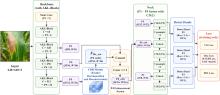
图1
LiteFocus-Net整体架构
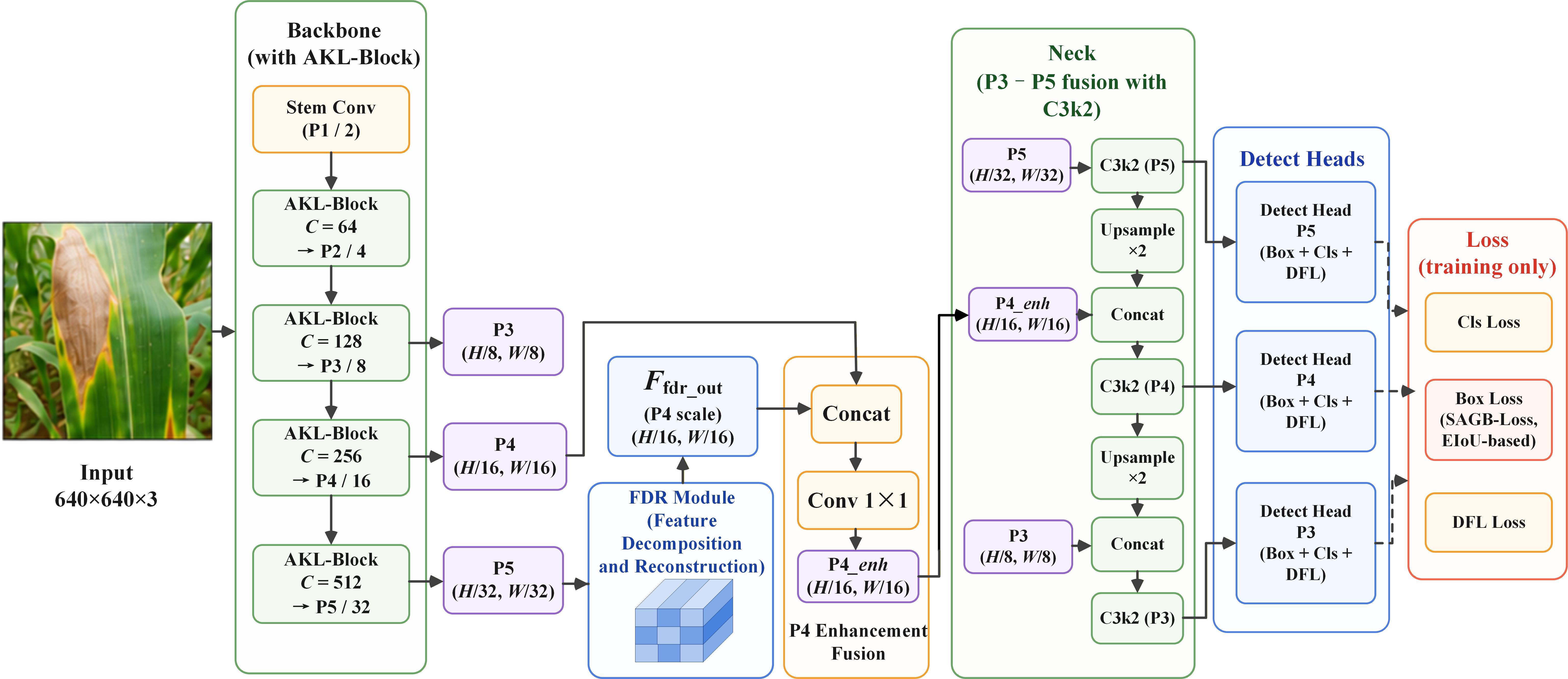
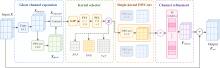
图2
AKL-Block结构图
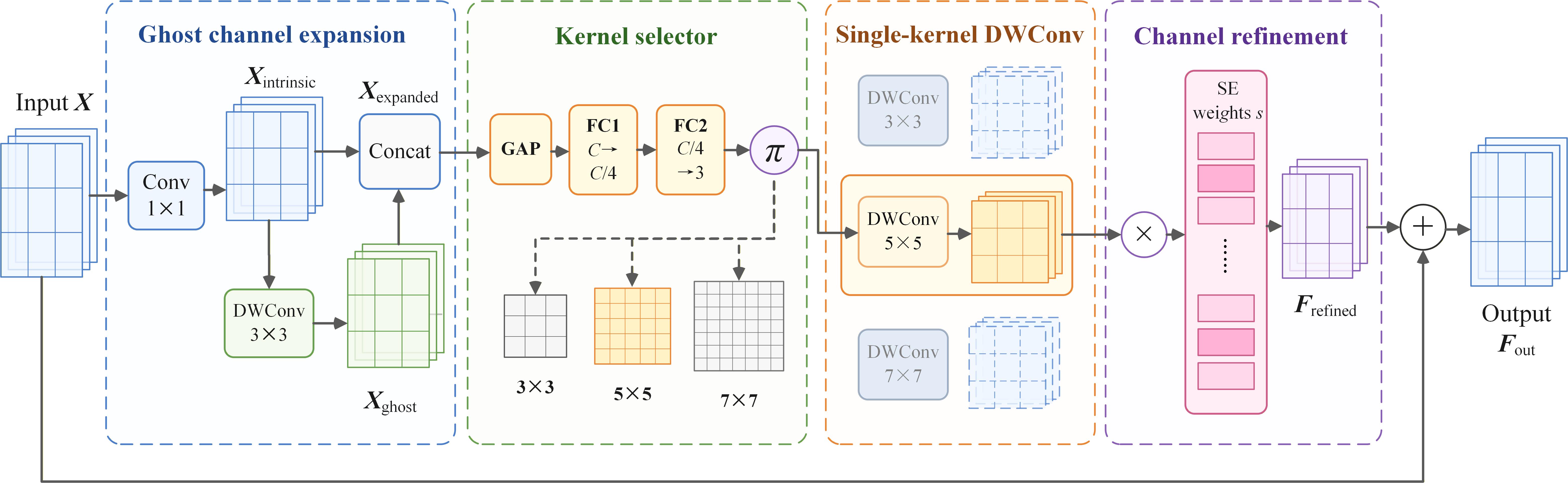
图3
FDR模块结构
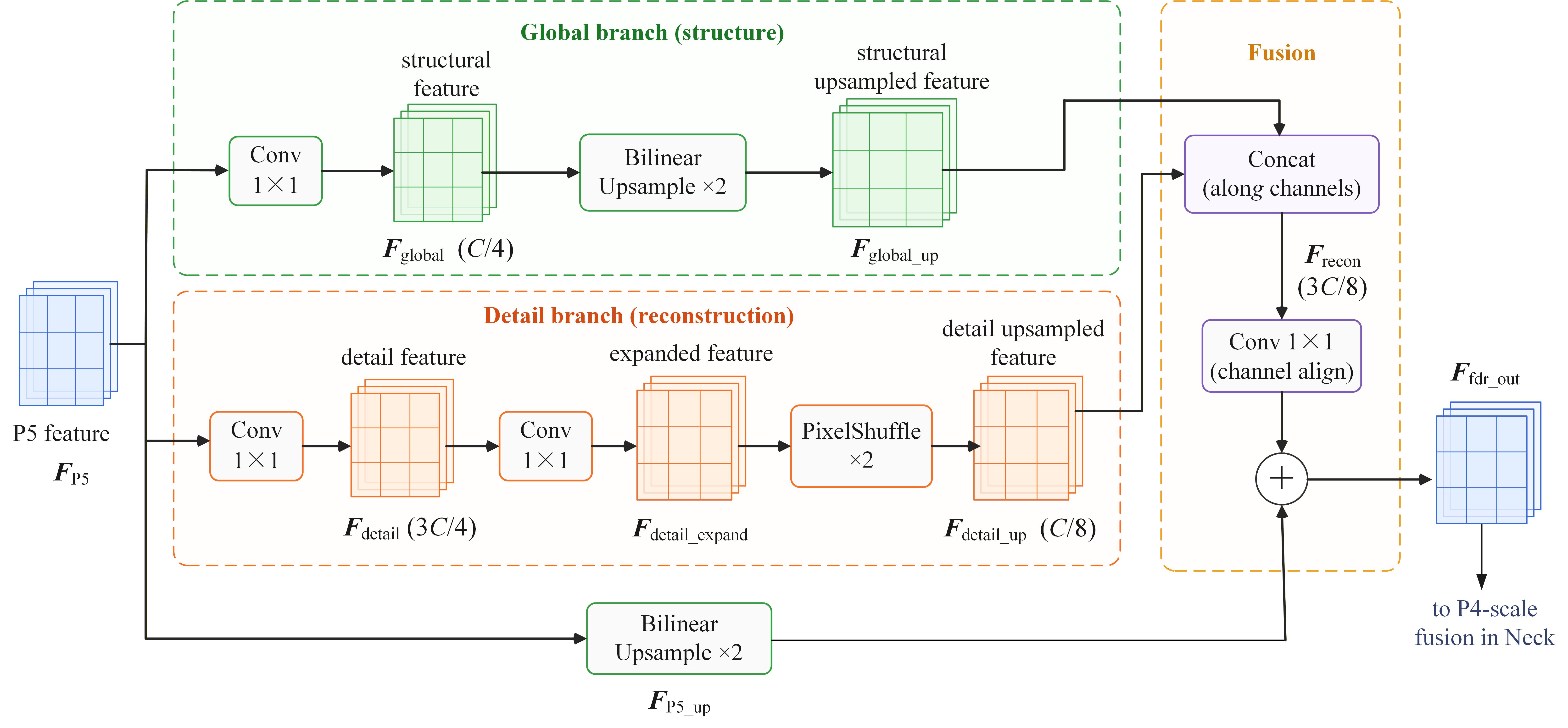
表3
LiteFocus-Net在玉米叶片病虫害数据集上的完整消融实验及统计显著性分析
| Scheme | AKL | FDR | SAGB | mAP@0.5/% | AP_s/% | AP_m/% | AP_l/% | Params/M | 计算量/GFLOPs | 调整后p值(AP_s) | 调整后p值 (mAP) |
|---|---|---|---|---|---|---|---|---|---|---|---|
| YOLOv11n Baseline | — | — | — | 72.20±0.20 | 28.10±0.50 | 55.80±0.30 | 64.30±0.20 | 2.58 | 6.3 | — | — |
| only AKL-Block | √ | — | — | 73.50±0.20 | 30.10±0.40 | 56.20±0.20 | 64.10±0.30 | 2.50 | 5.0 | 0.026 | 0.005 |
| only FDR | — | √ | — | 72.80±0.20 | 28.70±0.40 | 55.90±0.30 | 64.00±0.20 | 2.58 | 6.3 | 0.367 | 0.043 |
| only SAGB-Loss | — | — | √ | 72.70±0.20 | 28.50±0.40 | 55.90±0.30 | 64.10±0.20 | 2.58 | 6.3 | 0.367 | 0.043 |
| AKL-Block + FDR | √ | √ | — | 74.30±0.30 | 31.40±0.50 | 56.10±0.30 | 63.90±0.30 | 2.52 | 5.3 | 0.008 | 0.005 |
| AKL-Block + SAGB-Loss | √ | — | √ | 73.70±0.20 | 30.30±0.40 | 56.30±0.20 | 64.10±0.30 | 2.50 | 5.0 | 0.023 | 0.005 |
| FDR + SAGB-Loss | — | √ | √ | 73.50±0.20 | 29.20±0.50 | 56.00±0.30 | 63.80±0.20 | 2.58 | 6.3 | 0.163 | 0.005 |
| LiteFocus-Net | √ | √ | √ | 74.97±0.32 | 32.77±0.71 | 56.37±0.40 | 64.03±0.15 | 2.52 | 5.3 | 0.004 | 0.009 |
表4
LiteFocus-Net完整消融矩阵在各精度指标上的单因素方差分析结果
| 指标 | ANOVA 结果 | p 值 | 结论 |
|---|---|---|---|
| mAP@0.5 | F(7,16)=44.78 | <0.001 | 差异显著 |
| AP_s | F(7,16)=32.25 | <0.001 | 差异显著 |
| AP_m | F(7,16)=1.47 | 0.246 | 差异不显著 |
| AP_l | F(7,16)=1.19 | 0.361 | 差异不显著 |
表 5
LiteFocus-Net在3种不同随机种子下的重复性实验结果
| 随机种子 | mAP@0.5/% | AP_s/% | AP_m/% | AP_l/% |
|---|---|---|---|---|
| 42 | 75.1 | 33.4 | 56.6 | 64.0 |
| 123 | 74.6 | 32.0 | 55.9 | 63.9 |
| 2 024 | 75.2 | 32.9 | 56.6 | 64.2 |
| 均值±标准差 | 74.97±0.32 | 32.77±0.71 | 56.37±0.40 | 64.03±0.15 |
| 95%置信区间 | [74.17,75.77] | [31.00,34.53] | [55.36,57.37] | [63.65,64.41] |
表 6
LiteFocus-Net各模块在小目标精度(AP_s)上的单独及组合增益对比
| 模块组合 | AP_s/% (均值±标准差) | 相对基线增益 | 单独增益之和 | 交互增益 |
|---|---|---|---|---|
| Baseline | 28.10±0.50 | — | — | — |
| only AKL | 30.10±0.40 | +2.0 | — | — |
| only FDR | 28.70±0.40 | +0.6 | — | — |
| only SAGB | 28.50±0.40 | +0.4 | — | — |
| AKL + FDR | 31.40±0.50 | +3.3 | +2.6 | +0.7 (正向) |
| AKL + SAGB | 30.30±0.40 | +2.2 | +2.4 | -0.2 (轻微负向) |
| FDR + SAGB | 29.20±0.50 | +1.1 | +1.0 | +0.1 (中性) |
| AKL + FDR + SAGB | 32.77±0.71 | +4.7 | +3.0 | +1.7 (正向) |
表7
AKL-Block不同候选核集合的消融实验
| 卷积核选择方案 | mAP@0.5/% | AP_s/% | AP_m/% | AP_l/% | Params/M | 计算量/GFLOPs |
|---|---|---|---|---|---|---|
| {3×3} | 72.80±0.20 | 29.00±0.40 | 55.90±0.30 | 63.70±0.30 | 2.47 | 4.6 |
| {3×3, 5×5} | 73.20±0.20 | 29.70±0.40 | 56.00±0.30 | 63.90±0.30 | 2.49 | 4.8 |
| {3×3, 5×5, 7×7} | 73.50±0.20 | 30.10±0.40 | 56.20±0.20 | 64.10±0.30 | 2.50 | 5.0 |
| {1×1, 3×3, 5×5, 7×7} | 73.40±0.20 | 29.90±0.40 | 56.10±0.30 | 64.00±0.30 | 2.51 | 4.9 |
| {3×3, 5×5, 7×7, 9×9} | 73.60±0.20 | 30.20±0.40 | 56.20±0.30 | 64.20±0.30 | 2.52 | 5.4 |
表8
FDR模块不同通道比例的消融实验
| 结构分支:细节分支 | 结构分支通道数 | 细节分支通道数 | mAP@0.5/% | AP_s/% | AP_m/% | AP_l/% | Params/M | 计算量/GFLOPs |
|---|---|---|---|---|---|---|---|---|
| 1∶1 | 128 | 128 | 74.00±0.20 | 30.80±0.40 | 56.20±0.30 | 64.10±0.30 | 2.51 | 5.2 |
| 3∶5 | 96 | 160 | 74.10±0.20 | 31.10±0.40 | 56.20±0.30 | 64.00±0.30 | 2.51 | 5.2 |
| 1∶3 | 64 | 192 | 74.30±0.30 | 31.40±0.50 | 56.10±0.30 | 63.90±0.30 | 2.52 | 5.3 |
| 1∶7 | 32 | 224 | 74.10±0.20 | 31.50±0.50 | 55.80±0.30 | 63.60±0.30 | 2.54 | 5.4 |
表9
FDR与P4特征不同融合方式的消融实验
| Scheme | mAP@0.5/% | AP_s/% | AP_m/% | AP_l/% | Params/M | 计算量/GFLOPs |
|---|---|---|---|---|---|---|
| 逐元素相加(Add) | 74.30±0.30 | 31.40±0.50 | 56.10±0.30 | 63.90±0.30 | 2.52 | 5.3 |
| 通道拼接 + 1×1 Conv | 74.40±0.30 | 31.60±0.50 | 56.20±0.30 | 64.00±0.30 | 2.58 | 5.6 |
| 可学习加权相加 | 74.40±0.30 | 31.50±0.50 | 56.20±0.30 | 64.00±0.30 | 2.53 | 5.3 |
表10
SAGB-Loss不同面积增强函数形式的消融实验
| Scheme | mAP@0.5/% | AP_s/% | AP_m/% | AP_l/% |
|---|---|---|---|---|
| 无面积增强 | 74.70±0.30 | 32.20±0.50 | 56.40±0.30 | 64.00±0.30 |
| 硬阈值增强 | 74.60±0.30 | 32.80±0.50 | 55.80±0.30 | 63.80±0.30 |
| 线性衰减增强 | 74.70±0.30 | 32.50±0.50 | 56.00±0.30 | 63.90±0.30 |
| Sigmoid衰减增强 | 74.80±0.30 | 32.60±0.50 | 56.20±0.30 | 64.00±0.30 |
| 指数衰减增强 | 74.97±0.32 | 32.77±0.71 | 56.37±0.40 | 64.03±0.15 |
表 11
固定大核、Inception、SKNet和AKL-Block骨干模块的性能与复杂度比较
| Scheme | mAP@0.5/% | AP_s/% | AP_m/% | AP_l/% | Params/M | 计算量/GFLOPs |
|---|---|---|---|---|---|---|
| YOLOv11n Baseline | 72.20±0.20 | 28.10±0.50 | 55.80±0.30 | 64.30±0.20 | 2.58 | 6.3 |
| C3k2-Fixed 7×7 | 72.10±0.20 | 27.60±0.40 | 55.60±0.30 | 64.50±0.30 | 2.55 | 6.8 |
| C3k2-Inception | 73.70±0.30 | 30.40±0.50 | 56.30±0.30 | 64.80±0.30 | 2.68 | 7.9 |
| C3k2-SK | 73.60±0.30 | 30.20±0.50 | 56.20±0.30 | 64.60±0.30 | 2.66 | 7.3 |
| AKL-Bloc | 73.50±0.20 | 30.10±0.40 | 56.20±0.20 | 64.10±0.30 | 2.50 | 5.0 |
表 12
AKL-Block与Inception在同图大小尺度目标混合样本上的性能比较
| Scheme | mAP@0.5/% | AP_s/% | AP_l/% |
|---|---|---|---|
| C3k2-Inception | 73.00±0.30 | 30.20±0.50 | 63.80±0.30 |
| AKL-Block (Ours) | 73.10±0.30 | 30.10±0.40 | 64.10±0.30 |
表 13
FDR与其他特征增强方法对比
| Scheme | mAP@0.5/% | AP_s/% | AP_m/% | AP_l/% | Params/M | 计算量/GFLOPs | Extra Params/M |
|---|---|---|---|---|---|---|---|
| No P5 enhancement | 73.50±0.20 | 30.10±0.40 | 56.20±0.20 | 64.10±0.30 | 2.50 | 5.0 | 0 |
| Bilinear-only | 73.60±0.20 | 30.30±0.40 | 56.10±0.20 | 64.10±0.30 | 2.50 | 5.0 | 0 |
| Deconv | 74.10±0.30 | 31.00±0.50 | 56.20±0.30 | 64.00±0.30 | 2.68 | 5.6 | 0.18 |
| Full-PixelShuffle | 74.80±0.30 | 32.20±0.50 | 56.40±0.30 | 64.20±0.30 | 2.62 | 5.8 | 0.12 |
| FDR (Ours) | 74.30±0.30 | 31.40±0.50 | 56.10±0.30 | 63.90±0.30 | 2.52 | 5.3 | 0.02 |
表 14
FDR与Full-PixelShuffle在超小目标上的召回率对比
| Scheme | Recall@0.5/% | Recall@0.3/% |
|---|---|---|
| No P5 enhancement | 31.20±0.50 | 48.50±0.60 |
| Full-PixelShuffle | 34.80±0.60 | 52.10±0.60 |
| FDR (Ours) | 33.00±0.50 | 50.40±0.50 |
表 15
SAGB-Loss与其他损失加权策略对比
| Loss Strategy | mAP@0.5/% | AP_s/% | AP_m/% | AP_l/% |
|---|---|---|---|---|
| CIoU (Baseline) | 74.30±0.30 | 31.40±0.50 | 56.10±0.30 | 63.90±0.30 |
| EIoU | 74.50±0.30 | 31.70±0.50 | 56.30±0.30 | 64.00±0.30 |
| EIoU + Layer-wise weighting | 74.70±0.30 | 32.20±0.50 | 56.40±0.30 | 64.00±0.30 |
| EIoU + Hard area threshold weighting | 74.60±0.30 | 32.80±0.50 | 55.80±0.30 | 63.90±0.30 |
| SAGB-Loss (Ours) | 74.97±0.32 | 32.77±0.71 | 56.37±0.40 | 64.03±0.15 |
表 16
SAGB-Loss增强系数α对小、中、大目标检测性能的敏感性分析 ( %)
| mAP@0.5 | AP_s | AP_m | AP_l | |
|---|---|---|---|---|
| 0.0 | 74.70±0.30 | 32.20±0.50 | 56.40±0.30 | 64.00±0.30 |
| 1.0 | 74.82±0.30 | 32.50±0.55 | 56.40±0.30 | 64.05±0.25 |
| 2.0 | 74.97±0.32 | 32.77±0.71 | 56.37±0.40 | 64.03±0.15 |
| 3.0 | 74.75±0.30 | 32.85±0.60 | 56.00±0.30 | 63.90±0.30 |
| 4.0 | 74.45±0.30 | 32.90±0.60 | 55.70±0.30 | 63.70±0.30 |
表 17
LiteFocus-Net与现有模型的性能对比
| Method | mAP@0.5/% | AP_s/% | AP_m/% | AP_l/% | Params/M | 计算量/GFLOPs | FPS/(帧/s) |
|---|---|---|---|---|---|---|---|
| Faster R-CNN (ResNet50) | 66.9 | 19.3 | 48.2 | 60.4 | 137.10 | 370.20 | 21.0 |
| SSD (VGG16) | 72.3 | 24.5 | 53.1 | 63.8 | 26.29 | 62.74 | 41.0 |
| RT-DETR (R18)[ | 75.8 | 31.2 | 57.0 | 65.8 | 20.00 | 71.10 | 24.0 |
| YOLOv5n | 62.1 | 22.3 | 48.5 | 56.2 | 1.90 | 4.50 | 141.0 |
| YOLOv8n | 71.1 | 26.5 | 54.2 | 63.1 | 3.20 | 8.70 | 124.0 |
| YOLOv11n (Baseline) | 72.2 | 28.1 | 55.8 | 64.3 | 2.58 | 6.30 | 136.0 |
| YOLOv11s | 74.5 | 30.1 | 56.6 | 65.2 | 9.42 | 21.90 | 86.0 |
| YOLOv11m | 75.3 | 31.0 | 57.0 | 65.8 | 20.00 | 67.70 | 51.0 |
| YOLOv11l | 76.7 | 32.3 | 58.2 | 66.5 | 25.29 | 86.60 | 43.0 |
| EfficientViT[ | 73.3 | 29.5 | 55.9 | 64.8 | 3.56 | 6.90 | 128.0 |
| Gold-YOLO[ | 74.8 | 31.5 | 56.9 | 65.6 | 21.50 | 46.00 | 38.0 |
| YOLO-MS (XS)[ | 73.8 | 30.2 | 56.1 | 64.9 | 4.50 | 8.70 | 118.0 |
| YOLO-MS (S)[ | 75.6 | 32.0 | 57.2 | 66.0 | 8.10 | 15.40 | 82.0 |
| DAMO-YOLO (Tiny)[ | 73.1 | 29.0 | 55.5 | 64.5 | 6.80 | 14.10 | 95.0 |
| DAMO-YOLO(Small)[ | 74.3 | 30.6 | 56.3 | 65.2 | 11.20 | 23.40 | 68.0 |
| RTMDet-Tiny[ | 73.5 | 29.8 | 55.7 | 64.7 | 4.00 | 14.20 | 72.0 |
| RTMDet-Small[ | 74.9 | 31.2 | 56.8 | 65.3 | 8.89 | 14.80 | 68.0 |
| MobileViT-YOLO[ | 72.8 | 28.6 | 54.8 | 64.0 | 8.60 | 10.20 | 105.0 |
| EMO-YOLO[ | 73.4 | 29.7 | 55.6 | 64.5 | 5.10 | 8.50 | 122.0 |
| FasterNet-YOLO[ | 72.5 | 28.9 | 55.0 | 64.2 | 3.96 | 7.80 | 136.0 |
| YOLO-MSM[ | 74.0 | 30.2 | 55.8 | 64.5 | 5.40 | 18.50 | 69.6 |
| MA-YOLO[ | 73.9 | 32.1 | 56.8 | 65.2 | 6.42 | 17.20 | 67.2 |
| YOLO-LCE[ | 73.9 | 30.1 | 56.2 | 64.0 | 1.69 | 5.40 | 130.0 |
| LiteFocus-Net (Ours) | 75.0 | 32.8 | 56.4 | 64.0 | 2.52 | 5.30 | 135.0 |
表 18
YOLOv11n 与 LiteFocus-Net 的统计显著性对比
| 指标 | YOLOv11n | LiteFocus-Net | 提升/百分点 | 调整后p值 | 结论 |
|---|---|---|---|---|---|
| mAP@0.5/% | 72.20±0.20 | 74.97±0.32 | +2.77 | 0.002 | 显著提升 |
| AP_s/% | 28.10±0.50 | 32.77±0.71 | +4.67 | 0.004 | 显著提升 |
| AP_m/% | 55.80±0.30 | 56.37±0.40 | +0.57 | 0.250 | 差异不显著 |
| AP_l/% | 64.30±0.20 | 64.03±0.15 | -0.27 | 0.250 | 差异不显著 |
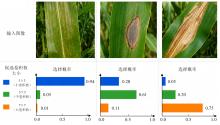
图4
AKL-Block卷积核选择行为可视化 a. 密集小型锈病病斑 b. 中等尺寸灰斑病病斑 c. 大型大斑病病斑
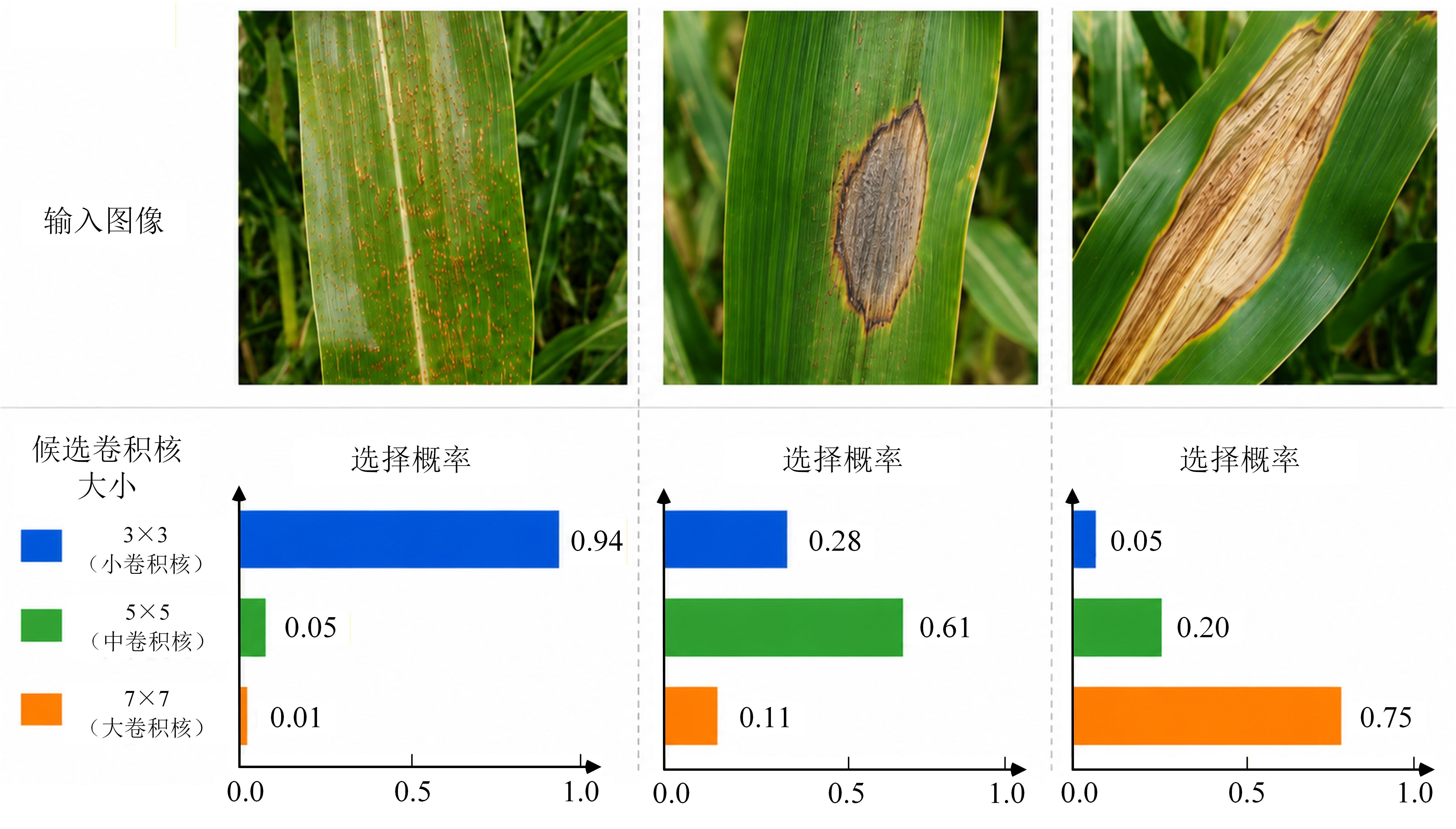
图5
FDR模块对微小目标的特征增强效果 a. 原始 P4 特征激活热力图 b. FDR 增强后特征激活热力图 c. 高频残差热力图
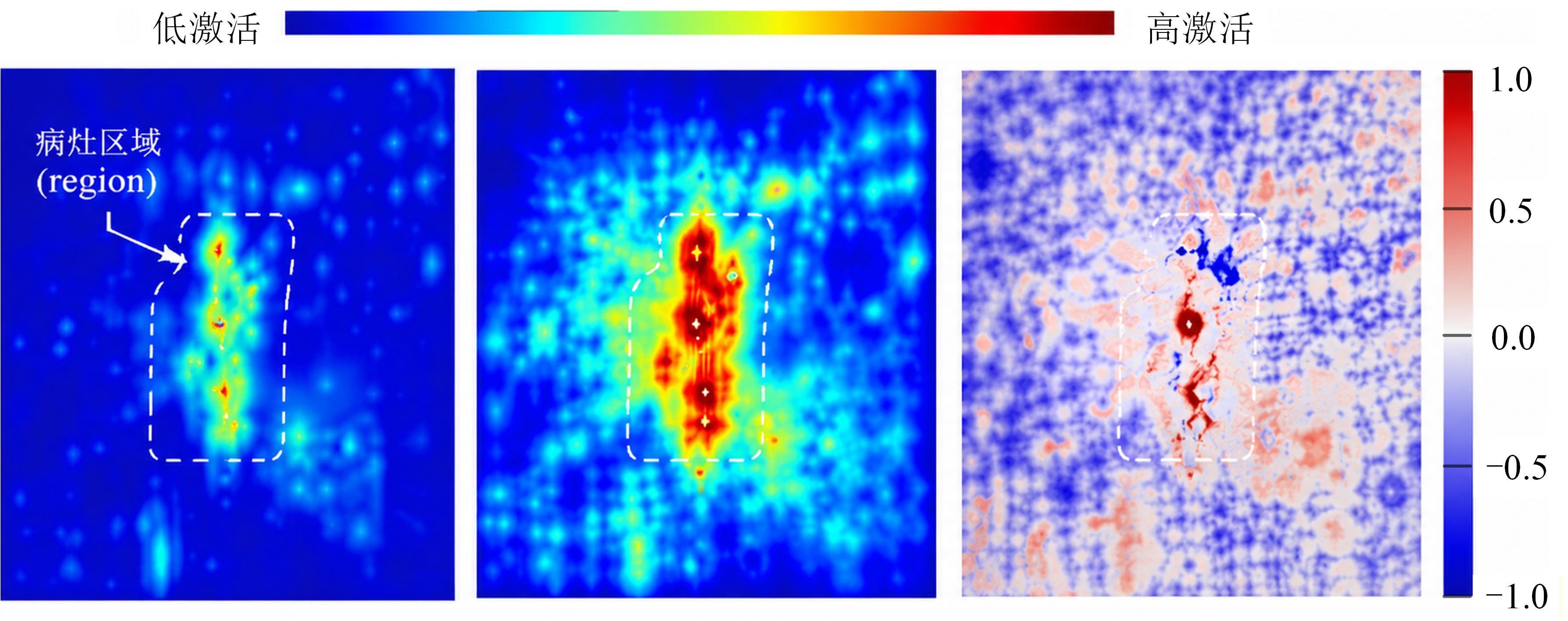
表 19
LiteFocus-Net与YOLOv11n在RK3588和Jetson Orin上的量化推理性能及能效
| 平台 | 模型 | 精度 | 延迟/ms | 功耗/W | 内存/MB | mAP@0.5/% | 单帧能耗/(mJ/frame) | 能效比/(帧/s/W) |
|---|---|---|---|---|---|---|---|---|
| RK3588 CPU | YOLOv11n | INT8 | 12.7 | 0.9 | 92 | 69.8 | 11.43 | 87.5 |
| RK3588 CPU | LiteFocus-Net | INT8 | 12.1 | 0.9 | 88 | 71.5 | 10.89 | 91.8 |
| RK3588 NPU | LiteFocus-Net | INT8 | 7.5 | 1.2 | 152 | 71.5 | 9.00 | 111.1 |
| Jetson Orin | YOLOv11n | INT8 | 5.3 | 5.1 | 124 | 69.7 | 27.03 | 37.0 |
| Jetson Orin | LiteFocus-Net | FP16 | 6.8 | 6.2 | 198 | 74.7 | 42.16 | 23.7 |
| Jetson Orin | LiteFocus-Net | INT8 | 4.8 | 4.9 | 122 | 71.5 | 23.52 | 42.5 |
表 20
LiteFocus-Net与YOLOv11n在不同复杂田间条件下的鲁棒性测试结果
| 测试条件 | 图像数/张 | 目标实例数/个 | YOLOv11n mAP@0.5/% | LiteFocus-Net mAP@0.5/% | YOLOv11n AP_s/% | LiteFocus-Net AP_s/% |
|---|---|---|---|---|---|---|
| 全部测试集 | 2 049 | 4 827 | 72.2 | 75.0 | 28.1 | 32.8 |
| 强光条件 | 312 | 708 | 70.8 | 74.1 | 26.9 | 31.7 |
| 弱光条件 | 286 | 655 | 69.6 | 73.0 | 25.8 | 30.8 |
| 逆光条件 | 241 | 536 | 67.9 | 71.7 | 24.6 | 29.8 |
| 局部遮挡 | 354 | 812 | 68.7 | 72.6 | 25.1 | 30.4 |
| 不同拍摄角度 | 328 | 741 | 71.0 | 74.4 | 27.2 | 32.0 |
图6
LiteFocus-Net在田间复杂场景下的定性检测玉米叶片结果
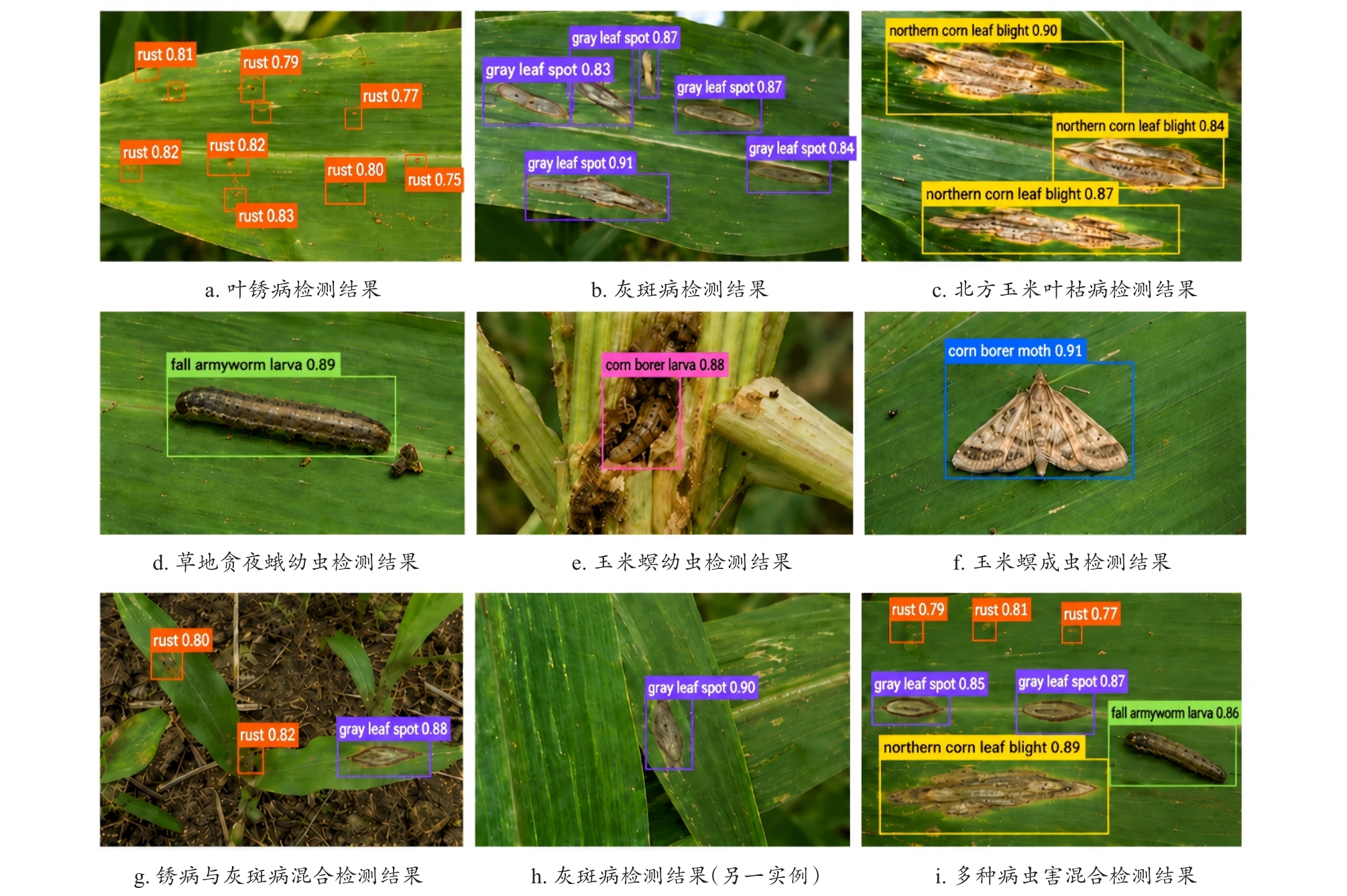
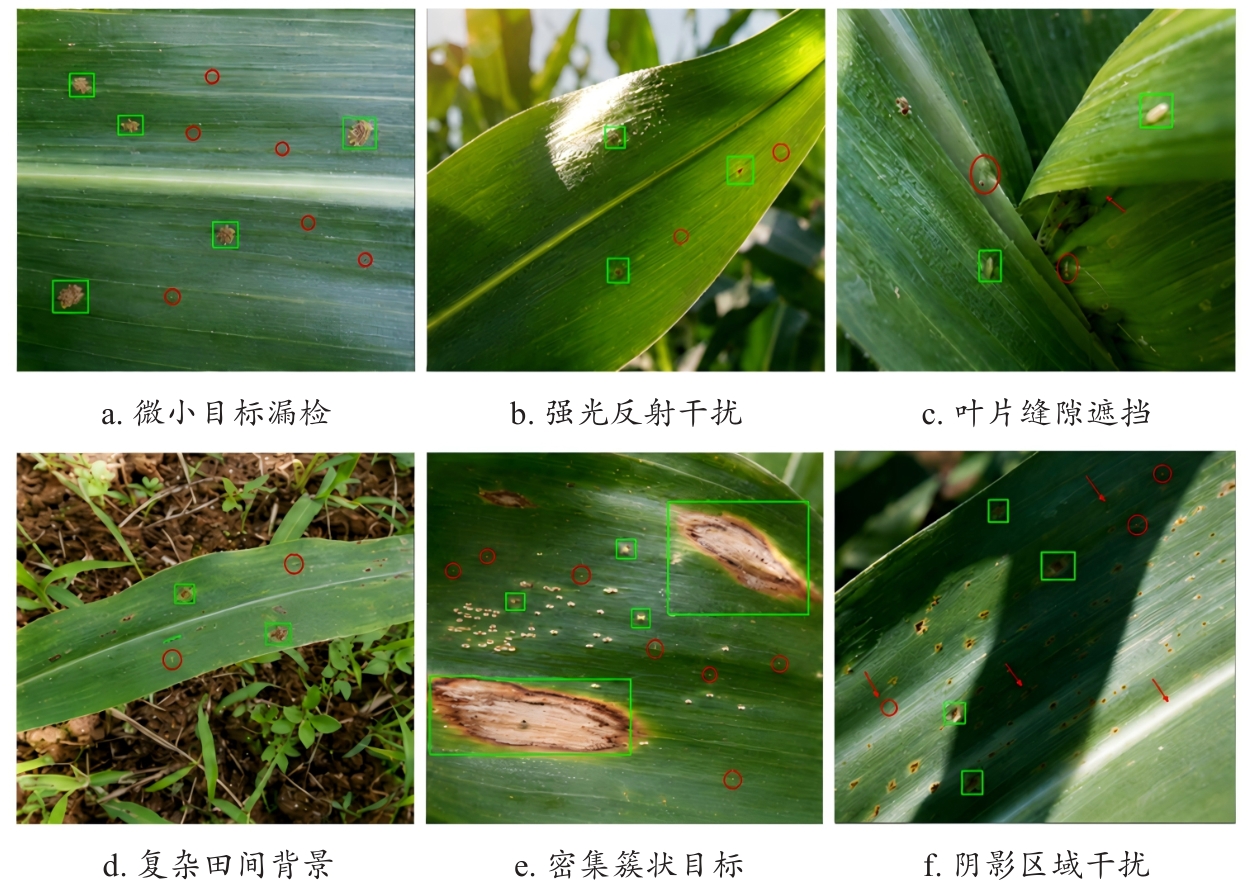
图7
LiteFocus-Net 玉米病虫害检测典型漏检异常分析
| [1] |
|
| [2] |
李董, 汤启国, 王红波, 等. 农作物重大病虫害预警与应急防控技术研究现状与趋势[J]. 智能化农业装备学报(中英文), 2025, 6 (1): 25-40.
|
|
|
|
| [3] |
|
| [4] |
|
| [5] |
|
| [6] |
|
| [7] |
|
| [8] |
|
| [9] |
|
| [10] |
|
| [11] |
|
| [12] |
|
| [13] |
|
| [14] |
|
| [15] |
|
| [16] |
|
| [17] |
|
| [18] |
|
| [19] |
|
| [20] |
|
| [21] |
|
| [22] |
|
| [23] |
|
| [24] |
|
| [25] |
|
| [26] |
|
| [27] |
|
| [28] |
|
| [29] |
|
| [30] |
|
| [31] |
|
| [32] |
|
| [33] |
|
| [34] |
|
| [35] |
|
| [36] |
|
| [37] |
|
| [38] |
|
| [1] | 沈学利, 张越, 金海波, 张旭旭. 多尺度异构特征协同的棉花叶片病害检测模型[J]. 智慧农业(中英文), 2026, 8(4): 204-216. |
| [2] | 张文博, 江一珏, 宋巍, 贺琪, 张文博. CAGE-YOLO: 基于遥感影像的水产养殖网箱高密度小目标检测模型[J]. 智慧农业(中英文), 2026, 8(2): 98-117. |
| [3] | 苏玉杰, 李玥, 魏霖静, 吴兵, 郭林海, 剡斌, 周慧, 高玉红, 康亮河, 刘欢, 苏舜昌. 基于轻量化改进YOLOv11n-Seg的胡麻倒伏区域识别方法[J]. 智慧农业(中英文), 2026, 8(2): 35-47. |
| [4] | 姚晓通, 曲绍业. 基于改进YOLOv12s的辣椒叶片病虫害轻量化检测方法[J]. 智慧农业(中英文), 2026, 8(1): 1-14. |
| [5] | 常戬, 王冰冰, 尹龙, 李燕青, 李兆歆, 李壮. 基于YOLOv10n-CHL的蜜蜂授粉轻量化识别模型[J]. 智慧农业(中英文), 2025, 7(3): 185-198. |
| [6] | 常戬, 王冰冰, 尹龙, 李燕青, 李兆歆, 李壮. 基于YOLOv10n-CHL轻量化的蜜蜂授粉识别模型[J]. 智慧农业(中英文), 2025, 7(3): 1-14. |
| [7] | 谢纪元, 张东彦, 牛圳, 程涛, 苑峰, 刘亚玲. 基于YOLOv10-MHSA的“三北”工程内蒙古地区植树位点精准检测研究[J]. 智慧农业(中英文), 2025, 7(3): 108-119. |
| [8] | 吴六爱, 许雪珂. 基于改进YOLOv10n的轻量化番茄叶片病虫害检测方法[J]. 智慧农业(中英文), 2025, 7(1): 146-155. |
| [9] | 叶大鹏, 景均, 张之得, 李辉煌, 吴昊宇, 谢立敏. MSH-YOLOv8:融合尺度重建的蘑菇小目标检测方法[J]. 智慧农业(中英文), 2024, 6(5): 139-152. |
| [10] | 胡程喜, 谭立新, 王文胤, 宋敏. 基于改进DeepLabV3+的轻量化茶叶嫩芽采摘点识别模型[J]. 智慧农业(中英文), 2024, 6(5): 119-127. |
| [11] | 杨锋, 姚晓通. 基于改进YOLOv8的小麦叶片病虫害检测轻量化模型[J]. 智慧农业(中英文), 2024, 6(1): 147-157. |
| [12] | 夏雪, 柴秀娟, 张凝, 周硕, 孙琦鑫, 孙坦. 用于边缘计算设备的果树挂果量轻量化估测模型[J]. 智慧农业(中英文), 2023, 5(2): 1-12. |
| [13] | 夏烨, 雷哓晖, 祁雁楠, 徐陶, 袁全春, 潘健, 姜赛珂, 吕晓兰. 基于改进Ghost-YOLOv5s-BiFPN算法检测梨树花序[J]. 智慧农业(中英文), 2022, 4(3): 108-119. |
| 阅读次数 | ||||||
|
全文 |
|
|||||
|
摘要 |
|
|||||