Smart Agriculture ›› 2026, Vol. 8 ›› Issue (4): 85-99.doi: 10.12133/j.smartag.SA202512007
• Information Processing and Decision Making • Previous Articles Next Articles
LI Chuanmeng, YANG Jie( ), ZHANG Xiaoyu
Received:2025-12-08
Online:2026-07-30
Foundation items:The 2025 YS Three-Area Talent Support Program(09900/990025166); The Scientific Research Fund of Yunnan Provincial Department of Education(0111723084)
About author:LI Chuanmeng, E-mail: 1817841280@qq.com
corresponding author:
CLC Number:
LI Chuanmeng, YANG Jie, ZHANG Xiaoyu. Lightweight Detection Method for Grading Fresh Cut Dianthus caryophyllus L. Based on Flor-YOLO[J]. Smart Agriculture, 2026, 8(4): 85-99.
Add to citation manager EndNote|Ris|BibTeX
URL: https://www.smartag.net.cn/EN/10.12133/j.smartag.SA202512007
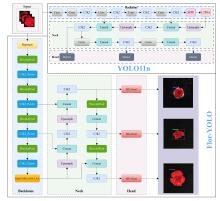
Fig. 1
Comparison of network architectures between Flor-YOLO and YOLO11n
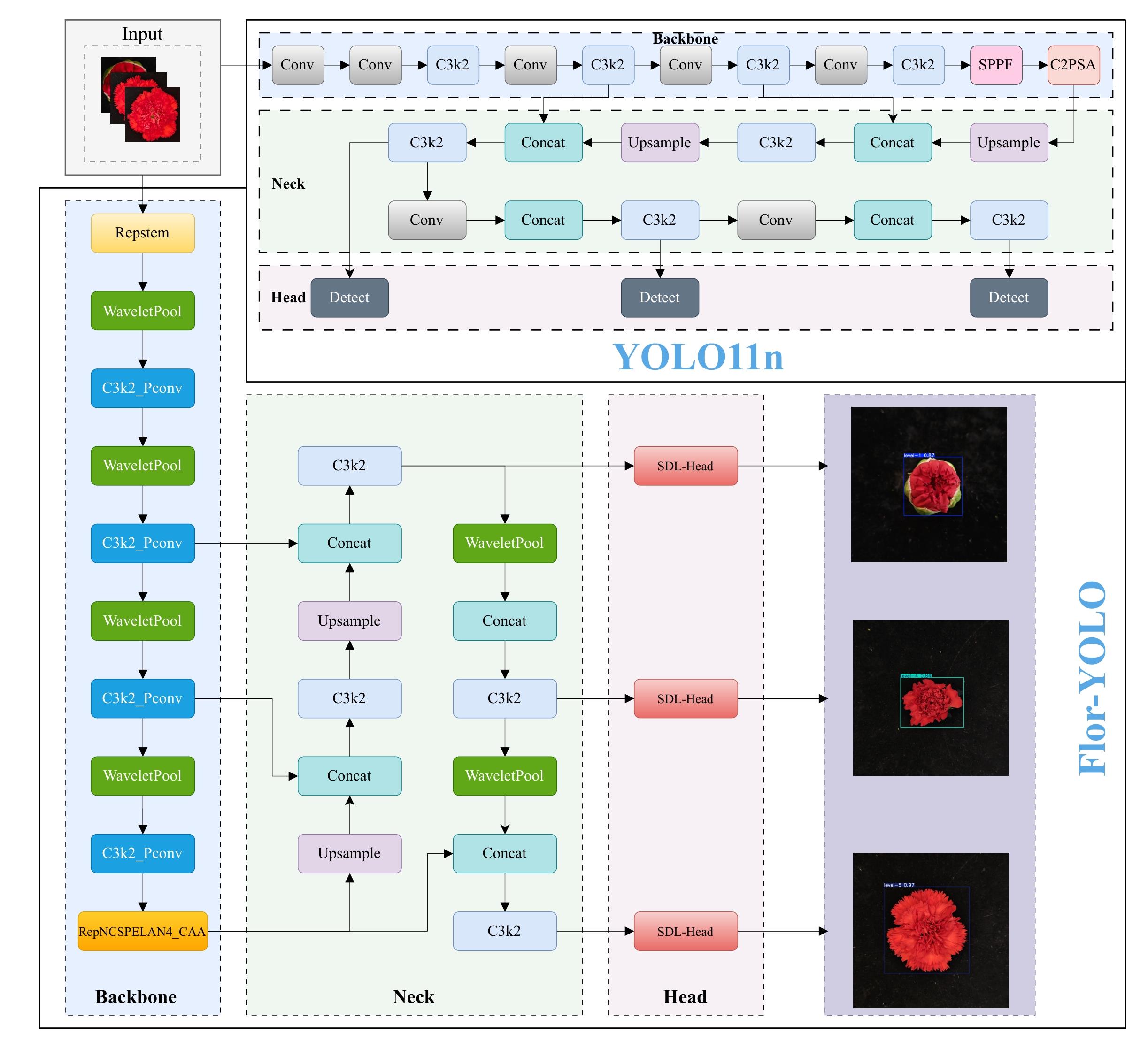
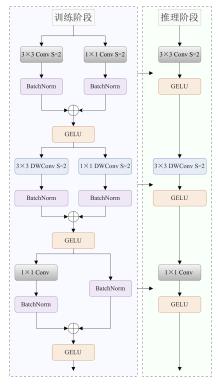
Fig. 2
Structure diagram of the RepStem module
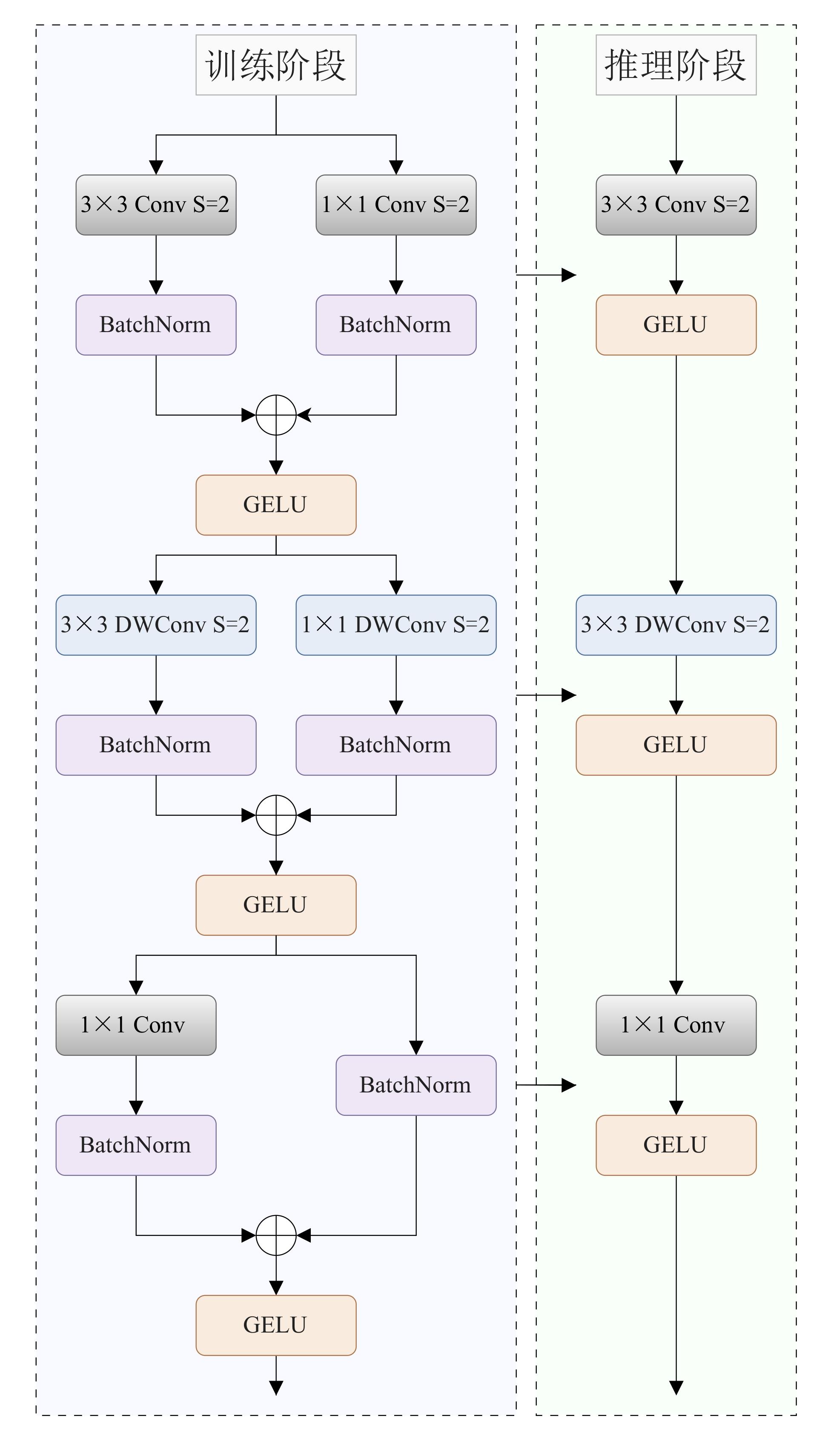
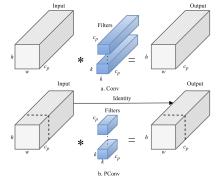
Fig. 3
Comparison of PConv and Conv modules
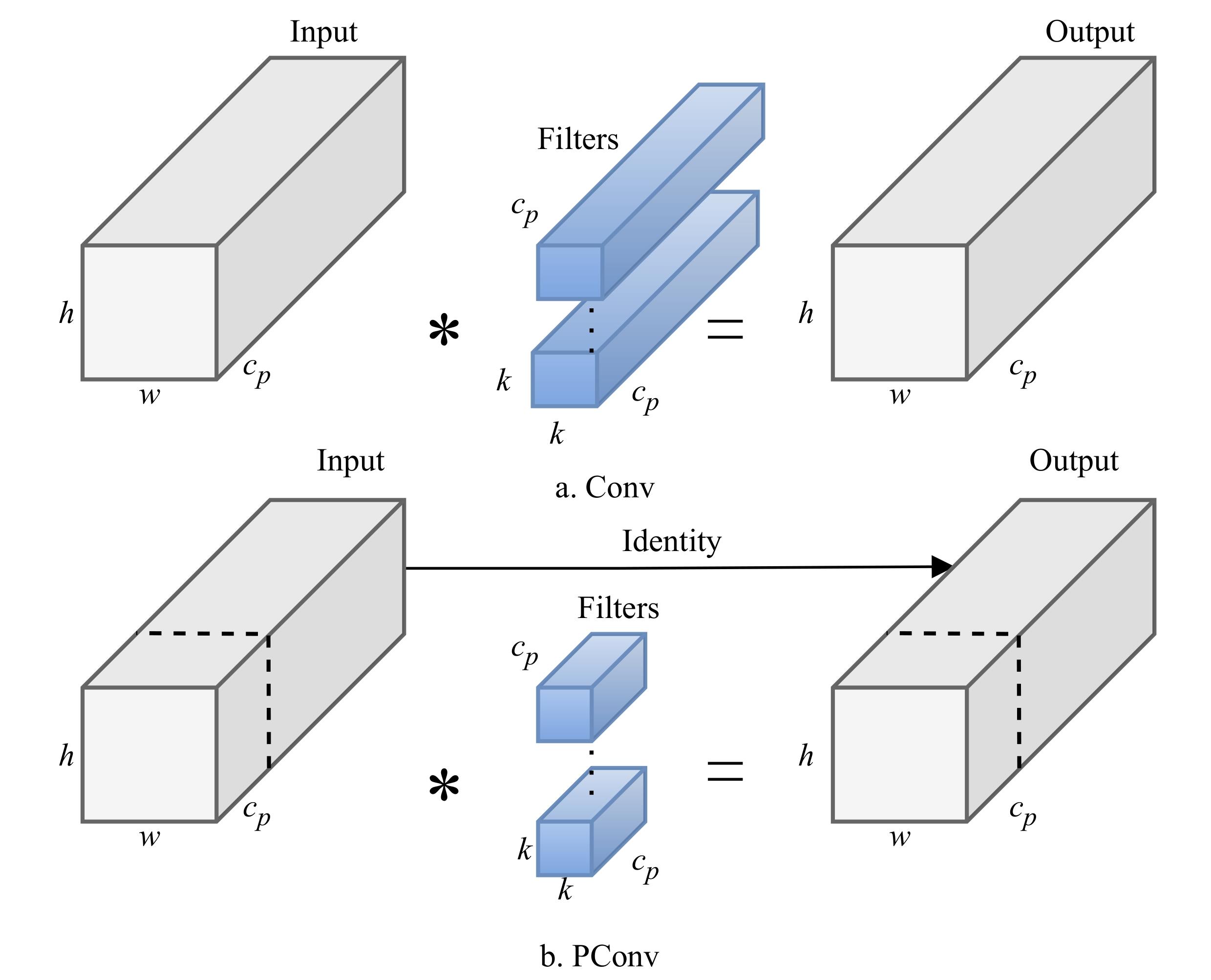
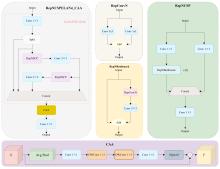
Fig. 4
Structure diagram of the RepNCSPELAN4_CAA module

Fig. 5
Forward and backward propagation processes of WaveletPool
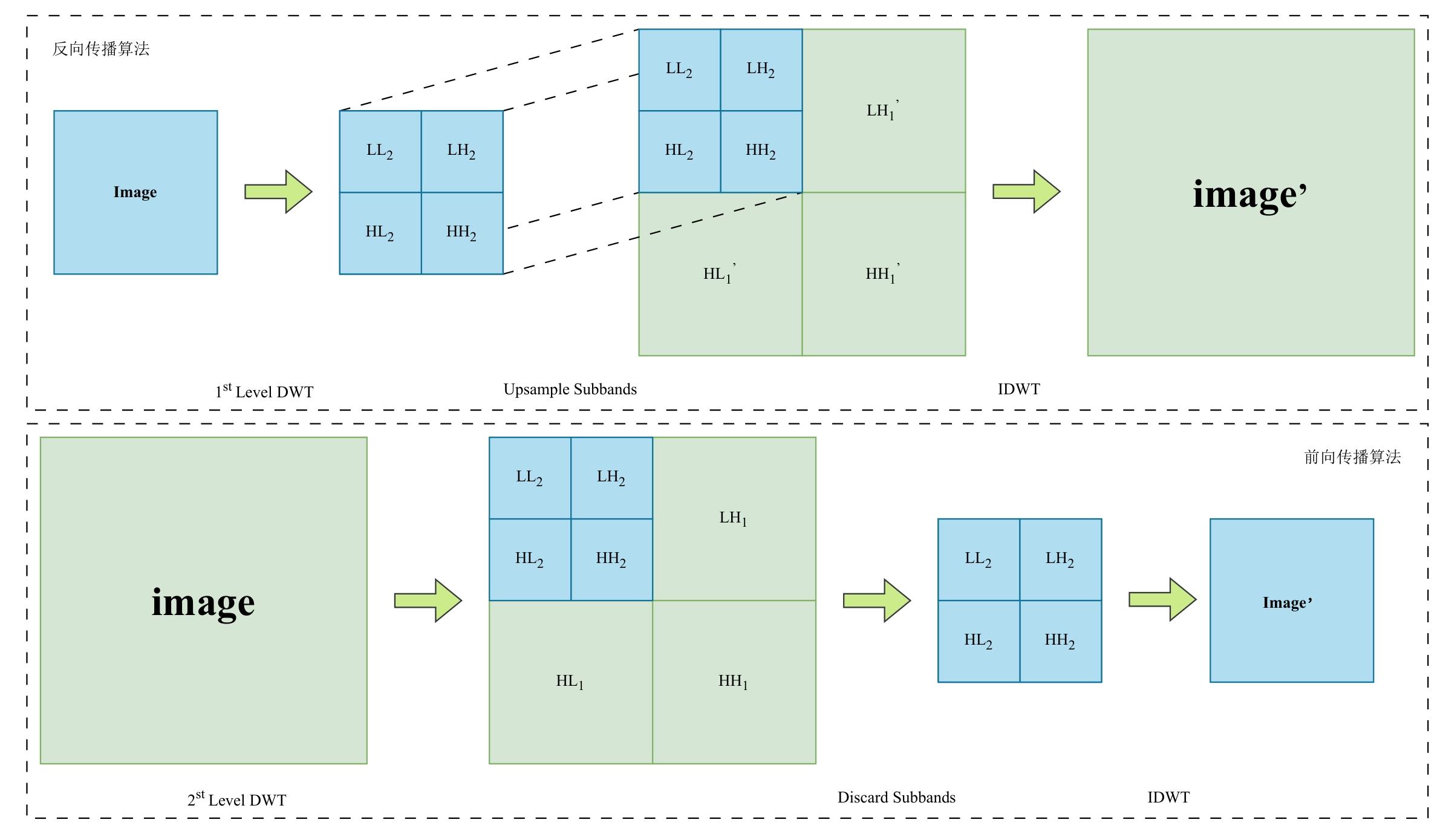
Fig.6
Structure diagram of the SDL-Head module
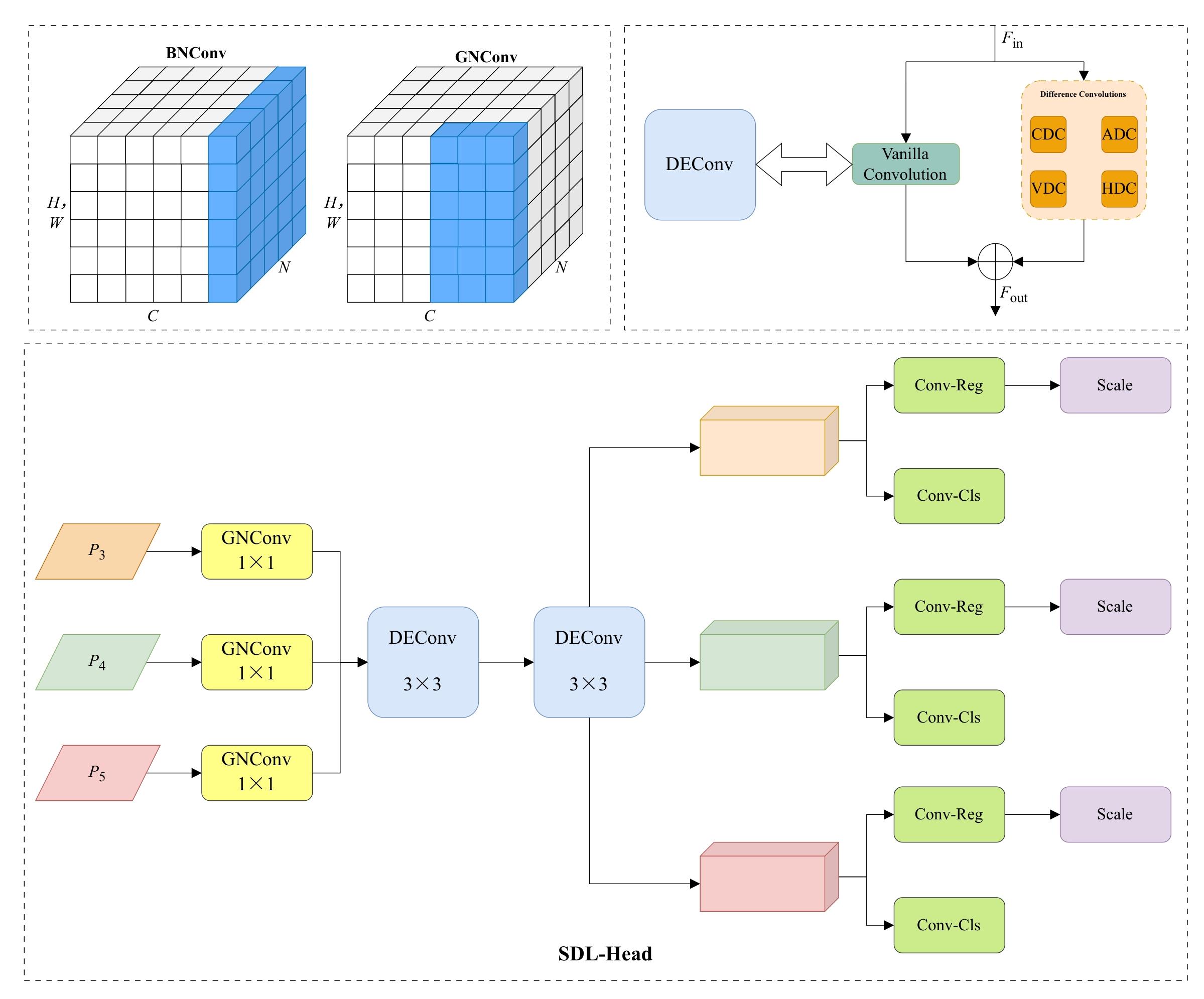
Table 1
Grading standards for the flowering index of standard cut Dianthus caryophyllus L.
| 开花指数/度 | 描述 |
|---|---|
| 1 | 花瓣从萼片中伸出约0.5 cm,花朵顶部呈“星形”。此阶段采收,开花指数过小,除非有强力的促进花蕾开放的技术措施,否则切花不易开放或开放不好,为不适宜采收时期 |
| 2 | 花瓣从萼片中伸出约1 cm,且花瓣直立。适宜夏秋季远距离运输销售 |
| 3 | 花瓣开始散开,但中心较紧实。适宜冬春季远距离运输销售 |
| 4 | 花瓣更松散些,且外瓣展开度小于水平线。适宜冬春季近距离运输销售 |
| 5 | 花瓣全面松散,外瓣展开度呈水平。此阶段花过于成熟,不宜采收;若采收应尽快销售 |
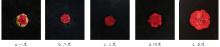
Fig. 7
Schematic diagram of fresh cut Dianthus caryophyllus L. grading
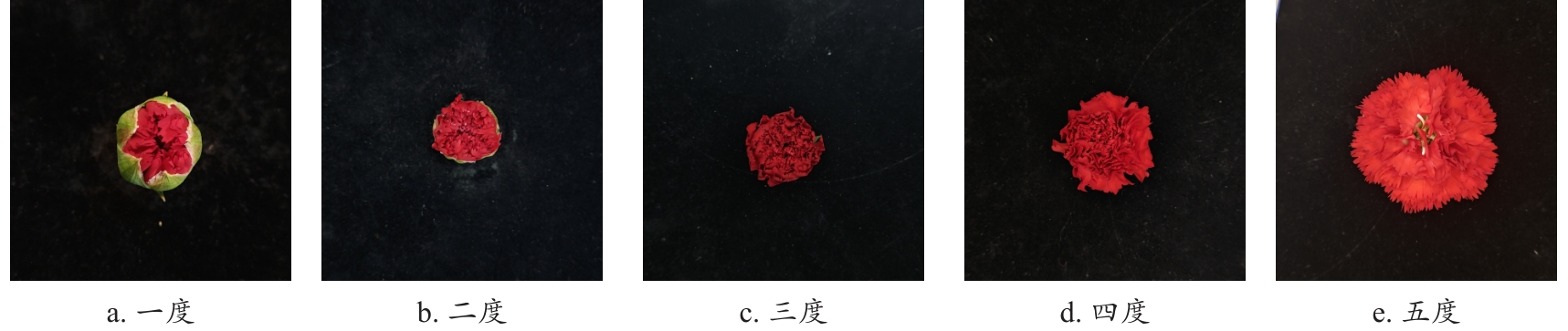
Table 2
Data augmentation results of standard cut Dianthus caryophyllus L.
| 开放度 | 1度/张 | 2度/张 | 3度/张 | 4度/张 | 5度/张 | 合计/张 |
|---|---|---|---|---|---|---|
| 增强前 | 52 | 220 | 589 | 549 | 338 | 1 748 |
| 增强后 | 832 | 1 320 | 1 767 | 1 647 | 1 014 | 6 580 |
Table3
Ablation study results of backbone network reconstruction
| 模型 | R/% | F 1/% | P/% | mAP@50/% | mAP@50∶95/% | 参数量/M | 计算量/GFLOPs | 推理速度/(帧/s) | 模型大小/M |
|---|---|---|---|---|---|---|---|---|---|
| YOLO11n | 93.13 | 91.22 | 89.52 | 92.85 | 74.74 | 2.58 | 6.3 | 275.00 | 5.2 |
| YOLO11n+R | 92.00 | 92.33 | 92.22 | 92.87 | 75.67 | 2.58 | 1.7 | 269.42 | 5.3 |
| YOLO11n+P | 94.98 | 91.86 | 89.39 | 93.94 | 74.87 | 2.40 | 5.9 | 330.13 | 4.9 |
| YOLO11n+RC | 95.82 | 92.33 | 89.23 | 95.01 | 76.38 | 2.18 | 6.0 | 298.09 | 4.5 |
| YOLO11n+P+RC | 92.19 | 92.82 | 93.71 | 94.37 | 76.51 | 2.00 | 5.6 | 270.06 | 4.1 |
| YOLO11n+R+RC | 90.63 | 91.90 | 88.69 | 94.95 | 75.95 | 2.18 | 1.6 | 507.18 | 4.5 |
| LiteChimeraNet | 90.76 | 92.18 | 93.92 | 95.04 | 76.13 | 2.00 | 1.5 | 521.60 | 4.1 |
Table 4
Performance comparison of mainstream lightweight backbone networks
| 模型 | R/% | F 1/% | P/% | mAP@50/% | mAP@50∶95/% | 参数量/M | 计算量/GFLOPs | 推理速度/(帧/s) | 模型大小/M |
|---|---|---|---|---|---|---|---|---|---|
| YOLO11n | 93.13 | 91.22 | 89.52 | 92.85 | 74.74 | 2.58 | 6.3 | 275.00 | 5.2 |
| YOLO11n+RevCol | 89.94 | 91.50 | 93.20 | 93.70 | 74.28 | 2.09 | 4.9 | 267.74 | 4.5 |
| YOLO11n+StarNet | 90.28 | 87.97 | 85.97 | 91.22 | 72.06 | 1.94 | 5.0 | 226.76 | 4.0 |
| YOLO11n+HGNetV2 | 92.05 | 91.01 | 90.10 | 92.30 | 73.70 | 2.14 | 5.7 | 273.08 | 4.5 |
| YOLO11n+LiteChimeraNet | 90.76 | 92.18 | 93.92 | 95.04 | 76.13 | 2.00 | 1.5 | 521.60 | 4.1 |
Table 5
Ablation study of Flor-YOLO
| 模型 | R% | F 1/% | P/% | mAP@50/% | mAP@50∶95/% | 参数量/M | 计算量/GFLOPs | 推理速度/(帧/s) | 模型大小/M |
|---|---|---|---|---|---|---|---|---|---|
| YOLO11n | 93.13 | 91.22 | 89.52 | 92.85 | 74.74 | 2.58 | 6.3 | 275.00 | 5.2 |
| YOLO11n+L | 90.76 | 92.18 | 93.92 | 95.04 | 76.13 | 2.00 | 1.5 | 521.60 | 4.1 |
| YOLO11n+W | 91.89 | 92.03 | 92.18 | 94.64 | 76.11 | 2.17 | 5.4 | 282.99 | 4.4 |
| YOLO11n+S | 94.38 | 89.85 | 94.25 | 92.80 | 74.70 | 2.26 | 6.0 | 304.81 | 5.0 |
| YOLO11n+W+S | 93.88 | 92.72 | 91.88 | 93.66 | 74.71 | 2.26 | 6.2 | 265.55 | 5.0 |
| YOLO11n+L+W | 93.77 | 93.28 | 92.85 | 95.74 | 76.26 | 1.58 | 1.2 | 431.60 | 3.3 |
| YOLO11n+L+S | 92.75 | 91.95 | 93.39 | 95.14 | 76.10 | 1.32 | 1.2 | 519.75 | 3.2 |
| YOLO11n+L+W+S(Flor-YOLO) | 94.47 | 93.69 | 93.04 | 96.10 | 76.24 | 1.26 | 1.1 | 616.09 | 3.0 |
Table 6
Comparative performance of representative lightweight object detection models for Dianthus caryophyllus L. openness detection under unified experimental settings
| 模型 | R/% | F 1/% | P/% | mAP@50/% | mAP@50∶95/% | 参数量/M | 计算量/GFLOPs | 推理速度/(帧/s) | 模型大小/M |
|---|---|---|---|---|---|---|---|---|---|
| YOLOv5n | 88.58 | 88.42 | 88.44 | 92.08 | 73.50 | 2.50 | 7.1 | 292.82 | 5.1 |
| YOLOv8n | 91.63 | 87.47 | 84.58 | 92.05 | 74.29 | 3.00 | 8.1 | 304.19 | 6.0 |
| YOLOv9t | 94.65 | 91.41 | 88.98 | 92.68 | 73.72 | 1.97 | 7.6 | 254.52 | 4.4 |
| YOLOv10n | 91.04 | 91.26 | 91.59 | 92.66 | 75.40 | 2.27 | 6.5 | 266.51 | 5.5 |
| YOLO11n | 93.13 | 91.22 | 89.52 | 92.85 | 74.74 | 2.58 | 6.3 | 275.00 | 5.2 |
| YOLO12n | 93.52 | 91.12 | 89.00 | 92.69 | 75.02 | 2.56 | 6.3 | 228.42 | 5.3 |
| NanoDet-m | 73.20 | 81.17 | 89.10 | 91.10 | 60.90 | 0.93 | 1.4 | 116.94 | 3.6 |
| Hyper-YOLO-t | 92.62 | 90.73 | 89.55 | 92.56 | 74.16 | 3.62 | 7.7 | 215.15 | 5.4 |
| Flor-YOLO | 94.47 | 93.69 | 93.04 | 96.10 | 76.24 | 1.26 | 1.1 | 616.09 | 3.0 |
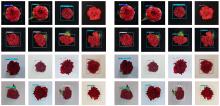
Fig. 8
Comparison of detection results between Flor-YOLO and YOLO11n in representative openness grading scenarios
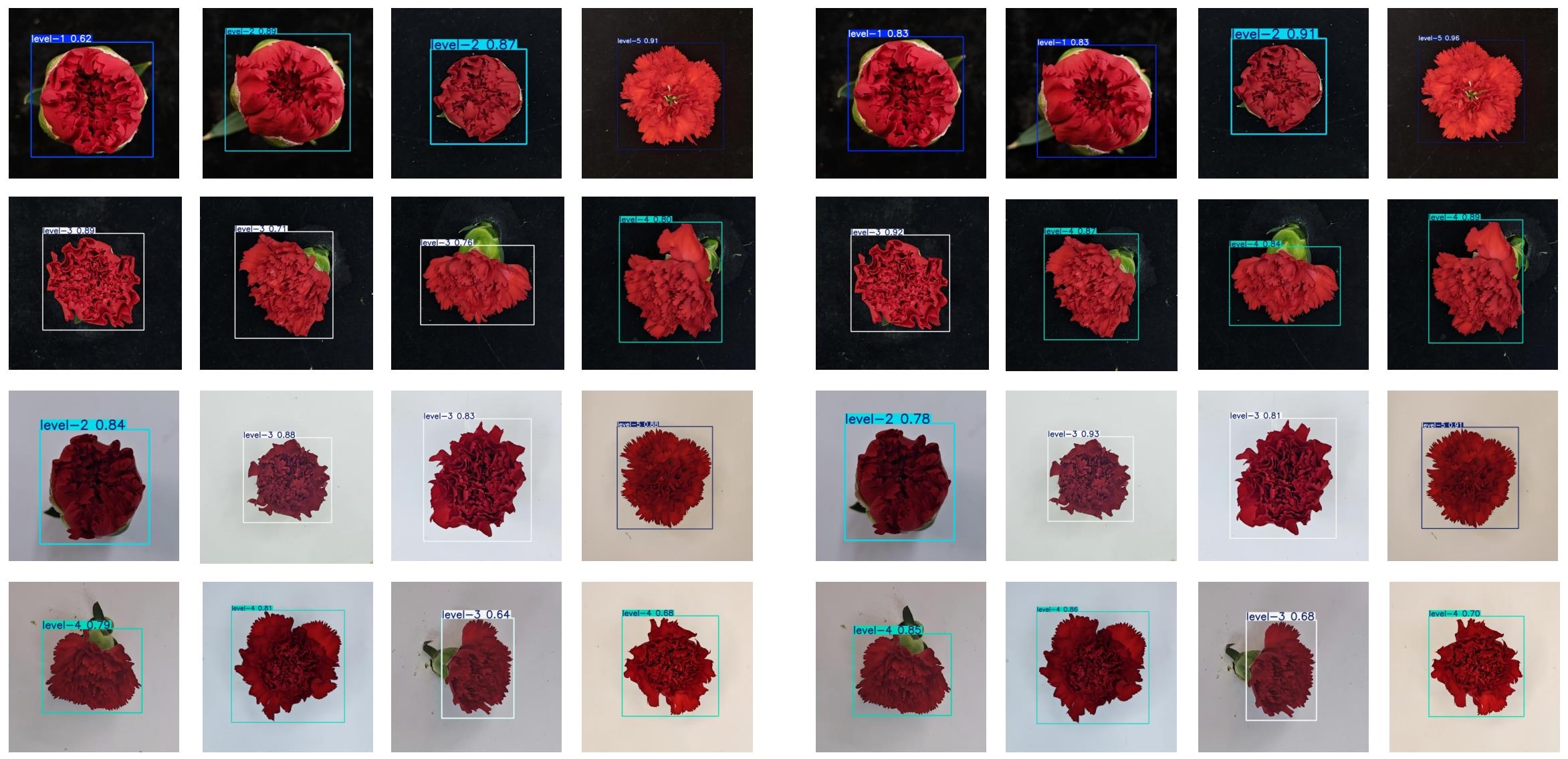
Fig. 9
Grad-CAM++ class activation heatmap comparison between YOLO11n and Flor-YOLO for Dianthus caryophyllus L. openness detection
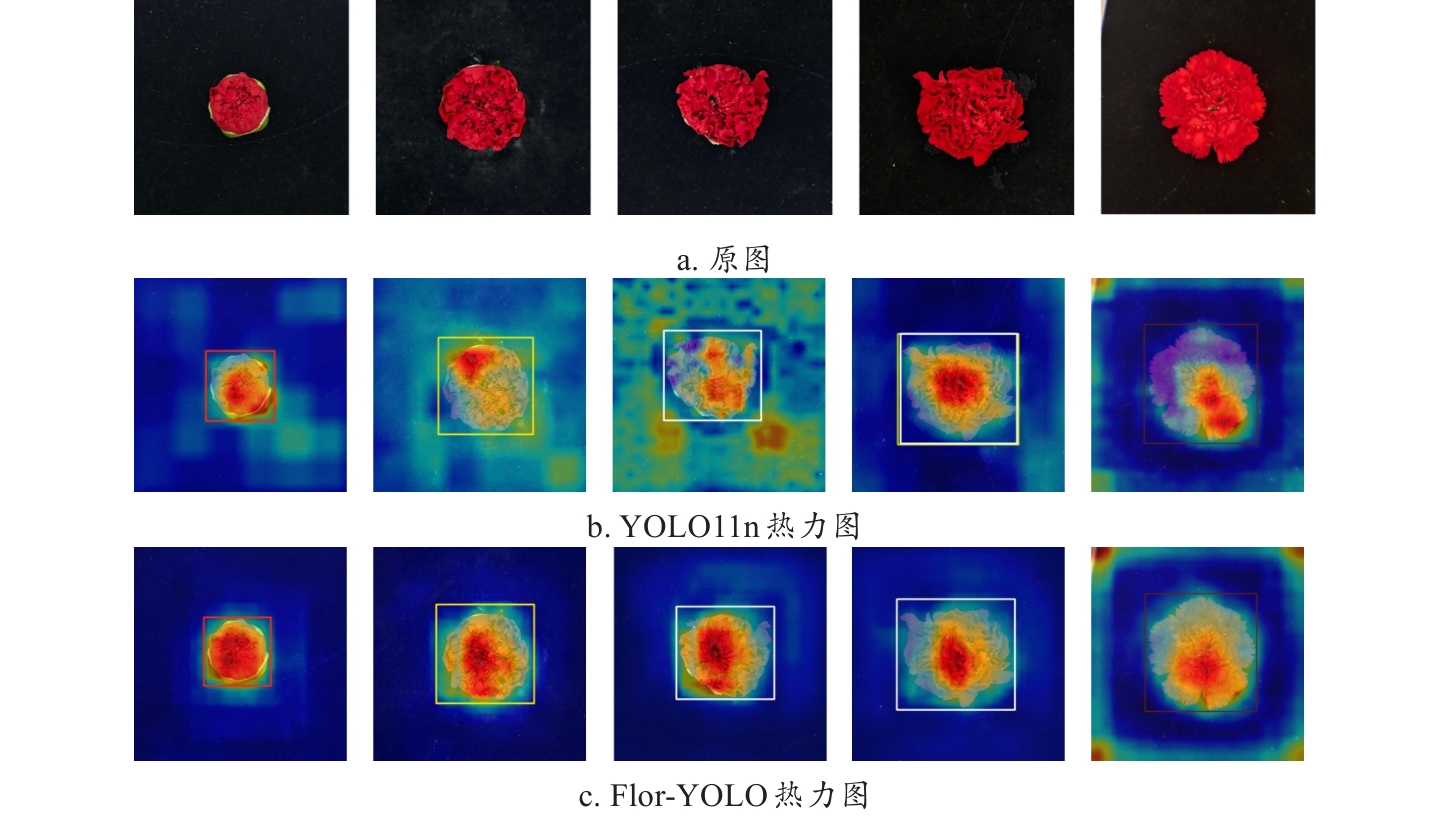
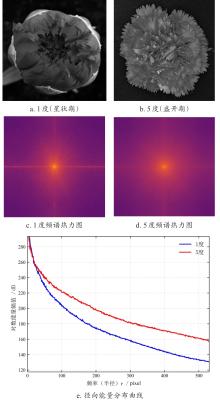
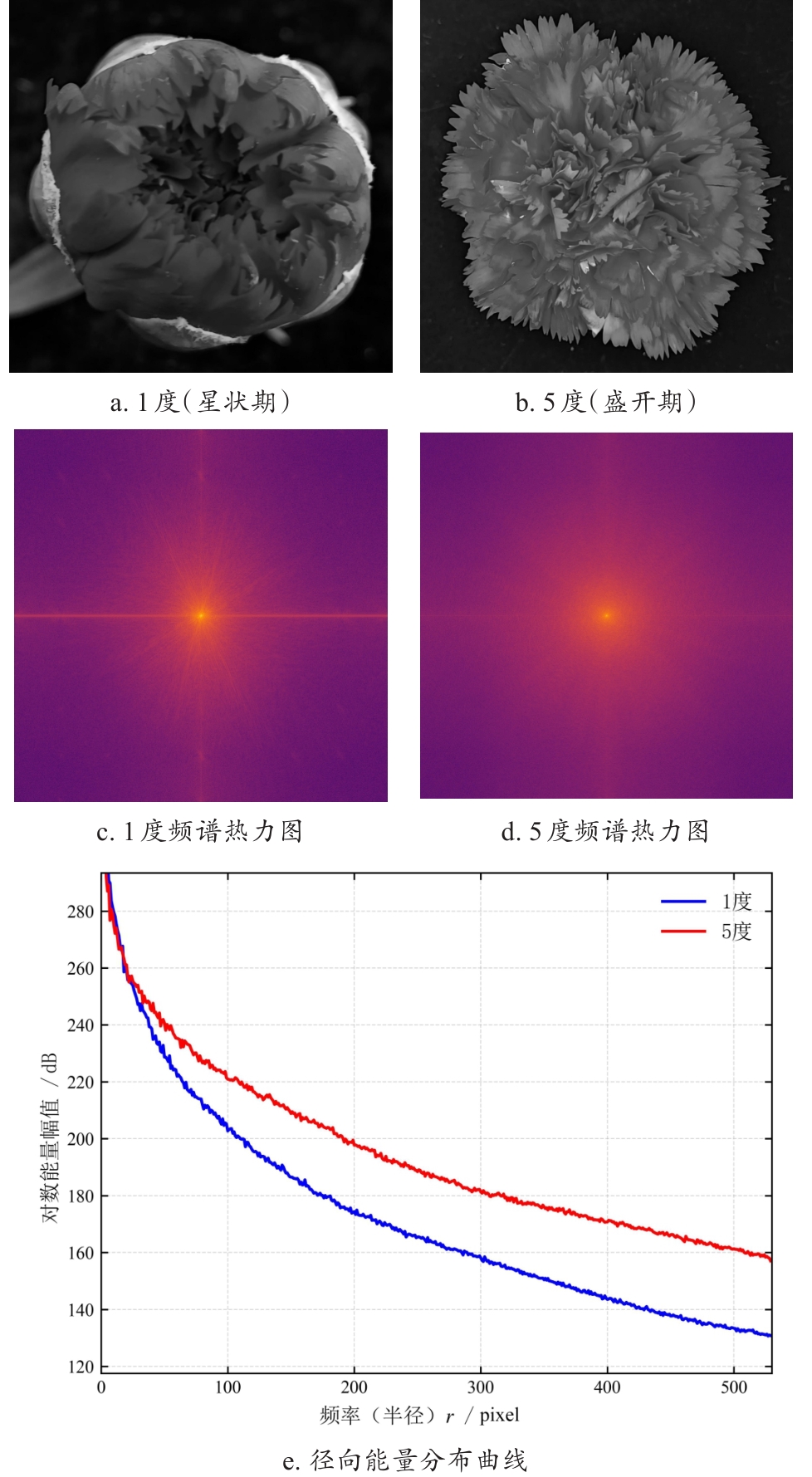
Fig. 10
Frequency-domain feature comparison of Dianthus caryophyllus L. openness
| [1] |
|
| [2] |
|
| [3] |
|
| [4] |
顾仲阳. 我国种苗花卉企业年产值超5200亿元 云南鲜切花国内市场占有率达70%[EB/OL].中国政府网, 2025-03-05[2026-02-22].
|
| [5] |
|
| [6] |
|
| [7] |
云南省农业农村厅. 云南省花卉产业发展报告[R]. 昆明: 云南省农业农村厅,2022.
|
| [8] |
|
| [9] |
肖瑞宏, 谭立新, 王日凤, 等. 基于改进YOLOv11n的多尺度茶叶病害检测方法[J]. 智慧农业(中英文), 2026, 8(1): 62-71.
|
|
|
|
| [10] |
王雪, 高雅, 陶桂香, 等. 基于CBLP-YOLO 11n的无人机稻穗轻量化检测方法[J]. 农业机械学报, 2025, 56(11): 461-470.
|
|
|
|
| [11] |
|
| [12] |
|
| [13] |
张玉玉, 邴树营, 纪元浩, 等. 基于改进YOLOv8s的玫瑰鲜切花分级方法[J]. 智慧农业(中英文), 2024, 6(2): 118-127.
|
|
|
|
| [14] |
钱晔, 陈江权, 李兆文, 等. 基于多重注意力协同优化的鲜切花等级分类模型[J/OL]. 南京农业大学学报. (2025-09-08)[2025-12-01].
|
|
|
|
| [15] |
|
| [16] |
|
| [17] |
|
| [18] |
|
| [19] |
|
| [20] |
|
| [21] |
|
| [22] |
|
| [23] |
|
| [24] |
|
| [25] |
|
| [26] |
|
| [27] |
|
| [28] |
|
| [29] |
|
| [30] |
|
| [31] |
国家市场监督管理总局, 国家标准化管理委员会. 香石竹切花等级: GB/T 41202—2021 [S]. 北京: 中国标准出版社, 2021.
|
|
State Administration for Market Regulation; Standardization Administration of the People's Republic of China. Grade of cut carnation: GB/T 41202—2021 [S]. Beijing: Standards Press of China, 2021.
|
|
| [32] |
|
| [33] |
|
| [34] |
|
| [35] |
|
| [1] | SHEN Xueli, ZHANG Yue, JIN Haibo, ZHANG Xuxu. Multi-Scale Heterogeneous Feature Synergistic Model for Cotton Leaf Disease Detection [J]. Smart Agriculture, 2026, 8(4): 204-216. |
| [2] | SHI Qimeng, WANG Jun, XU Xiaofeng, ZHANG Weiyi. Cotton Maturity Detection Algorithm Based on Improved RT-DETR [J]. Smart Agriculture, 2026, 8(4): 100-113. |
| [3] | YANG Yu, ZHANG Yibo, MAO Bo, ZHANG Lei. LiteFocus-Net: A Three-Point Lightweight Enhancement Framework for Small-Target Detection of Corn Leaf Diseases and Pests [J]. Smart Agriculture, 2026, 8(4): 217-237. |
| [4] | SU Yujie, LI Yue, WEI Linjing, WU Bing, GUO Linhai, YAN Bin, ZHOU Hui, GAO Yuhong, KANG Lianghe, LIU Huan, SU Shunchang. Lodging Region Detection Method in Flax Based on Lightweight Improved YOLOv11n-seg Model [J]. Smart Agriculture, 2026, 8(2): 35-47. |
| [5] | WU Tingting, GUO Junrui, TAO Qiujie, CHEN Shihua, GUO Shanli. YOLOv8n-SSND: An Improved Lightweight Model for Aerial Chenopodium Chenopodium quinoa Willd. Spike Target [J]. Smart Agriculture, 2026, 8(2): 59-71. |
| [6] | ZHANG Wenbo, JIANG Yijue, SONG Wei, HE Qi, ZHANG Wenbo. CAGE-YOLO: A Dense Small Object Detection Model for Aquaculture Net Cages Based on Remote Sensing Images [J]. Smart Agriculture, 2026, 8(2): 98-117. |
| [7] | LIU Haoran, WANG Yu, ZHAO Xueguan, WU Huarui, FU Hao, PANG Shujie, ZHAI Changyuan. CD-YOLO: A Method for Detecting Carrot Seedlings in Field Based on Improved YOLOv11s [J]. Smart Agriculture, 2026, 8(2): 158-174. |
| [8] | YAO Xiaotong, QU Shaoye. Lightweight Detection Method for Pepper Leaf Diseases and Pests Based on Improved YOLOv12s [J]. Smart Agriculture, 2026, 8(1): 1-14. |
| [9] | XIAO Ruihong, TAN Lixin, WANG Rifeng, SONG Min, HU Chengxi. Multi-Scale Tea Leaf Disease Detection Method Based on Improved YOLOv11n [J]. Smart Agriculture, 2026, 8(1): 62-71. |
| [10] | GAO Guangfu, WANG Qilei, SONG Liwen, FENG Haikuan, SHI Lei, YANG Hao, LIU Yang, YUE Jibo. Object Detection Method of Maize Ears Within Canopy Based on CornYOLO [J]. Smart Agriculture, 2026, 8(1): 167-177. |
| [11] | ZHAO Jun, NIE Zhigang, LI Guang, LIU Jiayu. Corn Borer Pests Infestations Detection Method Using Low-Altitude Close-Range UAV Imagery [J]. Smart Agriculture, 2025, 7(6): 111-123. |
| [12] | LUO Xuelun, GOUDA Mostafa, SONG Xinbei, HU Yan, ZHANG Wenkai, HE Yong, ZHANG Jin, LI Xiaoli. Detection Method of Ectropis Grisescens Larvae in Canopy Environments Based on YOLO and Diffusion Models [J]. Smart Agriculture, 2025, 7(5): 156-168. |
| [13] | WANG Fengyun, WANG Xuanyu, AN Lei, FENG Wenjie. Detection Method for Log-Cultivated Shiitake Mushrooms Based on Improved RT-DETR [J]. Smart Agriculture, 2025, 7(5): 67-77. |
| [14] | HAN Wenkai, LI Tao, FENG Qingchun, CHEN Liping. Lightweight Apple Instance Segmentation Algorithm Based on SSW-YOLOv11n for Complex Orchard Environments [J]. Smart Agriculture, 2025, 7(5): 114-123. |
| [15] | YANG Qilang, YU Lu, LIANG Jiaping. Grading Asparagus officinalis L. Using Improved YOLOv11 [J]. Smart Agriculture, 2025, 7(4): 84-94. |
| Viewed | ||||||
|
Full text |
|
|||||
|
Abstract |
|
|||||