Smart Agriculture ›› 2026, Vol. 8 ›› Issue (3): 85-98.doi: 10.12133/j.smartag.SA202604007
• Special Issue--Digital Technologies Reshaping Agriculture and Agricultural Economics • Previous Articles Next Articles
HUI Liwei1, CAI Hailong1( ), YI Hongmei2
Received:2026-04-03
Online:2026-05-30
Foundation items:National Natural Science Foundation of China(72373142;72361147522)
About author:HUI Liwei, E-mail: huilw2024@163.com
corresponding author:
CLC Number:
HUI Liwei, CAI Hailong, YI Hongmei. How Is Smart Agricultural Machinery Adopted by Farmers? Micro-Evidence from Beidou Navigation Tractors[J]. Smart Agriculture, 2026, 8(3): 85-98.
Add to citation manager EndNote|Ris|BibTeX
URL: https://www.smartag.net.cn/EN/10.12133/j.smartag.SA202604007
Table 1
Variable definitions and descriptive statistics for the analysis of factors influencing BeiDou navigation tractor adoption among maize farmers
| 变量 | 变量定义及说明 | 均值 | 标准差 | ||
|---|---|---|---|---|---|
| 响应变量 | 是否应用北斗导航拖拉机 | 1是,0否 | 0.163 | 0.369 | |
| 特征变量 | 户主特征 | 性别 | 1男,0女 | 0.915 | 0.278 |
| 年龄 | 岁 | 50.233 | 15.045 | ||
| 文化程度 | 1文盲,2小学,3初中;4高中,5大专,6本科及以上 | 2.961 | 1.049 | ||
| 农业培训参与次数 | 次/年 | 0.960 | 1.722 | ||
| 家庭特征 | 家庭总收入 | 万元 | 22.705 | 74.744 | |
| 家庭劳动力外出务工比例 | (外出务工劳动力数量/家庭劳动力总数)/% | 0.272 | 0.292 | ||
| 是否加入合作社 | 1是,0否 | 0.260 | 0.439 | ||
| 是否村干部户 | 1是,0否 | 0.195 | 0.396 | ||
| 经营特征 | 农地经营规模 | hm2 | 5.780 | 26.27 | |
| 耕地块数 | 块 | 9.748 | 29.033 | ||
| 是否密植 | 1是,0否 | 0.239 | 0.427 | ||
| 是否成立家庭农场 | 1是,0否 | 0.126 | 0.332 | ||
| 社会化服务参与程度 | 购买社会化服务支出/元 | 122.741 | 79.822 | ||
| 是否使用植保无人机 | 1是,0否 | 0.221 | 0.415 | ||
| 是否购买农业保险 | 1是,0否 | 0.656 | 0.475 | ||
| 灾害损失程度 | % | 15.628 | 22.721 | ||
| 区域特征 | 县域经济发展水平 | (GDP/户籍人口)/(元/人) | 64 869.640 | 38 112.810 | |
| 县域产业结构 | (第一产业增加值/GDP)/% | 14.875 | 9.133 | ||
| 县域财政自给率 | (一般公共预算收入/一般公共预算支出)/% | 0.415 | 0.222 | ||
| 县域智能农机市场供给能力 | 本县涉及智能农机或其装备销售的企业数量/个 | 82.301 | 54.726 | ||
| 县域农机服务组织密度 | 本县经营范围包含农机业务的合作社数量/个 | 466.575 | 468.507 | ||
| 智能农机政策支持力度 | 依据近三年县级政府官网公开的智能农机推广相关政策文件赋分求得 | 29.149 | 6.529 | ||
| 北斗导航设备购置补贴金额 | 元/套 | 3 879.630 | 2 225.761 | ||
| 环境特征 | 年均气温 | ℃ | 12.125 | 4.138 | |
| 年降水量 | ml | 655.359 | 201.437 | ||
Table 2
Probit regression results for the analysis of factors influencing BeiDou navigation tractor adoption among maize farmers
| 变量名称 | 系数 | 标准误 | 变量名称 | 系数 | 标准误 |
|---|---|---|---|---|---|
| 性别 | 0.266 | 0.237 | 是否使用植保无人机 | 0.619*** | 0.137 |
| 年龄 | -0.005 | 0.006 | 是否购买农业保险 | 0.024 | 0.126 |
| 文化程度 | 0.066 | 0.058 | 灾害损失程度 | -0.000 | 0.002 |
| 农业培训参与次数 | 0.056* | 0.029 | 县域经济发展水平 | 0.465 | 0.419 |
| 家庭总收入 | 0.120* | 0.063 | 县域产业结构 | 0.005 | 0.015 |
| 家庭劳动力外出务工比例 | -0.105 | 0.198 | 县域财政自给率 | -0.916 | 1.100 |
| 是否加入合作社 | 0.194 | 0.126 | 县域智能农机市场供给能力 | 0.042 | 0.169 |
| 是否村干部户 | 0.122 | 0.127 | 县域农机服务组织密度 | 0.089 | 0.192 |
| 农地经营规模 | 0.045 | 0.068 | 智能农机政策支持力度 | 1.506*** | 0.478 |
| 耕地块数 | -0.004** | 0.002 | 北斗导航设备购置补贴金额 | -0.566 | 4.116 |
| 是否密植 | 0.316** | 0.129 | 年均气温 | -0.158 | 0.102 |
| 是否成立家庭农场 | 0.129 | 0.141 | 年降水量 | -1.426* | 0.777 |
| 社会化服务参与程度 | 0.082 | 0.057 |
Table 3
Performance evaluation of different machine learning models for predicting the adoption of BeiDou navigation tractors among maize farmers
| 模型 | 准确率 | 精确率 | 召回率 | F 1 |
|---|---|---|---|---|
| 支持向量机 | 57.2 | 57.3 | 64.7 | 64.5 |
| 决策树 | 90.4 | 90.4 | 90.9 | 90.7 |
| 随机森林 | 92.8 | 93.4 | 91.3 | 92.3 |
| 梯度提升决策树 | 92.1 | 93.3 | 91.3 | 92.3 |
| 分类提升树 | 92.8 | 93.7 | 92.2 | 92.9 |
| 轻量梯度提升 | 93.1 | 94.2 | 92.2 | 93.2 |
| 极端梯度提升 | 93.4 | 94.3 | 92.8 | 93.5 |
Table 4
Ranking of feature variable importance based on the SHAP value method
| 排名 | 特征变量 | |SHAP|均值 | 贡献度/% |
|---|---|---|---|
| 1 | 智能农机政策支持力度 | 0.627 | 12.718 |
| 2 | 家庭总收入 | 0.562 | 11.404 |
| 3 | 农地经营规模 | 0.458 | 9.284 |
| 4 | 年龄 | 0.363 | 7.355 |
| 5 | 农业培训参与次数 | 0.352 | 7.142 |
| 6 | 是否使用植保无人机 | 0.327 | 6.630 |
| 7 | 县域农机服务组织密度 | 0.266 | 5.391 |
| 8 | 耕地块数 | 0.234 | 4.736 |
| 9 | 灾害损失程度 | 0.192 | 3.891 |
| 10 | 社会化服务参与程度 | 0.177 | 3.582 |
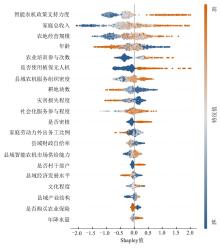
Fig. 1
Shapley value beeswarm plot of influencing factors for the adoption of Beidou navigation tractors by maize farmers
Table 5
Predictive results of other machine learning models for BeiDou navigation tractor adoption among maize farmers
| 排名 | 分类梯度提升 | 轻量梯度提升 | ||||
|---|---|---|---|---|---|---|
| 特征变量 | 贡献度/% | 影响方向 | 特征变量 | 贡献度/% | 影响方向 | |
| 1 | 智能农机政策支持力度 | 9.887 | 正向 | 家庭总收入 | 12.228 | 正向 |
| 2 | 农地经营规模 | 9.150 | 正向 | 智能农机政策支持力度 | 11.437 | 正向 |
| 3 | 家庭总收入 | 8.508 | 正向 | 农地经营规模 | 8.877 | 正向 |
| 4 | 是否使用植保无人机 | 8.338 | 正向 | 年龄 | 8.516 | 负向 |
| 5 | 年龄 | 7.287 | 负向 | 县域农机服务组织密度 | 6.510 | 正向 |
| 6 | 县域农机服务组织密度 | 5.650 | 正向 | 是否使用植保无人机 | 5.875 | 正向 |
| 7 | 社会化服务参与程度 | 4.894 | 正向 | 农业培训参与次数 | 5.694 | 正向 |
| 8 | 农业培训参与次数 | 4.889 | 正向 | 社会化服务参与程度 | 5.018 | 正向 |
| 9 | 县域智能农机市场供给能力 | 3.863 | 正向 | 耕地块数 | 4.998 | 负向 |
| 10 | 灾害损失程度 | 3.449 | 负向 | 灾害损失程度 | 3.506 | 负向 |
Table 6
Prediction results under different training set splitting strategies for BeiDou navigation tractor adoption among maize farmers
| 排名 | 特征变量 | 贡献度/% | 影响方向 |
|---|---|---|---|
| 1 | 智能农机政策支持力度 | 11.811 | 正向 |
| 2 | 家庭总收入 | 11.047 | 正向 |
| 3 | 是否使用植保无人机 | 8.199 | 正向 |
| 4 | 农地经营规模 | 7.659 | 正向 |
| 5 | 年龄 | 6.936 | 负向 |
| 6 | 县域农机服务组织密度 | 6.533 | 正向 |
| 7 | 农业培训参与次数 | 5.921 | 正向 |
| 8 | 灾害损失程度 | 4.518 | 负向 |
| 9 | 社会化服务参与程度 | 4.271 | 正向 |
| 10 | 耕地块数 | 3.981 | 负向 |
Table 7
Predictive performance of the XGBoost model for BeiDou navigation tractor adoption among maize farmers across different subsamples
| 分样本 | 准确率 | 精确率 | 召回率 | F 1 |
|---|---|---|---|---|
| 小农户 | 96.2 | 95.7 | 96.7 | 96.2 |
| 规模户 | 89.3 | 91.9 | 87.0 | 89.4 |
| 低年龄 | 93.1 | 95.0 | 91.6 | 93.3 |
| 高年龄 | 92.1 | 90.4 | 95.0 | 92.6 |
| 地形条件优 | 95.0 | 93.9 | 93.7 | 98.8 |
| 地形条件劣 | 89.4 | 92.2 | 87.6 | 89.8 |
Table 8
Analysis results of influencing factors on BeiDou navigation tractor adoption among maize farmers across different farmland operation scales
| 排名 | 小农户 | 规模户 | ||
|---|---|---|---|---|
| 特征变量 | |SHAP|均值 | 特征变量 | |SHAP|均值 | |
| 1 | 是否使用植保无人机 | 1.357 | 智能农机政策支持力度 | 0.834 |
| 2 | 县域农机服务组织密度 | 0.791 | 家庭总收入 | 0.413 |
| 3 | 年龄 | 0.454 | 是否密植 | 0.402 |
| 4 | 家庭总收入 | 0.447 | 年龄 | 0.401 |
| 5 | 社会化服务参与程度 | 0.430 | 耕地块数 | 0.340 |
Table 9
Analysis results of influencing factors on BeiDou navigation tractor adoption among maize farmers across different age groups
| 排名 | 低年龄 | 高年龄 | ||
|---|---|---|---|---|
| 特征变量 | |SHAP|均值 | 特征变量 | |SHAP|均值 | |
| 1 | 家庭总收入 | 0.714 | 县域农机服务组织密度 | 1.024 |
| 2 | 是否使用植保无人机 | 0.682 | 家庭总收入 | 0.534 |
| 3 | 智能农机政策支持力度 | 0.655 | 农地经营规模 | 0.515 |
| 4 | 农地经营规模 | 0.413 | 智能农机政策支持力度 | 0.487 |
| 5 | 社会化服务参与程度 | 0.323 | 是否加入合作社 | 0.329 |
Table 10
Analysis results of influencing factors on BeiDou navigation tractor adoption among maize farmers across different topographical conditions
| 排名 | 地形条件劣 | 地形条件优 | ||
|---|---|---|---|---|
| 特征变量 | |SHAP|均值 | 特征变量 | |SHAP|均值 | |
| 1 | 农地经营规模 | 0.729 | 县域农机服务组织密度 | 0.791 |
| 2 | 年龄 | 0.559 | 家庭总收入 | 0.496 |
| 3 | 是否使用植保无人机 | 0.556 | 农业培训参与次数 | 0.383 |
| 4 | 智能农机政策支持力度 | 0.445 | 年龄 | 0.379 |
| 5 | 家庭总收入 | 0.417 | 社会化服务参与程度 | 0.351 |
| [1] |
魏后凯, 崔凯. 建设农业强国的中国道路: 基本逻辑、进程研判与战略支撑[J]. 中国农村经济, 2022(1): 2-23.
|
|
|
|
| [2] |
高鸣, 杨新宇. 农业增效益: 数字技术赋能粮食产业高质量发展的实践进路[J]. 学习与探索, 2025(2): 23-32, 2.
|
|
|
|
| [3] |
|
| [4] |
姚科艳, 陈利根, 刘珍珍. 农户禀赋、政策因素及作物类型对秸秆还田技术采纳决策的影响[J]. 农业技术经济, 2018(12): 64-75.
|
|
|
|
| [5] |
李亚娟, 马骥. 科学施肥技术的收入效应差异分析——基于粮农初始禀赋的实证估计[J]. 农业技术经济, 2021(7): 18-32.
|
|
|
|
| [6] |
|
| [7] |
|
| [8] |
|
| [9] |
杨建辉, 张凯旋. 社会资本、农作物差异与农业化学投入替代技术的采纳——基于山东942份农户调查数据[J]. 农业技术经济, 2024(6): 90-106.
|
|
|
|
| [10] |
|
| [11] |
杜三峡, 罗小锋, 黄炎忠, 等. 技术评价对农户绿色防控技术采纳行为的影响[J]. 农业技术经济, 2024(3): 63-77.
|
|
|
|
| [12] |
|
| [13] |
|
| [14] |
路之纤, 陈煌, 王金霞. 突破信息壁垒: 信息干预对农户智能农机支付意愿的影响[J]. 中国农村观察, 2026, 47(1): 110-133.
|
|
|
|
| [15] |
郭峰, 陶旭辉. 机器学习与社会科学中的因果关系: 一个文献综述[J]. 经济学(季刊), 2023, 23(1): 1-17.
|
|
|
|
| [16] |
齐秀琳, 汪心如. 基于机器学习方法的农业转移人口市民化水平影响因素研究[J]. 中国农村经济, 2024(5): 128-150.
|
|
|
|
| [17] |
洪永淼, 汪寿阳. 大数据如何改变经济学研究范式?[J]. 管理世界, 2021, 37(10): 40-55, 72, 56.
|
|
|
|
| [18] |
苏岚岚, 王凯龙, 于艳丽. 高标准农田建设促进智慧农业技术采纳了吗?[J]. 经济与管理研究, 2026, 47(4): 81-98.
|
|
|
|
| [19] |
|
| [20] |
张正平, 董晶. 因普惠而低碳: 数字普惠金融对农村家庭消费碳排放的影响[J]. 农业技术经济, 2026(4): 126-144.
|
|
|
|
| [21] |
黄绍升, 闫春. 短视频推广对绿色防控技术采纳的渗透效应——基于469位农业创业者的调研数据[J]. 科技管理研究, 2026, 46(8): 230-239.
|
|
|
|
| [22] |
罗明忠, 雷显凯. 非农就业经历、风险偏好与新型职业农民生产技术采纳[J]. 江苏大学学报(社会科学版), 2022, 24(2): 44-56.
|
|
|
|
| [23] |
王明利, 鄢朝辉. 统筹发展"四个农业"的现实挑战与路径选择[J]. 中国农村经济, 2026(3): 3-25.
|
|
|
|
| [24] |
邓远远, 朱俊峰. 粮食种植户保护性耕作技术采纳决策——影响因素及其异质性特征[J]. 中国农业大学学报, 2023, 28(12): 248-261.
|
|
|
|
| [25] |
郭茜, 韩嵩, 李倩. "公转铁"政策对京津冀绿色物流效率的影响[J]. 中国流通经济, 2024, 38(3): 45-55.
|
|
|
|
| [26] |
闵师, 刘文丽, 杨敏达, 等. 乡镇农贸市场对农村居民膳食平衡水平的影响[J]. 中国农村观察, 2025(6): 62-80.
|
|
|
|
| [27] |
仇焕广, 王丹丹, 于晓华, 等. 关于机器学习在农业经济领域应用的若干思考[J]. 农业经济问题, 2025(10): 4-25.
|
|
|
|
| [28] |
刘媛, 熊柴, 蔡继明. 农民工进城落户的意愿为什么不高?——基于可解释机器学习方法的分析[J]. 中国农村经济, 2025(4): 20-41.
|
|
|
|
| [29] |
|
| [30] |
许庆, 陆钰凤, 章元. 规模经营补贴与粮食量质安全——来自规模经营农户的证据[J]. 经济研究, 2022, 57(11): 121-137.
|
|
|
| [1] | XU Jiabin, QIN Yaru, WEN Haoyang, QIU Huanguang, CUI Zhaoda. Can Digital Technology Improve the Resilience of Grain Production: Causal Inference Based on Dual Machine Learning [J]. Smart Agriculture, 2026, 8(3): 176-189. |
| [2] | YI Hongmei, HE Xu, ZHI Huayong, HUANG Jikun, CHEN Xi. Adoption and Challenges of Digital and Intelligent Technologies in Agriculture: Evidence from Two Representative Household Surveys [J]. Smart Agriculture, 2026, 8(3): 51-66. |
| [3] | WANG Yi, CUI Xitong, WANG Chen, XIONG Baowei, SHAO Guomin, WANG Wanying, CAO Pei, HAN Wenting. Field Maize Yield Prediction Model Based on Causal Inference and Machine Learningin Agricultural Fields [J]. Smart Agriculture, 2026, 8(2): 175-187. |
| [4] | XU Xiaobin, ZHU Hongchun, LI Feng, HE Wei, YANG Jiaming, LI Zhenhai. High Spatiotemporal Resolution Remote Sensing for Precision Agricultural Disaster Early Warning: Progress, Bottlenecks, and Integrative Pathways [J]. Smart Agriculture, 2026, 8(2): 18-34. |
| [5] | WU Zhangbin, HE Ning, WU Yandong, GUO Xinyu, WEN Weiliang. Point Cloud Data-driven Methods for Estimating Maize Leaf Biomass [J]. Smart Agriculture, 2026, 8(1): 156-166. |
| [6] | LIU Jie, GUO Jiaxin, ZHANG Jiahao, ZHANG Bingchao, XIONG Jie, CAO Jianpeng, WU Shangrong, DENG Yingbin, CHEN Guipeng. Method for Estimating Leaf Area Index of Winter Rapeseed Based on Fusion of Vegetation Indices and Texture Features [J]. Smart Agriculture, 2025, 7(6): 161-173. |
| [7] | BAI Ruibin, WANG Hui, WANG Hongpeng, HONG Jiashun, ZHOU Junhui, YANG Jian. Rapid and Non-Destructive Analysis Method of Hawthorn Moisture Content Based on Hyperspectral Imaging Technology [J]. Smart Agriculture, 2025, 7(4): 95-107. |
| [8] | LIU Liqi, WEI Guangyuan, ZHOU Ping. Prediction and Mapping of Soil Total Nitrogen Using GF-5 Image Based on Machine Learning Optimization Modeling [J]. Smart Agriculture, 2024, 6(5): 61-73. |
| [9] | LUAN Shijie, SUN Yefeng, GONG Liang, ZHANG Kai. Trajectory Tracking Method of Agricultural Machinery Multi-Robot Formation Operation Based on MPC Delay Compensator [J]. Smart Agriculture, 2024, 6(3): 69-81. |
| [10] | SHEN Yanyan, ZHAO Yutao, CHEN Gengshen, LYU Zhengang, ZHAO Feng, YANG Wanneng, MENG Ran. Identification and Severity Classification of Typical Maize Foliar Diseases Based on Hyperspectral Data [J]. Smart Agriculture, 2024, 6(2): 28-39. |
| [11] | GUO Wang, YANG Yusen, WU Huarui, ZHU Huaji, MIAO Yisheng, GU Jingqiu. Big Models in Agriculture: Key Technologies, Application and Future Directions [J]. Smart Agriculture, 2024, 6(2): 1-13. |
| [12] | JIA Wenshen, LYU Haolin, ZHANG Shang, QIN Yingdong, ZHOU Wei. Using a Portable Visible-near Infrared Spectrometer and Machine Learning to Distinguish and Quantify Mold Contamination in Wheat [J]. Smart Agriculture, 2024, 6(1): 89-100. |
| [13] | ZHAO Chunjiang, FAN Beibei, LI Jin, FENG Qingchun. Agricultural Robots: Technology Progress, Challenges and Trends [J]. Smart Agriculture, 2023, 5(4): 1-15. |
| [14] | LONG Jianing, ZHANG Zhao, LIU Xiaohang, LI Yunxia, RUI Zhaoyu, YU Jiangfan, ZHANG Man, FLORES Paulo, HAN Zhexiong, HU Can, WANG Xufeng. Wheat Lodging Types Detection Based on UAV Image Using Improved EfficientNetV2 [J]. Smart Agriculture, 2023, 5(3): 62-74. |
| [15] | YE Dapeng, CHEN Chen, LI Huilin, LEI Yingxiao, WENG Haiyong, QU Fangfang. Visible/NIR Spectral Inversion of Malondialdehyde Content in JUNCAO Based on Deep Convolutional Gengrative Adversarial Network [J]. Smart Agriculture, 2023, 5(3): 132-141. |
| Viewed | ||||||
|
Full text |
|
|||||
|
Abstract |
|
|||||