Smart Agriculture ›› 2026, Vol. 8 ›› Issue (4): 217-237.doi: 10.12133/j.smartag.SA202605017
• Information Processing and Decision Making • Previous Articles
YANG Yu1, ZHANG Yibo2, MAO Bo2, ZHANG Lei2( )
)
Received:2026-05-12
Online:2026-07-30
Foundation items:National Key Research and Development Program of China(2024YFF1105504)
About author:YANG Yu, E-mail: 2514056148@qq.com;
ZHANG Yibo, E-mail: feptsss@gmail.com
corresponding author:
CLC Number:
YANG Yu, ZHANG Yibo, MAO Bo, ZHANG Lei. LiteFocus-Net: A Three-Point Lightweight Enhancement Framework for Small-Target Detection of Corn Leaf Diseases and Pests[J]. Smart Agriculture, 2026, 8(4): 217-237.
Add to citation manager EndNote|Ris|BibTeX
URL: https://www.smartag.net.cn/EN/10.12133/j.smartag.SA202605017
Table 1
Image counts, instance counts, and small-object proportions for eight categories in the field corn leaf disease and pest dataset
| 类别 | 图像数/张 | 目标实例数/个 | 小目标实例数/个 | 小目标占比/% |
|---|---|---|---|---|
| 合计 | 10 324 | 24 136 | 15 946 | 66.1 |
| 玉米锈病 | 1 503 | 3 964 | 2 761 | 69.7 |
| 灰斑病 | 1 247 | 2 638 | 1 316 | 49.9 |
| 玉米大斑病 | 1 189 | 2 147 | 758 | 35.3 |
| 叶枯病 | 1 083 | 1 841 | 551 | 29.9 |
| 玉米螟 | 1 164 | 2 509 | 1 623 | 64.7 |
| 草地贪夜蛾幼虫 | 1 287 | 2 895 | 1 738 | 60.0 |
| 虫卵 | 1 538 | 4 621 | 4 074 | 88.2 |
| 孢子簇 | 1 313 | 3 521 | 3 125 | 88.8 |
Table 2
Stratified group-wise division of the field corn leaf dataset into training, validation, and test subsets
| 类别 | 训练集/张 | 验证集/张 | 测试集/张 | 合计/张 |
|---|---|---|---|---|
| 合计 | 6 147 | 2 128 | 2 049 | 10 324 |
| 玉米锈病 | 902 | 301 | 300 | 1 503 |
| 灰斑病 | 749 | 250 | 248 | 1 247 |
| 玉米大斑病 | 714 | 238 | 237 | 1 189 |
| 叶枯病 | 650 | 217 | 216 | 1 083 |
| 玉米螟 | 699 | 233 | 232 | 1 164 |
| 草地贪夜蛾幼虫 | 772 | 258 | 257 | 1 287 |
| 虫卵 | 923 | 308 | 307 | 1 538 |
| 孢子簇 | 788 | 263 | 262 | 1 313 |
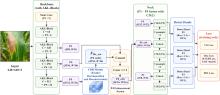
Fig. 1
Overall architecture of LiteFocus-Net
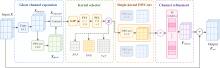
Fig. 2
Structure of the proposed AKL-Block
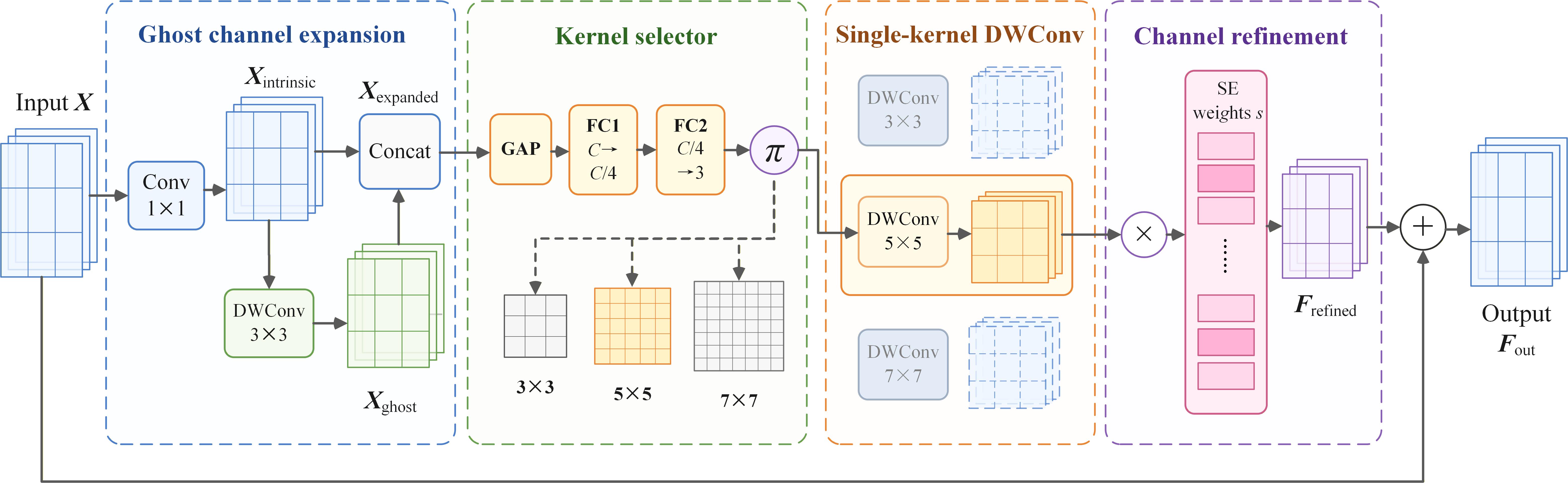
Fig. 3
Structure of the FDR module
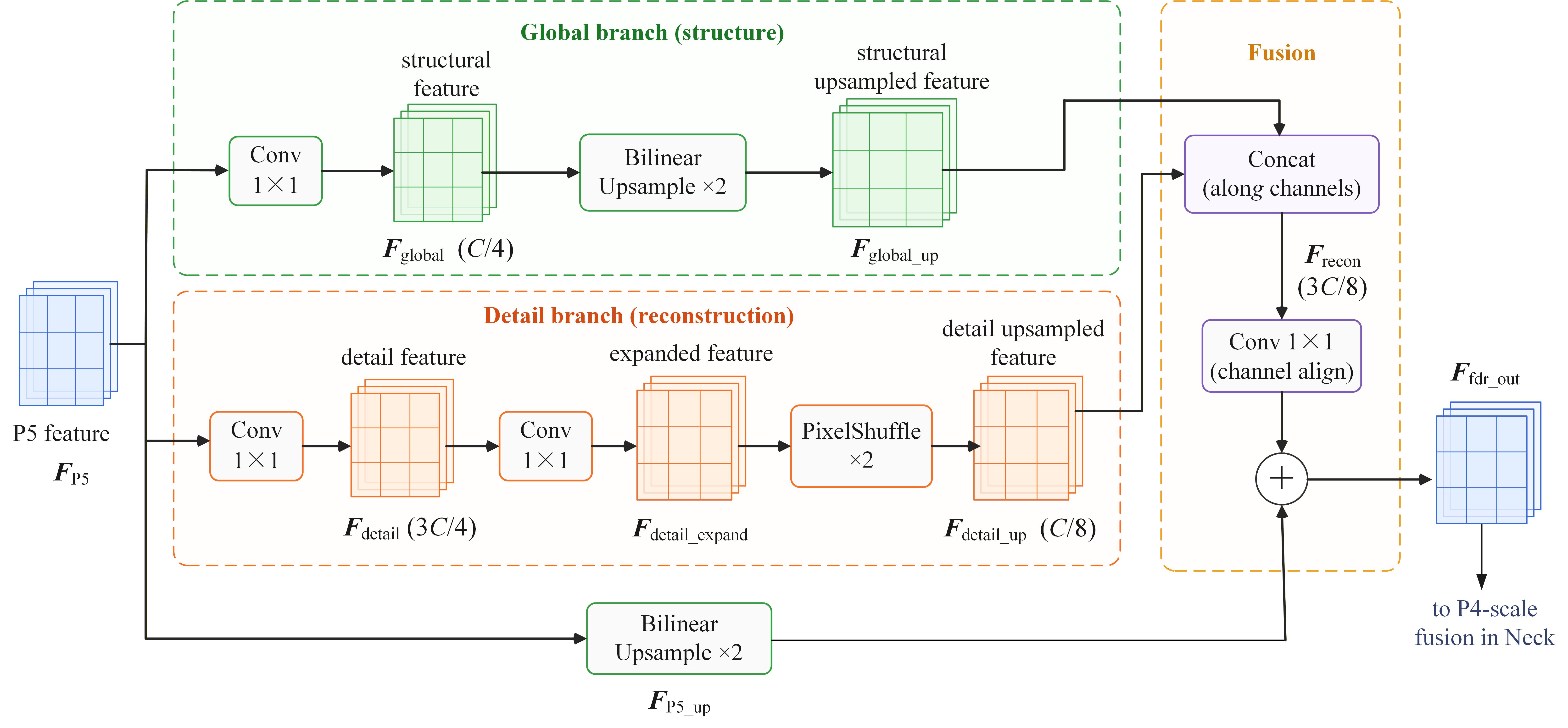
Table 3
Complete ablation study and statistical significance analysis of LiteFocus-Net on the corn leaf disease and pest dataset
| Scheme | AKL | FDR | SAGB | mAP@0.5/% | AP_s/% | AP_m/% | AP_l/% | Params/M | 计算量/GFLOPs | 调整后p值(AP_s) | 调整后p值 (mAP) |
|---|---|---|---|---|---|---|---|---|---|---|---|
| YOLOv11n Baseline | — | — | — | 72.20±0.20 | 28.10±0.50 | 55.80±0.30 | 64.30±0.20 | 2.58 | 6.3 | — | — |
| only AKL-Block | √ | — | — | 73.50±0.20 | 30.10±0.40 | 56.20±0.20 | 64.10±0.30 | 2.50 | 5.0 | 0.026 | 0.005 |
| only FDR | — | √ | — | 72.80±0.20 | 28.70±0.40 | 55.90±0.30 | 64.00±0.20 | 2.58 | 6.3 | 0.367 | 0.043 |
| only SAGB-Loss | — | — | √ | 72.70±0.20 | 28.50±0.40 | 55.90±0.30 | 64.10±0.20 | 2.58 | 6.3 | 0.367 | 0.043 |
| AKL-Block + FDR | √ | √ | — | 74.30±0.30 | 31.40±0.50 | 56.10±0.30 | 63.90±0.30 | 2.52 | 5.3 | 0.008 | 0.005 |
| AKL-Block + SAGB-Loss | √ | — | √ | 73.70±0.20 | 30.30±0.40 | 56.30±0.20 | 64.10±0.30 | 2.50 | 5.0 | 0.023 | 0.005 |
| FDR + SAGB-Loss | — | √ | √ | 73.50±0.20 | 29.20±0.50 | 56.00±0.30 | 63.80±0.20 | 2.58 | 6.3 | 0.163 | 0.005 |
| LiteFocus-Net | √ | √ | √ | 74.97±0.32 | 32.77±0.71 | 56.37±0.40 | 64.03±0.15 | 2.52 | 5.3 | 0.004 | 0.009 |
Table 4
One-way ANOVA results of the complete ablation matrix of LiteFocus-Net on various precision metrics
| 指标 | ANOVA 结果 | p 值 | 结论 |
|---|---|---|---|
| mAP@0.5 | F(7,16)=44.78 | <0.001 | 差异显著 |
| AP_s | F(7,16)=32.25 | <0.001 | 差异显著 |
| AP_m | F(7,16)=1.47 | 0.246 | 差异不显著 |
| AP_l | F(7,16)=1.19 | 0.361 | 差异不显著 |
Table 5
Repeatability results of LiteFocus-Net under three different random seeds
| 随机种子 | mAP@0.5/% | AP_s/% | AP_m/% | AP_l/% |
|---|---|---|---|---|
| 42 | 75.1 | 33.4 | 56.6 | 64.0 |
| 123 | 74.6 | 32.0 | 55.9 | 63.9 |
| 2 024 | 75.2 | 32.9 | 56.6 | 64.2 |
| 均值±标准差 | 74.97±0.32 | 32.77±0.71 | 56.37±0.40 | 64.03±0.15 |
| 95%置信区间 | [74.17,75.77] | [31.00,34.53] | [55.36,57.37] | [63.65,64.41] |
Table 6
Gain comparison of individual and combined modules on small object precision (AP_s) for LiteFocus-Net
| 模块组合 | AP_s/% (均值±标准差) | 相对基线增益 | 单独增益之和 | 交互增益 |
|---|---|---|---|---|
| Baseline | 28.10±0.50 | — | — | — |
| only AKL | 30.10±0.40 | +2.0 | — | — |
| only FDR | 28.70±0.40 | +0.6 | — | — |
| only SAGB | 28.50±0.40 | +0.4 | — | — |
| AKL + FDR | 31.40±0.50 | +3.3 | +2.6 | +0.7 (正向) |
| AKL + SAGB | 30.30±0.40 | +2.2 | +2.4 | -0.2 (轻微负向) |
| FDR + SAGB | 29.20±0.50 | +1.1 | +1.0 | +0.1 (中性) |
| AKL + FDR + SAGB | 32.77±0.71 | +4.7 | +3.0 | +1.7 (正向) |
Table 7
Ablation study of different candidate kernel sets in AKL-Block
| 卷积核选择方案 | mAP@0.5/% | AP_s/% | AP_m/% | AP_l/% | Params/M | 计算量/GFLOPs |
|---|---|---|---|---|---|---|
| {3×3} | 72.80±0.20 | 29.00±0.40 | 55.90±0.30 | 63.70±0.30 | 2.47 | 4.6 |
| {3×3, 5×5} | 73.20±0.20 | 29.70±0.40 | 56.00±0.30 | 63.90±0.30 | 2.49 | 4.8 |
| {3×3, 5×5, 7×7} | 73.50±0.20 | 30.10±0.40 | 56.20±0.20 | 64.10±0.30 | 2.50 | 5.0 |
| {1×1, 3×3, 5×5, 7×7} | 73.40±0.20 | 29.90±0.40 | 56.10±0.30 | 64.00±0.30 | 2.51 | 4.9 |
| {3×3, 5×5, 7×7, 9×9} | 73.60±0.20 | 30.20±0.40 | 56.20±0.30 | 64.20±0.30 | 2.52 | 5.4 |
Table 8
Ablation study of different channel ratios in the FDR module
| 结构分支:细节分支 | 结构分支通道数 | 细节分支通道数 | mAP@0.5/% | AP_s/% | AP_m/% | AP_l/% | Params/M | 计算量/GFLOPs |
|---|---|---|---|---|---|---|---|---|
| 1∶1 | 128 | 128 | 74.00±0.20 | 30.80±0.40 | 56.20±0.30 | 64.10±0.30 | 2.51 | 5.2 |
| 3∶5 | 96 | 160 | 74.10±0.20 | 31.10±0.40 | 56.20±0.30 | 64.00±0.30 | 2.51 | 5.2 |
| 1∶3 | 64 | 192 | 74.30±0.30 | 31.40±0.50 | 56.10±0.30 | 63.90±0.30 | 2.52 | 5.3 |
| 1∶7 | 32 | 224 | 74.10±0.20 | 31.50±0.50 | 55.80±0.30 | 63.60±0.30 | 2.54 | 5.4 |
Table 9
Ablation study of different fusion strategies between FDR and P4 features
| Scheme | mAP@0.5/% | AP_s/% | AP_m/% | AP_l/% | Params/M | 计算量/GFLOPs |
|---|---|---|---|---|---|---|
| 逐元素相加(Add) | 74.30±0.30 | 31.40±0.50 | 56.10±0.30 | 63.90±0.30 | 2.52 | 5.3 |
| 通道拼接 + 1×1 Conv | 74.40±0.30 | 31.60±0.50 | 56.20±0.30 | 64.00±0.30 | 2.58 | 5.6 |
| 可学习加权相加 | 74.40±0.30 | 31.50±0.50 | 56.20±0.30 | 64.00±0.30 | 2.53 | 5.3 |
Table 10
Ablation study of different area-aware enhancement functions in SAGB-Loss
| Scheme | mAP@0.5/% | AP_s/% | AP_m/% | AP_l/% |
|---|---|---|---|---|
| 无面积增强 | 74.70±0.30 | 32.20±0.50 | 56.40±0.30 | 64.00±0.30 |
| 硬阈值增强 | 74.60±0.30 | 32.80±0.50 | 55.80±0.30 | 63.80±0.30 |
| 线性衰减增强 | 74.70±0.30 | 32.50±0.50 | 56.00±0.30 | 63.90±0.30 |
| Sigmoid衰减增强 | 74.80±0.30 | 32.60±0.50 | 56.20±0.30 | 64.00±0.30 |
| 指数衰减增强 | 74.97±0.32 | 32.77±0.71 | 56.37±0.40 | 64.03±0.15 |
Table 11
Performance and complexity comparison of fixed-large-kernel, Inception, SKNet, and AKL-Block backbone modules
| Scheme | mAP@0.5/% | AP_s/% | AP_m/% | AP_l/% | Params/M | 计算量/GFLOPs |
|---|---|---|---|---|---|---|
| YOLOv11n Baseline | 72.20±0.20 | 28.10±0.50 | 55.80±0.30 | 64.30±0.20 | 2.58 | 6.3 |
| C3k2-Fixed 7×7 | 72.10±0.20 | 27.60±0.40 | 55.60±0.30 | 64.50±0.30 | 2.55 | 6.8 |
| C3k2-Inception | 73.70±0.30 | 30.40±0.50 | 56.30±0.30 | 64.80±0.30 | 2.68 | 7.9 |
| C3k2-SK | 73.60±0.30 | 30.20±0.50 | 56.20±0.30 | 64.60±0.30 | 2.66 | 7.3 |
| AKL-Bloc | 73.50±0.20 | 30.10±0.40 | 56.20±0.20 | 64.10±0.30 | 2.50 | 5.0 |
Table 12
Performance comparison of AKL-Block and Inception on images containing mixed small and large targets
| Scheme | mAP@0.5/% | AP_s/% | AP_l/% |
|---|---|---|---|
| C3k2-Inception | 73.00±0.30 | 30.20±0.50 | 63.80±0.30 |
| AKL-Block (Ours) | 73.10±0.30 | 30.10±0.40 | 64.10±0.30 |
Table 13
Comparison of FDR with other feature enhancement methods
| Scheme | mAP@0.5/% | AP_s/% | AP_m/% | AP_l/% | Params/M | 计算量/GFLOPs | Extra Params/M |
|---|---|---|---|---|---|---|---|
| No P5 enhancement | 73.50±0.20 | 30.10±0.40 | 56.20±0.20 | 64.10±0.30 | 2.50 | 5.0 | 0 |
| Bilinear-only | 73.60±0.20 | 30.30±0.40 | 56.10±0.20 | 64.10±0.30 | 2.50 | 5.0 | 0 |
| Deconv | 74.10±0.30 | 31.00±0.50 | 56.20±0.30 | 64.00±0.30 | 2.68 | 5.6 | 0.18 |
| Full-PixelShuffle | 74.80±0.30 | 32.20±0.50 | 56.40±0.30 | 64.20±0.30 | 2.62 | 5.8 | 0.12 |
| FDR (Ours) | 74.30±0.30 | 31.40±0.50 | 56.10±0.30 | 63.90±0.30 | 2.52 | 5.3 | 0.02 |
Table 14
Recall comparison between FDR and Full-PixelShuffle on extreme small objects
| Scheme | Recall@0.5/% | Recall@0.3/% |
|---|---|---|
| No P5 enhancement | 31.20±0.50 | 48.50±0.60 |
| Full-PixelShuffle | 34.80±0.60 | 52.10±0.60 |
| FDR (Ours) | 33.00±0.50 | 50.40±0.50 |
Table 15
Comparison of SAGB-Loss with other loss weighting strategies
| Loss Strategy | mAP@0.5/% | AP_s/% | AP_m/% | AP_l/% |
|---|---|---|---|---|
| CIoU (Baseline) | 74.30±0.30 | 31.40±0.50 | 56.10±0.30 | 63.90±0.30 |
| EIoU | 74.50±0.30 | 31.70±0.50 | 56.30±0.30 | 64.00±0.30 |
| EIoU + Layer-wise weighting | 74.70±0.30 | 32.20±0.50 | 56.40±0.30 | 64.00±0.30 |
| EIoU + Hard area threshold weighting | 74.60±0.30 | 32.80±0.50 | 55.80±0.30 | 63.90±0.30 |
| SAGB-Loss (Ours) | 74.97±0.32 | 32.77±0.71 | 56.37±0.40 | 64.03±0.15 |
Table 16
Sensitivity analysis of small-, medium-, and large-object detection to enhancement coefficient α in SAGB-Loss
| mAP@0.5 | AP_s | AP_m | AP_l | |
|---|---|---|---|---|
| 0.0 | 74.70±0.30 | 32.20±0.50 | 56.40±0.30 | 64.00±0.30 |
| 1.0 | 74.82±0.30 | 32.50±0.55 | 56.40±0.30 | 64.05±0.25 |
| 2.0 | 74.97±0.32 | 32.77±0.71 | 56.37±0.40 | 64.03±0.15 |
| 3.0 | 74.75±0.30 | 32.85±0.60 | 56.00±0.30 | 63.90±0.30 |
| 4.0 | 74.45±0.30 | 32.90±0.60 | 55.70±0.30 | 63.70±0.30 |
Table 17
Performance comparison between LiteFocus-Net and other models
| Method | mAP@0.5/% | AP_s/% | AP_m/% | AP_l/% | Params/M | 计算量/GFLOPs | FPS/(帧/s) |
|---|---|---|---|---|---|---|---|
| Faster R-CNN (ResNet50) | 66.9 | 19.3 | 48.2 | 60.4 | 137.10 | 370.20 | 21.0 |
| SSD (VGG16) | 72.3 | 24.5 | 53.1 | 63.8 | 26.29 | 62.74 | 41.0 |
| RT-DETR (R18)[ | 75.8 | 31.2 | 57.0 | 65.8 | 20.00 | 71.10 | 24.0 |
| YOLOv5n | 62.1 | 22.3 | 48.5 | 56.2 | 1.90 | 4.50 | 141.0 |
| YOLOv8n | 71.1 | 26.5 | 54.2 | 63.1 | 3.20 | 8.70 | 124.0 |
| YOLOv11n (Baseline) | 72.2 | 28.1 | 55.8 | 64.3 | 2.58 | 6.30 | 136.0 |
| YOLOv11s | 74.5 | 30.1 | 56.6 | 65.2 | 9.42 | 21.90 | 86.0 |
| YOLOv11m | 75.3 | 31.0 | 57.0 | 65.8 | 20.00 | 67.70 | 51.0 |
| YOLOv11l | 76.7 | 32.3 | 58.2 | 66.5 | 25.29 | 86.60 | 43.0 |
| EfficientViT[ | 73.3 | 29.5 | 55.9 | 64.8 | 3.56 | 6.90 | 128.0 |
| Gold-YOLO[ | 74.8 | 31.5 | 56.9 | 65.6 | 21.50 | 46.00 | 38.0 |
| YOLO-MS (XS)[ | 73.8 | 30.2 | 56.1 | 64.9 | 4.50 | 8.70 | 118.0 |
| YOLO-MS (S)[ | 75.6 | 32.0 | 57.2 | 66.0 | 8.10 | 15.40 | 82.0 |
| DAMO-YOLO (Tiny)[ | 73.1 | 29.0 | 55.5 | 64.5 | 6.80 | 14.10 | 95.0 |
| DAMO-YOLO(Small)[ | 74.3 | 30.6 | 56.3 | 65.2 | 11.20 | 23.40 | 68.0 |
| RTMDet-Tiny[ | 73.5 | 29.8 | 55.7 | 64.7 | 4.00 | 14.20 | 72.0 |
| RTMDet-Small[ | 74.9 | 31.2 | 56.8 | 65.3 | 8.89 | 14.80 | 68.0 |
| MobileViT-YOLO[ | 72.8 | 28.6 | 54.8 | 64.0 | 8.60 | 10.20 | 105.0 |
| EMO-YOLO[ | 73.4 | 29.7 | 55.6 | 64.5 | 5.10 | 8.50 | 122.0 |
| FasterNet-YOLO[ | 72.5 | 28.9 | 55.0 | 64.2 | 3.96 | 7.80 | 136.0 |
| YOLO-MSM[ | 74.0 | 30.2 | 55.8 | 64.5 | 5.40 | 18.50 | 69.6 |
| MA-YOLO[ | 73.9 | 32.1 | 56.8 | 65.2 | 6.42 | 17.20 | 67.2 |
| YOLO-LCE[ | 73.9 | 30.1 | 56.2 | 64.0 | 1.69 | 5.40 | 130.0 |
| LiteFocus-Net (Ours) | 75.0 | 32.8 | 56.4 | 64.0 | 2.52 | 5.30 | 135.0 |
Table 18
Statistical comparison between YOLOv11n and LiteFocus-Net
| 指标 | YOLOv11n | LiteFocus-Net | 提升/百分点 | 调整后p值 | 结论 |
|---|---|---|---|---|---|
| mAP@0.5/% | 72.20±0.20 | 74.97±0.32 | +2.77 | 0.002 | 显著提升 |
| AP_s/% | 28.10±0.50 | 32.77±0.71 | +4.67 | 0.004 | 显著提升 |
| AP_m/% | 55.80±0.30 | 56.37±0.40 | +0.57 | 0.250 | 差异不显著 |
| AP_l/% | 64.30±0.20 | 64.03±0.15 | -0.27 | 0.250 | 差异不显著 |
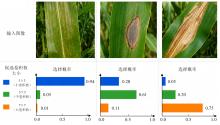
Fig. 4
Visualization of kernel selection behavior of AKL-Block
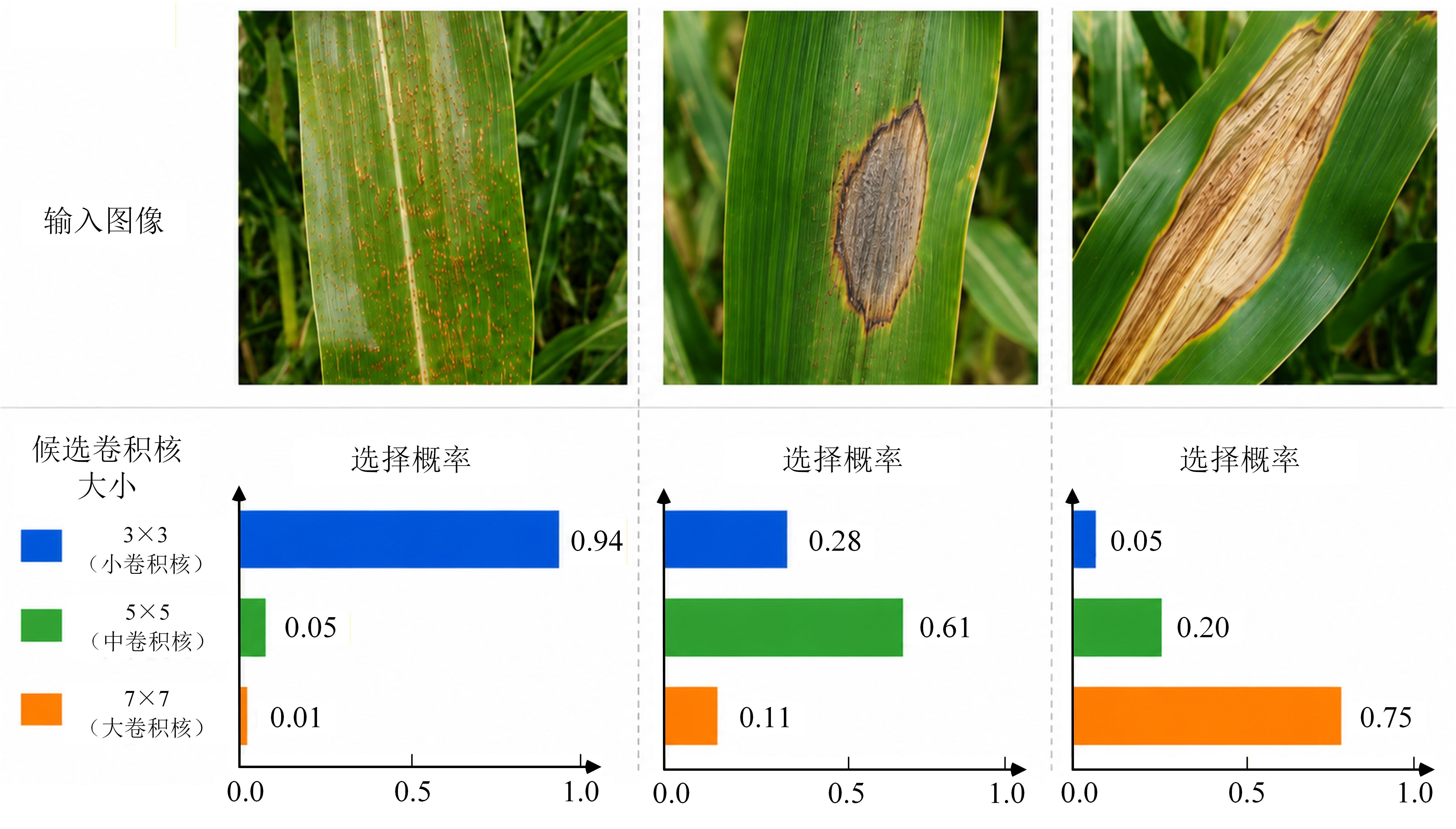
Fig. 5
Feature enhancement results of the FDR module
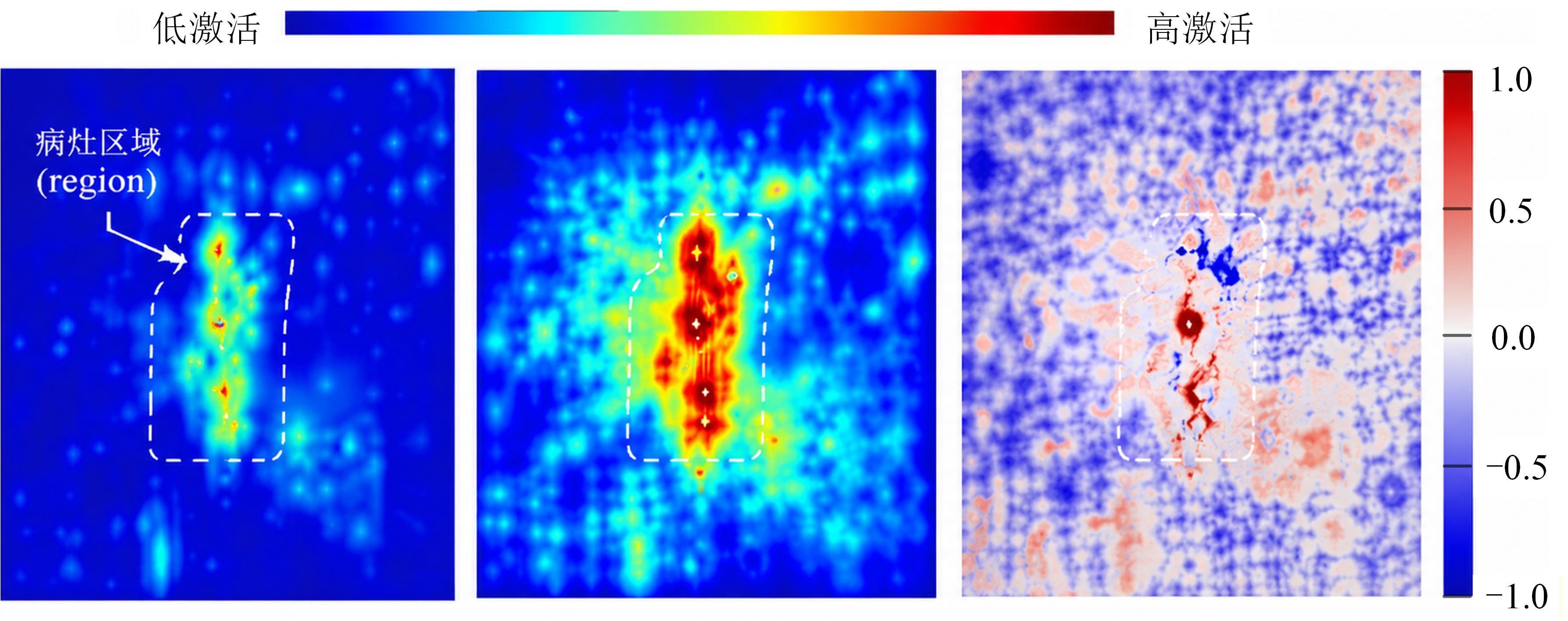
Table 19
Quantized inference performance and energy efficiency of LiteFocus-Net and YOLOv11n on RK3588 and Jetson Orin
| 平台 | 模型 | 精度 | 延迟/ms | 功耗/W | 内存/MB | mAP@0.5/% | 单帧能耗/(mJ/frame) | 能效比/(帧/s/W) |
|---|---|---|---|---|---|---|---|---|
| RK3588 CPU | YOLOv11n | INT8 | 12.7 | 0.9 | 92 | 69.8 | 11.43 | 87.5 |
| RK3588 CPU | LiteFocus-Net | INT8 | 12.1 | 0.9 | 88 | 71.5 | 10.89 | 91.8 |
| RK3588 NPU | LiteFocus-Net | INT8 | 7.5 | 1.2 | 152 | 71.5 | 9.00 | 111.1 |
| Jetson Orin | YOLOv11n | INT8 | 5.3 | 5.1 | 124 | 69.7 | 27.03 | 37.0 |
| Jetson Orin | LiteFocus-Net | FP16 | 6.8 | 6.2 | 198 | 74.7 | 42.16 | 23.7 |
| Jetson Orin | LiteFocus-Net | INT8 | 4.8 | 4.9 | 122 | 71.5 | 23.52 | 42.5 |
Table 20
Robustness evaluation of LiteFocus-Net and YOLOv11n under different complex field conditions
| 测试条件 | 图像数/张 | 目标实例数/个 | YOLOv11n mAP@0.5/% | LiteFocus-Net mAP@0.5/% | YOLOv11n AP_s/% | LiteFocus-Net AP_s/% |
|---|---|---|---|---|---|---|
| 全部测试集 | 2 049 | 4 827 | 72.2 | 75.0 | 28.1 | 32.8 |
| 强光条件 | 312 | 708 | 70.8 | 74.1 | 26.9 | 31.7 |
| 弱光条件 | 286 | 655 | 69.6 | 73.0 | 25.8 | 30.8 |
| 逆光条件 | 241 | 536 | 67.9 | 71.7 | 24.6 | 29.8 |
| 局部遮挡 | 354 | 812 | 68.7 | 72.6 | 25.1 | 30.4 |
| 不同拍摄角度 | 328 | 741 | 71.0 | 74.4 | 27.2 | 32.0 |
Fig. 6
Qualitative detection results of LiteFocus-Net in complex field scenarios
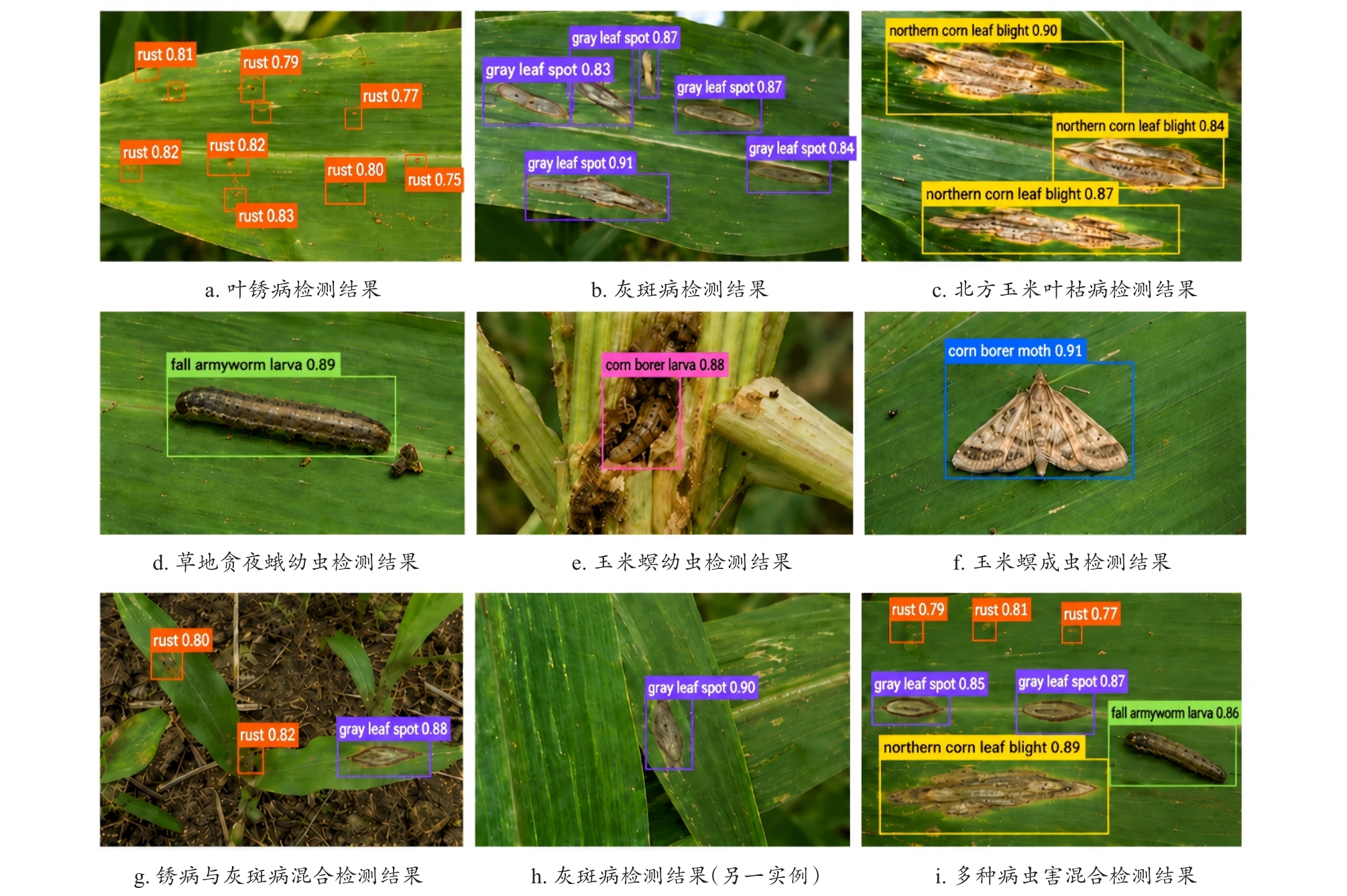
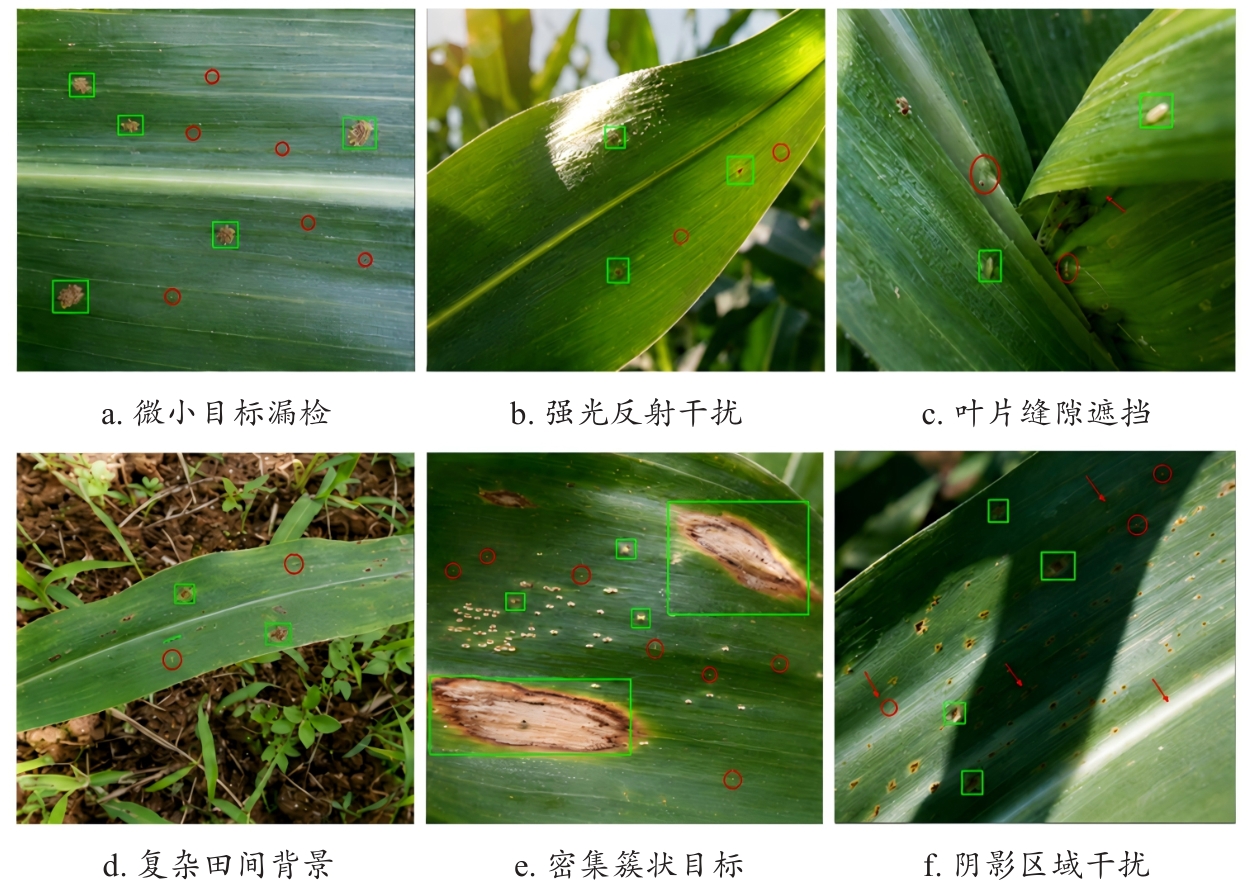
Fig. 7
Typical missed-detection anomaly analysis of Litefocus-Net for maize disease and pest detection
| [1] |
|
| [2] |
李董, 汤启国, 王红波, 等. 农作物重大病虫害预警与应急防控技术研究现状与趋势[J]. 智能化农业装备学报(中英文), 2025, 6 (1): 25-40.
|
|
|
|
| [3] |
|
| [4] |
|
| [5] |
|
| [6] |
|
| [7] |
|
| [8] |
|
| [9] |
|
| [10] |
|
| [11] |
|
| [12] |
|
| [13] |
|
| [14] |
|
| [15] |
|
| [16] |
|
| [17] |
|
| [18] |
|
| [19] |
|
| [20] |
|
| [21] |
|
| [22] |
|
| [23] |
|
| [24] |
|
| [25] |
|
| [26] |
|
| [27] |
|
| [28] |
|
| [29] |
|
| [30] |
|
| [31] |
|
| [32] |
|
| [33] |
|
| [34] |
|
| [35] |
|
| [36] |
|
| [37] |
|
| [38] |
|
| [1] | SHEN Xueli, ZHANG Yue, JIN Haibo, ZHANG Xuxu. Multi-Scale Heterogeneous Feature Synergistic Model for Cotton Leaf Disease Detection [J]. Smart Agriculture, 2026, 8(4): 204-216. |
| [2] | SU Yujie, LI Yue, WEI Linjing, WU Bing, GUO Linhai, YAN Bin, ZHOU Hui, GAO Yuhong, KANG Lianghe, LIU Huan, SU Shunchang. Lodging Region Detection Method in Flax Based on Lightweight Improved YOLOv11n-seg Model [J]. Smart Agriculture, 2026, 8(2): 35-47. |
| [3] | YAO Xiaotong, QU Shaoye. Lightweight Detection Method for Pepper Leaf Diseases and Pests Based on Improved YOLOv12s [J]. Smart Agriculture, 2026, 8(1): 1-14. |
| [4] | HU Chengxi, TAN Lixin, WANG Wenyin, SONG Min. Lightweight Tea Shoot Picking Point Recognition Model Based on Improved DeepLabV3+ [J]. Smart Agriculture, 2024, 6(5): 119-127. |
| [5] | YANG Feng, YAO Xiaotong. Lightweighted Wheat Leaf Diseases and Pests Detection Model Based on Improved YOLOv8 [J]. Smart Agriculture, 2024, 6(1): 147-157. |
| [6] | XIA Xue, CHAI Xiujuan, ZHANG Ning, ZHOU Shuo, SUN Qixin, SUN Tan. A Lightweight Fruit Load Estimation Model for Edge Computing Equipment [J]. Smart Agriculture, 2023, 5(2): 1-12. |
| [7] | ZHAO Yu, REN Yiping, PIAO Xinru, ZHENG Danyang, LI Dongming. Lightweight Intelligent Recognition of Saposhnikovia Divaricata (Turcz.) Schischk Originality Based on Improved ShuffleNet V2 [J]. Smart Agriculture, 2023, 5(2): 104-114. |
| [8] | XIA Ye, LEI Xiaohui, QI Yannan, XU Tao, YUAN Quanchun, PAN Jian, JIANG Saike, LYU Xiaolan. Detection of Pear Inflorescence Based on Improved Ghost-YOLOv5s-BiFPN Algorithm [J]. Smart Agriculture, 2022, 4(3): 108-119. |
| Viewed | ||||||
|
Full text |
|
|||||
|
Abstract |
|
|||||