Smart Agriculture ›› 2026, Vol. 8 ›› Issue (4): 204-216.doi: 10.12133/j.smartag.SA202601027
• Information Processing and Decision Making • Previous Articles
SHEN Xueli, ZHANG Yue( ), JIN Haibo, ZHANG Xuxu
Received:2026-01-22
Online:2026-07-30
Foundation items:National Natural Science Foundation of China(62173171)
About author:SHEN Xueli, E-mail: Shenxueli@lntu.edu.cn
corresponding author:
CLC Number:
SHEN Xueli, ZHANG Yue, JIN Haibo, ZHANG Xuxu. Multi-Scale Heterogeneous Feature Synergistic Model for Cotton Leaf Disease Detection[J]. Smart Agriculture, 2026, 8(4): 204-216.
Add to citation manager EndNote|Ris|BibTeX
URL: https://www.smartag.net.cn/EN/10.12133/j.smartag.SA202601027

Fig. 1
Cotton diseases category
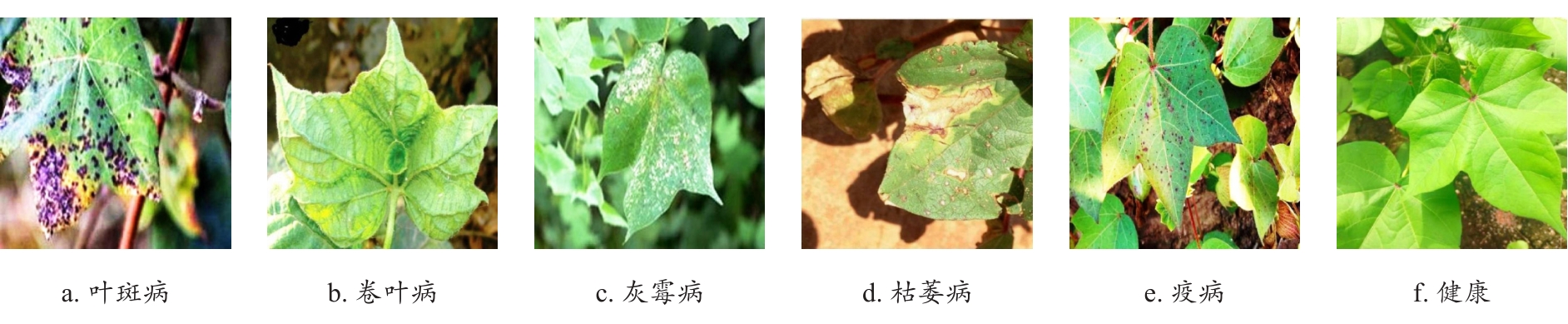
Fig. 2
MHSF-DETR network architecture diagram
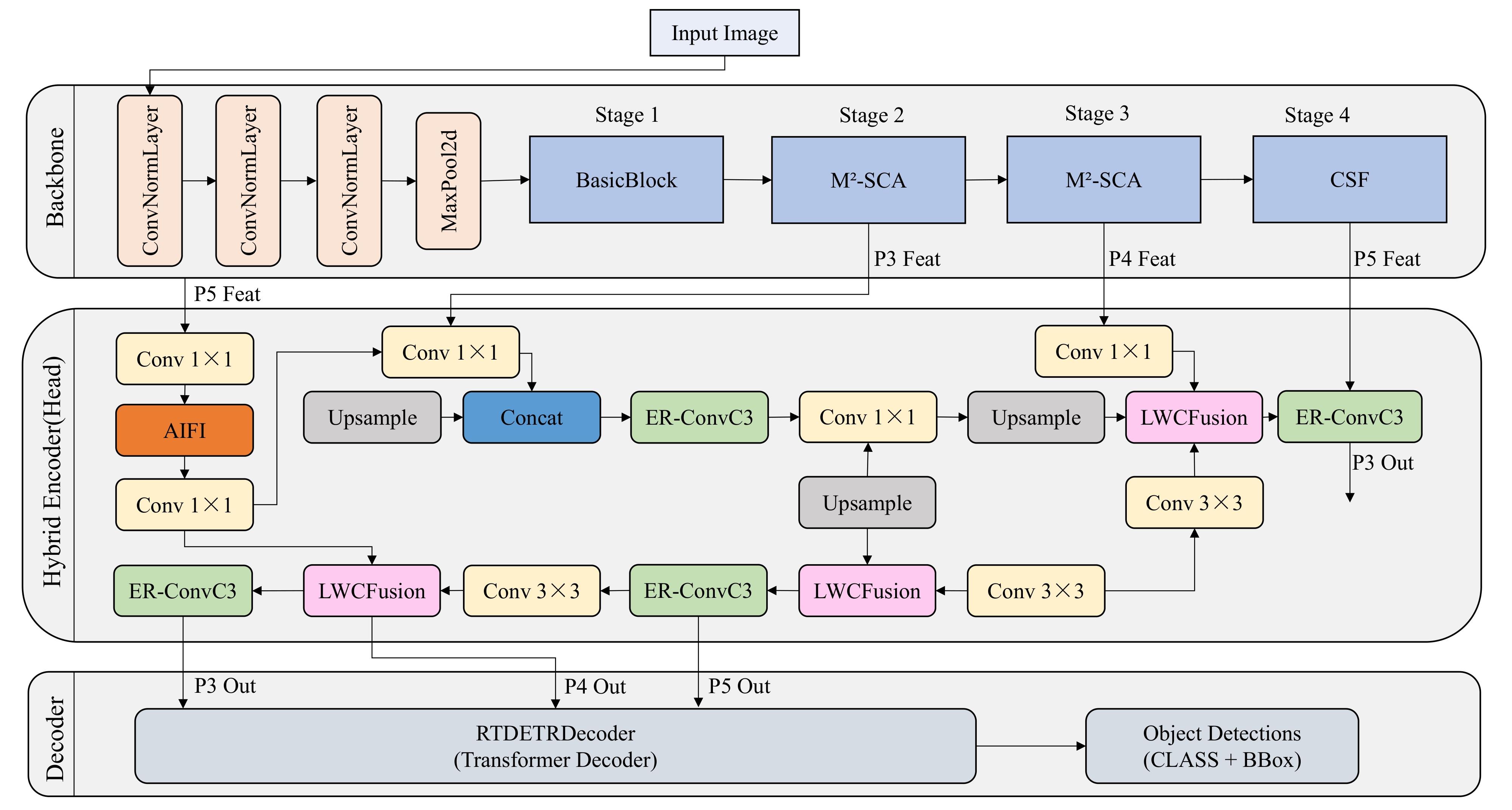
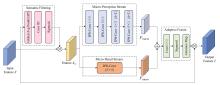
Fig. 3
M2-SCA architecture diagram
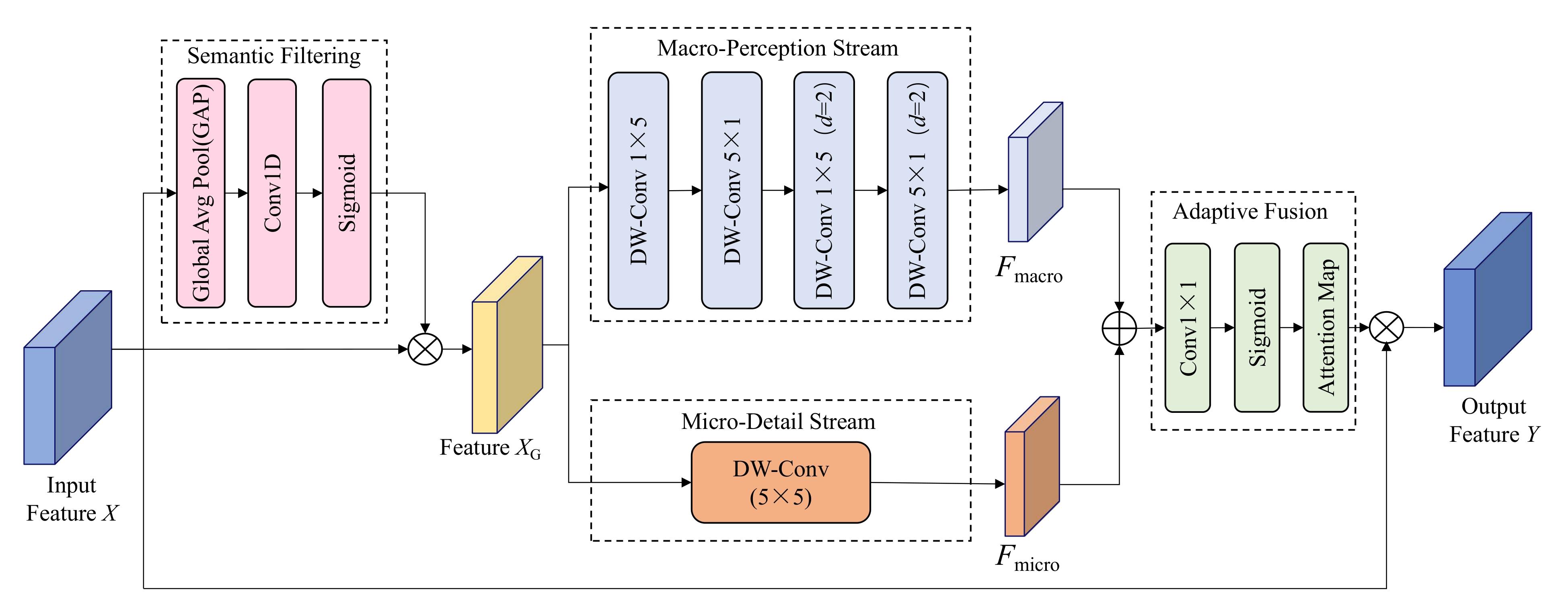
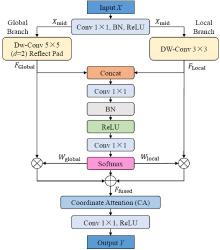
Fig. 4
CSF schematic
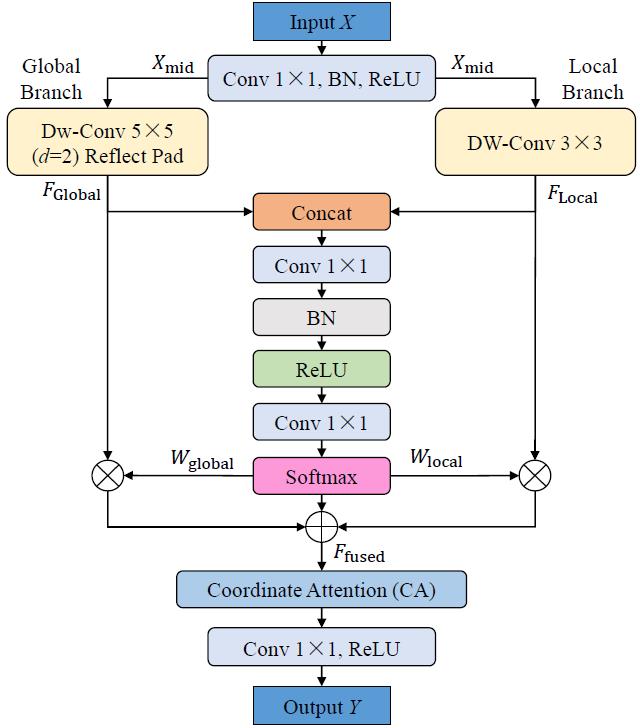
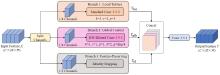
Fig. 5
ER-Conv architecture diagram
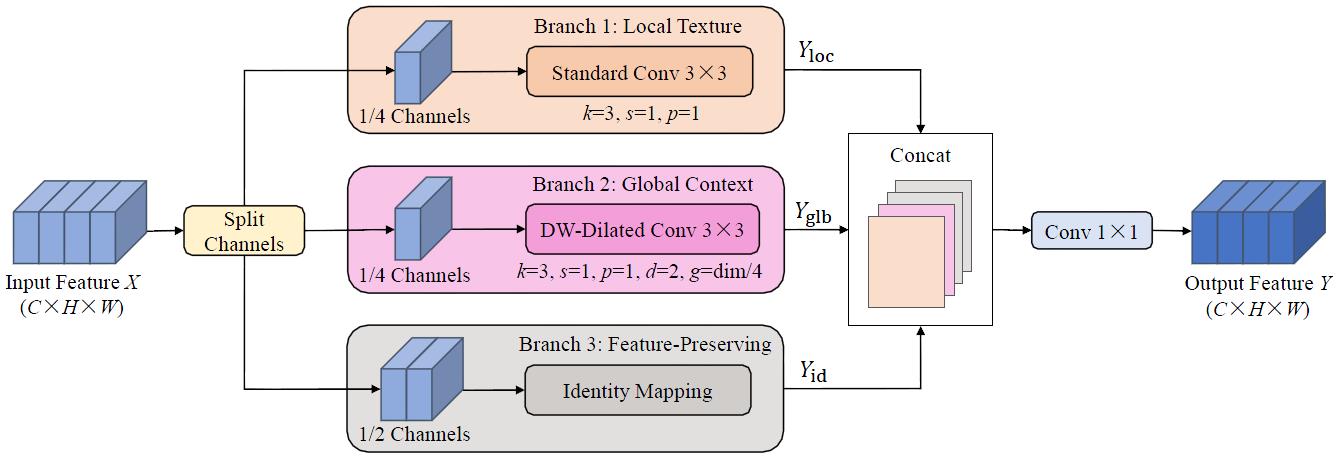
Fig. 6
ER-ConvC3 architecture diagram
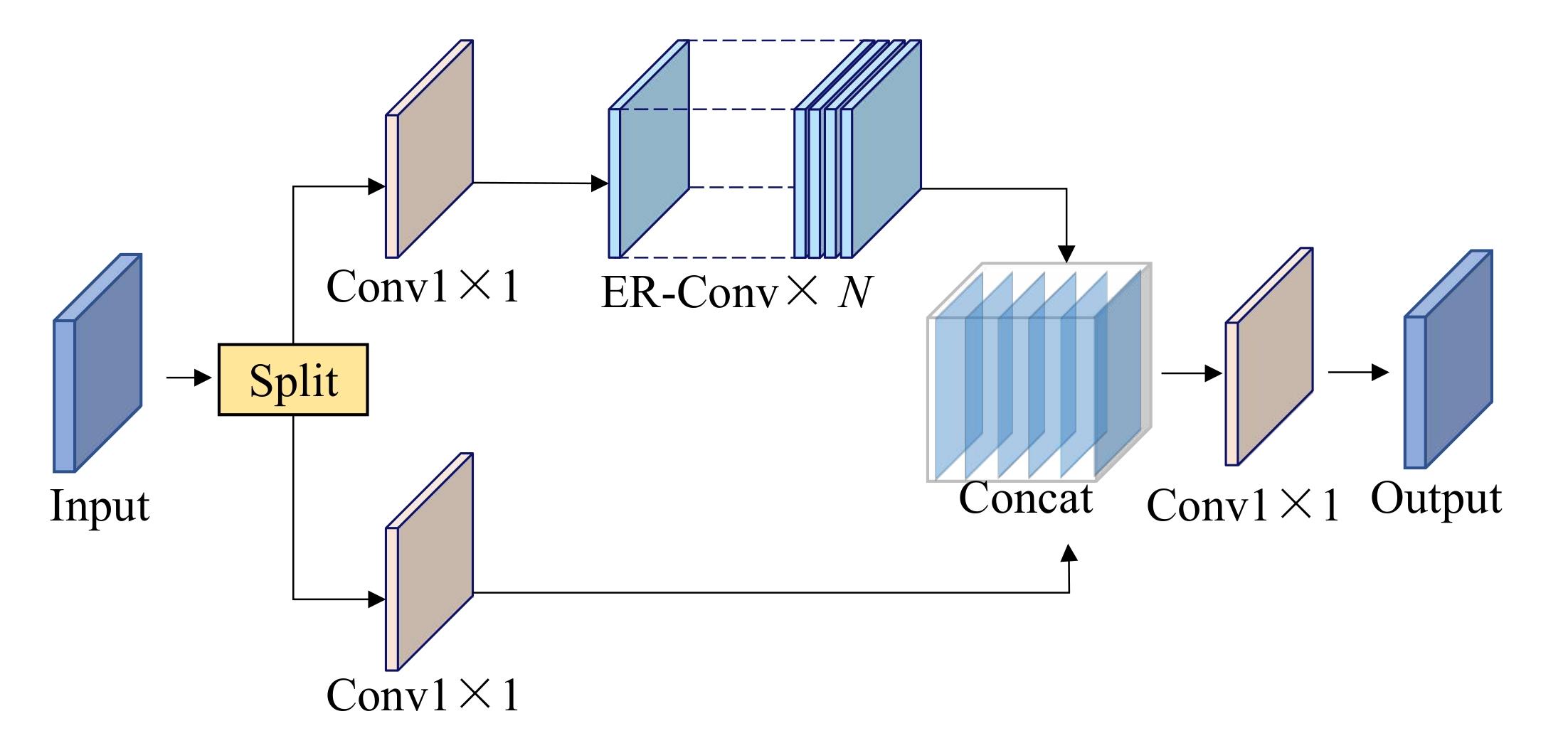
Fig. 7
LWC-Fusion architecture diagram
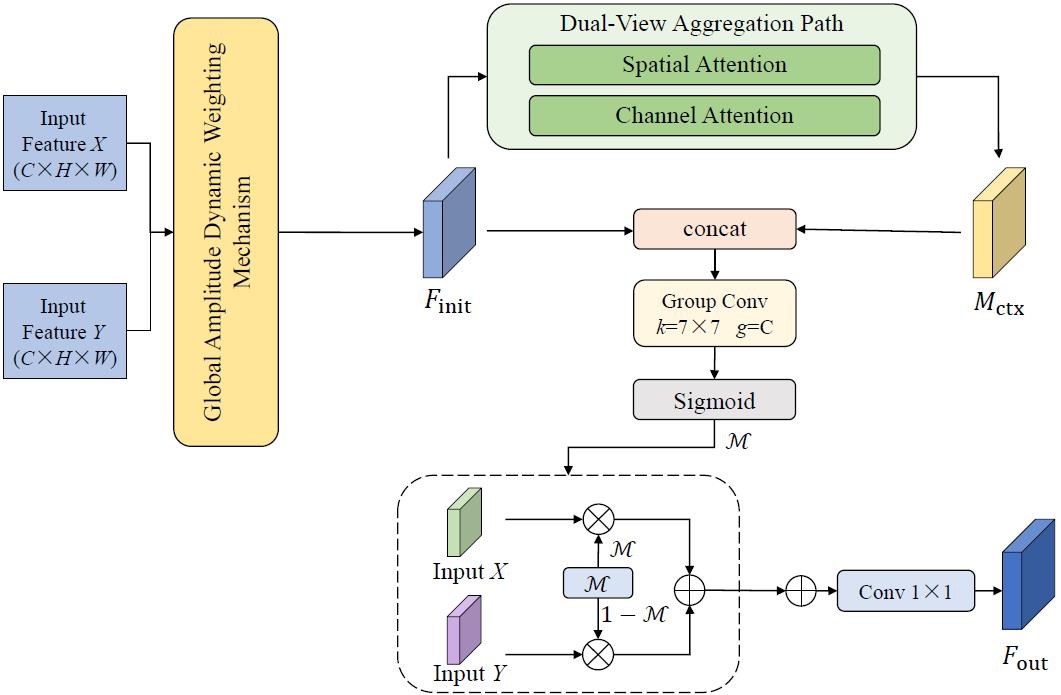
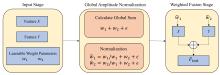
Fig. 8
Process of the global amplitude dynamic weighting mechanism in LWC-Fusion

Table 1
Experimental parameter settings
| 参数名称 | 参数数值 |
|---|---|
| 输入图像尺寸 | 640×640 |
| 初始学习率 | 0.000 1 |
| 权重衰减 | 0.000 5 |
| 批次大小 | 4 |
| 总训练轮次 | 200 |
| 优化器 | AdamW |
Table 2
Ablation study results of core modules
| 实验 | LWC-Fusion | EARM | HCSP-Net | 准确率/% | 召回率/% | mAP50/% | 参数量/M | 计算量/GFLOPs |
|---|---|---|---|---|---|---|---|---|
| 1 | × | × | × | 88.6 | 76.1 | 79.3 | 19.89 | 57.2 |
| 2 | √ | × | × | 86.4 | 75.5 | 79.8 | 20.44 | 57.6 |
| 3 | × | √ | × | 85.8 | 78.2 | 80.2 | 19.13 | 52.5 |
| 4 | × | × | √ | 84.8 | 77.8 | 81.1 | 16.00 | 55.0 |
| 5 | √ | √ | × | 87.1 | 78.9 | 80.9 | 19.66 | 53.2 |
| 6 | √ | × | √ | 88.2 | 78.5 | 81.8 | 16.48 | 55.4 |
| 7 | × | √ | √ | 88.4 | 79.2 | 82.1 | 15.01 | 49.4 |
| 8 | √ | √ | √ | 90.2 | 79.6 | 82.5 | 15.43 | 49.6 |
Table 3
Performance experimental results between MHSF-DETR and different detection models
| 算法 | 准确率/% | 召回率/% | mAP50/% | 参数量/M | 计算量/GFLOPs |
|---|---|---|---|---|---|
| YOLOv5m | 87.7 | 77.4 | 81.9 | 21.32 | 49.20 |
| YOLOv8m | 89.1 | 78.2 | 83.1 | 25.84 | 78.70 |
| YOLOv10m | 85.3 | 74.5 | 79.6 | 15.41 | 59.30 |
| RT-DETR-R18 | 88.6 | 76.1 | 79.3 | 19.89 | 57.20 |
| RT-DETR-R50 | 90.3 | 80.5 | 83.8 | 42.65 | 110.50 |
| SSD | 78.5 | 68.2 | 74.3 | 26.28 | 62.40 |
| Faster R-CNN | 81.3 | 76.9 | 80.1 | 136.02 | 358.50 |
| EdgeNeXt-B | 82.4 | 71.5 | 76.9 | 18.51 | 3.84 |
| MobileViT-S | 76.5 | 64.2 | 70.8 | 5.63 | 2.03 |
| MHSF-DETR | 90.2 | 79.6 | 82.5 | 15.43 | 49.60 |
Table 4
Generalization experiment results of different models on the Plant Village dataset
| 算法 | 准确率/% | 召回率/% | mAP50/% | 参数量/M | 计算量/GFLOPs |
|---|---|---|---|---|---|
| YOLOv5m | 84.2 | 74.1 | 78.5 | 21.32 | 49.20 |
| YOLOv8m | 86.5 | 75.3 | 80.1 | 25.84 | 78.70 |
| YOLOv10m | 82.1 | 71.8 | 78.4 | 15.41 | 59.30 |
| RT-DETR-R18 | 85.4 | 76.8 | 76.8 | 19.89 | 57.20 |
| RT-DETR-R50 | 87.2 | 80.5 | 80.7 | 42.65 | 110.50 |
| SSD | 75.2 | 70.1 | 70.2 | 26.28 | 62.40 |
| Faster R-CNN | 78.6 | 76.5 | 76.5 | 136.02 | 358.50 |
| EdgeNeXt-B | 80.2 | 69.6 | 74.1 | 18.51 | 3.84 |
| MobileViT-S | 74.5 | 62.8 | 68.6 | 5.63 | 2.03 |
| MHSF-DETR | 87.8 | 76.9 | 80.3 | 15.43 | 49.60 |
Table 5
Generalization experiment results of different models on the Roboflow Universe dataset
| 算法 | 准确率/% | 召回率/% | mAP50/% | 参数量/M | 计算量/GFLOPs |
|---|---|---|---|---|---|
| YOLOv5m | 89.5 | 78.4 | 84.2 | 21.32 | 49.20 |
| YOLOv8m | 92.2 | 82.5 | 89.6 | 25.84 | 78.70 |
| YOLOv10m | 92.8 | 81.9 | 88.1 | 15.41 | 59.30 |
| RT-DETR-R18 | 88.2 | 77.5 | 82.5 | 19.89 | 57.20 |
| RT-DETR-R50 | 93.5 | 83.1 | 88.6 | 42.65 | 110.50 |
| SSD | 82.4 | 72.1 | 76.8 | 26.28 | 62.40 |
| Faster R-CNN | 87.5 | 80.2 | 81.9 | 136.02 | 358.50 |
| EdgeNeXt-B | 83.2 | 73.3 | 78.5 | 18.51 | 3.84 |
| MobileViT-S | 80.5 | 69.4 | 73.1 | 5.63 | 2.03 |
| MHSF-DETR | 92.5 | 81.1 | 86.9 | 15.43 | 49.60 |
Table 6
Comparison of inference efficiency between MHSF-DETR and different algorithms on edge devices
| 算法 | 参数量/M | mAP50/% | 推理耗时/ms | FPS/(帧/s) |
|---|---|---|---|---|
| YOLOv8m | 25.84 | 83.1 | 2 054.56 | 0.49 |
| RT-DETR-R50 | 42.65 | 83.8 | 2 833.34 | 0.35 |
| RT-DETR-R18 | 19.89 | 79.3 | 1 685.23 | 0.59 |
| MHSF-DETR | 15.43 | 82.5 | 1 454.04 | 0.69 |
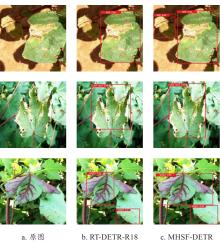
Fig. 9
Comparison of detection results between MHSF-DETR and baseline model RT-DETR-R18
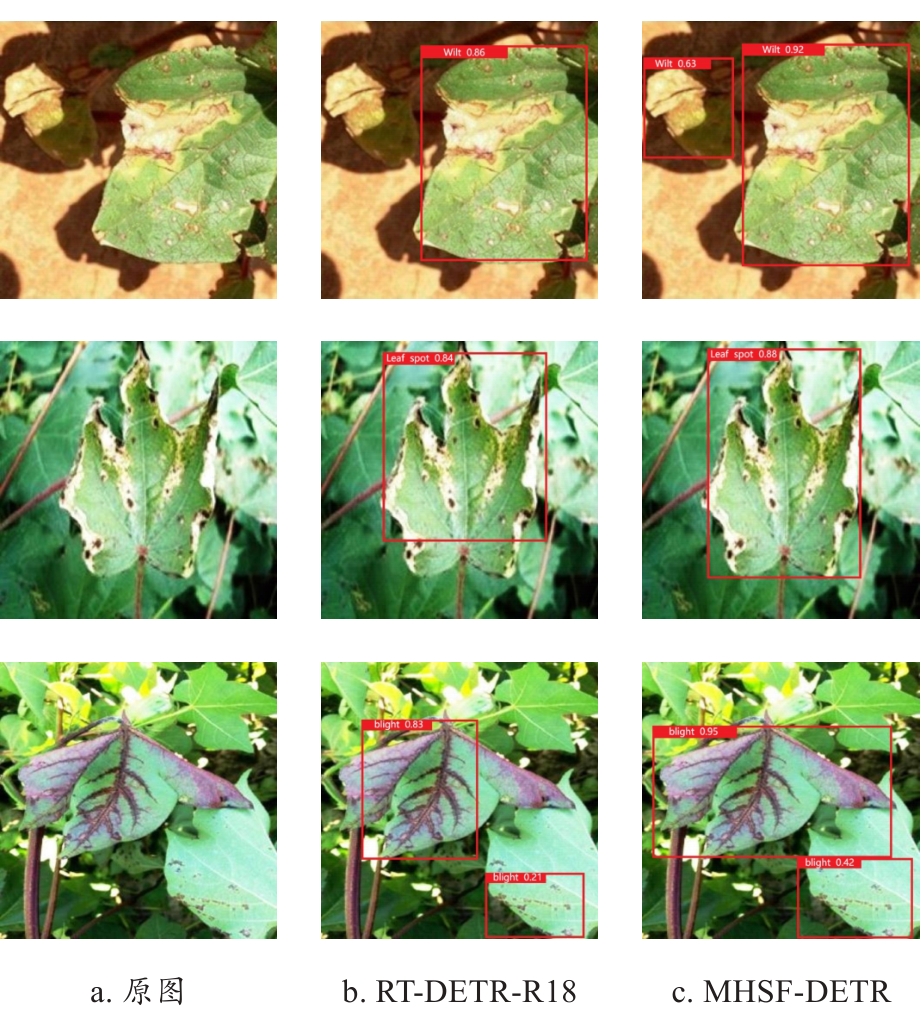
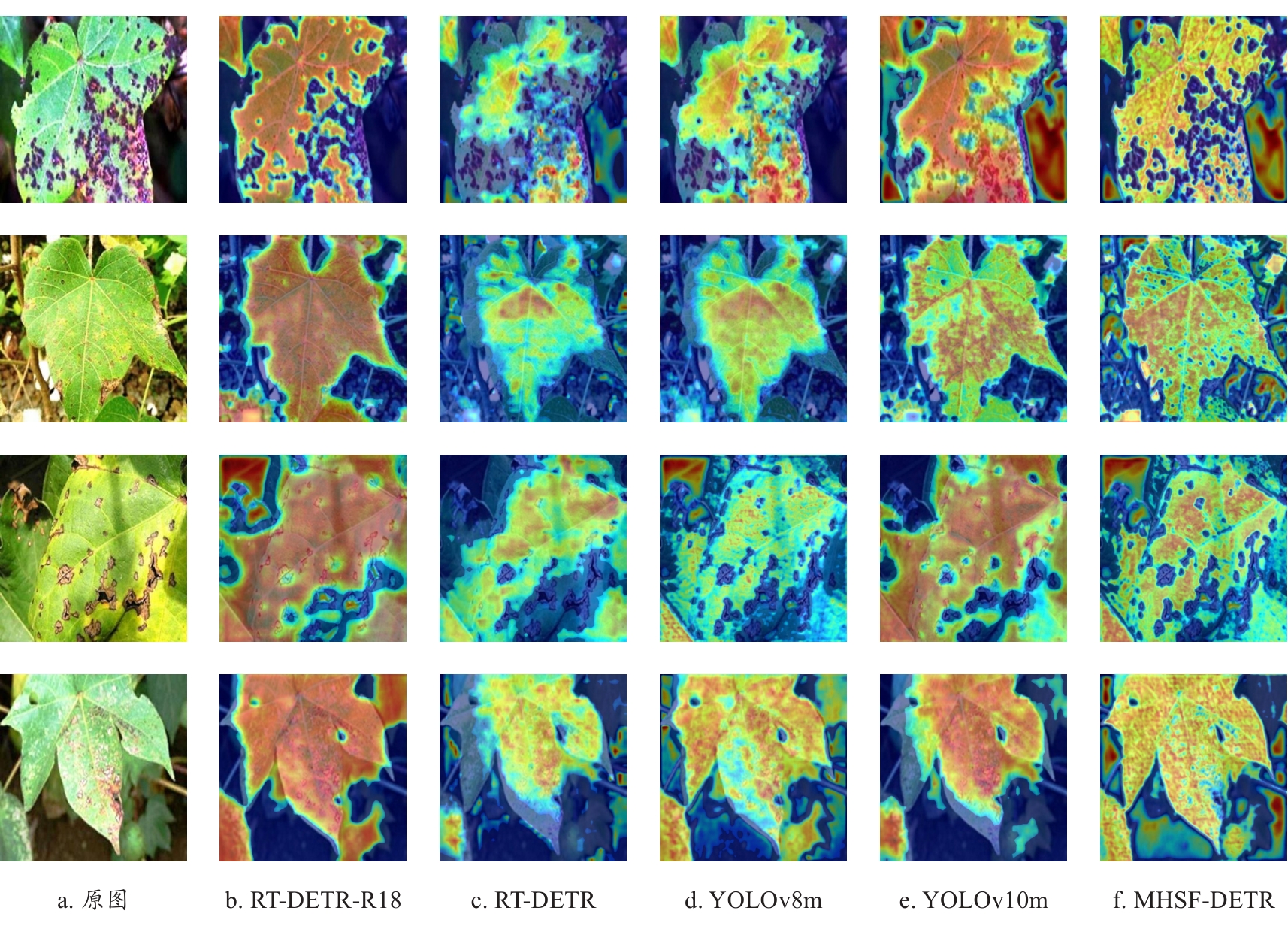
Fig. 10
Comparative heatmap results of different models on cotton leaf diseases detection
| [1] |
赵卫松, 郭庆港, 鹿秀云, 等. 我国棉花主要病虫草害农药登记现状及存在问题与展望[J]. 农药学学报, 2026, 28(1): 64-75.
|
|
|
|
| [2] |
魏梦婷. 中国棉花国际竞争力及影响因素分析[C]// 高质量伙伴关系与全球可持续发展论文集(下). 2022: 197-205. DOI:10.26914/c.cnkihy.2022.079923 .
|
|
|
|
| [3] |
徐虹, 李林峰, 杨昊, 等. 基于深度学习的植物叶病斑精细化分割方法[J]. 沈阳农业大学学报, 2025, 56 (1): 92-107.
|
|
|
|
| [4] |
王晋伟, 赵丽红, 师勇强, 等. 棉花病害全程防治技术研究初报[J]. 中国棉花, 2020, 47(5): 20-22, 46.
|
|
|
|
| [5] |
曹冰雪, 赵春江, 李瑾, 等. 中国智慧农业技术发展现状、挑战与展望[J]. 农业工程学报, 2025, 41(21): 1-10.
|
|
|
|
| [6] |
赵法川, 徐晓辉, 宋涛, 等. 融合多头注意力的轻量级作物病虫害识别[J]. 华南农业大学学报, 2023, 44(6): 986-994.
|
|
|
|
| [7] |
|
| [8] |
|
| [9] |
|
| [10] |
|
| [11] |
|
| [12] |
龚昌智, 郭丹丹. 基于深度学习的番茄叶片病害检测研究[J]. 现代农业科技, 2025(10): 159-164.
|
|
|
|
| [13] |
王俏, 张彪, 刘鑫. 基于改进行锚分类的快速葡萄叶片病害检测算法[J]. 江苏农业科学, 2024, 52(23): 206-213.
|
|
|
|
| [14] |
|
| [15] |
|
| [16] |
|
| [17] |
|
| [18] |
|
| [19] |
|
| [20] |
|
| [21] |
DetectionDisease. Cotton disease detection dataset[DB/OL]. Roboflow Universe, 2024. [2026-01-11].
|
| [22] |
|
| [23] |
|
| [24] |
|
| [25] |
李江, 骆炜, 陈豪, 等. 基于改进RT-DETR的PCBA管脚焊点缺陷检测方法[J]. 液晶与显示, 2025, 40(10): 1532-1544.
|
|
|
|
| [26] |
|
| [1] | SHI Qimeng, WANG Jun, XU Xiaofeng, ZHANG Weiyi. Cotton Maturity Detection Algorithm Based on Improved RT-DETR [J]. Smart Agriculture, 2026, 8(4): 100-113. |
| [2] | LI Xiaxi, JI Ronghua, CHANG Hongrui, ZHANG Suoxiang. DC-YOLO: A Behavior Detection Model for Hu Sheep Addressing Occlusion and Illumination Variations [J]. Smart Agriculture, 2026, 8(4): 127-147. |
| [3] | SU Yujie, LI Yue, WEI Linjing, WU Bing, GUO Linhai, YAN Bin, ZHOU Hui, GAO Yuhong, KANG Lianghe, LIU Huan, SU Shunchang. Lodging Region Detection Method in Flax Based on Lightweight Improved YOLOv11n-seg Model [J]. Smart Agriculture, 2026, 8(2): 35-47. |
| [4] | ZHAO Licheng, LU Xinyu, WU Qian, REN Ni, ZHOU Lingli, CHENG Yawen, HU Anqi, QI Chao. An Improved YOLOv10-Based Tomato Ripeness Detection Algorithm with LAMP Channel Pruning [J]. Smart Agriculture, 2026, 8(2): 133-146. |
| [5] | WU Chenxu, ZUO Haolong, LI Gang. Cross-Modal Attention for Multi-Source Remote Sensing Crop Classification under Cloud Occlusion and Complex Field Scenarios [J]. Smart Agriculture, 2026, 8(2): 118-132. |
| [6] | CAI Yuqin, LIU Daming, XU Qin, LI Boyang, LIU Bojie. Greenhouse Temperature and Humidity Prediction Method Based on Adaptive Kalman Filter and GWO-LSTM-Attention [J]. Smart Agriculture, 2026, 8(1): 148-155. |
| [7] | HU Yumeng, GUAN Feifan, XIE Dongchen, MA Ping, YU Youben, ZHOU Jie, NIE Yanming, HUANG Lüwen. Tea Leaf Disease Diagnosis Based on Improved Lightweight U-Net3+ [J]. Smart Agriculture, 2026, 8(1): 15-27. |
| [8] | HUANG Xianguo, ZHU Qibing, HUANG Min. Online Detection System for Freshness of Fruits and Vegetables Based on Temporal Multi-source Information Fusion [J]. Smart Agriculture, 2026, 8(1): 203-212. |
| [9] | YAO Xiaotong, QU Shaoye. Lightweight Detection Method for Pepper Leaf Diseases and Pests Based on Improved YOLOv12s [J]. Smart Agriculture, 2026, 8(1): 1-14. |
| [10] | YE Penglin, MIN Chao, GOU Liangjie, WANG Pengcheng, HUANG Xiaopeng, LI Xin, MENG Yuping. Self-Supervised Adaptive Multimodal Feature Fusion Recognition of Crop Diseases and Pests [J]. Smart Agriculture, 2026, 8(1): 72-84. |
| [11] | XIE Wenhao, ZHANG Xin, DONG Wen, ZHENG Yizhen, CHENG Bo, TU Wenli, SUN Fengqing. Parcel-Scale Crop Distribution Mapping Based on Stacking Ensemble Learning [J]. Smart Agriculture, 2025, 7(6): 196-209. |
| [12] | LIU Jie, GUO Jiaxin, ZHANG Jiahao, ZHANG Bingchao, XIONG Jie, CAO Jianpeng, WU Shangrong, DENG Yingbin, CHEN Guipeng. Method for Estimating Leaf Area Index of Winter Rapeseed Based on Fusion of Vegetation Indices and Texture Features [J]. Smart Agriculture, 2025, 7(6): 161-173. |
| [13] | LIU Yiheng, LIU Libo. Beef Cattle Object Detection Method Under Occlusion Environment Based on Improved YOLOv12 [J]. Smart Agriculture, 2025, 7(5): 182-192. |
| [14] | WANG Yi, XUE Rong, HAN Wenting, SHAO Guomin, HOU Yanqiao, CUI Xitong. Estimation of Maize Aboveground Biomass Based on CNN-LSTM-SA [J]. Smart Agriculture, 2025, 7(4): 159-173. |
| [15] | PENG Qiujun, LI Weiran, LIU Yeqiang, LI Zhenbo. High-Precision Fish Pose Estimation Method Based on Improved HRNet [J]. Smart Agriculture, 2025, 7(3): 160-172. |
| Viewed | ||||||
|
Full text |
|
|||||
|
Abstract |
|
|||||