Smart Agriculture ›› 2026, Vol. 8 ›› Issue (2): 158-174.doi: 10.12133/j.smartag.SA202511008
• Information Processing and Decision Making • Previous Articles
LIU Haoran1,2, WANG Yu1, ZHAO Xueguan2,4, WU Huarui3, FU Hao2,4, PANG Shujie5, ZHAI Changyuan2,4( )
)
Received:2025-11-09
Online:2026-03-30
Foundation items:Beijing Academy of Agriculture and Forestry Sciences Innovation Capacity Building Project(KJCX20230409); National Natural Science Foundation of China(32201647); Reform and Development Project(GGFZ20250205)
About author:LIU Haoran, E-mail: lhr13646345271@outlook.com
corresponding author:
CLC Number:
LIU Haoran, WANG Yu, ZHAO Xueguan, WU Huarui, FU Hao, PANG Shujie, ZHAI Changyuan. CD-YOLO: A Method for Detecting Carrot Seedlings in Field Based on Improved YOLOv11s[J]. Smart Agriculture, 2026, 8(2): 158-174.
Add to citation manager EndNote|Ris|BibTeX
URL: https://www.smartag.net.cn/EN/10.12133/j.smartag.SA202511008
Fig. 1
Carrot seedling image collection examples
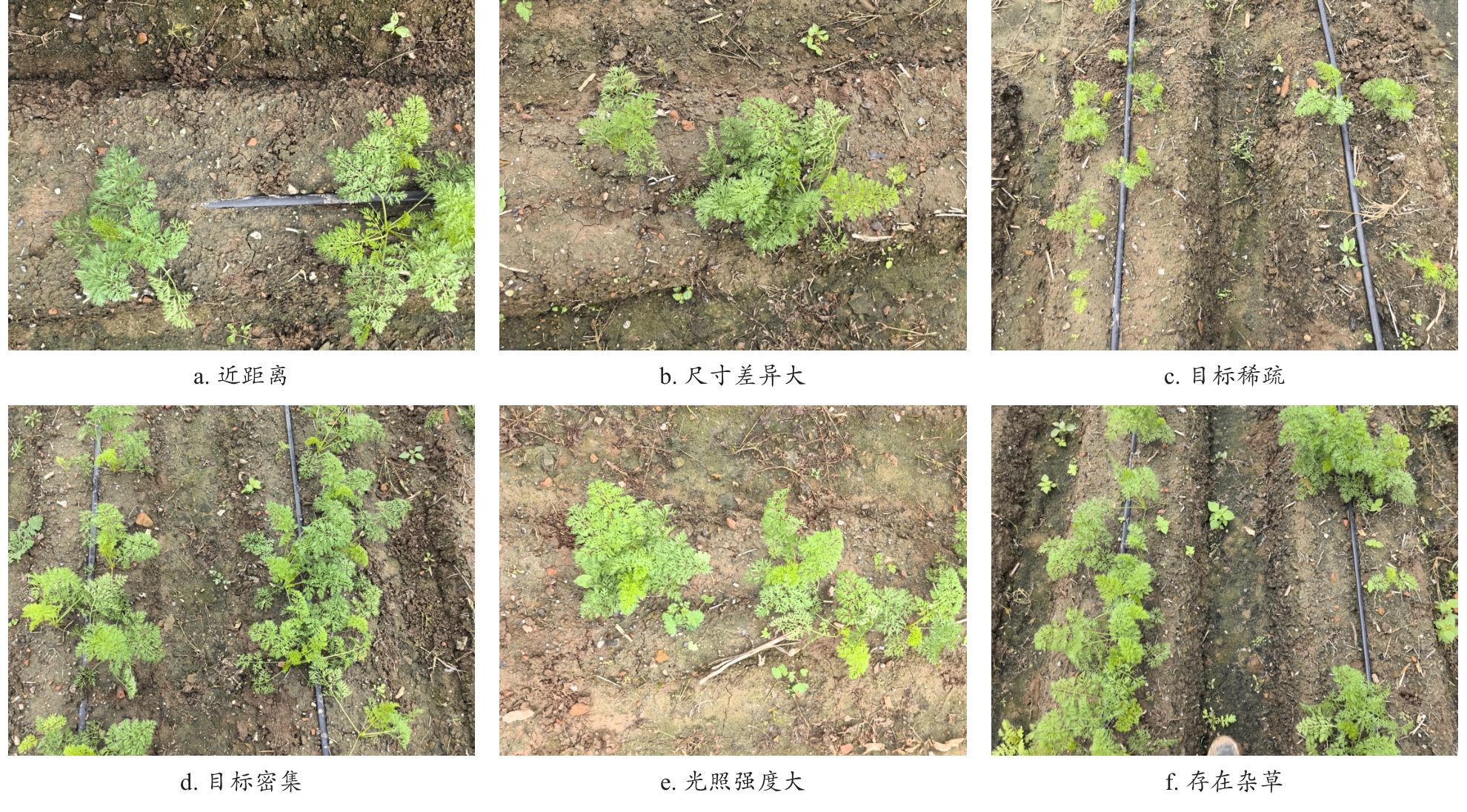
Fig. 2
Quantitative chart of carrot seedling occlusion coverage
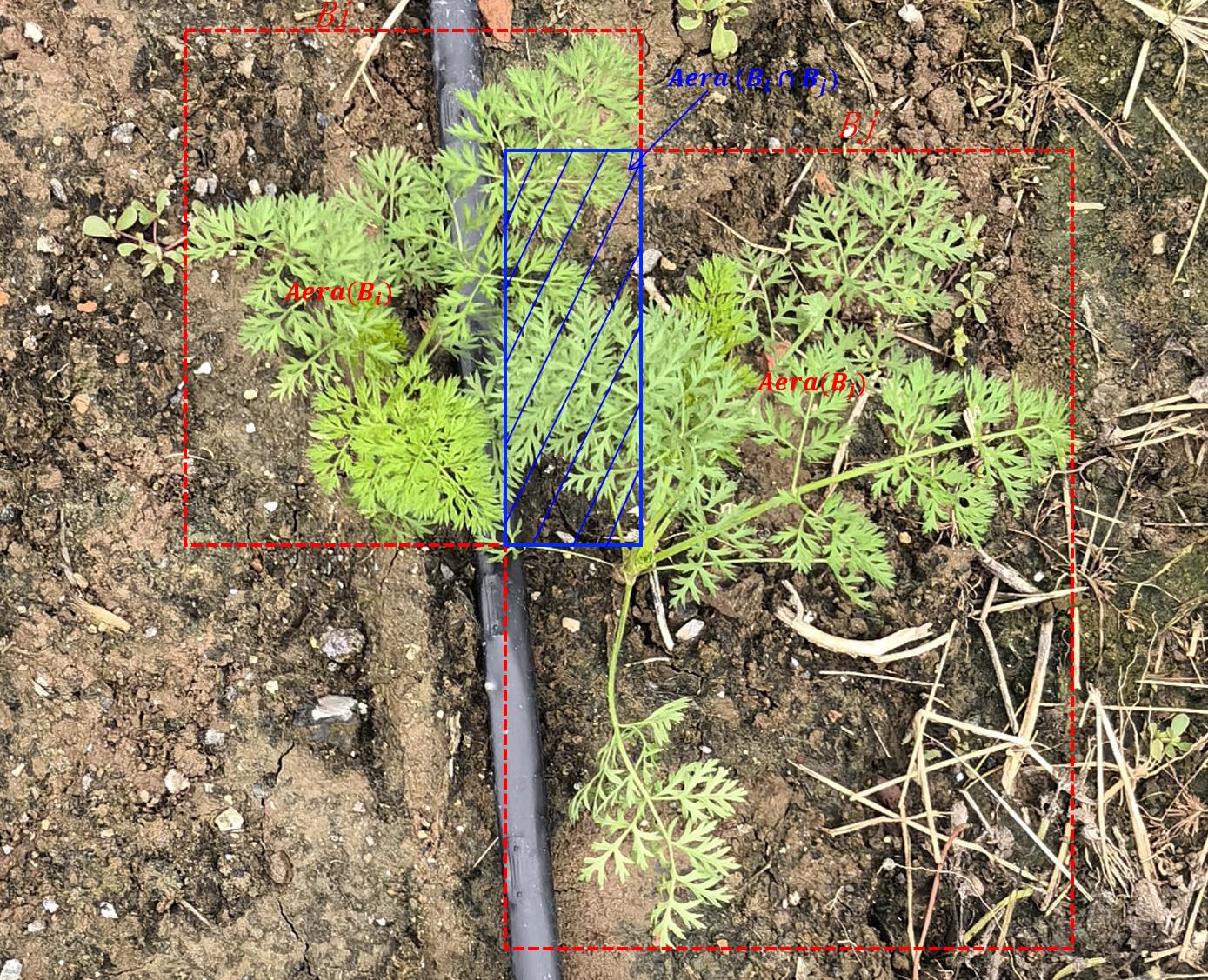
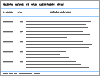
Table 1
Distribution table of carrot seedling dataset
| 类别 | 图像数量/张 | 标签数量/张 |
|---|---|---|
| 训练集 | 3 837 | 43 880 |
| 验证集 | 480 | 6 156 |
| 测试集 | 479 | 6 867 |
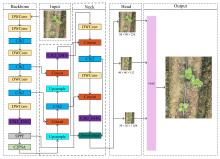
Fig. 3
CD-YOLO model architecture diagram
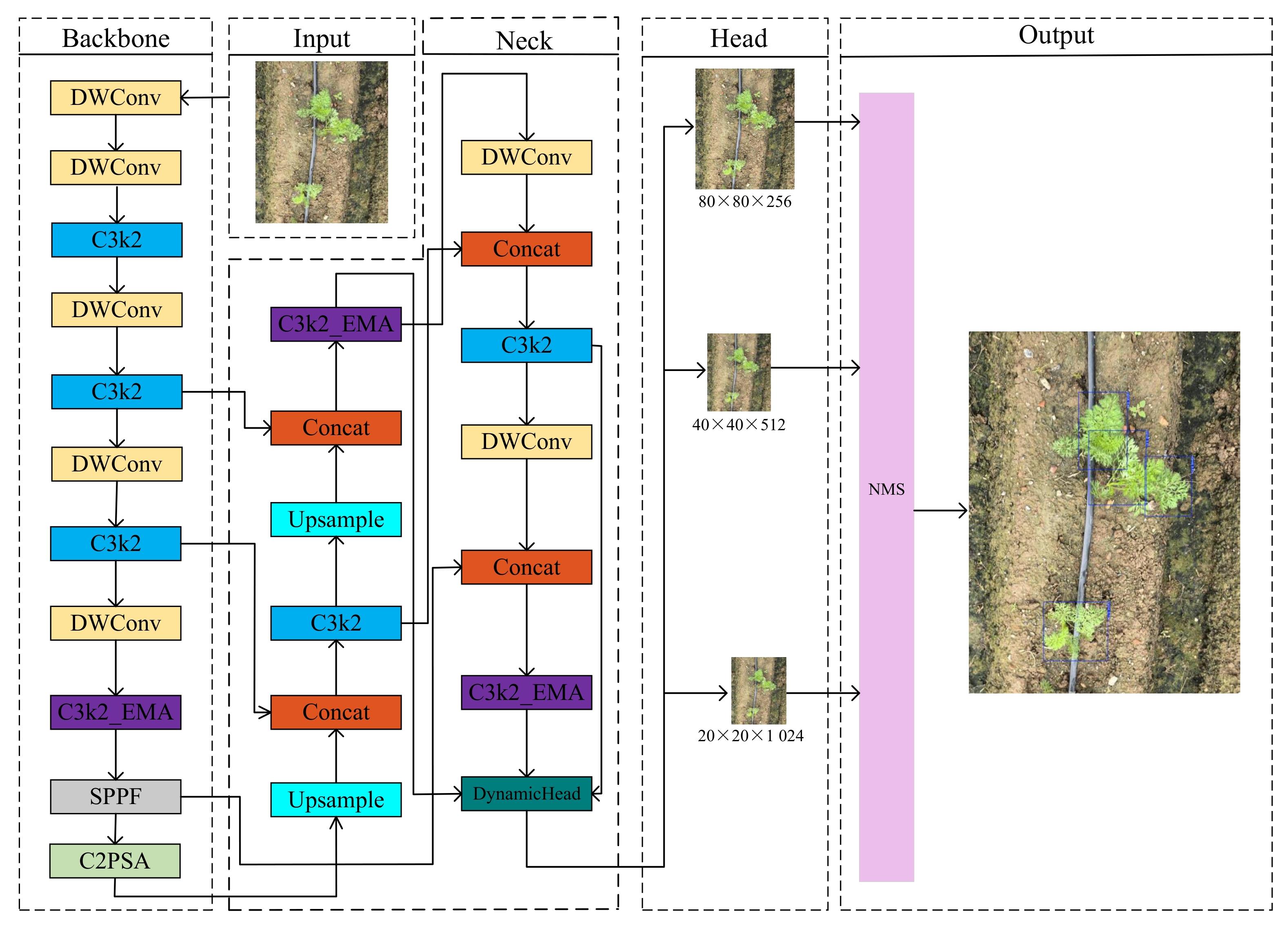
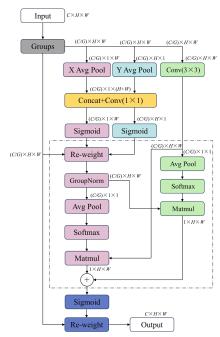
Fig. 4
EMA module
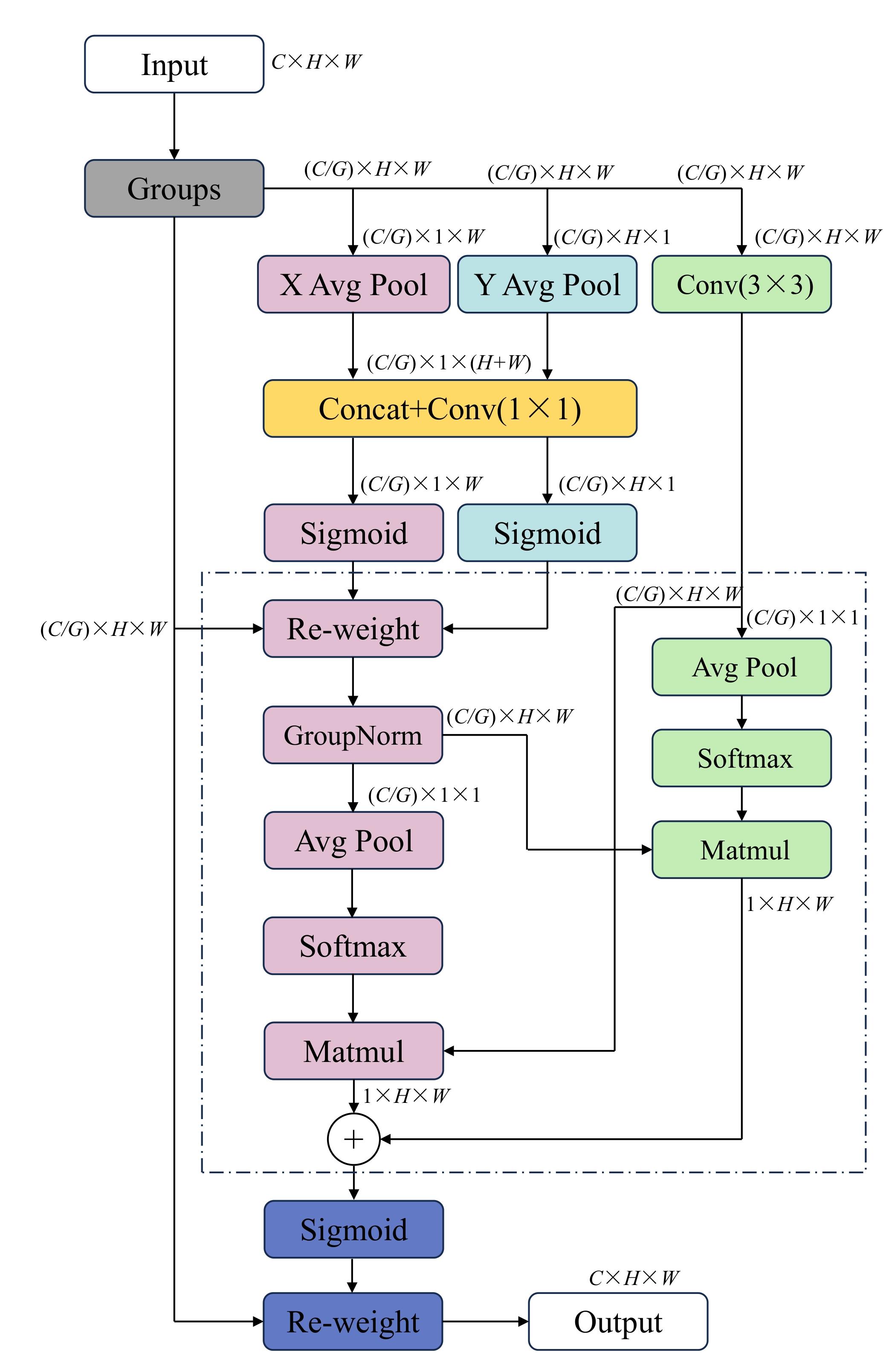
Fig. 5
C3k2_EMA module
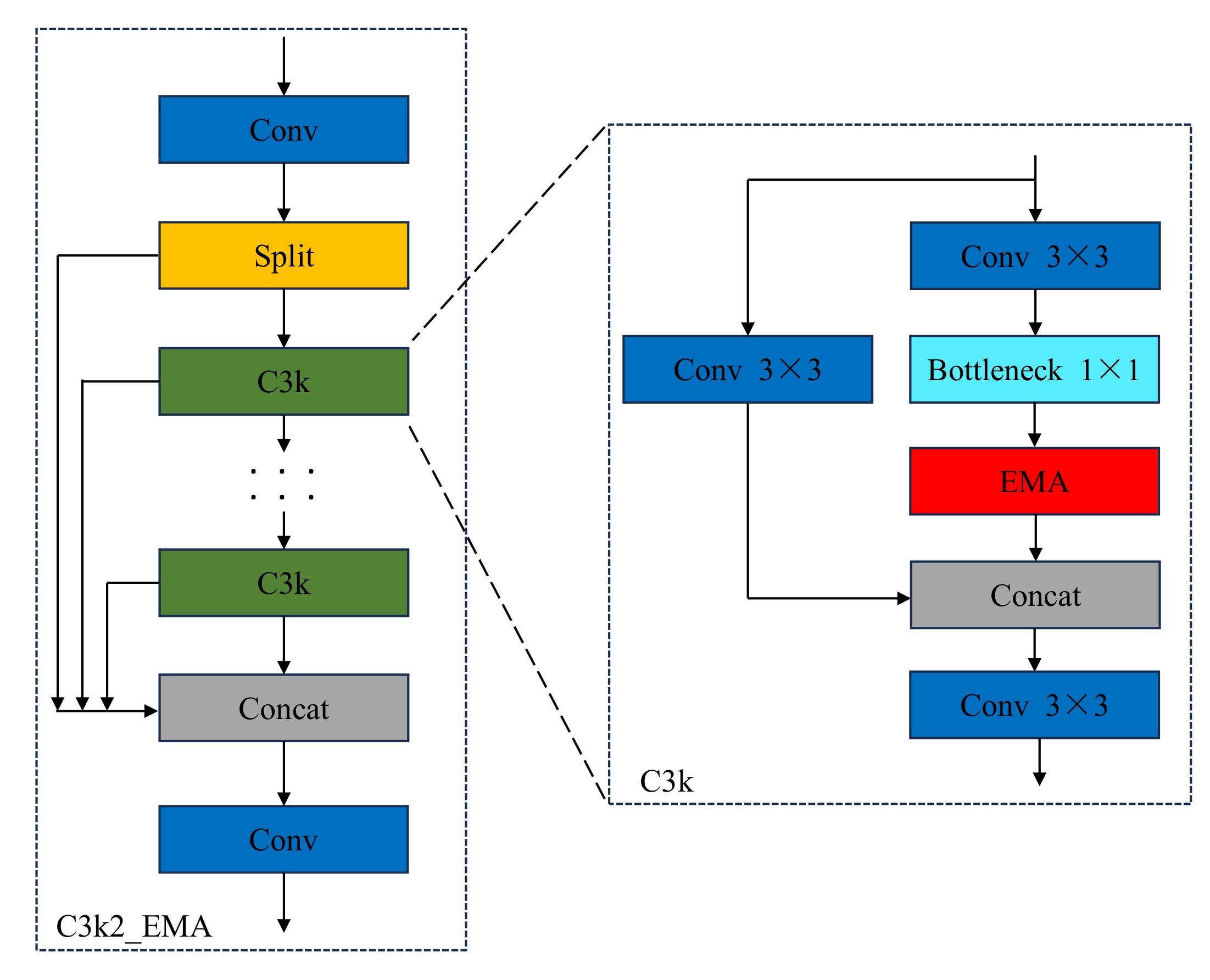
Table 2
Training parameters of CD-YOLO model
| 训练参数 | 值 |
|---|---|
| 训练周期 | 100 |
| 初始学习率 | 0.001 |
| 优化器 | Adam |
| 每批次图像数量 | 24 |
| 动量 | 0.937 |
| 优化器权重衰减系数 | 0.000 5 |
| 输入尺寸 | 640×640 |
Table 3
Results of ablation experiments for carrot seedling detection research
| 试验编号 | 改进方式 | P/% | R/% | mAP0.5/% | 计算量/GFLOPs | 模型大小/MB | 单张图片处理时间/ms | ||
|---|---|---|---|---|---|---|---|---|---|
| DWConv | C3k2_EMA | DynamicHead | |||||||
| 1 | × | × | × | 78.2 | 74.9 | 81.6 | 21.5 | 19.2 | 14.3 |
| 2 | √ | × | × | 79.8 | 73.6 | 81.4 | 14.8 | 13.8 | 11.5 |
| 3 | × | √ | × | 78.7 | 77.1 | 82.9 | 21.3 | 19.2 | 11.7 |
| 4 | × | × | √ | 79.9 | 76.7 | 83.7 | 21.5 | 19.8 | 12.3 |
| 5 | √ | √ | × | 79.7 | 74.5 | 81.7 | 14.7 | 13.9 | 10.6 |
| 6 | √ | × | √ | 79.0 | 74.9 | 81.8 | 15.0 | 14.4 | 9.8 |
| 7 | × | √ | √ | 80.2 | 75.1 | 83.2 | 21.6 | 19.8 | 11.6 |
| 8 | √ | √ | √ | 81.2 | 76.4 | 84.0 | 15.3 | 14.4 | 9.6 |
Fig. 6
Comparison of feature maps between C3k2 and C3k2_EMA modules

Fig.7
Comparative results of different models on the carrot seedling test set
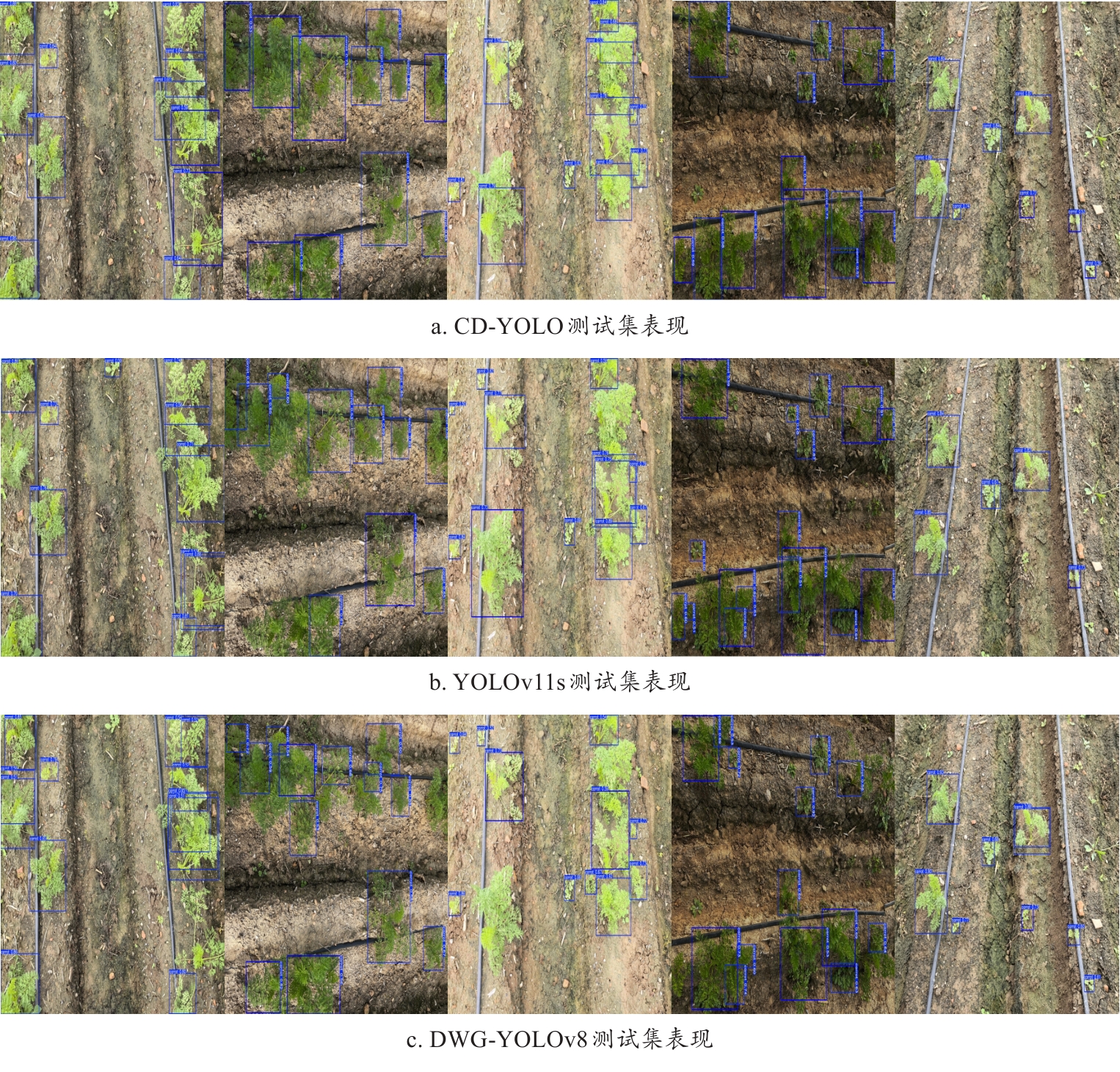
Fig. 8
Comparison of carrot seedling detection performance between YOLOv11s and CD-YOLO under occlusion conditions
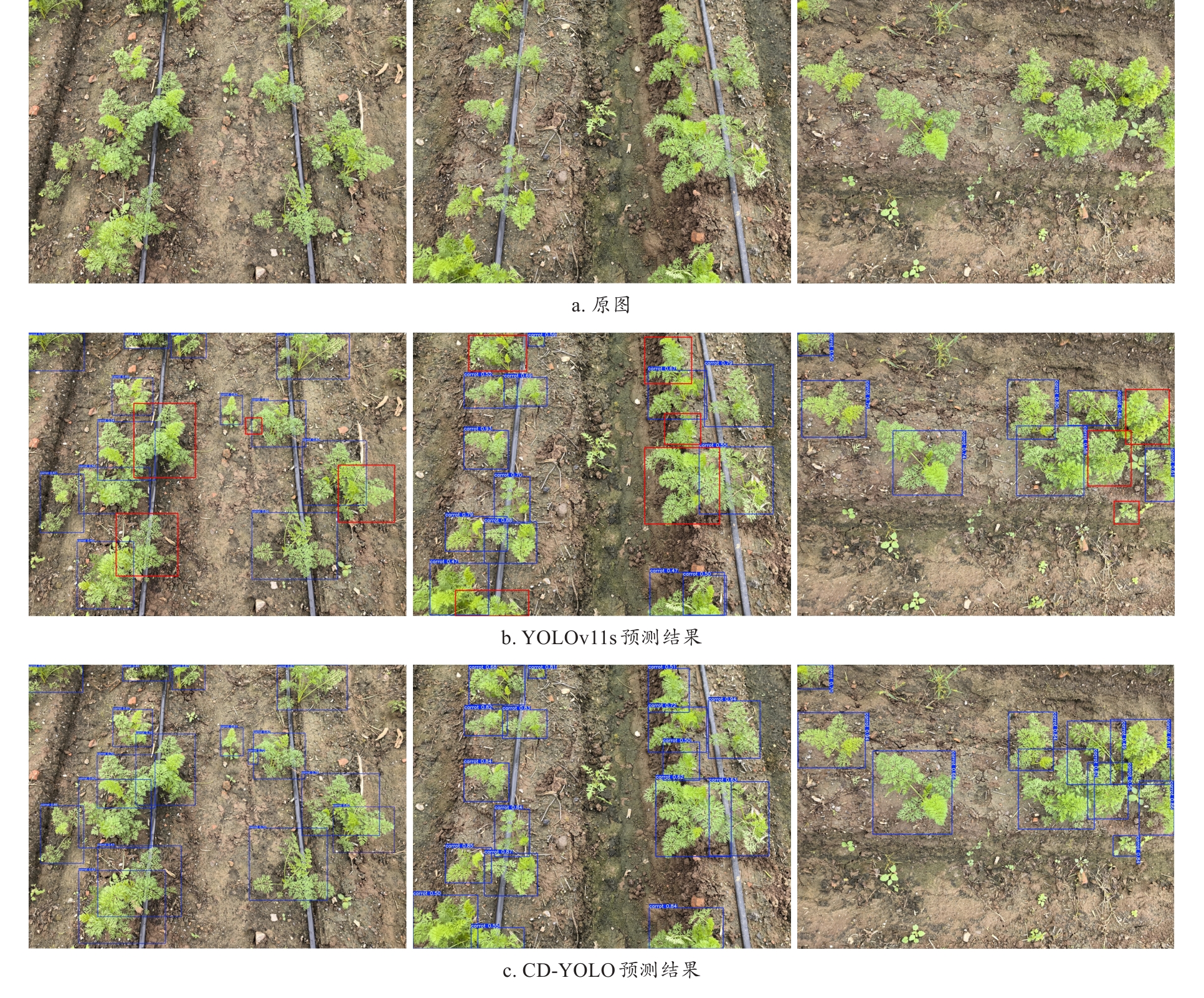
Table 4
Comparison of different lightweight backbone network effects for carrot seedling detection
| 主干网络 | P/% | R/% | mAP0.5/% | 计算量/GFLOPs | 参数量 | 模型大小/MB | 单张图片处理时间/ms |
|---|---|---|---|---|---|---|---|
| MobileNetv3 | 76.2 | 73.0 | 79.9 | 13.2 | 7.21×10⁶ | 16.9 | 14.6 |
| ShuffleNetv2 | 73.0 | 72.3 | 77.8 | 10.4 | 5.34×10⁶ | 11.0 | 12.2 |
| EfficientVit | 76.0 | 74.5 | 79.7 | 14.6 | 7.39×10⁶ | 15.7 | 11.4 |
| CD-YOLO | 81.2 | 76.4 | 84.0 | 15.3 | 7.06×10⁶ | 14.4 | 9.6 |
Table 5
Comparison results of different models for carrot seedling detection research
| 模型 | P/% | R/% | mAP0.5/% | 计算量/GFLOPs | 模型大小/MB | 单张图片处理时间/ms |
|---|---|---|---|---|---|---|
| SSD | 63.5 | 81.4 | 72.2 | 63.5 | 90.5 | 36.6 |
| Faster R-CNN | 69.1 | 84.5 | 77.7 | 142.6 | 108.1 | 113.3 |
| YOLOv5s | 80.2 | 73.9 | 80.5 | 16.2 | 15.1 | 14.2 |
| YOLOv8s | 79.1 | 74.8 | 81.6 | 49.1 | 22.5 | 9.8 |
| YOLOv11s | 78.2 | 74.9 | 81.6 | 21.5 | 19.2 | 14.3 |
| YOLOv8s-P2 | 79.3 | 74.4 | 81.5 | 55.3 | 24.8 | 10.7 |
| DWG-YOLOv8 | 78.2 | 73.2 | 82.0 | 17.4 | 14.7 | 10.5 |
| HAD-YOLO | 77.9 | 74.3 | 81.1 | 35.4 | 12.5 | 19.3 |
| CD-YOLO | 81.2 | 76.4 | 84.0 | 15.3 | 14.4 | 9.6 |
Table6
Comparative results of YOLOv11s and CD-YOLO performance across different test subsets
| 测试子集 | 模型 | 图像数量 | P/% | R/% | mAP0.5/% |
|---|---|---|---|---|---|
| 常规子集 | YOLOv11s | 357 | 78.7 | 76.3 | 77.6 |
| CD-YOLO | 357 | 79.8 | 78.1 | 79.4 | |
| 遮挡子集 | YOLOv11s | 122 | 75.9 | 71.1 | 75.5 |
| CD-YOLO | 122 | 79.6 | 75.1 | 80.6 | |
| 整体测试集 | YOLOv11s | 479 | 78.9 | 74.7 | 76.9 |
| CD-YOLO | 479 | 79.7 | 76.2 | 79.9 |
Table 7
Comparison of carrot seedling detection performance between YOLOv11s and CD-YOLO under occlusion conditions
| 模型 | 目标总数/个 | 正确识别数/个 | 漏识数/个 | 识别率/% | 漏识率/% |
|---|---|---|---|---|---|
| YOLOv11s | 1 652 | 1 337 | 315 | 80.9 | 19.1 |
| CD-YOLO | 1 652 | 1 431 | 221 | 86.6 | 13.4 |
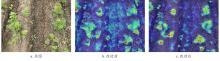
Fig. 9
Visual comparison of heatmaps between YOLOv11s and CD-YOLO models

Table 8
Frame rate comparison between YOLOv11s and CD-YOLO models on different devices
| 模型 | 工作站 | 边缘算力设备 | TensorRT |
|---|---|---|---|
| YOLOv11s | 89.6 | 10.5 | 29.7 |
| CD-YOLO | 104.2 | 12.9 | 32.5 |
Table 9
Comparison of carrot seedling detection performance between YOLOv11s and CD-YOLO on edge devices
| 模型 | 目标总数/个 | 识别数/个 | 正确识别数/个 | 漏识数/个 | 误识数/个 | 漏识率/% | 误识率/% |
|---|---|---|---|---|---|---|---|
| YOLOv11s | 492 | 453 | 429 | 63 | 24 | 12.8 | 5.3 |
| CD-YOLO | 492 | 480 | 467 | 25 | 13 | 5.1 | 2.7 |
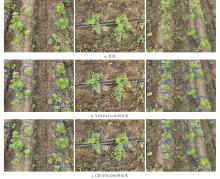
Fig. 10
Comparison of carrot seedling detection performance between YOLOv11s and CD-YOLO on edge devices

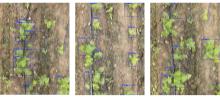
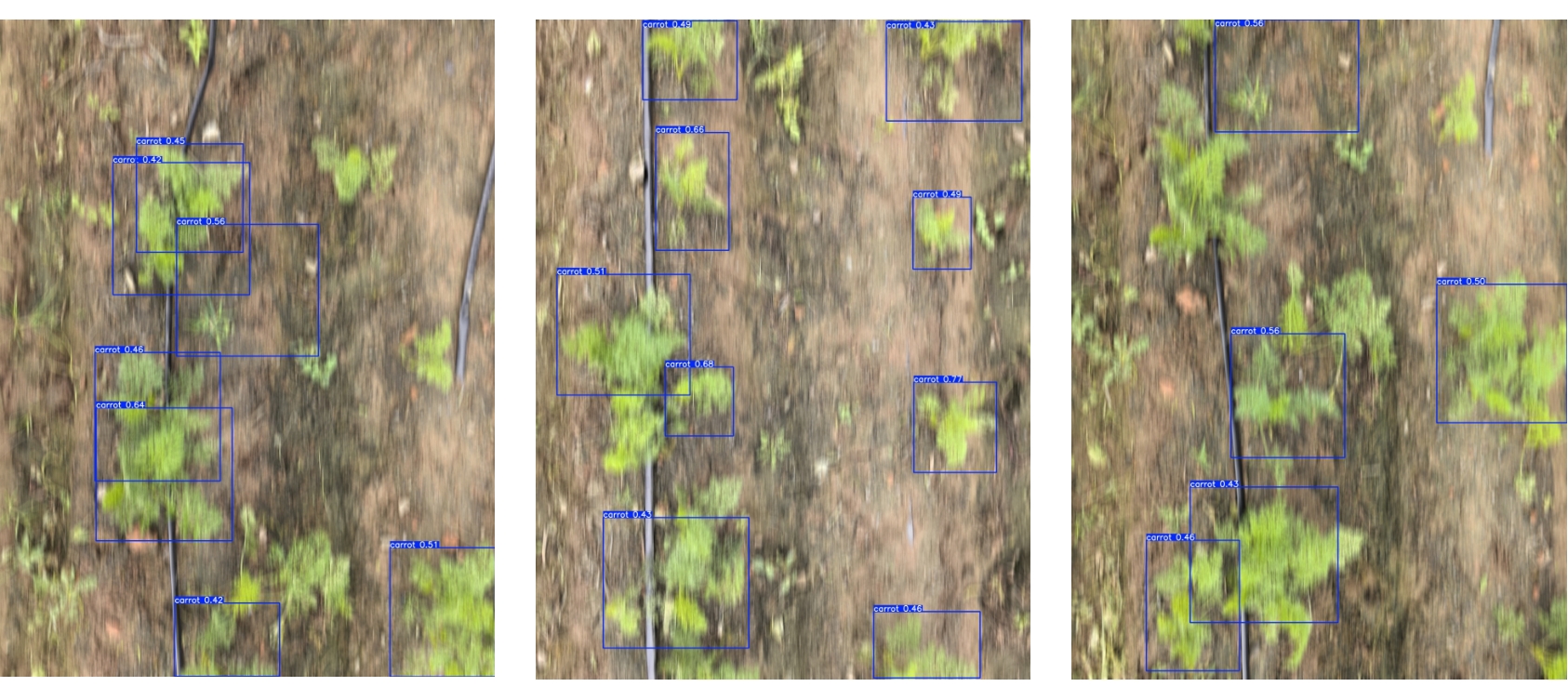
Fig. 11
CD-YOLO performance in carrot seedling detection under severe motion blur
| [1] |
刘星, 黄建新, 欧承刚, 等.胡萝卜根色及其色素组分的遗传和育种研究进展[J]. 植物遗传资源学报, 2022,23(5): 1241-1248.
|
|
|
|
| [2] |
赵童, 米月花, 籍镭钒, 等. 胡萝卜收割机的结构优化设计[J]. 工程机械, 2025, 56(6): 154-156,
|
|
|
|
| [3] |
张清蓉, 王国栋, 赵正伟, 等. 基于自动控制技术的胡萝卜种植收割一体机设计[J]. 南方农机, 2024, 55(21): 46-50.
|
|
|
|
| [4] |
倪建功, 李娟, 邓立苗, 等. 基于知识蒸馏的胡萝卜外观品质等级智能检测[J]. 农业工程学报, 2020, 36(18): 181-187.
|
|
|
|
| [5] |
|
| [6] |
王春桃, 梁炜健, 郭庆文, 等. 农业害虫智能视觉检测研究综述[J]. 中国农机化学报, 2023, 44(7): 207-213.
|
|
|
|
| [7] |
黄友锐, 王小桥, 韩涛, 等. 基于改进YOLOv8n的甜菜杂草检测算法研究[J]. 江苏农业科学, 2024, 52(24): 196-204.
|
|
|
|
| [8] |
曲福恒, 李金状, 杨勇, 等. 基于改进DeepLabv3+的轻量化作物杂草识别方法[J]. 石河子大学学报(自然科学版), 2024, 42(1): 117-125.
|
|
|
|
| [9] |
|
| [10] |
孟庆宽, 张漫, 杨晓霞, 等. 基于轻量卷积结合特征信息融合的玉米幼苗与杂草识别[J]. 农业机械学报, 2020, 51(12): 238-245, 303.
|
|
|
|
| [11] |
张志远, 罗铭毅, 郭树欣, 等. 基于改进YOLOv5的自然环境下樱桃果实识别方法[J]. 农业机械学报, 2022, 53(S1): 232-240.
|
|
|
|
| [12] |
|
| [13] |
汤晨, 刘振青, 邵阳, 等. 基于改进YOLOv11n的密集遮挡环境百香果识别方法[J]. 农业机械学报, 2026, 57 (5): 167-176.
|
|
|
|
| [14] |
李文峰, 胡世康, 杨琳琳, 等. 基于轻量化YOLOv4对不同遮挡程度成熟番茄果实的识别[J]. 云南农业大学学报(自然科学版), 2024(4): 184-189.
|
|
|
|
| [15] |
王元昊, 娄欢欢, 罗红品, 等. 基于改进YOLOv8算法对被遮挡柑橘的识别与定位优化[J]. 西南大学学报(自然科学版), 2025, 47(2): 171-183.
|
|
|
|
| [16] |
李会, 郭家文, 黄世醒, 等. 基于改进YOLOv7的甘蔗幼苗检测方法试验研究[J]. 农机化研究, 2025, 47(9): 146-154.
|
|
|
|
| [17] |
郑健林, 黄世醒, 郑丁科, 等. 基于改进YOLOv5的机收蔗含杂率检测方法试验研究[J]. 农机化研究, 2026, 48(2): 217-224.
|
|
|
|
| [18] |
牛子昂, 裘正军. 基于改进YOLOv11-Pose的玉米植株骨架及表型参数提取方法[J]. 智慧农业(中英文), 2025(2): 95-105.
|
|
|
|
| [19] |
谭泗桥, 陈涵, 朱磊, 等. 基于改进YOLOv8m的稻田害虫识别方法[J]. 农业工程学报, 2025, 41(2): 185-195.
|
|
|
|
| [20] |
|
| [21] |
李亚, 蒋晨, 王海瑞, 等. 基于EDW-YOLOv8的棉花叶片病害检测[J]. 华中农业大学学报, 2025, 44(5): 189-197.
|
|
|
|
| [22] |
|
| [23] |
|
| [24] |
刘坤, 吉宏亚, 黄程菲, 等. 基于改进YOLOv5s的番茄成熟度识别技术研究[J]. 中国农机化学报, 2025, 46(5): 79-85.
|
|
|
|
| [25] |
曹玉莹, 刘银川, 高新悦, 等. LightTassel-YOLO:一种基于无人机遥感的玉米雄穗实时检测方法(英文)[J]. 智慧农业(中英文), 2025, 7(6): 96-110.
|
|
|
|
| [26] |
李大华, 孔舒, 李栋, 等. 基于改进SSD模型的柑橘叶片病害轻量化检测模型[J]. 浙江农业学报, 2024, 36(3): 662-670.
|
|
|
|
| [27] |
|
| [28] |
|
| [29] |
|
| [30] |
|
| [31] |
李茂, 肖洋轶, 宗望远, 等. 基于改进YOLOv8模型的轻量化板栗果实识别方法[J]. 农业工程学报, 2024, 40(1): 201-209.
|
|
|
|
| [32] |
|
| [1] | GAO Guangfu, WANG Qilei, SONG Liwen, FENG Haikuan, SHI Lei, YANG Hao, LIU Yang, YUE Jibo. Object Detection Method of Maize Ears Within Canopy Based on CornYOLO [J]. Smart Agriculture, 2026, 8(1): 167-177. |
| [2] | XIAO Ruihong, TAN Lixin, WANG Rifeng, SONG Min, HU Chengxi. Multi-Scale Tea Leaf Disease Detection Method Based on Improved YOLOv11n [J]. Smart Agriculture, 2026, 8(1): 62-71. |
| [3] | YAO Xiaotong, QU Shaoye. Lightweight Detection Method for Pepper Leaf Diseases and Pests Based on Improved YOLOv12s [J]. Smart Agriculture, 2026, 8(1): 1-14. |
| [4] | ZHAO Jun, NIE Zhigang, LI Guang, LIU Jiayu. Corn Borer Pests Infestations Detection Method Using Low-Altitude Close-Range UAV Imagery [J]. Smart Agriculture, 2025, 7(6): 111-123. |
| [5] | LI Wenzheng, YANG Xinting, SUN Chuanheng, CUI Tengpeng, WANG Hui, LI Shanshan, LI Wenyong. Light-Trapping Rice Planthopper Detection Method by Combining Spatial Depth Transform Convolution and Multi-scale Attention Mechanism [J]. Smart Agriculture, 2025, 7(5): 169-181. |
| [6] | HAN Wenkai, LI Tao, FENG Qingchun, CHEN Liping. Lightweight Apple Instance Segmentation Algorithm Based on SSW-YOLOv11n for Complex Orchard Environments [J]. Smart Agriculture, 2025, 7(5): 114-123. |
| [7] | WANG Fengyun, WANG Xuanyu, AN Lei, FENG Wenjie. Detection Method for Log-Cultivated Shiitake Mushrooms Based on Improved RT-DETR [J]. Smart Agriculture, 2025, 7(5): 67-77. |
| [8] | LUO Xuelun, GOUDA Mostafa, SONG Xinbei, HU Yan, ZHANG Wenkai, HE Yong, ZHANG Jin, LI Xiaoli. Detection Method of Ectropis Grisescens Larvae in Canopy Environments Based on YOLO and Diffusion Models [J]. Smart Agriculture, 2025, 7(5): 156-168. |
| [9] | LIU Yiheng, LIU Libo. Beef Cattle Object Detection Method Under Occlusion Environment Based on Improved YOLOv12 [J]. Smart Agriculture, 2025, 7(5): 182-192. |
| [10] | YANG Qilang, YU Lu, LIANG Jiaping. Grading Asparagus officinalis L. Using Improved YOLOv11 [J]. Smart Agriculture, 2025, 7(4): 84-94. |
| [11] | CHANG Jian, WANG Bingbing, YIN Long, LI Yanqing, LI Zhaoxin, LI Zhuang. The Lightweight Bee Pollination Recognition Model Based On YOLOv10n-CHL [J]. Smart Agriculture, 2025, 7(3): 185-198. |
| [12] | WU Liuai, XU Xueke. Lightweight Tomato Leaf Disease and Pest Detection Method Based on Improved YOLOv10n [J]. Smart Agriculture, 2025, 7(1): 146-155. |
| [13] | YANG Xinting, HU Huan, CHEN Xiao, LI Wenzheng, ZHOU Zijie, LI Wenyong. Lightweight Detection and Recognition Model for Small Target Pests on Sticky Traps in Multi-Source Scenarios [J]. Smart Agriculture, 2025, 7(1): 111-123. |
| [14] | LIU Chang, SUN Yu, YANG Jing, WANG Fengchao, CHEN Jin. Grape Recognition and Localization Method Based on 3C-YOLOv8n and Depth Camera [J]. Smart Agriculture, 2024, 6(6): 121-131. |
| [15] | HU Chengxi, TAN Lixin, WANG Wenyin, SONG Min. Lightweight Tea Shoot Picking Point Recognition Model Based on Improved DeepLabV3+ [J]. Smart Agriculture, 2024, 6(5): 119-127. |
| Viewed | ||||||
|
Full text |
|
|||||
|
Abstract |
|
|||||