YANG Yongkang1,3( ), HUANG Xinyao2(), LI Guoliang2, LI Lin1, YOU Liangzhi3, LI Wanli2(), FENG Zaiwen2,3()
Received:2026-04-17
Online:2026-07-08
Foundation items:National Key Research and Development Program of China(2023YFF1000100); Hubei Provincial Technological Innovation Program Projects(2024BBB055;2024BAA008)
corresponding author:
CLC Number:
YANG Yongkang, HUANG Xinyao, LI Guoliang, LI Lin, YOU Liangzhi, LI Wanli, FENG Zaiwen. Knowledge-Enhanced Decision Agent Framework for Maize Precision Fertilization[J]. Smart Agriculture, doi: 10.12133/j.smartag.SA202604027.
Add to citation manager EndNote|Ris|BibTeX
URL: https://www.smartag.net.cn/EN/10.12133/j.smartag.SA202604027
Table 1
Statistics of basic attributes, soil indicators, and fertilization schemes in the historical case database for maize precision fertilization
| 历史案例库属性 | 最小值 | 最大值 | 均值 | 标准差 |
|---|---|---|---|---|
| 案例数量/条 | 815 | 815 | ||
| 玉米品种数量/种 | 24 | 24 | ||
| 有机质/( ) | 10.03 | 35.99 | 21.35 | 6.65 |
| 全氮/( ) | 0.83 | 2.28 | 1.46 | 0.33 |
| 碱解氮/( ) | 35.00 | 147.54 | 90.48 | 23.07 |
| 有效磷/( ) | 10.15 | 41.92 | 23.73 | 7.08 |
| 速效钾/( ) | 70.07 | 244.34 | 148.65 | 37.5 |
| pH | 5.00 | 8.40 | 6.79 | 0.82 |
| 目标产量/( ) | 7 828.00 | 14 940.00 | 11 283.75 | 1 125.44 |
| 总施氮量/( ) | 143.50 | 360.00 | 224.55 | 35.88 |
| 总施磷量/( ) | 72.00 | 180.00 | 105.92 | 17.09 |
| 总施钾量/( ) | 30 | 160 | 72.68 | 21.7 |
| 氮肥平均分期比例(基肥:拔节肥:喇叭口肥) | 46.7:29.1:24.3 | |||
| 磷肥平均分期比例(基肥:拔节肥:喇叭口肥) | 83.0:12.0:5.0 | |||
| 钾肥平均分期比例(基肥:拔节肥:喇叭口肥) | 61.5:14.3:24.2 | |||
Table 2
Statistics of entity types and node counts in the maize fertilization knowledge graph
| 实体类型 | 数量/个 | 占比/% |
|---|---|---|
| 施肥记录 | 23 633 | 37.46 |
| 产量表现 | 9 088 | 14.40 |
| 品种 | 8 420 | 13.34 |
| 杂交组合来源 | 8 250 | 13.08 |
| 施肥策略 | 7 885 | 12.50 |
| 品种性状 | 2 445 | 3.88 |
| 育种单位 | 2 380 | 3.77 |
| 施肥量 | 728 | 1.15 |
| 栽培技术要点 | 113 | 0.18 |
| 抗性 | 98 | 0.16 |
| 区域 | 29 | 0.05 |
| 感病性 | 21 | 0.03 |
| 施肥阶段 | 3 | 0.00 |
| 肥料类型 | 3 | 0.00 |
Table3
Statistics of relation types and relation counts in the maize fertilization knowledge graph
| 关系类型 | 数量/个 | 占比/% |
|---|---|---|
| 具有性状 | 46 565 | 16.76 |
| 具有产量表现 | 37 480 | 13.49 |
| 适宜种植于 | 29 722 | 10.69 |
| 具有抗性 | 23 983 | 8.63 |
| 具有施肥量 | 23 633 | 8.50 |
| 具有施肥阶段 | 23 633 | 8.50 |
| 使用肥料 | 23 633 | 8.50 |
| 具有施肥记录 | 23 633 | 8.50 |
| 具有栽培要点 | 17 661 | 6.36 |
| 由某单位选育 | 10 088 | 3.63 |
| 来源于杂交组合 | 9 566 | 3.44 |
| 具有施肥策略 | 7 885 | 2.84 |
| 具有感病性 | 424 | 0.15 |
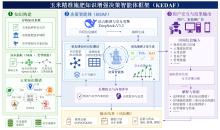
Fig. 1
KEDAF decision framework
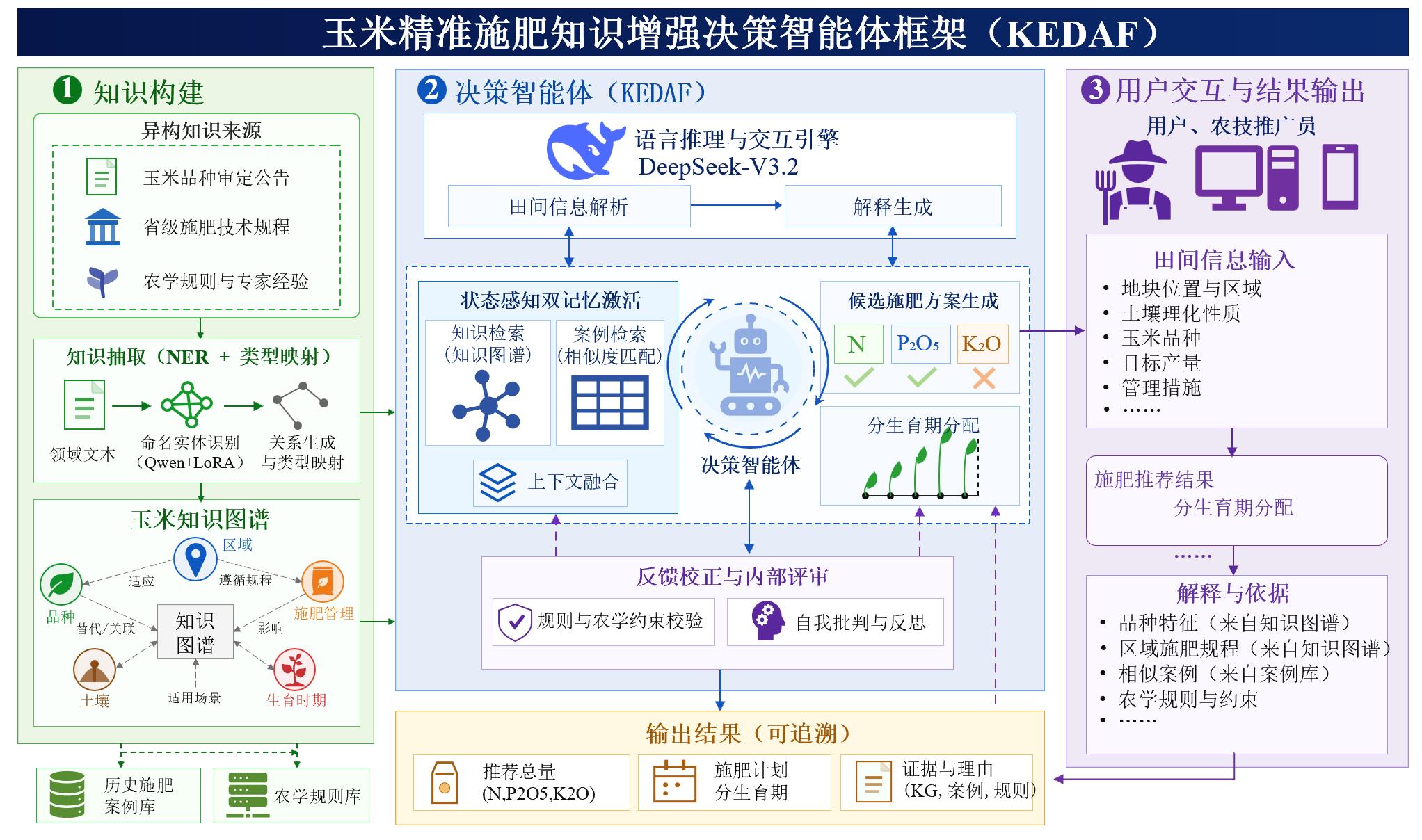
Table 4
Regression results of KEDAF by dimension
| 指标 | MAE | RMSE | MAPE/% | R 2 |
|---|---|---|---|---|
| 施氮总量 | 9.167 7 | 11.657 3 | 4.203 4 | 0.882 4 |
| 施磷总量 | 4.246 8 | 5.544 2 | 4.046 9 | 0.888 8 |
| 施钾总量 | 5.614 8 | 7.323 8 | 7.760 8 | 0.874 7 |
| 基肥施肥量 | 6.204 3 | 7.986 7 | 2.669 1 | 0.948 3 |
| 拔节肥施肥量 | 3.148 0 | 3.937 3 | 3.636 4 | 0.937 7 |
| 大喇叭口期追肥施肥量 | 3.030 9 | 3.864 5 | 4.028 2 | 0.947 1 |
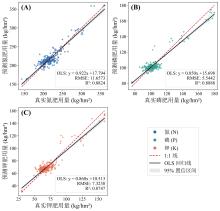
Fig.2
Comparison between predicted and actual total nitrogen, phosphorus, and potassium fertilizer amounts for KEDAF
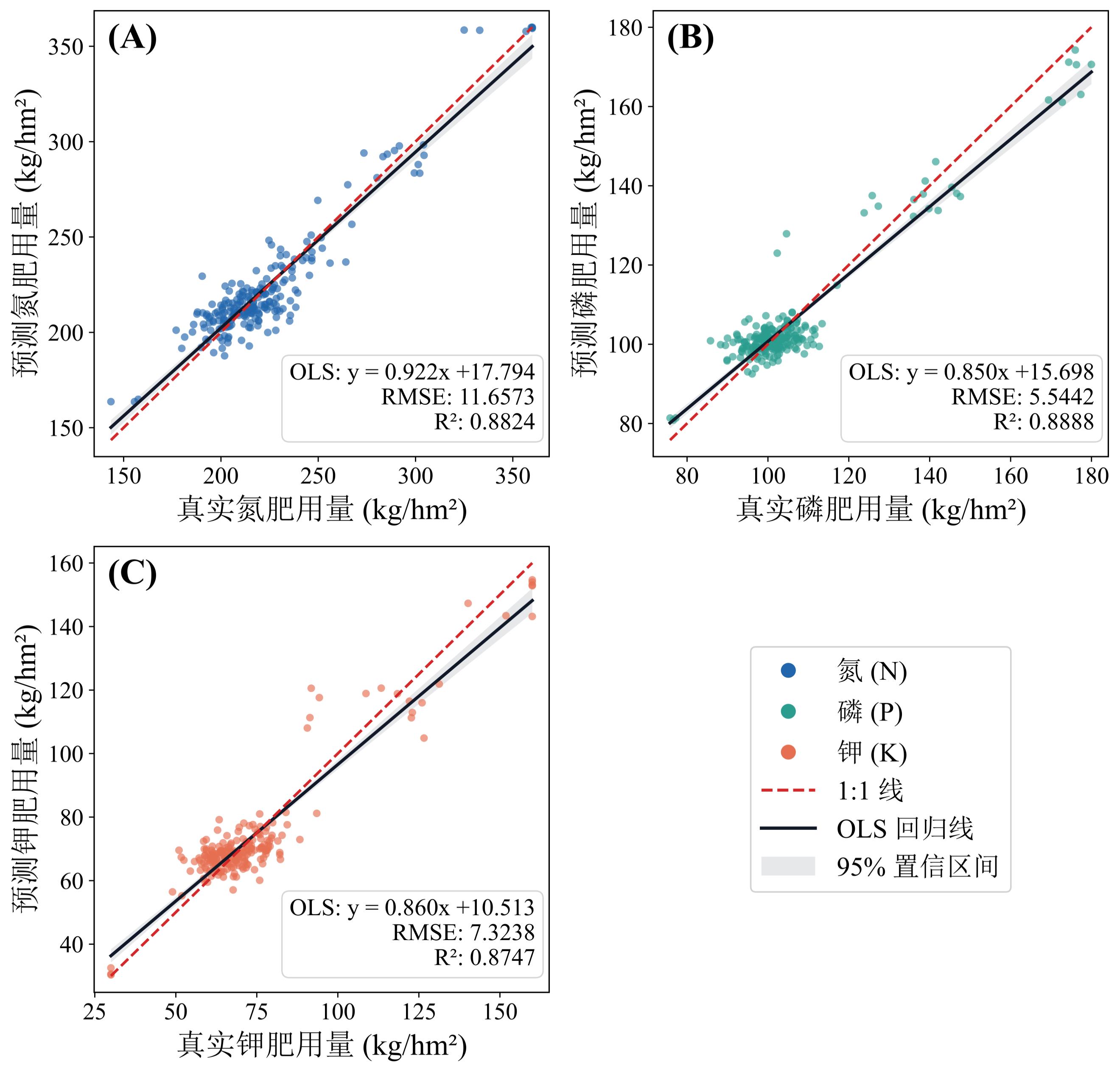
Table 5
Ablation results of fertilization decision system
| 变体 | 总量 MAPE/% | 总量 R 2 | 分期 MAPE/% | 分期R 2 |
|---|---|---|---|---|
| KEDAF | 5.337 0 | 0.882 0 | 3.444 6 | 0.944 4 |
| 移除知识图谱先验 | 6.331 9 | 0.792 2 | 4.136 6 | 0.867 7 |
| 移除案例修正 | 5.826 5 | 0.859 2 | 3.779 6 | 0.932 1 |
| 移除安全约束 | 5.718 1 | 0.869 2 | 3.545 8 | 0.935 9 |
Table 6
Main comparative results of the KEDAF decision system for maize precision fertilization
| 方法 | 总量 MAPE/% | 总R 2 | 分期MAPE/% | 分期 R 2 |
|---|---|---|---|---|
| 规则方法 | 9.957 0 | 0.529 2 | 8.540 7 | 0.587 7 |
| 传统案例推理 | 6.502 8 | 0.807 1 | 4.028 3 | 0.899 9 |
| CBR-ML混合模型 | 6.328 0 | 0.797 9 | 4.166 7 | 0.869 3 |
| KEDAF | 5.337 0 | 0.882 0 | 3.444 6 | 0.944 4 |
Table 7
Decision trajectory of KEDAF for a representative field
| 决策阶段 | 关键依据与处理 | 输出结果 |
|---|---|---|
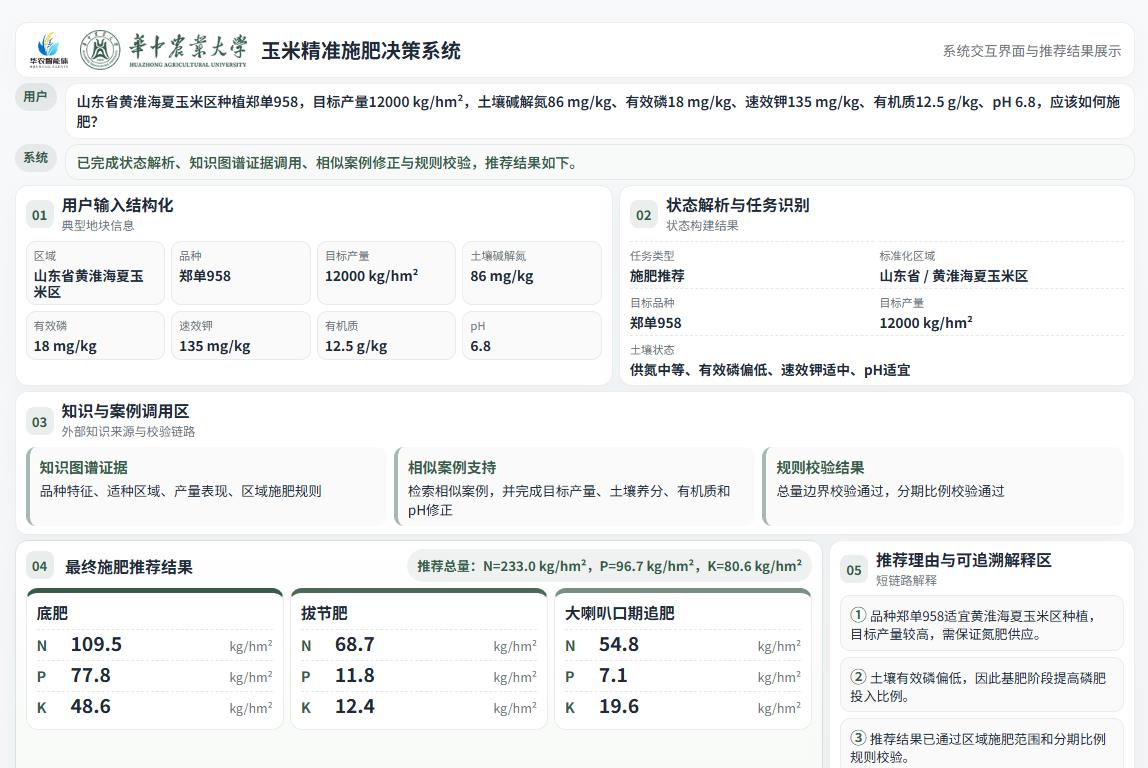
| 用户输入与状态构建 | 输入山东省、品种郑单958、目标产量12000 kg/hm2,以及土壤碱解氮、有效磷、速效钾、有机质和pH值等指标;系统完成字段抽取与标准化 | 形成标准化地块状态 |
| 知识图谱先验生成 | 检索品种特征、适种区域、产量表现和区域施肥规则 | 生成先验方案:N=224 kg/hm2,P=94 kg/hm2,K=79 kg/hm2 |
| 案例检索与迁移修正 | 检索相似历史案例,并依据目标产量、土壤养分、有机质和pH差异进行修正 | 生成案例迁移方案:N=233 kg/hm2,P=97 kg/hm2,K=81 kg/hm2 |
| 候选方案融合与规则校验 | 综合知识先验、案例支持度和农学规则,校验总量边界与分期比例约束 | 形成最终推荐总量:N=233 kg/hm2,P=97 kg/hm2,K=81 kg/hm2 |
| 结果解释输出 | 汇总知识图谱证据、相似案例依据和规则校验结果 | 输出分期施肥方案及推荐依据 |
Table 8
Final fertilization recommendation of KEDAF for a representative field
| 施肥阶段 | 氮肥/(kg/hm2) | 磷肥/(kg/hm2) | 钾肥/(kg/hm2) |
|---|---|---|---|
| 合计 | 233.0 | 96.7 | 80.6 |
| 底肥 | 109.5 | 77.8 | 48.6 |
| 拔节肥 | 68.7 | 11.8 | 12.4 |
| 大喇叭口期追肥 | 54.8 | 7.1 | 19.6 |
Fig.3
Interactive interface and recommendation output of the maize precision fertilization decision system
| [1] |
|
| [2] |
|
| [3] |
徐新朋, 魏丹, 李玉影, 等. 基于产量反应和农学效率的推荐施肥方法在东北春玉米上应用的可行性研究[J]. 植物营养与肥料学报, 2016, 22(6): 1458-1467.
|
|
|
|
| [4] |
包启平, 韩晓日, 崔志刚, 等. 东北春玉米氮肥推荐施肥模型研究[J]. 植物营养与肥料学报, 2020, 26(4): 705-716.
|
|
|
|
| [5] |
|
| [6] |
|
| [7] |
|
| [8] |
|
| [9] |
|
| [10] |
|
| [11] |
|
| [12] |
|
| [13] |
|
| [14] |
|
| [15] |
|
| [16] |
|
| [17] |
|
| [18] |
|
| [19] |
|
| [20] |
许多, 鲁旺平, 许瑞清, 等. 基于农业时空多模态知识图谱的水稻精准施肥决策方法[J]. 华中农业大学学报, 2023, 42(3): 281-292.
|
|
|
|
| [21] |
穆维松, 刘天琪, 苗子溦, 等. 知识图谱技术及其在农业领域应用研究进展[J]. 农业工程学报, 2023, 39(16): 1-12.
|
|
|
|
| [22] |
|
| [23] |
|
| [24] |
|
| [25] |
|
| [26] |
|
| [27] |
裘佳颖, 刘应昌, 高星杰, 等. AgriAgent: 面向农业环境控制的端到端大模型智能体系统架构[J]. 智慧农业(中英文), 2026, 8(2): 220-236.
|
|
|
|
| [28] |
|
| [1] | LI Runteng, WANG Yiqun, LI Hongda, LI Jingchen, CHEN Wenbai. Key Factor Extraction Method of Agricultural User Demand Based on Large Language Models [J]. Smart Agriculture, 2026, 8(2): 265-278. |
| [2] | QIU Jiaying, LIU Yingchang, GAO Xingjie, HUANG Yuan, ZHANG Hongyu, TIAN Fang, LI Wanli, FENG Zaiwen. AgriAgent: End-to-End Large Model Agent System Architecture for Agricultural Environment Control [J]. Smart Agriculture, 2026, 8(2): 220-236. |
| [3] | WU Zhangbin, HE Ning, WU Yandong, GUO Xinyu, WEN Weiliang. Point Cloud Data-driven Methods for Estimating Maize Leaf Biomass [J]. Smart Agriculture, 2026, 8(1): 156-166. |
| [4] | GAO Guangfu, WANG Qilei, SONG Liwen, FENG Haikuan, SHI Lei, YANG Hao, LIU Yang, YUE Jibo. Object Detection Method of Maize Ears Within Canopy Based on CornYOLO [J]. Smart Agriculture, 2026, 8(1): 167-177. |
| [5] | CAO Yuying, LIU Yinchuan, GAO Xinyue, JIA Yinjiang, DONG Shoutian. LightTassel-YOLO: A Real-Time Detection Method for Maize Tassels Based on UAV Remote Sensing [J]. Smart Agriculture, 2025, 7(6): 96-110. |
| [6] | ZHAO Yingping, LIANG Jinming, CHEN Beizhang, DENG Xiaoling, ZHANG Yi, XIONG Zheng, PAN Ming, MENG Xiangbao. Applications Research Progress and Prospects of Multi-Agent Large Language Models in Agricultural [J]. Smart Agriculture, 2025, 7(5): 37-51. |
| [7] | DANG Shanshan, QIAO Shicheng, BAI Mingyu, ZHANG Mingyue, ZHAO Chenyu, PAN Chunyu, WANG Guochen. Small Target Detection Method of Maize Leaf Disease Based on DCC-YOLOv10n [J]. Smart Agriculture, 2025, 7(5): 124-135. |
| [8] | ZHANG Zishen, CHENG Hong, GENG Wenjuan, GUAN Junfeng. Research Advances in Hyperspectral Imaging Technology for Fruit Quality Assessment [J]. Smart Agriculture, 2025, 7(5): 52-66. |
| [9] | WANG Yi, XUE Rong, HAN Wenting, SHAO Guomin, HOU Yanqiao, CUI Xitong. Estimation of Maize Aboveground Biomass Based on CNN-LSTM-SA [J]. Smart Agriculture, 2025, 7(4): 159-173. |
| [10] | QIAO Lei, CHEN Lei, YUAN Yuan. Bi-Intentional Modeling and Knowledge Graph Diffusion for Rice Variety Selection and Breeding Recommendation [J]. Smart Agriculture, 2025, 7(2): 73-80. |
| [11] | YANG Chenxue, LI Xian, ZHOU Qingbo. Knowledge Graph Driven Grain Big Data Applications: Overview and Perspective [J]. Smart Agriculture, 2025, 7(2): 26-40. |
| [12] | NIU Ziang, QIU Zhengjun. Extraction Method of Maize Plant Skeleton and Phenotypic Parameters Based on Improved YOLOv11-Pose [J]. Smart Agriculture, 2025, 7(2): 95-105. |
| [13] | YUAN Huan, FAN Beilei, YANG Chenxue, LI Xian. Graph Neural Networks for Knowledge Graph Construction: Research Progress, Agricultural Development Potential, and Future Directions [J]. Smart Agriculture, 2025, 7(2): 41-56. |
| [14] | WU Huarui, LI Jingchen, YANG Yusen. Intelligent Decision-Making Method for Personalized Vegetable Crop Water and Fertilizer Management Based on Large Language Models [J]. Smart Agriculture, 2025, 7(1): 11-19. |
| [15] | WU Huarui, ZHAO Chunjiang, LI Jingchen. Agri-QA Net: Multimodal Fusion Large Language Model Architecture for Crop Knowledge Question-Answering System [J]. Smart Agriculture, 2025, 7(1): 1-10. |
| Viewed | ||||||
|
Full text |
|
|||||
|
Abstract |
|
|||||