Smart Agriculture ›› 2026, Vol. 8 ›› Issue (3): 67-84.doi: 10.12133/j.smartag.SA202602016
• Special Issue--Digital Technologies Reshaping Agriculture and Agricultural Economics • Previous Articles Next Articles
XU Qiyu1, ZHENG Bo1,2( ), ZHONG Shangwei1,3
Received:2026-02-09
Online:2026-05-30
Foundation items:National Natural Science Foundation of China(32300248); Natural Science Foundation of Shandong Province(ZR2022QC010)
About author:XU Qiyu, E-mail: xuqiyu@nwafu.edu.cn
corresponding author:
CLC Number:
XU Qiyu, ZHENG Bo, ZHONG Shangwei. Artificial Intelligence Empowering Modern Agricultural Biological Breeding[J]. Smart Agriculture, 2026, 8(3): 67-84.
Add to citation manager EndNote|Ris|BibTeX
URL: https://www.smartag.net.cn/EN/10.12133/j.smartag.SA202602016
Fig. 1
Historical perspective on crop breeding technology
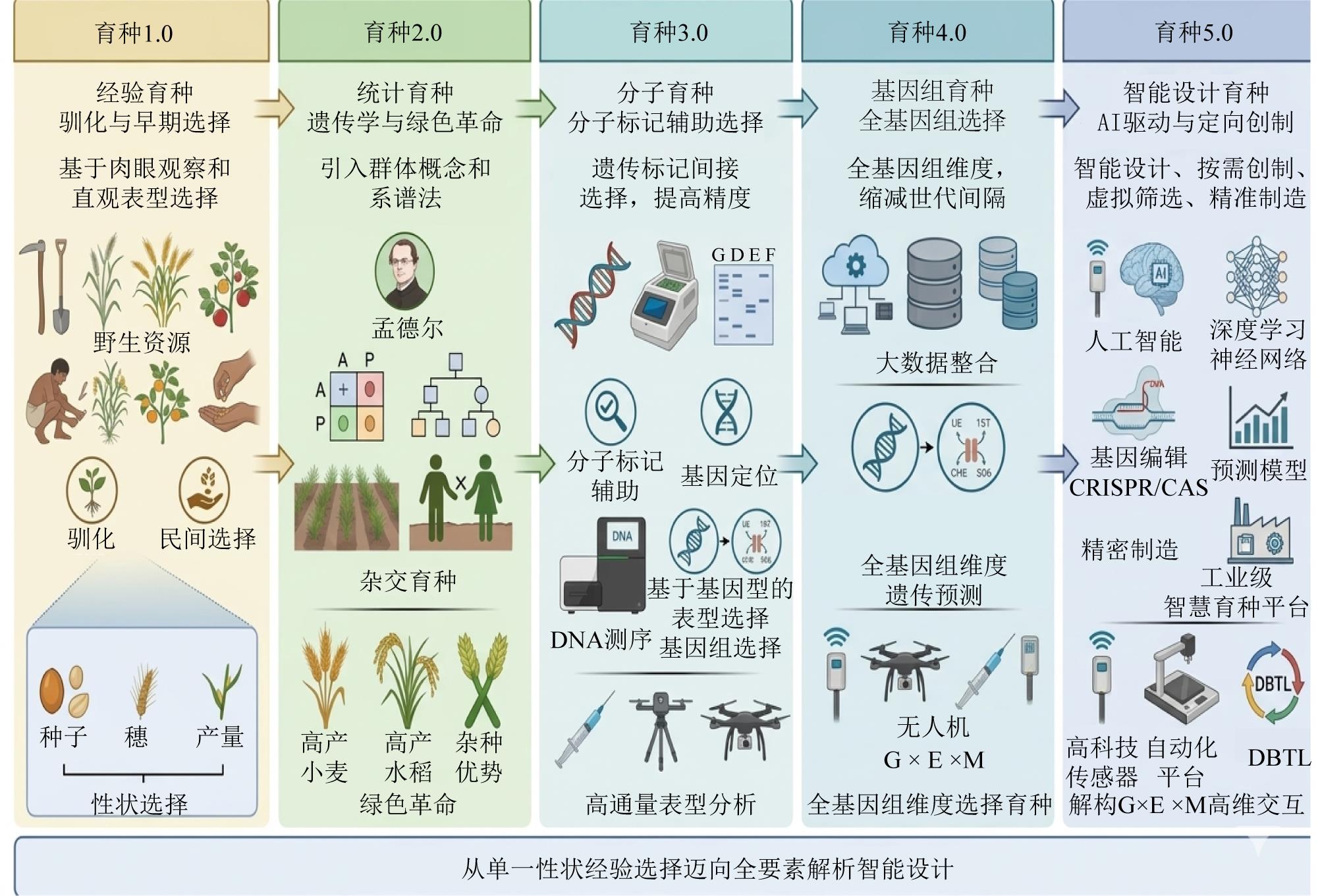
Fig. 2
Roadmap of AI-enabled crop breeding
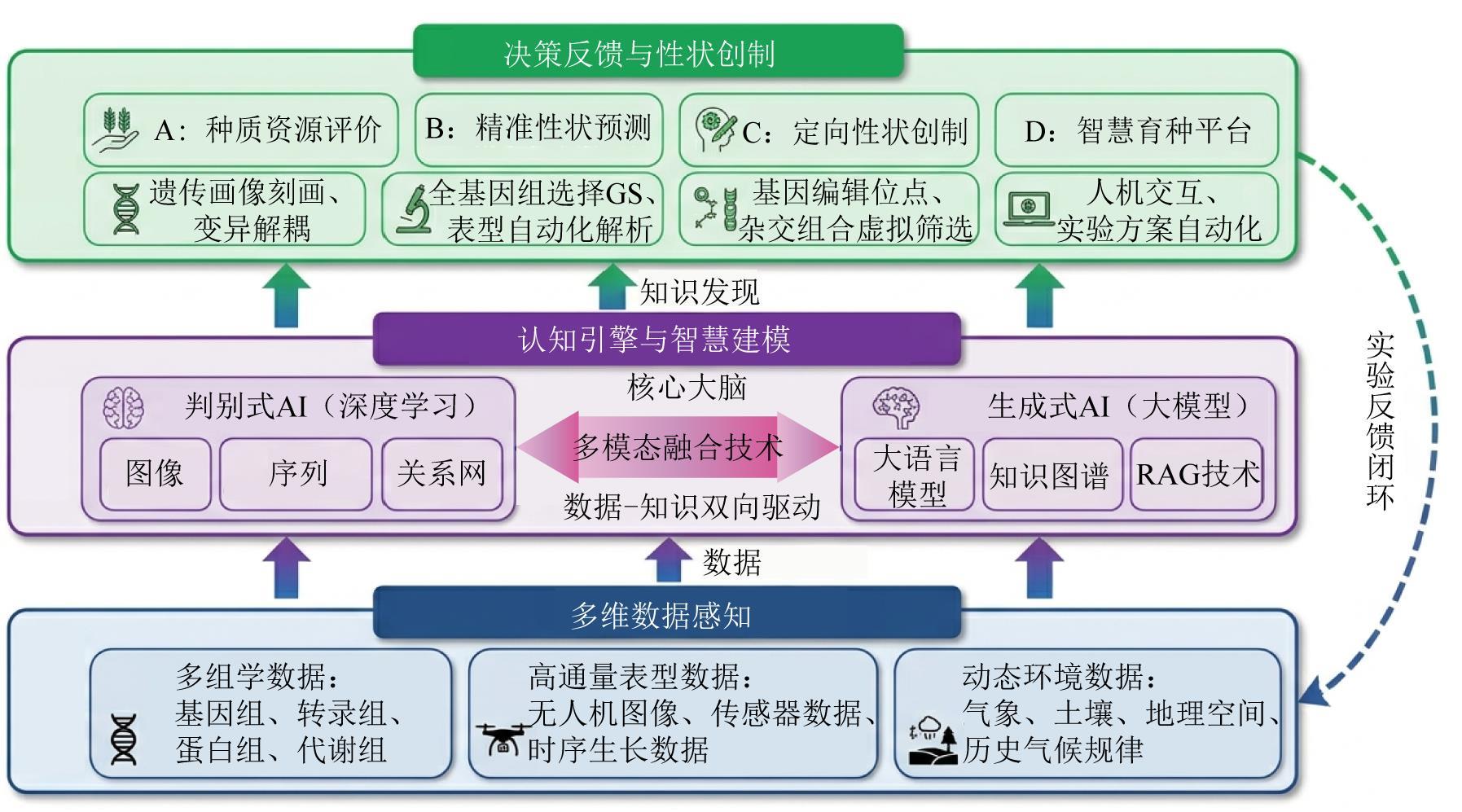
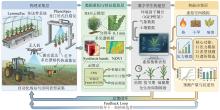
Fig. 3
Crop high-throughput phenotyping and digital twin workflow
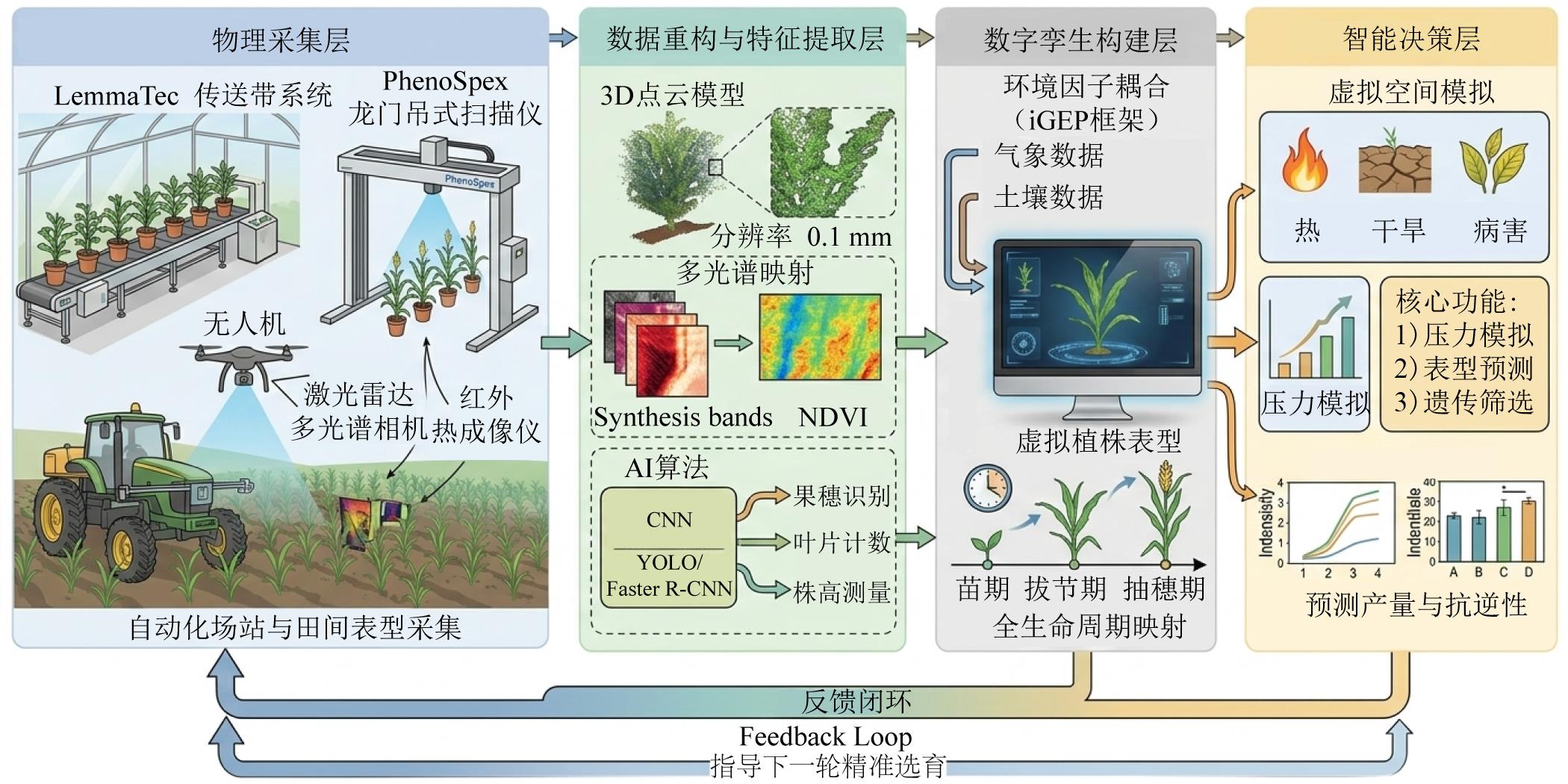
Table 1
Large-scale models for major crop breeding
| 名称 | 类型 | 主要功能描述 | 发布机构及时间 |
|---|---|---|---|
| 司农(Sinong) | 通用农业领域垂直大模型 | 全学科知识检索与农业生产问题诊断 | 南京农业大学,2026 |
| 农业科学发现大模型 | 农业科研领域大模型 | 基因挖掘、性状预测、方案设计、种植系统智慧管理 | 中国农业科学院生物技术研究所/华为云,2025 |
| 神农大模型 3.0 | 农业垂直领域大模型 | 智慧育种、智慧种植、智慧养殖、遥感气象、智慧教育 | 中国农业大学,2025 |
| AI Breeder for Crops (ABC) | 集成化智慧育种平台 | 棉花一站式育种平台,并逐步拓展至水稻等多作物平台 | 浙江大学/北京大学,2025 |
| 西南种芯 V1 | 玉米智慧育种大模型 | 西南特色玉米的遗传演化分析、特异性状挖掘及改良 | 四川农业大学/博瑞迪,2025 |
| 天工开悟 2.0 | 农业大语言模型 | 病虫害预警、产量预测及生产要素的动态优化配置 | 哈尔滨工业大学,2025 |
| 作物育种大模型(BreedingGPT) | 育种专业辅助模型 | 科研问答,基因解析,文献检索,科研助手 | 北京大学现代农业研究院,2025 |
| PlantGPT | 大语言模型人工智能助手 | 植物功能基因组学智能问答、普及农业知识 | 华南农业大学,2025 |
| SeedBench | 多模态大模型测评基准 | 评估大模型在基因信息获取与分析、基因功能与调控机制分析、品种选育与农艺特性优化中的效用 | 上海人工智能实验室、崖州湾国家实验室,2025 |
| CropGPT | 生物大数据模型 | 协同应用AI、基因组编辑、多组学等前沿技术,丰富基础种质资源,提高育种精准 | 华中农业大学,2024 |
| 丰登(SeedLLM) | 种业大语言模型 | 品种选育、栽培管理、种子经营、种业管理 | 上海人工智能实验室/崖州湾国家实验室/中国农业大学,2024 |
| WBLM(Wheat Breeding LLM) | 多模态育种大模型 | 融合基因型、表型、遥感、环境数据;性状预测与育种决策 | 康奈尔大学/浙江大学,2025 |
| CropOS | 工业AI育种平台 | 基因型-表型预测、候选品系筛选、目标性状设计 | 美国Benson Hill公司,2025 |
| SEEDesign™ | AI+基因编辑设计平台 | in-silico性状设计、预测编辑位点、加速品种创制 | 美国农业科技公司(Inari),2025 |
| PlantCaduceus | 植物特异DNA基础模型 | 专门针对植物基因组训练;增强跨物种预测能力 | 开源植物基因组AI项目,2024 |
| PLLaMA | 植物科学基础开源大模型 | 植物学知识问答、实验设计辅助及育种决策咨询 | 加州大学圣巴巴拉分校/林肯大学等,2024 |
| AgroNT | 植物基因组基础模型(DNA LLM) | 多作物基因组预训练;调控元件识别、表达预测、功能变异优先级评估、跨物种迁移学习 | InstaDeep/先正达,2024 |
| Mineral | 农业机器人+ AI感知基础模型 | 高通量田间表型采集,作物个体级识别与监测,病害/营养状态检测,数据驱动育种与管理决策 | Alphabet X(Google Moonshot)农业AI项目,2024 |
| FarmVibes AI | 多模态农业基础模型平台 | 融合卫星、气候、土壤、农机数据,作物生长预测与产量分析,精准播种与施肥决策,农田“what-if”模拟分析 | 微软,2022 |
Table 2
Challenges and countermeasures in AI-driven breeding
| 维度 | 挑战 | 对策 |
|---|---|---|
| 数据 | 数据孤岛、标准化缺失 | FAIR原则、联邦学习、国家级数据版权平台 |
| 算力 | 算力不对称、成本高 | 育种专用算力集群、LoRA量化/轻量化技术 |
| 算法 | 黑盒模型、缺少生物学因果 | iGEP框架、知识引导的自监督学习、RAG技术 |
| 人才 | 复合型人才匮乏 | 农学+AI数据科学交叉学科培养 |
| [1] |
王术坤, 韩磊. 中国种业发展形势与国际比较[J]. 农业现代化研究, 2022, 43(5): 814-822.
|
|
|
|
| [2] |
|
| [3] |
种聪, 郭雨溪, 岳希明. 中国种业振兴: 发展历程、关键问题与机制构建[J]. 农业现代化研究, 2023, 44(2): 205-213.
|
|
|
|
| [4] |
|
| [5] |
|
| [6] |
|
| [7] |
|
| [8] |
|
| [9] |
|
| [10] |
|
| [11] |
谷晓峰, 张立超, 李慧慧, 等. 农业生物智能设计育种[J]. 中国农业科技导报, 2025, 27(12): 1-13.
|
|
|
|
| [12] |
|
| [13] |
|
| [14] |
|
| [15] |
|
| [16] |
|
| [17] |
|
| [18] |
|
| [19] |
|
| [20] |
简六梅, 肖英杰, 严建兵. 从头驯化: 作物品种设计与培育的新方向[J]. 遗传, 2023, 45(9): 741-753.
|
|
|
|
| [21] |
|
| [22] |
|
| [23] |
|
| [24] |
张丰勇, 应晓平, 张健, 等. 半矮秆基因sd1调控水稻重要农艺性状的研究进展[J]. 中国水稻科学, 2025, 39(1): 24-32.
|
|
|
|
| [25] |
|
| [26] |
|
| [27] |
|
| [28] |
|
| [29] |
方宣钧. 育种5.0: 人工智能驱动的设计育种革命[J]. 分子植物育种(网络版), 2024, 22(3): 29-38.
|
|
|
|
| [30] |
徐云碧. 大数据与智慧育种[C]// 第二十届中国作物学会学术年会论文集. 长沙, 中国, 2023: 96.
|
| [31] |
|
| [32] |
|
| [33] |
|
| [34] |
|
| [35] |
|
| [36] |
|
| [37] |
|
| [38] |
周济, 陈佳玮, 沈利言, 等. 人工智能——推动植物研究发展的新动力[J]. 南京农业大学学报, 2022, 45(5): 1060-1071.
|
|
|
|
| [39] |
|
| [40] |
|
| [41] |
|
| [42] |
|
| [43] |
|
| [44] |
|
| [45] |
杨莹莹, 郭嘉, 芦天罡, 等. 深度学习助力智慧农业高质量发展[J]. 农业工程, 2025, 15(12): 16-21.
|
|
|
|
| [46] |
|
| [47] |
|
| [48] |
|
| [49] |
|
| [50] |
李媛媛. 卷积神经网络优化及其在图像识别中的应用[D]. 沈阳: 沈阳工业大学, 2016.
|
|
|
|
| [51] |
|
| [52] |
吉文翰, 郑恒彪, 王迪, 等. 基于无人机影像和卷积神经网络的水稻育种材料产量预测研究[J]. 南京农业大学学报, 2025, 48(5): 1001-1012.
|
|
|
|
| [53] |
|
| [54] |
|
| [55] |
|
| [56] |
乔磊, 陈雷, 袁媛. 基于双意图建模和知识图谱扩散的水稻品种选育推荐方法[J]. 智慧农业(中英文), 2025, 7(2): 73-80.
|
|
|
|
| [57] |
鲍艳春, 石彩霞, 张传强, 等. 深度学习在基因组学中的研究进展[J]. 遗传, 2024, 46(9): 701-715.
|
|
|
|
| [58] |
|
| [59] |
|
| [60] |
|
| [61] |
|
| [62] |
|
| [63] |
|
| [64] |
陈亦男, 史展. 改进DeepLabv3+模型的图像语义分割算法[J]. 黑龙江科技大学学报, 2026, 36(1): 163-168.
|
|
|
|
| [65] |
|
| [66] |
|
| [67] |
|
| [68] |
|
| [69] |
|
| [70] |
|
| [71] |
|
| [72] |
|
| [73] |
黄勃, 吴申奥, 王文广, 等. 图模互补: 知识图谱与大模型融合综述[J]. 武汉大学学报(理学版), 2024, 70(4): 397-412.
|
|
|
|
| [74] |
|
| [75] |
|
| [76] |
|
| [77] |
|
| [78] |
张子悦, 周欣智, 吕斌. 人工智能驱动的基因编辑技术及其应用[J]. 中国生物化学与分子生物学报, 2025, 41(4): 522-532.
|
|
|
|
| [79] |
|
| [80] |
郭旺, 杨雨森, 吴华瑞, 等. 农业大模型: 关键技术、应用分析与发展方向[J]. 智慧农业(中英文), 2024, 6(2): 1-13.
|
|
|
|
| [81] |
冯在文, 许多, 田芳, 等. 设施农业智能决策大模型关键技术与发展方向[J]. 农业工程学报, 2025, 41(13): 50-61.
|
|
|
|
| [82] |
|
| [83] |
|
| [84] |
|
| [85] |
|
| [86] |
|
| [87] |
|
| [88] |
|
| [89] |
|
| [90] |
|
| [91] |
|
| [92] |
|
| [93] |
|
| [94] |
|
| [95] |
|
| [96] |
|
| [97] |
|
| [98] |
|
| [99] |
欧阳峥峥, 马毓聪, 寇远涛, 等. 中国农业大模型数据治理、核心技术与应用挑战[J]. 农业工程学报, 2025, 41(24): 153-162.
|
|
|
|
| [100] |
|
| [101] |
|
| [102] |
|
| [103] |
|
| [104] |
|
| [105] |
|
| [106] |
|
| [107] |
|
| [108] |
|
| [109] |
王可依. “粮农大讲堂” 第五期: 就我国种业振兴行动进行集中学习[J]. 世界农业, 2025(5): 138.
|
| [110] |
何玮萱, 刘琳, 胡博隆. 都市田园——互联网现代农业平台需求分析与开发推广研究[J]. 科技视界, 2018, 8(6): 28-29, 33.
|
|
|
|
| [111] |
|
| [112] |
|
| [113] |
|
| [114] |
|
| [115] |
万志前, 刘玉珍. 智慧农业背景下农业经营者数据权益保护困境与制度因应[J/OL]. 智慧农业(中英文), [2026-06-20]. Doi: 10.12133/j.smartag.SA202603023 .
|
|
|
|
| [116] |
郭小东. 从“可解释”到“可信任”: 人工智能治理的逻辑重构[J]. 北京工业大学学报(社会科学版), 2025(6): 117-135.
|
|
|
|
| [117] |
|
| [118] |
|
| [119] |
|
| [120] |
|
| [121] |
|
| [122] |
|
| [123] |
|
| [124] |
|
| [1] | WANG Jian, ZHAO Haosen, MA Yue, XING Bin, ZHU Wenying. Research Progress and Prospects of Intelligent Control Technology for Facility Vegetable [J]. Smart Agriculture, 2026, 8(1): 104-119. |
| [2] | DAI Weijiao, LIANG Yudongchen, ZHOU Yong, YAO Chao, ZHANG Cheng, SONG Yongjian, LI Guoliang, TIAN Fang. Advances and Prospects in Body-Size Measurement of Sheep: From 2D Vision to 3D Reconstruction and 2D-3D Fusion [J]. Smart Agriculture, 2026, 8(1): 120-147. |
| [3] | ZHANG Zhiyong, CAO Shanshan, KONG Fantao, LIU Jifang, SUN Wei. Advances, Problems and Challenges of Precise Estrus Perception and Intelligent Identification Technology for Cows [J]. Smart Agriculture, 2025, 7(3): 48-68. |
| [4] | ZHANG Le, LI Aixue, CHEN Liping. Electrochemical Sensors for Plant Active Small Molecule Detection: A review [J]. Smart Agriculture, 2025, 7(3): 69-88. |
| [5] | QIAO Lei, CHEN Lei, YUAN Yuan. Bi-Intentional Modeling and Knowledge Graph Diffusion for Rice Variety Selection and Breeding Recommendation [J]. Smart Agriculture, 2025, 7(2): 73-80. |
| [6] | LIU Jifang, ZHOU Xiangyang, LI Min, HAN Shuqing, GUO Leifeng, CHI Liang, YANG Lu, WU Jianzhai. Artificial Intelligence-Driven High-Quality Development of New-Quality Productivity in Animal Husbandry: Restraining Factors, Generation Logic and Promotion Paths [J]. Smart Agriculture, 2025, 7(1): 165-177. |
| [7] | ZHANG Fan, ZHOU Mengting, XIONG Benhai, YANG Zhengang, LIU Minze, FENG Wenxiao, TANG Xiangfang. Research Advances and Prospect of Intelligent Monitoring Systems for the Physiological Indicators of Beef Cattle [J]. Smart Agriculture, 2024, 6(4): 1-17. |
| [8] | CAO Bingxue, LI Hongfei, ZHAO Chunjiang, LI Jin. The Path of Smart Agricultural Technology Innovation Leading Development of Agricultural New Quality Productivity [J]. Smart Agriculture, 2024, 6(4): 116-127. |
| [9] | GUO Wang, YANG Yusen, WU Huarui, ZHU Huaji, MIAO Yisheng, GU Jingqiu. Big Models in Agriculture: Key Technologies, Application and Future Directions [J]. Smart Agriculture, 2024, 6(2): 1-13. |
| [10] | MAO Kebiao, ZHANG Chenyang, SHI Jiancheng, WANG Xuming, GUO Zhonghua, LI Chunshu, DONG Lixin, WU Menxin, SUN Ruijing, WU Shengli, JI Dabin, JIANG Lingmei, ZHAO Tianjie, QIU Yubao, DU Yongming, XU Tongren. The Paradigm Theory and Judgment Conditions of Geophysical Parameter Retrieval Based on Artificial Intelligence [J]. Smart Agriculture, 2023, 5(2): 161-171. |
| [11] | LIU Youfu, XIAO Deqin, ZHOU Jiaxin, BIAN Zhiyi, ZHAO Shengqiu, HUANG Yigui, WANG Wence. Status Quo of Waterfowl Intelligent Farming Research Review and Development Trend Analysis [J]. Smart Agriculture, 2023, 5(1): 99-110. |
| [12] | GUI Zechun, ZHAO Sijian. Research Application of Artificial Intelligence in Agricultural Risk Management: A Review [J]. Smart Agriculture, 2023, 5(1): 82-98. |
| [13] | ZHAO Ruixue, YANG Chenxue, ZHENG Jianhua, LI Jiao, WANG Jian. Agricultural Intelligent Knowledge Service: Overview and Future Perspectives [J]. Smart Agriculture, 2022, 4(4): 105-125. |
| [14] | GENG Wenxuan, ZHAO Junye, RUAN Jiwei, HOU Yuehui. Comparative Study of the Regulation Effects of Artificial Intelligence-Assisted Planting Strategies on Strawberry Production in Greenhouse [J]. Smart Agriculture, 2022, 4(2): 183-193. |
| [15] | ZHANG Yu, ZHAO Chunjiang, LIN Sen, GUO Wenzhong, WEN Chaowu, LONG Jiehua. Irrigation Method and Verification of Strawberry Based on Penman-Monteith Model and Path Ranking Algorith [J]. Smart Agriculture, 2021, 3(3): 116-128. |
| Viewed | ||||||
|
Full text |
|
|||||
|
Abstract |
|
|||||