XIU Xianchao1, FEI Shiqi1,2,3, ZHANG Wei1( ), HUANG Wenqian2,3, MIAO Zhonghua1
Received:2026-03-13
Online:2026-05-22
Foundation items:National Natural Science Foundation of China(32401712); Natural Science Foundation of Shanghai(24ZR1424800); China Postdoctoral Science Foundation(2024M751937)
About author:XIU Xianchao, E-mail: xcxiu@shu.edu.cn
corresponding author:
CLC Number:
XIU Xianchao, FEI Shiqi, ZHANG Wei, HUANG Wenqian, MIAO Zhonghua. Research Progress and Development Trends of YOLO Family of Algorithms in Fruit Defect Detection[J]. Smart Agriculture, doi: 10.12133/j.smartag.SA202603017.
Add to citation manager EndNote|Ris|BibTeX
URL: https://www.smartag.net.cn/EN/10.12133/j.smartag.SA202603017
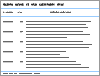
Table 1
Main steps of fruit defect detection based on deep learning
| 主要步骤 | 详细操作 |
|---|---|
| 数据集准备 | 构建水果缺陷数据集,数据清洗,数据标注,数据集划分 |
| 模型设计 | 设计合适的深度学习模型,以适应水果缺陷检测任务的要求 |
| 模型训练 | 利用整理后的水果缺陷数据集训练模型,同时调整网络的训练参数 |
| 模型评估 | 选用合适的评估指标验证模型性能,如准确率、精确率、召回率、F 1值、平均精度均值等 |
| 缺陷检测 | 将新的缺陷水果图像输入到训练好的模型中进行检测,并输出缺陷检测结果 |
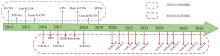
Fig.1
Deep learning-based object detection methods(2014-2016)
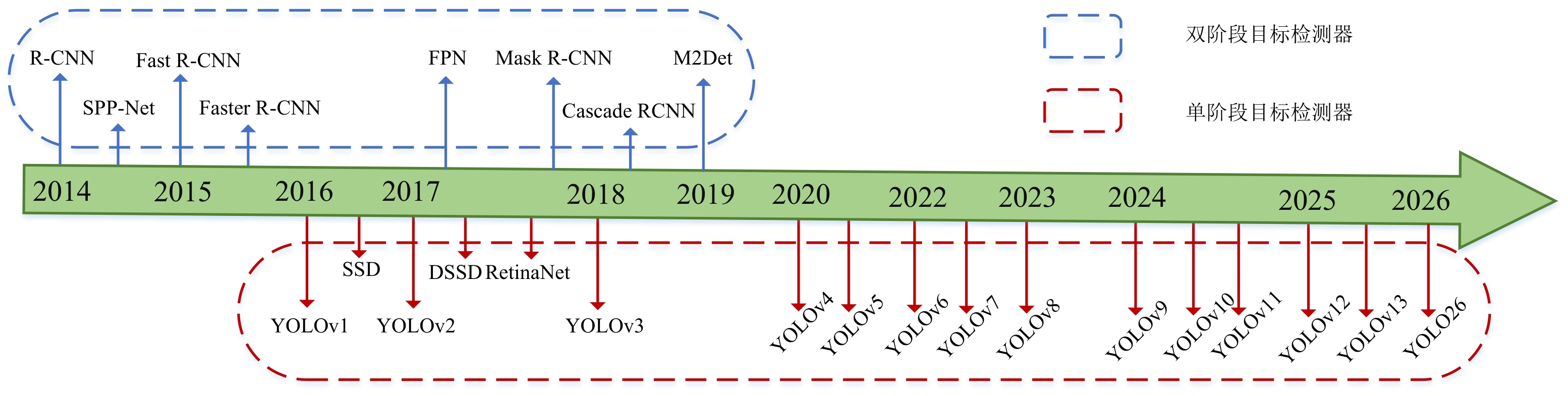
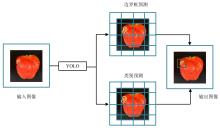
Fig. 2
Schematic diagram of YOLO-based object detection technology
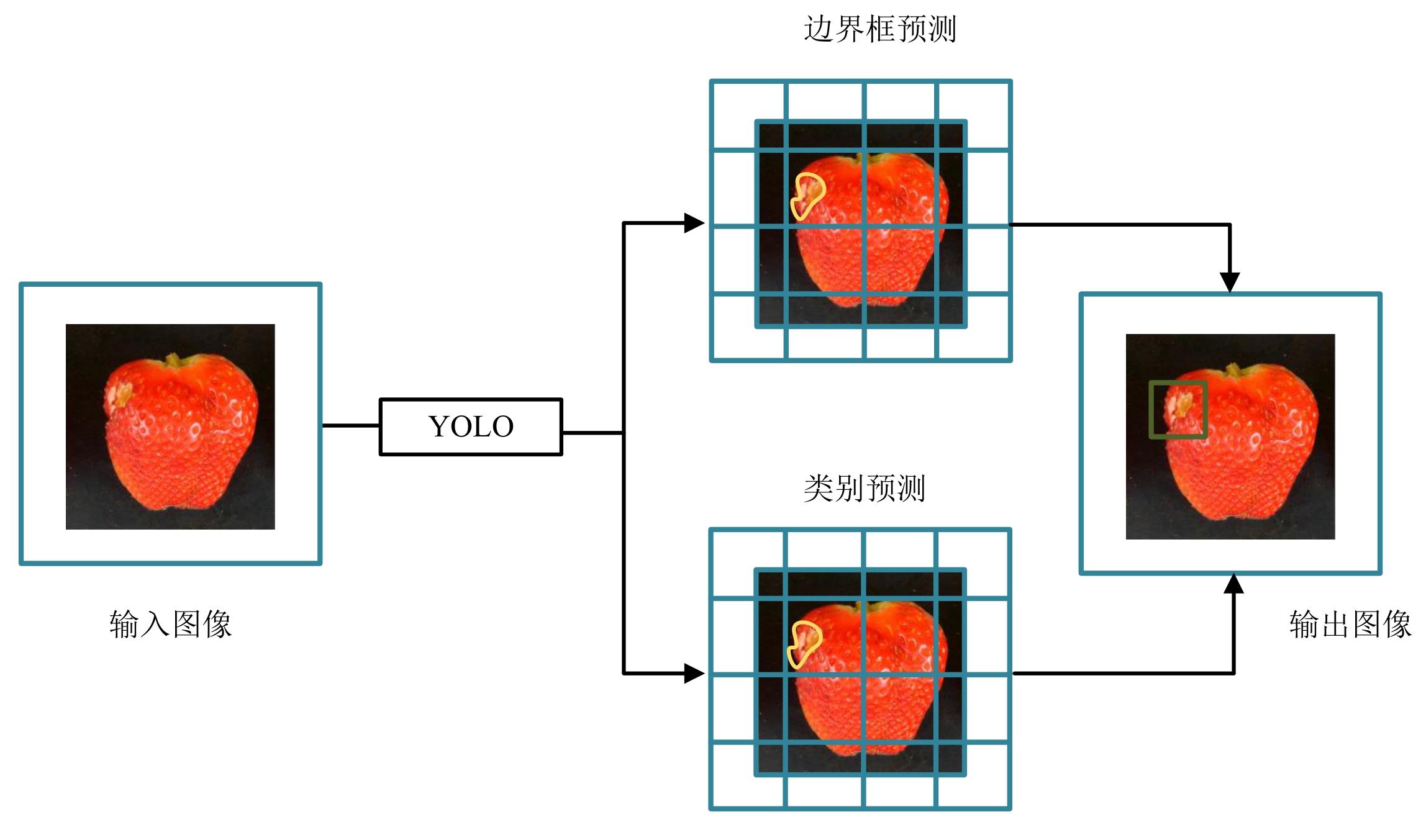
Table 2
Contributions of YOLO versions
| 版本 | 贡献 | 框架 | |
|---|---|---|---|
| 第一阶段 | YOLOv1 | 单阶段检测器 | Darknet |
| YOLOv2 | 多尺度训练,维度聚类 | Darknet | |
| YOLOv3 | Darknet-53网络 | Darknet | |
| 第二阶段 | YOLOv4 | 空间金字塔池化模块,基于Mish的激活函数,CSPDarknet-53网络 | Darknet |
| YOLOv5 | 基于SWISH的激活函数,路径聚合网络 | Pytorch | |
| YOLOv6 | SimOTA标签分配策略,无锚框检测头 | Pytorch | |
| YOLOv7 | E-ELAN网络,Transformers预测头,扩展高效层聚合网络重参数化 | Pytorch | |
| YOLOv8 | 分布焦点损失函数,空间金字塔快速池化层,任务对齐分配策略 | Pytorch | |
| 第三阶段 | YOLOv9 | 可编程梯度信息,广义高效层聚合网络 | Pytorch |
| YOLOv10 | 无非极大值抑制训练方法,双重标签分配,面向提升精度与效率的整体模型设计 | Pytorch | |
| YOLOv11 | 带空间注意力的跨阶段局部网络,C3k2(Cross-Stage Partial Kernel-2)模块 | Pytorch | |
| YOLOv12 | 残差高效层聚合网络,区域注意力机制 | Pytorch | |
| YOLOv13 | 基于超图的自适应相关性增强,全流程聚合与分布 | Pytorch | |
| YOLO26 | MuSGD优化器,语义分割损失模块,多尺度原型模块 | Pytorch |
Fig.3
Figures of common surface defects of some fruits
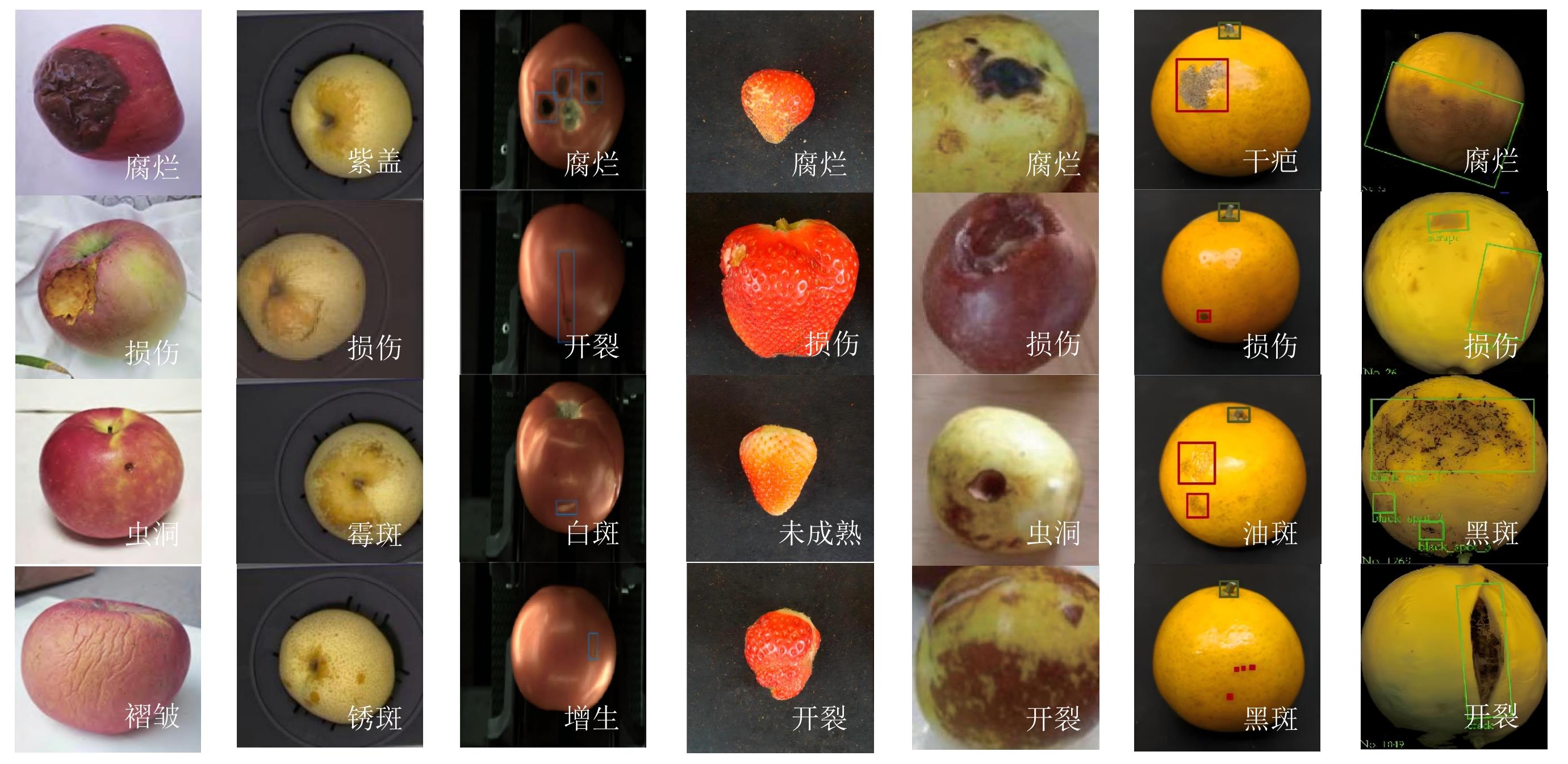
Table3
A review of research advances in internal and latent defect detection in fruits using YOLO series models
| 年份 | 模型 | 水果 | 改进方法 | 研究难点 | mAP0.5/% |
|---|---|---|---|---|---|
| 2024 | YOLOv7[ | 柑橘 | 1)SIRI技术 2)坐标注意力机制 3)Mish激活函数 4)引入SPPFS(Spatial Pyramid Pooling - Fast, SPP Fand feature selection)模块 | RGB图像无法检测内部缺陷 | 95.9 |
| 2022 | YOLOv4[ | 苹果 | 1)近红外相机图像采集系统 2)模型的通道剪枝与层剪枝 | RGB图像无法检测内部缺陷 | 92.42 |
| 2023 | YOLOv3[ | 草莓 | 1)近红外相机图像采集系统 2)近红外与RGB图像像素融合 | RGB图像无法检测内部缺陷 | 87.18 |
| 2023 | YOLOv5[ | 柑橘 | 1)双光源采集系统 2)广义交并比(Generalized Intersection over Union,GIoU)损失函数 3)卷积块注意力模块(Convolutional Block Attention Module,CBAM) | 自然光下缺陷不易检测 | 98.7 |
| 2026 | YOLOv11[ | 柑橘 | 1)紫外荧光成像 | 自然光下缺陷不易检测 | 96.9 |
| 2025 | YOLOv12[ | 苹果 | 1)滤波成像与色彩空间重建结合 | 自然光下缺陷不易检测 | 98.9 |
| 2023 | YOLOv5[ | 草莓 | 1)引入分类模型 2)优化损失函数 | 复杂环境缺陷不易检测 | 85.4 |
| 2023 | YOLOv5[ | 草莓 | 1)引入Deeplabv3语义分割网络 2)添加分支结构 3)引入可变形卷积 | 复杂环境缺陷不易检测 | 62.8 |
Table 4
A review of research advances in fruit defect detection under complex surface conditions using YOLO series models
| 年份 | 模型 | 水果 | 改进方法 | 研究难点 | mAP0.5/% |
|---|---|---|---|---|---|
| 2022 | YOLOv8[ | 苹果 | 1)引入空间深度卷积(Space-to-Depth Convolution, SPD-Conv) 2)引入多尺度空洞注意力机制(Multi-scale Empty Attention, MSDA) 3)引入上下文引导特征金字塔网络(Context Guided Feature Pyramid Network, CGFPN) | 表面坑凹区域与缺陷相似易误检 | 91.4 |
| 2025 | YOLOv8[ | 苹果 | 1)引入部分卷积(Partial Convolution,PConv)模块 2)高效多尺度注意力(Efficient Multi-scale Attention,EMA)机制 3)最小点距离交并比(Minimum Point Distance Intersection over Union) 4)引入Slim-neck架构 | 表面坑凹区域与缺陷相似易误检 | 90.1 |
| 2023 | YOLOv5[ | 苹果 | 1)引入TRANS(Transformer)模块 2)引入BiFPN 3)基于归一化的注意力模块(Normalization-based Attention Module,NAM) | 表面坑凹区域与缺陷相似易误检 | 98.9 |
| 2024 | YOLOv5[ | 梨 | 1)BAM(Bottleneck Attention Module)注意力机制 2)设计C3-GDC(C3-GhostDynamicConv)卷积模块 3)明智交并比(Wise Intersection over Union,WIoU)损失函数 | 花萼/果梗与缺陷相似易误检 | 93.9 |
| 2025 | YOLOv5[ | 梨 | 1)基于双层路由注意力机制的视觉 Transformer( 2)引入双向特征金字塔网络(Bidirectional Feature Pyramid Network,BiFPN) | 花萼/果梗与缺陷相似易误检 | 68.2 |
| 2023 | YOLOv10[ | 柑橘 | 1)引入线性可变形卷积(Linear Deformable Convolution,LDConv) 2)引入广义特征金字塔网络(Generalized Feature Pyramid Network,GFPN) | 缺陷微小且复杂多变易漏检 | 98.7 |
| 2024 | YOLOv5[ | 柑橘 | 1)三维坐标注意力(Three-dimensional Coordinate Attention,TDCA)机制 2)引入CT(Contextual Transformer)模块 3)引入BiFPN | 缺陷微小且复杂多变易漏检 | 98.7 |
| 2024 | YOLOv8[ | 柠檬 | 1)CBAM注意力机制 2)设计C2f-SAS(Switchable Atrous Convolution)模块 | 缺陷形态复杂多变易漏检 | 90.62 |
| 2024 | YOLOv5[ | 苹果 | 1)设计DSCS卷积模块 2)指数线性单元(Exponential Linear Unit,ELU)激活函数 3)WIoU损失函数 | 缺陷微小且复杂多变易漏检 | 90.9 |
| 2024 | YOLOv7[ | 苹果 | 1)CBAM和ECA注意力机制 2)引入深度可分离卷积策略 3)参数化修正线性单元(Parametric Rectified Linear Unit,PReLU)损失函数 | 缺陷微小且复杂多变易漏检 | 90.7 |
| 2026 | YOLOv11[ | 苹果 | 1)设计三视角成像系统 2)引入非局部自注意力残差多层感知机模块(Non-Local Attention Residual Multi-layer perceptron,NARM) | 缺陷微小且复杂多变易漏检 | 89.8 |
| 2024 | YOLOv8[ | 李子 | 1)引入SPD-Conv模块 2)引入扩张式残差分割网络(Dilation-wise Residual Segmentation,DWRSeg)模块 3)高效交并比(Efficient Intersection over Union,EIoU)损失函数 | 缺陷微小且复杂多变易漏检 | 87.8 |
| 2025 | YOLOv11[ | 番茄 | 1)引入小波深度可分离卷积 ( Wavelet Depth Separable Convolution,WDWConv) 2)设计WC3k2模块 | 不规则缺陷易漏检 | 88 |
| 2024 | YOLOv7[ | 猕猴桃 | 1)CBAM注意力机制 2)设计C3-Ghost模块 3)优化损失函数 | 不规则缺陷易漏检 | 93 |
| 2024 | YOLOv7[ | 红枣 | 1)简单注意力机制(Simple Attention Module,SimAM) 2)引入深度可分离卷积 (Depthwise Separable Convolution,DSConv) 3)引入ByteTrack跟踪算法 | 密集排列遮挡且不规则缺陷易漏检 | 85.3 |
| 2025 | YOLOv5[ | 红枣 | 1)坐标注意力(Coordinate Attention,CA)机制 2)增加小目标检测头 | 密集排列遮挡且不规则缺陷易漏检 | 91.6 |
| 2025 | YOLOv7[ | 葡萄 | 1)WIoU损失函数 2)Bi-Former注意力机制 | 果实小且密集排列遮挡易漏检 | 80.1 |
| 2023 | YOLOX[ | 樱桃 | 1)CBAM注意力机制 2)改进损失函数 | 果实小且密集排列遮挡易漏检 | 91.84 |
| 2025 | YOLOv8[ | 樱桃 | 1)引入DySlimNeck动态颈部层 2)引入Detect-FRM(Detect-Fourier Representation Module)检测头 3)引入FasterNet-RepMixer网络 | 果实小且密集排列遮挡易漏检 | 91.5 |
Table5
A review of research advances in lightweight model design for fruit defect detection using YOLO series algorithms
| 年份 | 模型 | 水果 | 改进方法 | 研究难点 | mAP0.5/% |
|---|---|---|---|---|---|
| 2025 | YOLOv11[ | 梨 | 1)引入BiFPN 2)CBAM注意力机制 3)引入TR2(Two Transformer)模块 4)双层迁移学习 | 实际场景计算资源受限模型难以部署 | 92.7 |
| 2023 | YOLOv4[ | 梨 | 1)PConv模块 2)EMA机制 3)MPDIoU损失函数 4)引入Slim-neck架构轻量化颈部网络 | 实际场景计算资源受限模型难以部署 | 85.52 |
| 2025 | YOLOv5[ | 苹果 | 1)多尺度检测头简化为双尺度或单尺度 2)移除冗余卷积层 | 实际场景计算资源受限模型难以部署 | 99.8 |
| 2024 | YOLOv5[ | 苹果 | 1)引入LightweightC3模块作为骨干网络的基本构建模块 2)设计EnhancedC3模块替代模型特征融合部分的C3模块 3)引入GSConv模块 | 实际场景计算资源受限模型难以部署 | 96.12 |
| 2022 | YOLOv5[ | 芒果 | 1)引入PPLCNet网络 2)引入GhostNet网络 | 实际场景计算资源受限模型难以部署 | 94.3 |
| 2025 | YOLOv5[ | 百香果 | 1)设计了StarC3SE模块替代C3模块 2)CBAM注意力机制 3)距离交并比(Distance Intersection over Union, DIoU)损失函数 | 实际场景计算资源受限模型难以部署 | 88.4 |
| 2024 | YOLOv5[ | 苹果 | 1)引入EfficientNetV模块 2)EMA机制 | 实际场景计算资源受限模型难以部署 | 93.6 |
| 2023 | YOLOv4[ | 柑橘 | 1)对网络进行剪枝优化移除冗余通道 2)去除冗余预测框 | 实际场景计算资源受限模型难以部署 | 94.56 |
| 2022 | YOLOv4[ | 苹果 | 1)与BiSeNet V2语义网络结合构成了双模型级联检测框架 2)对网络进行剪枝优化移除冗余通道 | 实际场景计算资源受限模型难以部署 | 92.42 |
| 2025 | YOLOv12[ | 番茄 | 1)引入RFEM模块 2)设计Dysample-Slim-Neck机制 3)引入动态卷积替代检测头中的传统卷积结构 | 实际场景计算资源受限模型难以部署 | 88.5 |
| 2024 | YOLOv8[ | 苹果 | 知识蒸馏 | 实际场景计算资源受限模型难以部署 | 97.8 |
| 2025 | YOLOv8[ | 百香果 | 1)设计MFSO(More Focus on Small Objects)网络结构 2)动态重参数化 (Dynamic Reparameterization, DyRep) 3)NWD(Normalized Wasserstein Distance)损失函数 4)模型剪枝 | 实际场景计算资源受限模型难以部署 | 94.6 |
| 2024 | YOLOv3[ | 莲蓬 | 1)先验锚框尺度调整 2)引入金字塔池化层(Spatial Pyramid Pooling, SPP) 3)使用遗传算法改进网络超参数 | 实际场景计算资源受限模型难以部署 | 96.8 |
| [1] |
|
| [2] |
|
| [3] |
|
| [4] |
田有文, 吴伟, 卢时铅, 等. 深度学习在水果品质检测与分级分类中的应用[J]. 食品科学, 2021, 42(19): 260-270.
|
|
|
|
| [5] |
|
| [6] |
宋怀波, 尚钰莹, 何东健. 果实目标深度学习识别技术研究进展[J]. 农业机械学报, 2023, 54(1): 1-19.
|
|
|
|
| [7] |
|
| [8] |
|
| [9] |
|
| [10] |
张子申, 程红, 耿文娟, 等. 高光谱成像技术在水果品质检测中的应用研究进展[J]. 智慧农业(中英文), 2025, 7(5): 52-66.
|
|
|
|
| [11] |
徐文青, 丁爱霞, 朱文卿. 基于数字图像处理技术的水果分级检测研究进展[J]. 食品安全导刊, 2025(4): 183-189.
|
|
|
|
| [12] |
|
| [13] |
麻剑钧, 刘晓慈, 金龙新, 等. 基于机器视觉的农作物病害识别研究进展[J]. 湖南农业科学, 2023(9): 97-100.
|
|
|
|
| [14] |
周长建, 宋佳, 向文胜. 基于人工智能的作物病害识别研究进展[J]. 植物保护学报, 2022, 49(1): 316-324.
|
|
|
|
| [15] |
郭文娟, 冯全, 李相周. 基于农作物病害检测与识别的卷积神经网络模型研究进展[J]. 中国农机化学报, 2022, 43(10): 157-166.
|
|
|
|
| [16] |
|
| [17] |
|
| [18] |
|
| [19] |
|
| [20] |
|
| [21] |
|
| [22] |
|
| [23] |
|
| [24] |
|
| [25] |
|
| [26] |
|
| [27] |
|
| [28] |
|
| [29] |
|
| [30] |
|
| [31] |
|
| [32] |
|
| [33] |
|
| [34] |
|
| [35] |
|
| [36] |
|
| [37] |
|
| [38] |
|
| [39] |
|
| [40] |
|
| [41] |
|
| [42] |
|
| [43] |
|
| [44] |
|
| [45] |
|
| [46] |
|
| [47] |
|
| [48] |
|
| [49] |
|
| [50] |
|
| [51] |
|
| [52] |
|
| [53] |
|
| [54] |
|
| [55] |
|
| [56] |
|
| [57] |
|
| [58] |
|
| [59] |
朱文铭. 基于深度学习的草莓缺陷检测算法研究[D]. 湛江: 广东海洋大学, 2023.
|
|
|
|
| [60] |
|
| [61] |
王会征, 李新龙, 薄萍, 等. 基于改进YOLOv8n的自然场景下苹果外观品质检测方法[J]. 农业工程学报, 2025, 41(11): 173-182.
|
|
|
|
| [62] |
张嘉琪, 徐啟蕾. 基于NAM-YOLO网络的苹果缺陷检测算法[J]. 计算机与现代化, 2023(10): 53-58, 64.
|
|
|
|
| [63] |
|
| [64] |
陈峻生. 基于深度学习的梨缺陷检测与分级[D]. 福州: 福建农林大学, 2025.
|
|
|
|
| [65] |
|
| [66] |
|
| [67] |
|
| [68] |
朱琦, 周德强, 盛卫锋, 等. 基于DSCS-YOLO的苹果表面缺陷检测方法[J]. 南京农业大学学报, 2024, 47(3): 592-601.
|
|
|
|
| [69] |
徐江鹏, 王传安. 基于轻量化改进YOLO v7-Tiny算法的苹果检测与分类[J]. 江苏农业科学, 2024, 52(23): 221-229.
|
|
|
|
| [70] |
孙国祥, 陈光宇, 汪小旵, 等. 基于三视角成像的苹果表面缺陷检测方法[J]. 农业工程学报, 2026, 42(3): 348-358.
|
|
|
|
| [71] |
霍新梅. 自然环境中李子果实成熟度与表面缺陷检测方法研究[D]. 合肥: 安徽农业大学, 2024.
|
|
|
|
| [72] |
朱婷婷, 滕广, 张亚军, 等. 基于改进YOLOv11的番茄表面缺陷检测方法[J]. 农业机械学报, 2025, 56(6): 546-553.
|
|
|
|
| [73] |
许川. 猕猴桃表面缺陷智能检测与分级方法研究[D]. 柳州: 广西科技大学, 2024.
|
|
|
|
| [74] |
刘鑫, 马本学, 李玉洁, 等. 基于改进YOLOv7-ByteTrack的干制哈密大枣缺陷检测与计数系统[J]. 农业工程学报, 2024, 40(3): 303-312.
|
|
|
|
| [75] |
史鹏涛, 田政伟, 李晓泽, 等. 基于改进YOLO v5s算法的红枣缺陷检测与分拣方法[J]. 江苏农业科学, 2025, 53(5): 83-88.
|
|
|
|
| [76] |
|
| [77] |
刘敬宇, 裴悦琨, 常志远, 等. 基于改进YOLOX模型的樱桃缺陷及分级检测[J]. 食品与机械, 2023, 39(1): 139-145.
|
|
|
|
| [78] |
|
| [79] |
李成轩, 赵春江, 张驰, 等. 基于AIC-YOLOv11n模型的砀山梨多表面缺陷检测方法[J]. 农业工程学报, 2025, 41(14): 320-328.
|
|
|
|
| [80] |
|
| [81] |
|
| [82] |
鄢紫, 陈良艳, 刘卫华, 等. 基于YOLO-FFD的水果品种和新鲜度识别方法[J]. 食品与机械, 2024, 40(1): 115-121.
|
|
|
|
| [83] |
聂衍文, 徐建. 基于YOLOv5s的移动端轻量化芒果果面缺陷检测应用设计[J]. 武汉轻工大学学报, 2022, 41(5): 89-95, 103.
|
|
|
|
| [84] |
|
| [85] |
|
| [86] |
|
| [87] |
梁晓婷, 庞琦, 杨一, 等. 基于YOLOv4模型剪枝的番茄缺陷在线检测[J]. 农业工程学报, 2022, 38(6): 283-292.
|
|
|
|
| [88] |
|
| [89] |
方晨羽. 基于深度学习的果实采前识别与采后品质检测研究[D]. 杭州: 浙江科技大学, 2024.
|
|
|
|
| [90] |
|
| [91] |
张雷, 严昊, 贾永镒, 等. 采用改进YOLOv3-Tiny模型的轻量化莲蓬质量分级算法[J]. 农业工程学报, 2024, 40(23): 248-257.
|
|
|
|
| [92] |
|
| [93] |
梁秀满, 肖寒. 基于SDD-YOLO的轻量级带钢缺陷实时检测算法[J]. 中国测试, 2025, 51(3): 154-161.
|
|
|
|
| [94] |
|
| [95] |
徐彦威, 李军, 董元方, 等. YOLO系列目标检测算法综述[J]. 计算机科学与探索, 2024, 18(9): 2221-2238.
|
|
|
|
| [96] |
|
| [97] |
|
| [98] |
|
| [1] | SU Yujie, LI Yue, WEI Linjing, WU Bing, GUO Linhai, YAN Bin, ZHOU Hui, GAO Yuhong, KANG Lianghe, LIU Huan, SU Shunchang. Lodging Region Detection Method in Flax Based on Lightweight Improved YOLOv11n-seg Model [J]. Smart Agriculture, 2026, 8(2): 35-47. |
| [2] | WU Tingting, GUO Junrui, TAO Qiujie, CHEN Shihua, GUO Shanli. YOLOv8n-SSND: An Improved Lightweight Model for Aerial Chenopodium Chenopodium quinoa Willd. Spike Target [J]. Smart Agriculture, 2026, 8(2): 59-71. |
| [3] | ZHAO Licheng, LU Xinyu, WU Qian, REN Ni, ZHOU Lingli, CHENG Yawen, HU Anqi, QI Chao. An Improved YOLOv10-Based Tomato Ripeness Detection Algorithm with LAMP Channel Pruning [J]. Smart Agriculture, 2026, 8(2): 133-146. |
| [4] | XIU Xianchao, FEI Shiqi, HUANG Wenqian, LI Nan, MIAO Zhonghua. A Lightweight Method for Pear Surface Defect Detection Based on Improved Mamba-YOLO Architecture [J]. Smart Agriculture, 2026, 8(2): 147-157. |
| [5] | LIU Haoran, WANG Yu, ZHAO Xueguan, WU Huarui, FU Hao, PANG Shujie, ZHAI Changyuan. CD-YOLO: A Method for Detecting Carrot Seedlings in Field Based on Improved YOLOv11s [J]. Smart Agriculture, 2026, 8(2): 158-174. |
| [6] | ZHANG Wenbo, JIANG Yijue, SONG Wei, HE Qi, ZHANG Wenbo. CAGE-YOLO: A Dense Small Object Detection Model for Aquaculture Net Cages Based on Remote Sensing Images [J]. Smart Agriculture, 2026, 8(2): 98-117. |
| [7] | WU Chenxu, ZUO Haolong, LI Gang. Cross-Modal Attention for Multi-Source Remote Sensing Crop Classification under Cloud Occlusion and Complex Field Scenarios [J]. Smart Agriculture, 2026, 8(2): 118-132. |
| [8] | LI Aoqiang, DAI Hangyu, GUO Ya. Underwater Insitu Weight Estimation Method for Chinese Mitten Crab Based on Binocular Vision and Improved YOLOv11-pose [J]. Smart Agriculture, 2026, 8(1): 192-202. |
| [9] | XIAO Ruihong, TAN Lixin, WANG Rifeng, SONG Min, HU Chengxi. Multi-Scale Tea Leaf Disease Detection Method Based on Improved YOLOv11n [J]. Smart Agriculture, 2026, 8(1): 62-71. |
| [10] | WU Zhangbin, HE Ning, WU Yandong, GUO Xinyu, WEN Weiliang. Point Cloud Data-driven Methods for Estimating Maize Leaf Biomass [J]. Smart Agriculture, 2026, 8(1): 156-166. |
| [11] | GAO Guangfu, WANG Qilei, SONG Liwen, FENG Haikuan, SHI Lei, YANG Hao, LIU Yang, YUE Jibo. Object Detection Method of Maize Ears Within Canopy Based on CornYOLO [J]. Smart Agriculture, 2026, 8(1): 167-177. |
| [12] | YAO Xiaotong, QU Shaoye. Lightweight Detection Method for Pepper Leaf Diseases and Pests Based on Improved YOLOv12s [J]. Smart Agriculture, 2026, 8(1): 1-14. |
| [13] | ZHAO Jun, NIE Zhigang, LI Guang, LIU Jiayu. Corn Borer Pests Infestations Detection Method Using Low-Altitude Close-Range UAV Imagery [J]. Smart Agriculture, 2025, 7(6): 111-123. |
| [14] | CAO Yuying, LIU Yinchuan, GAO Xinyue, JIA Yinjiang, DONG Shoutian. LightTassel-YOLO: A Real-Time Detection Method for Maize Tassels Based on UAV Remote Sensing [J]. Smart Agriculture, 2025, 7(6): 96-110. |
| [15] | ZHANG Yun, ZHANG Lumin, XU Guangtao, HAO Jiahui. Remote Sensing Extraction Method of Rice-Crayfish Fields Based on Dual-Branch and Multi-Scale Attention [J]. Smart Agriculture, 2025, 7(6): 185-195. |
| Viewed | ||||||
|
Full text |
|
|||||
|
Abstract |
|
|||||